🦎 Scaly Garden Helpers: Lizards & Skinks for Kids
What if you ran entirely on sunshine, could drop your tail to escape a villain and grow a new one, and swam through sand like it was water?
You would be one of Florida's lizards or skinks. And honestly? They have been running the garden's pest-control night shift — and day shift — this whole time, and almost nobody noticed.
Lizards and skinks are reptiles. That means dry, scaly skin, claws on their toes (most of them, anyway), and eggs or live babies that start out as tiny, perfect copies of the grown-ups. No jelly eggs in a pond. No tadpole phase. A baby skink hatches ready to skink.
Skinks are one special family inside the lizard world: smooth, shiny, and built low to the ground, like little polished submarines for traveling through leaf litter and loose sand. Anoles, racerunners, fence lizards, and geckos are lizard cousins with their own tricks. This guide will introduce the whole crew, explain how a tail can be a getaway car, and show you how to build a garden they will want to move into.
Grab your sun hat. Your tour guides are solar-powered, and they are already warming up.
☀️ Solar-Powered Animals
Lizards and skinks are ectotherms (EK-toh-therms) — ecto means “outside” and therm means “heat.” Their body heat comes from outside them. They do not burn food to stay warm the way you do. They go and collect warmth, like charging a battery in the sun.
That is why you see a lizard flattened on a warm rock in the morning. It is not being lazy. It is literally turning itself on — muscles, digestion, and speedy hunting all work better once the body is warm. Too hot? It slips into shade or under leaf litter and waits. Warm up, cool down, all day long: a lizard is its own thermostat.
🌟 Meet the Crew
These are the scaly helpers you are most likely to meet in a Florida garden. Learn the tail colors and the head shapes, and you will start spotting them everywhere — because they were always there. You just did not have the search image in your brain yet. Now you will.
⭐ The Star: Mole Skink — Plestiodon egregius
Look along the edge of an old timber, under leaf litter, or in loose sandy soil and you might catch a flash of polished gunmetal-brown sliding away — with a tail the color of a shiny new penny. That is a mole skink, and getting a good look at one is a genuine prize, because this lizard spends most of its life underground.
A mole skink sand-swims. It tucks its four tiny legs close, wiggles its smooth body in S-curves, and pushes through loose sand and litter the way a fish moves through water. Its hard, glossy scales let sand slide right off. Its menu down there is wonderfully gross and wonderfully helpful: cockroach nymphs (baby roaches), termites, crickets, and other small insects hiding under logs.
That orange-copper tail is your best clue. Body: shiny gray-brown, sometimes with a faint pale stripe. Legs: surprisingly tiny for an animal that gets around so well. Attitude: extremely shy, and gone in a blink.
🤏 Ground Skink — Scincella lateralis
If the mole skink is a submarine, the ground skink is a zipper. This is one of the smallest reptiles in North America — a grown-up is about as long as a crayon and much thinner. Look for a coppery-bronze back, a dark stripe down each side, and nonstop motion: it does not walk through leaf litter so much as stir it.
Ground skinks almost never climb. Their whole world is the top inch of the forest floor, hunting tiny insects and spiders most predators are too big to bother with. Spotted by a bird? It dives into the leaves and vanishes — copper on brown, a perfect disappearing act.
💙 Southeastern Five-Lined Skink — Plestiodon inexpectatus
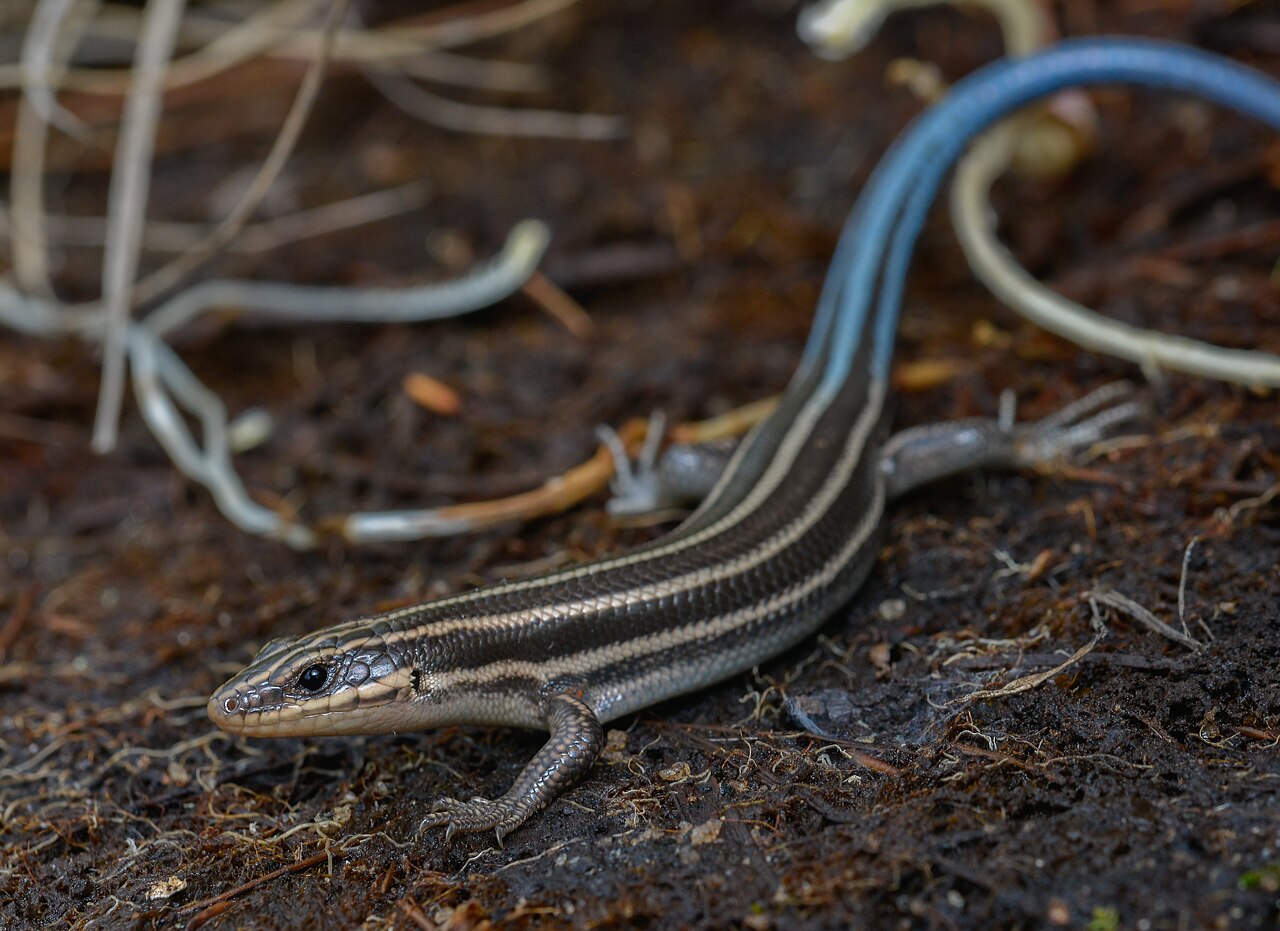
The kid version of this skink looks like it was painted by somebody showing off: five neat cream stripes on a dark body, and a tail so bright blue it looks electric. That blue tail is not decoration — scientists think it works like a flag that says to a hungry bird, “Bite this end!” The tail can come off. The head cannot. Guess which end the skink would rather lose?
As they grow up, the stripes fade. Adult males turn plain brownish and, in spring, their heads swell and flush orange-red. Same lizard, whole new outfit — no shopping required. Five-lined skinks hunt around logs, mulch, and woodpiles, eating crickets, roaches, spiders, and beetles.
🌳 Broad-Headed Skink — Plestiodon laticeps
Meet the heavyweight champion. The broad-headed skink is Florida's biggest skink — and unlike most skinks, it happily climbs trees. Look up into the oaks, not just down at the mulch. That flash of bronze high on a trunk might be the boss himself.
In spring, a grown male's head gets wide, strong, and bright orange, built for pushing contests with rival males over the best tree. Strong jaws, big appetite: beetles, roaches, and snails are all on the menu. The Latin name is a giveaway — laticeps basically means “wide head.” Scientists: very smart, not always subtle with the nicknames.
💚 Green Anole — Anolis carolinensis
Florida's own little dragon. The green anole is the lizard doing push-ups on your fence and flashing a bright pink fan from its throat. That fan is called a dewlap, and flashing it is anole language for “This is MY fence post, and also, hello, I look great.” Males show it to claim territory and to impress females. It is a flag, a billboard, and a dating profile in one pink package.
Green anoles can shift between bright green and chocolate brown — not to match a color exactly like a cartoon chameleon, but depending on temperature, light, and mood. And check out those toes: sticky pads covered in microscopic hairs grip smooth surfaces, letting an anole stroll straight up a wall like it pays rent there.
🤎 Brown Anole — Anolis sagrei
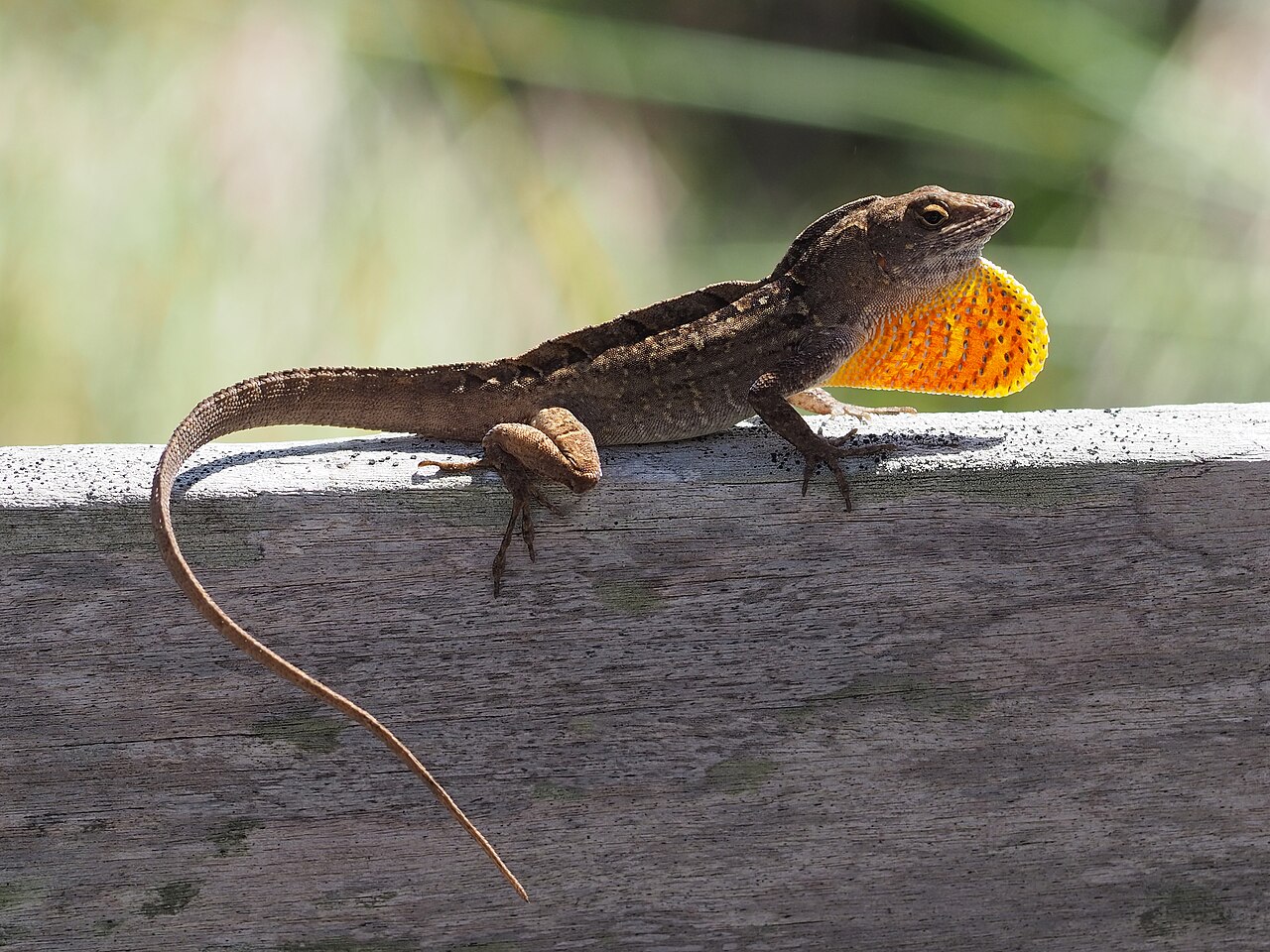
Time for an honest note, because real science includes the complicated parts. The brown anole is not originally from Florida. It arrived from Cuba and the Bahamas — most likely as a stowaway on plants and cargo — and it did so well here that it is now one of the most common lizards in the state. Stockier than its green cousin, tan-to-brown with patterns down its back, and happiest on the ground and on low walls and shrubs.
Here is the fascinating part scientists actually watched happen: as brown anoles took over the ground floor, green anoles moved up — spending more time higher in shrubs and trees. Two similar lizards, dividing a garden like floors of an apartment building. The brown anole is not a villain; it is just a very successful newcomer — and a perfect example of why moving animals around the world changes things in ways nobody planned.
⚡ Six-Lined Racerunner — Aspidoscelis sexlineatus
Blink and you missed it. The six-lined racerunner is built like a tiny race car: slim body, six pale stripes running nose to tail, long whip of a tail, and legs made for sprinting across hot, open, sandy ground. It loves the sunniest, sandiest patch in the yard — the spot where everything else has given up and gone in for lemonade.
Racerunners are nervous, speedy hunters that chase down grasshoppers and other quick insects in broad daylight, then brake hard, dig a little, and check what they kicked up. If a lizard ever needed a tiny checkered flag, it is this one.
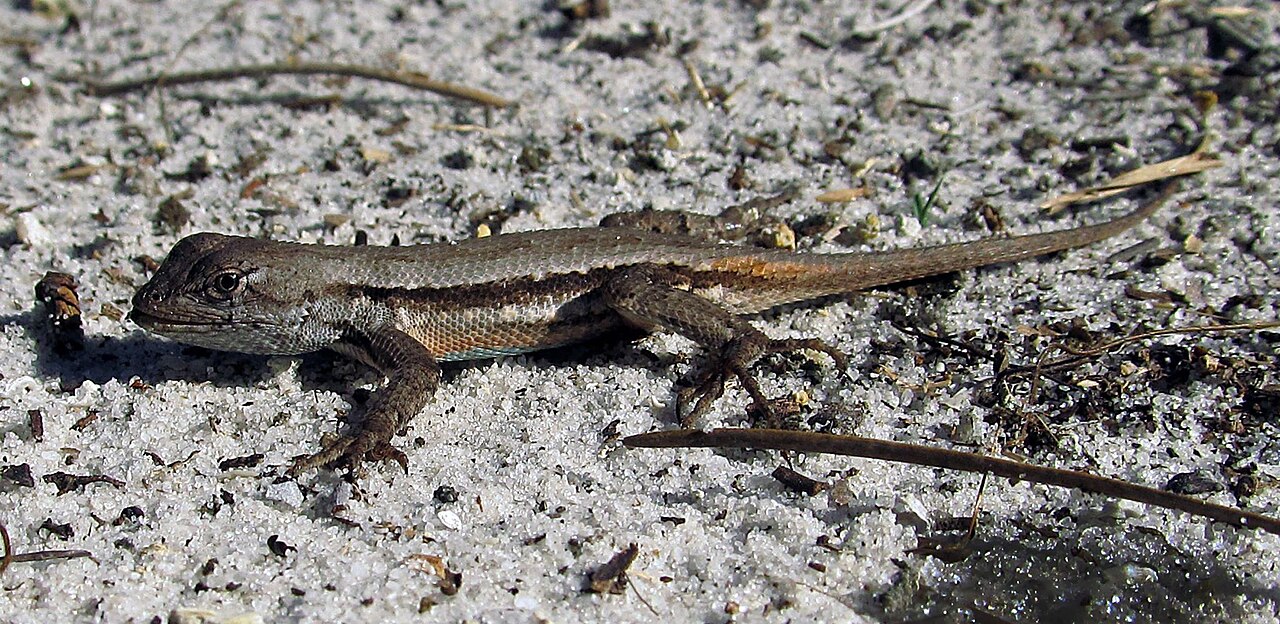
🧱 Eastern Fence Lizard — Sceloporus undulatus
The fence lizard is the rough-and-spiky opposite of the polished skinks. Its scales are keeled — each one has a little ridge and point — so it feels like living sandpaper and blends perfectly with pine bark, logs, and (yes) fence posts. Its whole strategy: sit very still, look exactly like wood, and let lunch come to it.
Secret signal alert: a male has bright blue patches on its belly and throat that you almost never see — until he does push-ups for a rival, flashing the blue like a hidden badge. Hidden most of the time, dazzling on purpose. Excellent strategy, honestly.
🌙 Tropical House Gecko — Hemidactylus mabouia
When the porch light comes on, the night shift clocks in. The tropical house gecko is a soft, speckled, big-eyed lizard that hunts on walls around lights, gobbling the moths and beetles that gather there. Its toe pads let it climb glass-smooth walls and even walk across a ceiling.
Listen on a warm night and you may hear it chirp — little clicking, chattering sounds, which is a wild thing for a lizard to do. Like the brown anole, this gecko is a newcomer that settled in around Florida houses. It causes no trouble, asks for no food, and pays its rent entirely in moths.
✂️ The Great Tail Escape
Here is the trick that makes lizards famous. A bird dives, grabs a skink by the tail — and ends up holding a wiggling tail while the skink sprints to safety. The tail keeps twitching for a while after it lets go, holding the predator's attention like a decoy. Meanwhile, the actual skink is already under a log, planning its afternoon.
Which brings us to the most important lizard rule in this whole guide: never grab a lizard by the tail, and never pull one. That tail is a one-time emergency escape device, not a handle. Losing it costs the lizard stored fat and its best trick for surviving the next bird. Watch them, admire them, photograph them — let them keep their tails.
🦎💚🌙 Lizard or Skink or Gecko? Spot the Style
All skinks are lizards, but not all lizards are skinks — the same way all toads turned out to be frogs in disguise. Here is how the main styles compare once you start looking closely:
| Clue | ✨ Skinks | 🌳 Anoles & Other Lizards | 🌙 Geckos |
|---|---|---|---|
| Skin | Smooth, shiny, polished — built for sliding through sand and leaves | From rough and spiky (fence lizard) to smooth and soft (anole) | Soft, velvety, often speckled |
| Eyes | Small, dark, and quick to duck underground | Active hunters that watch everything; anoles can move each eye separately | Huge, no eyelids — cleaned with a tongue-lick |
| Favorite hangout | Under logs, in leaf litter, in loose sand | Fences, shrubs, tree trunks, sunny open ground | Walls near porch lights, after dark |
| Signature trick | Sand-swimming and tail-drop escapes | Dewlap flags, push-ups, and sticky toes | Ceiling-walking toe pads and chirping |
⬍ swipe the table on small screens ⬍
🔍 The Habitat Explorer
Every corner of a garden is somebody's neighborhood. Tap a habitat to explore who lives there and what they are up to. Wander in any order you like, stay as long as you like, and revisit your favorites — the lizards are in no hurry, except the racerunner. The racerunner is always in a hurry.
Want to build a lizard neighborhood of your own? Here is how to make a habitat for garden lizards →
🦟🐜 Free Pest Control, Paid in Sunshine
Now add it all up. Mole skinks eat roach nymphs and termites under your logs. Five-lined and broad-headed skinks work the woodpiles. Ground skinks vacuum up the tiny insects everybody else misses. Anoles patrol the shrubs, racerunners chase grasshoppers, and geckos clear moths around the porch light — every night, for free.
That is a whole pest-control company, and its salary is sunshine, hiding places, and not being sprayed. Because sprays do not just remove the lizards' food — they can poison the hunters themselves, and a sprayed yard soon has no lizards, no frogs, and plenty of the toughest pests left with nobody hunting them. Protect the hunters and the hunters protect the garden.
🏡 Build a Lizard Hotel (Five Stars, Very Rustic)
Lizards are not picky guests. They want warmth, hiding places, hunting grounds, and safety. Give them these four things and they will check in on their own:
- A log pile. Stack a few logs in a quiet corner and then — this is the hard part — leave them alone. Under a log is cool, damp, and full of insects: a restaurant with a roof. Mole, five-lined, and ground skinks all approve.
- Leaf litter, kept. Fallen leaves under shrubs are not a mess to a skink. They are a hunting ground, a blanket, and a hiding place in one. Rake the paths if you must, but let the beds keep their leaves.
- Flat rocks in the sun. Flat stones in a sunny spot are basking decks by morning and cool hiding spaces underneath by afternoon — warm-up station and cool-down lounge in one rock.
- A sunny, sandy patch. Leave one open, sandy corner unplanted. Racerunners and mole skinks dream about this real estate.
- No pesticides, ever. Poisoned bugs make poisoned lizards. A lizard hotel where bugs get sprayed gets zero lizards.
- Water, low and shallow. A ground-level saucer, refreshed every few days, serves lizards, frogs, and birds alike.
👀 How to Observe Like a Scientist (Gently)
The very best lizard scientists are not the fastest grabbers. They are the quietest watchers. Lizards notice movement long before they notice you, so stillness is your superpower. Here is the gentle-observer code:
- Watch, do not grab. Sit near a log pile or fence on a sunny morning and wait. Within minutes, heads pop up, dewlaps flash, and push-up contests begin. A lizard that does not know you are there behaves like a real lizard. A chased lizard just behaves like a fugitive.
- Never, ever pull a tail. You know the science now: that tail is a one-time escape device with a real cost. Hands off, always, no exceptions — even “gentle” tail touches are a no.
- Put every log back exactly as you found it. If a grown-up lifts a log for a peek, that log is a roof. Set it back down gently, in the same spot, the same way. Somebody lives under there.
- Keep cats indoors, or on porch patrol only. This one is serious: outdoor cats are one of the biggest threats lizards face. A cat does not know a mole skink is rare and special — it just sees a wiggle. Keeping cats inside protects skinks, anoles, frogs, and birds all at once. It is the single kindest thing a cat family can do for the whole scaly crew.
- Look at three different times of day. Morning shows you the baskers warming up on rocks and fences. Afternoon brings out the racerunners at full speed. Night belongs to the geckos on the wall by the light. Same garden, three completely different casts.
That is the whole field guide: sunshine-powered hunters with polished scales, flag-throats, six stripes, spiky camouflage, ceiling-walking toes, and one very devoted underground mom. They were patrolling your garden long before you knew their names. Now you know their names. Say hello quietly — and keep your hands to yourself, so they can keep their tails. 🦎