
🌴 Mule Palm
What it looks like
Quick facts
- Sun: Full sun
- Soil: Well-drained, sandy to loamy; tolerates a range of soils once established
- Spacing: 15 to 20 feet from structures — the crown is wide
- Height: 20 to 30 feet at maturity
- Life cycle: Long-lived evergreen palm
- Zones: Commonly listed zones 8 to 11; nursery sources put established trees hardy to around 14°F
- Florida: Grown statewide; popular in Central and North Florida precisely because it handles cold snaps better than most palms
What it is — and why it is called a mule
The mule palm is a hybrid, and the name is a joke with a botanical punchline. A mule is the sterile offspring of a horse and a donkey; the mule palm is the offspring of two different palm genera, and it was long believed to be sterile too. Its parents, stated plainly, are the pindo palm (Butia odorata) and the queen palm (Syagrus romanzoffiana) — an intergeneric cross, Butia × Syagrus, which gives the hybrid genus name ×Butyagrus and the species name nabonnandii, after Paul Nabonnand, the French nurseryman who made the cross in the late nineteenth century. The Latin is confirmed by UF/IFAS Extension (publication PP382) and by recent botanical work on the hybrid.
Here is the nerdy update: the sterility story is more complicated than the name suggests. Cultivated mule palms are generally treated as sterile — they do not set viable seed reliably, which is why they are propagated by hand-pollination and cost more than their parents — but recent research on wild populations in South America, where the parents grow together, found that the hybrid’s seeds can germinate, and its pollen has been used in backcrosses. So the honest statement is: effectively sterile in cultivation, not absolutely sterile in nature. The mule keeps a little mystery, which seems fair.
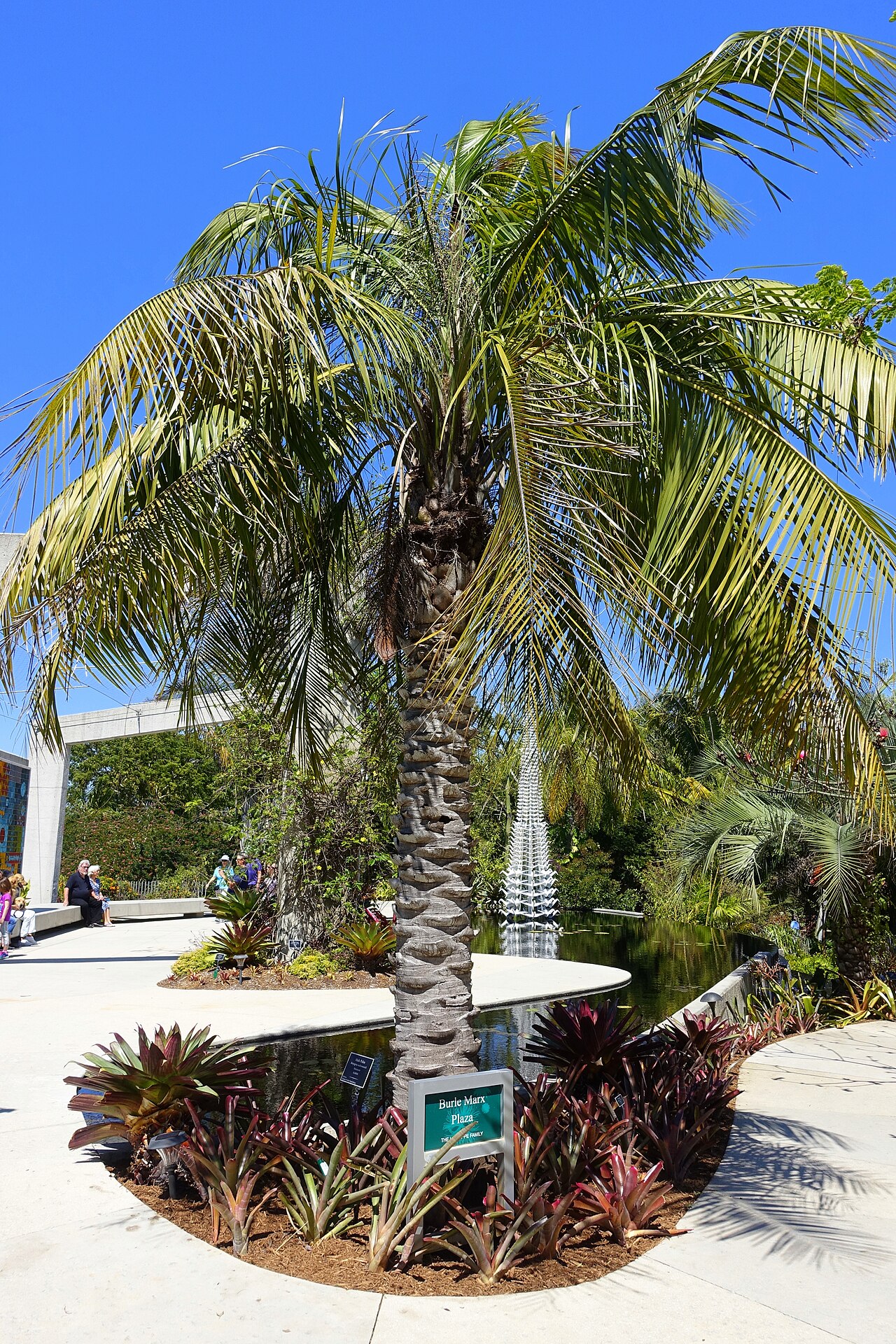
What you get for the trouble is a palm that looks like a coconut palm that learned to handle a frost: a stout trunk, long arching feather fronds in dark green, and a crown wider and fuller than either parent’s. It inherits the pindo’s cold tolerance and the queen’s grace, and it is one of the most popular landscape palms in the Southeast for exactly that combination.
Growing mule palm in Florida
Florida is mule palm country, with one honest caveat: it is a full-sun, well-drained-soil palm, not a swamp palm. Plant it in a sunny spot with room for a 15-to-20-foot crown, in soil that drains — sandy Florida soils are fine, and it tolerates a range of soil types once established. Water deeply and regularly for the first year; after that it is moderately drought-tolerant, though it looks its best with consistent moisture and a feeding program. Palms are famously hungry for potassium and magnesium, and mule palm is no exception: use a palm-specific fertilizer (with slow-release potassium and magnesium) rather than lawn fertilizer, which can induce the yellowing and frizzled fronds that mean a palm is starving for exactly those nutrients.
Do not over-prune. Remove only fully brown, dead fronds; cutting green fronds starves the palm, because palms have a single growing point and a limited number of fronds doing all the photosynthesis. Do not pile mulch or soil against the trunk, and do not let string trimmers near the base — trunk wounds on a palm do not heal the way tree bark does. A wide mulch ring, kept off the trunk, does the job.
Cold: established mule palms are reported hardy into the mid-teens Fahrenheit, which is why North and Central Florida gardeners plant them where queen palms freeze back. Young palms are less hardy than established ones, so protect a new planting through its first couple of winters if a hard freeze is forecast — wrap the growing point, not the whole crown in plastic, which cooks the fronds on the next sunny day.
Problems worth knowing
Mule palms are generally healthy, with the usual palm caveats: nutrient deficiencies (potassium and magnesium first), and the odd leaf-spot issue. UF/IFAS has documented a curious one: a lesion-mimic condition, where palms develop spontaneous leaf spots that look like disease but are a genetic quirk of wide hybridization — the mixed genes of two genera sometimes misfire in leaf cells. It is not contagious and not a reason to spray; it is a reminder that a hybrid is an experiment nature is still running. As with all palms, never top a palm or cut the growing point — there is no coming back from that.
Where this guide came from
Mule palm is one of the palms surveyed in the group guide. See also the Palm guide, which surveys the whole group this plant belongs to.
Propagation
The mule palm is named for a mule for a reason, and the reason is sterility — or at least, that is what everyone believed for more than a century. It is a hand-made hybrid between a pindo palm and a queen palm, first created in 1890, and for generations the nursery trade treated it as a plant that simply does not set viable seed. A mule palm in your yard will make fruit, but most of that fruit is seedless, and the seed that does form rarely sprouts. That is why mule palms are expensive: every one of them has to be made by hand-pollinating a pindo palm with queen palm pollen, a slow, labor-intensive process that no home gardener can shortcut.
Here is the honest update to that story. A 2023 study of wild mule palms in Brazil found that the sterility was overstated: wild plants can and do set some viable seed, but germination rates are low, partly because beetle larvae eat the seed and partly because so much of the fruit is seedless to begin with. So the mule palm is not quite the sterile mule of its name — it is more like a mule that very occasionally has a foal. For a home gardener, the practical advice is unchanged: do not count on seed from your tree. If you find a fat, full seed in the fruit, you can try sowing it fresh in a warm, moist mix and waiting several months, but expect most of it to fail.
The reliable way to get a mule palm is to buy one from a nursery. There is no cutting, division, or layering that works for a single-trunked palm, and no home method of making the hybrid yourself — the cross requires controlled pollination between two specific parent species, and then years of growing out the seedling to confirm it is actually a mule. That is specialist work, and it is priced accordingly.
What you can do is give the palm you buy the best possible start: full sun, well-draining soil, and protection from hard freezes while young. A mule palm is a slow, stately investment, and it rewards patience the way only a palm can — by outliving the gardener who planted it.