
Some butterflies will nectar on anything with petals. The Atala made a different life choice: it bet everything on a single plant, got poisoned on purpose, and dressed like a jewel to advertise it.
The Atala (Eumaeus atala) is a small, velvety-black hairstreak butterfly — the largest hairstreak in Southeast Florida, and the most iridescent. It lives or dies by coontie, and its whole story is a Florida story: a plant harvested nearly out of existence, a butterfly believed extinct, and a comeback powered mostly by ordinary people planting a shrub in their yards.
At a glance
- Latin name: Eumaeus atala — family Lycaenidae, the hairstreaks and blues
- Wingspan: 3.8 to 5.1 cm (about 1.5 to 2 inches)
- Florida range: southeastern Florida, historically Palm Beach, Broward, and Miami-Dade counties, now in fragmented colonies wherever coontie is planted, spreading northward as winters allow
- Host plant: coontie (Zamia integrifolia) — the only native host
- Flight: year-round, with populations peaking in June and January; adults may live up to two months when nectar is plentiful
- Also found: the Bahamas, Turks and Caicos, the Cayman Islands, and Cuba
How to recognize it
The adult is unmistakable once you have seen one, and that is the point. The upper wings are velvety black with a turquoise shimmer that reads bright blue in summer and greener in winter. Flip one over (gently, in your mind — do not grab butterflies) and the underside carries three curved rows of ultramarine spots and one large red spot on the hindwing. The abdomen is orangish-red, matching that spot. Males carry a pheromone-emitting structure called a hair pencil at the end of the abdomen. Females are larger than males.
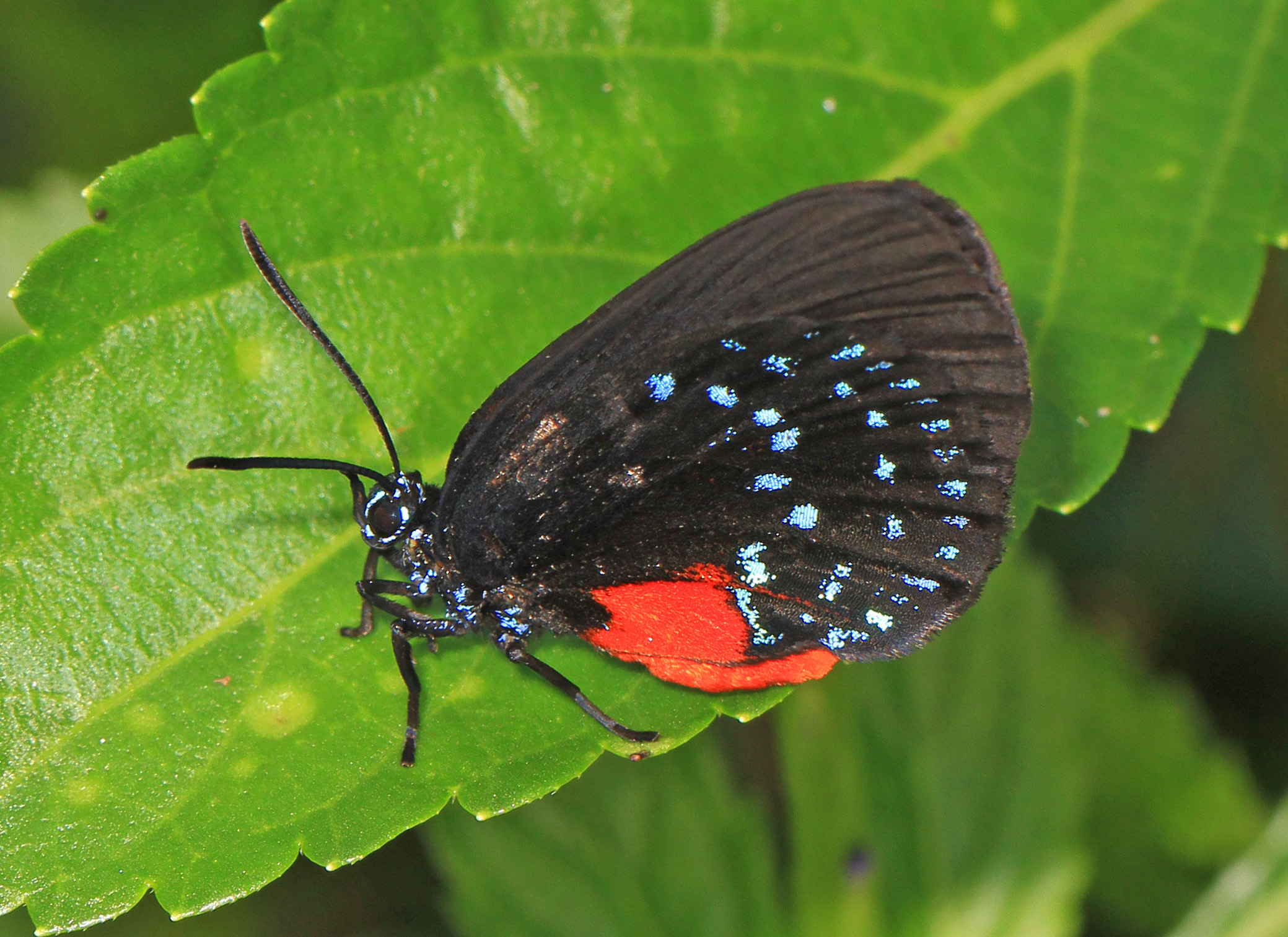
Males perch on the tops of leaves. Females hang upside down underneath them. Both are most active in early morning and late afternoon, and both fly slowly, in a fluttery pattern more like a moth than the dashing flight of a swallowtail. That slow flight is a clue to the whole animal: Atalas are relatively sedentary. They do not migrate, they do not wander far, and they stay close to home.
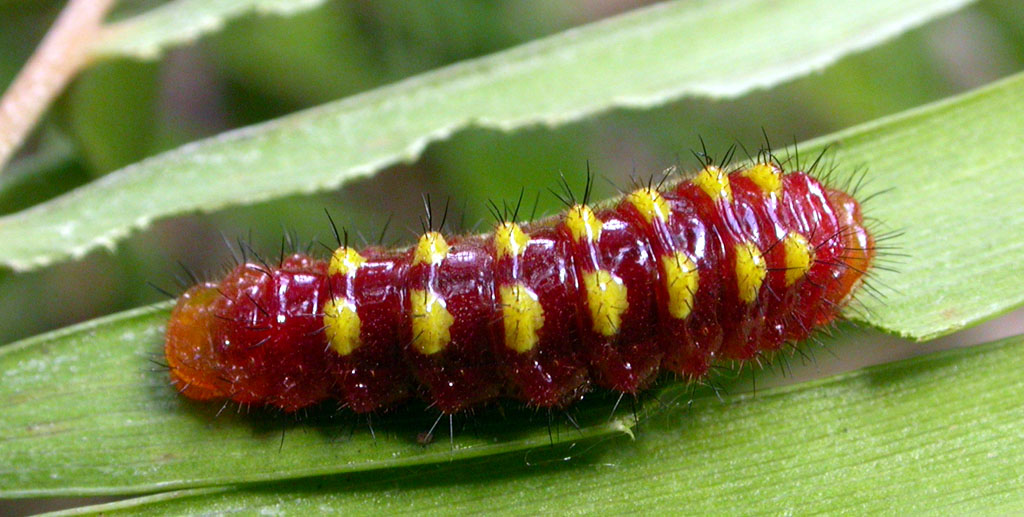
The caterpillar is just as loud-looking as the adult, which is also the point. Newly hatched caterpillars are pale and tiny, half a millimeter to a millimeter long, but within two days of hatching they turn red with yellow spots, and they feed in groups. Fully grown, they reach about 2.5 cm. If you find a cluster of red-and-yellow caterpillars stripping a coontie, you have not found a pest problem. You have found the main event.
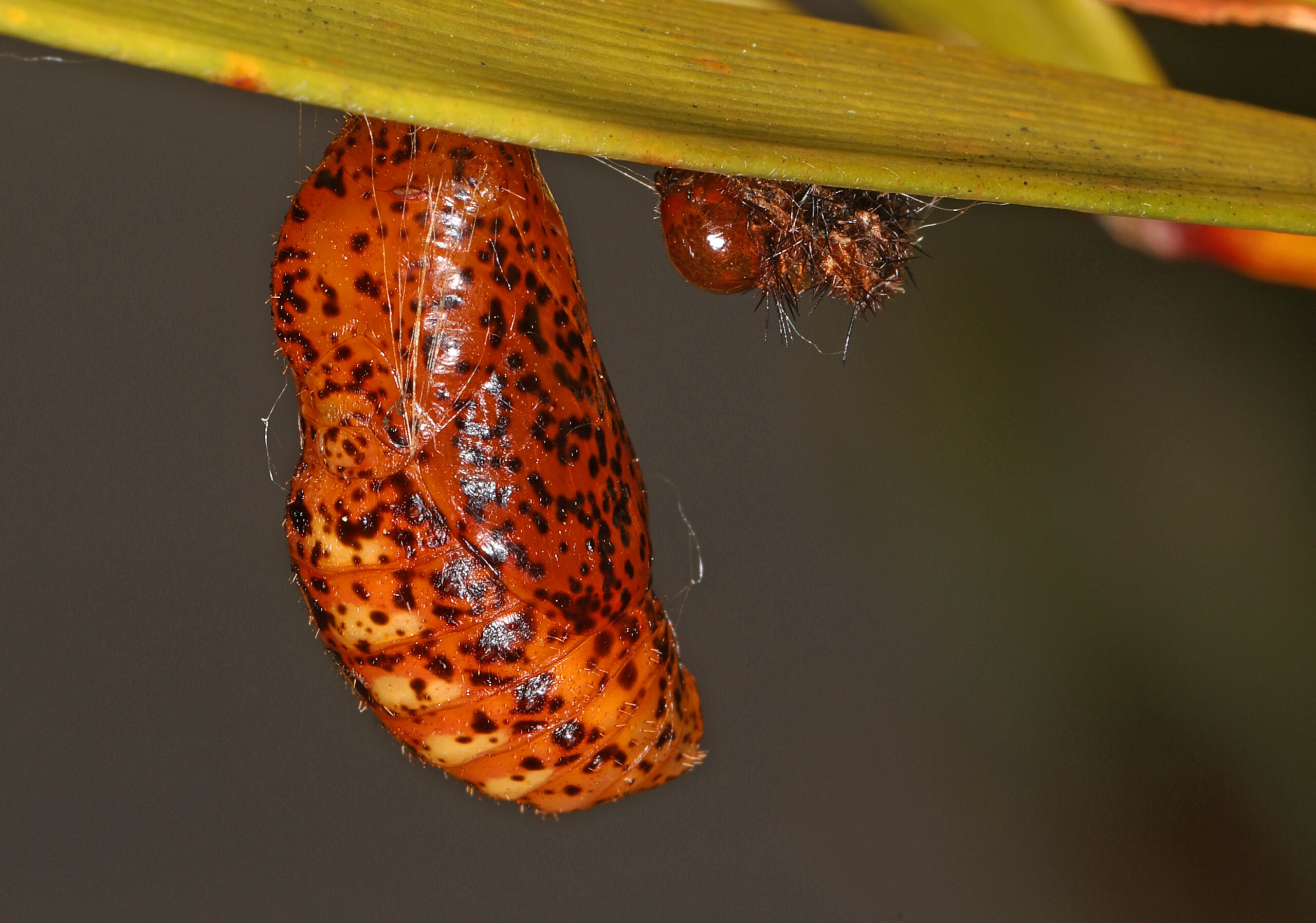
Eggs are cream-colored, about 1 to 1.25 mm across, laid in clusters of more than 60 on the tips of new coontie leaves, especially seedlings, and ringed with bright orange scales from the female’s anal tuft. Pupae are brown or orange-brown with small dark spots, held by a silken girdle — and they stridulate, producing sound inaudible to humans that may help coordinate emergence. On the tenth day of the last instar, larvae gather together and spin silk connecting themselves to each other and to the host plant, anchoring against strong winds. Even the chrysalis stage is a group project.
The coontie pact: poisonous on purpose
Here is the deal the Atala made, and it is one of the stranger bargains in Florida nature. Coontie is North America’s only native cycad — not a palm, not a fern, a survivor from a much older plant lineage. Its leaves contain cycasin, a toxin. Most things that eat coontie regret it. Atala caterpillars eat it, keep the toxin in their bodies through their entire life cycle — it is even found in their eggs — and wear warning colors to advertise the fact. This is aposematic coloration: the black wings, the blue spots, the cherry-red abdomen are a billboard that reads “I taste terrible.” Predators learn fast, which is why Atalas are usually not easily frightened off. They do not have many natural predators, because they paid for that privilege in poison.
Coontie is the Atala’s only native host plant. Females lay eggs exclusively on coontie foliage in the wild, and caterpillars eat nothing else. (Females have been observed laying on exotic Zamia species in cultivation — cardboard palm (Zamia furfuracea) is regularly colonised in South Florida gardens — but coontie is the native relationship that matters. Sago palm (Cycas revoluta), the other cycad most Florida gardeners know, is generally not accepted as a host, despite the occasional report; plant coontie, not sago, if you want Atalas.) The two even help each other in a small way: caterpillar droppings fertilize the soil around the plant. It is not quite a fair trade — the caterpillars eat a lot — but it is a relationship, not a robbery.
That relationship is also the butterfly’s whole vulnerability. No coontie, no Atala. There is no backup host, no plan B. Keep that sentence in mind, because the comeback story turns on it.
Why it does not wander far
Atalas live in colonies, and colonies stay put. An adult does not strike out across the county looking for adventure; it flutters near its host plants, perches, nectars, mates, and lays eggs on the coontie it grew up on. A colony is a local affair: a patch of coontie, some nectar flowers, some shade, and the same butterflies, generation after generation. Adults can live up to two months when nectar is plentiful, long enough that generations overlap and mate across generations, which helps keep a small colony genetically healthy.
Historically, that meant the Atala lived in southeastern Florida’s shady hammocks and pine rocklands where coontie grew wild. Today, colonies are fragmented — a yard here, a botanical garden there, a median planting somewhere unexpected — because coontie is now mostly a landscape plant. The butterfly has followed the plantings: as gardeners and landscapers planted coontie across South Florida and beyond, Atalas expanded into home landscapes, commercial nurseries, and botanical gardens, and have pushed northward along with the plantings as winters allow. Cold is still a barrier — a hard cold snap knocks adult numbers back, though caterpillars and pupae often carry the colony through. The Atala’s range is, in a very literal sense, the map of where people planted coontie and the weather let it stay.
The comeback story, told straight
The Atala was once called the most conspicuous insect in semitropical Florida. Then it nearly vanished, and the reason was not mysterious: people harvested its host plant out from under it.
Coontie roots and stems are full of starch. Indigenous communities in South Florida harvested coontie sustainably for generations, processing out the toxin to make flour. When settlers learned the technique, the starch — sold as Florida arrowroot — became a commercial product, and large-scale harvesting stripped wild coontie far faster than the slow-growing cycads could replenish. As coontie disappeared, so did the butterfly that depended on it. University of Florida records show the Atala was not collected in Florida from 1937 until 1959, and by the mid-1900s it was believed extinct.
It was not. Surviving colonies were found, and the recovery that followed is the rare conservation story with a genuinely simple mechanism: people planted coontie. Gardeners, landscapers, and conservationists put the host plant back into yards and public spaces, and the butterfly followed its food home. It is now common locally in Southeast Florida and still expanding — still rare overall, with a limited distribution, and not federally listed, but a long way from the extinction it was once assigned. The site’s own Florida Butterfly Host Plants guide calls it the atala’s comeback story. That is exactly what it is, and it is still being written by whoever plants the next coontie.
Hosting a colony: what a yard actually needs
The social media version of this advice is “plant coontie and they will come.” The honest version has four parts, and the first one is non-negotiable.
1. Lots of coontie. Not one lonely plant in a corner — a real patch. Caterpillars eat in groups and they eat a lot, and a colony needs enough foliage to raise generation after generation without stripping every plant bare at once. If you want Atalas, coontie is the whole foundation. Plant several, give them sun or shade and well-drained soil, and be patient: coontie is slow-growing, and a colony takes time to find you. A mile of flight is a long way for this butterfly, so a yard next door to an existing colony has a much better shot than an isolated planting — but every new patch shortens the distance for the next one.
2. Nectar flowers, especially white ones. Atalas have short proboscises and need easily accessible nectar. Their favorites include porterweed, Spanish needle, and wild coffee, along with saw palmetto, cabbage palm, beautyberry, and swampprivet. Plant a spread so something is blooming when adults are active, morning and late afternoon.
3. Shaded, sheltered cover. Atalas live in shady hammocks in the wild, and a yard colony wants the same feel: shrubs and small trees to perch on, hang under, and shelter in. Wild coffee doubles here as nectar and cover. A wide-open, blazing lawn with one coontie in the middle is not Atala habitat, however good your intentions.
4. Do not spray the coontie. This is the one people get wrong. Atala caterpillars can strip coontie foliage dramatically and quickly, and the plant looks rough for a while. That is not an emergency, and it is not a pest outbreak — it is the entire point of planting a host plant. The coontie pushes out new growth after the caterpillars move on. Spraying caterpillar-covered coontie kills the very wildlife you planted it to support. If the stripped look bothers you, plant more coontie so the feeding spreads out, and let the colony do its thing.
Two safety notes, because this guide would be irresponsible without them. First, coontie seeds are toxic to pets — the same cycasin that protects the butterfly can be fatal to cats and dogs if seeds are eaten, so keep pets from crunching fallen seeds. Second, do not collect butterflies or caterpillars, and do not buy or release Atalas on your own initiative. Colonies establish where the habitat is right, not because someone shipped in a box of butterflies. Plant the habitat, skip the insecticide, and let them find you.
If you spot one
Enjoy it, photograph it, and look around: there is almost certainly coontie nearby, and there may be a colony you did not know about. Do not touch it — not because it is fragile in your hands (it is chemically defended, remember), but because a sedentary butterfly that stays put is doing important work exactly where it is, and the kindest thing you can do for it is leave it to that work. Then go plant more coontie. The Atala’s whole comeback runs on that one act, repeated yard by yard, and it is still the most effective butterfly conservation most Floridians will ever do.
🪱 Your Soil Needs This
Reading about healthy soil is great. Growing in it is better. Our small-batch, traceable worm castings are the shortcut your garden deserves.
Shop Worm Castings Subscribe & SaveEvery bag comes with a lot certificate. Know what's in your soil.