
🌾 Sedge
What it looks like
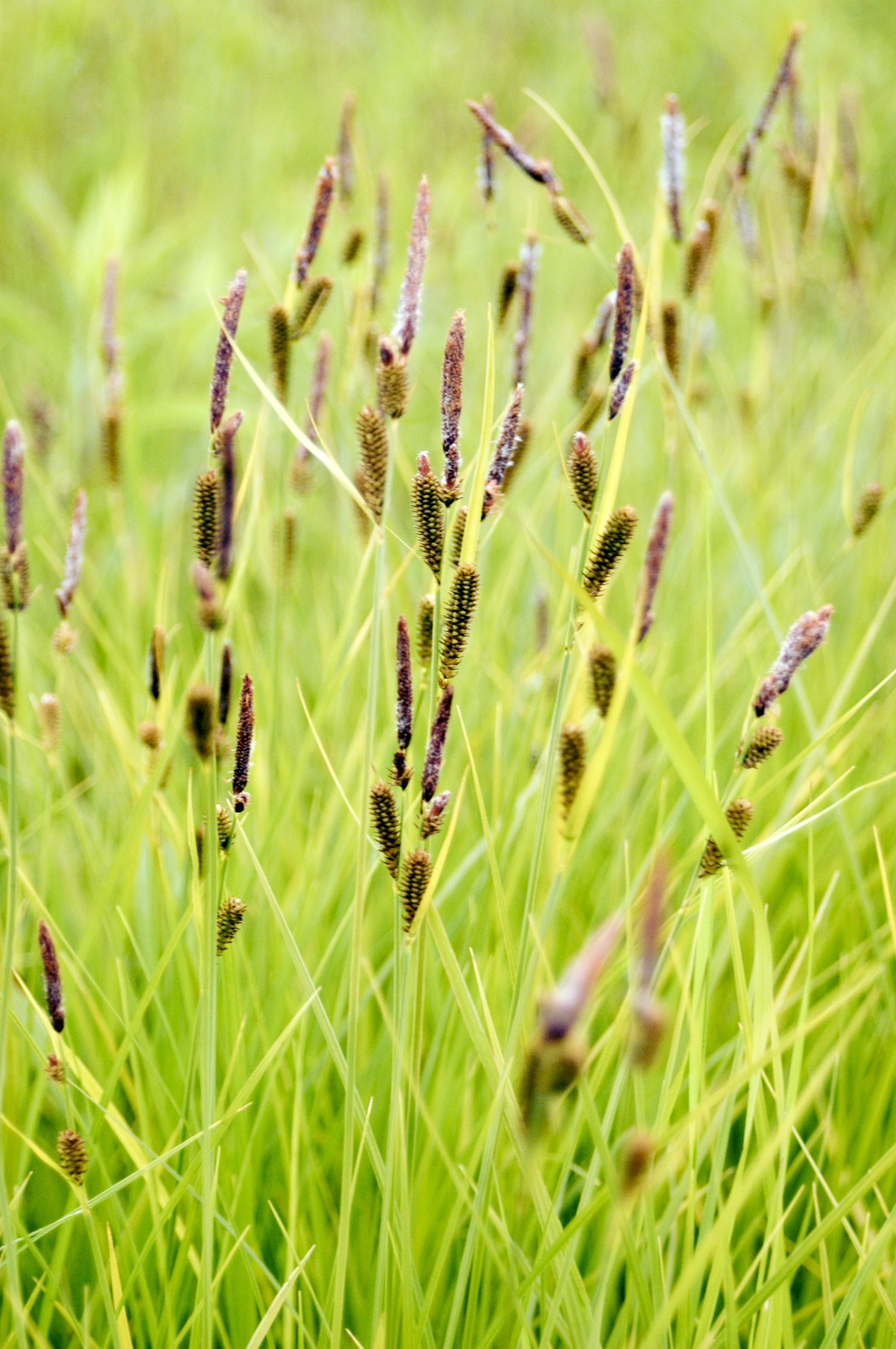
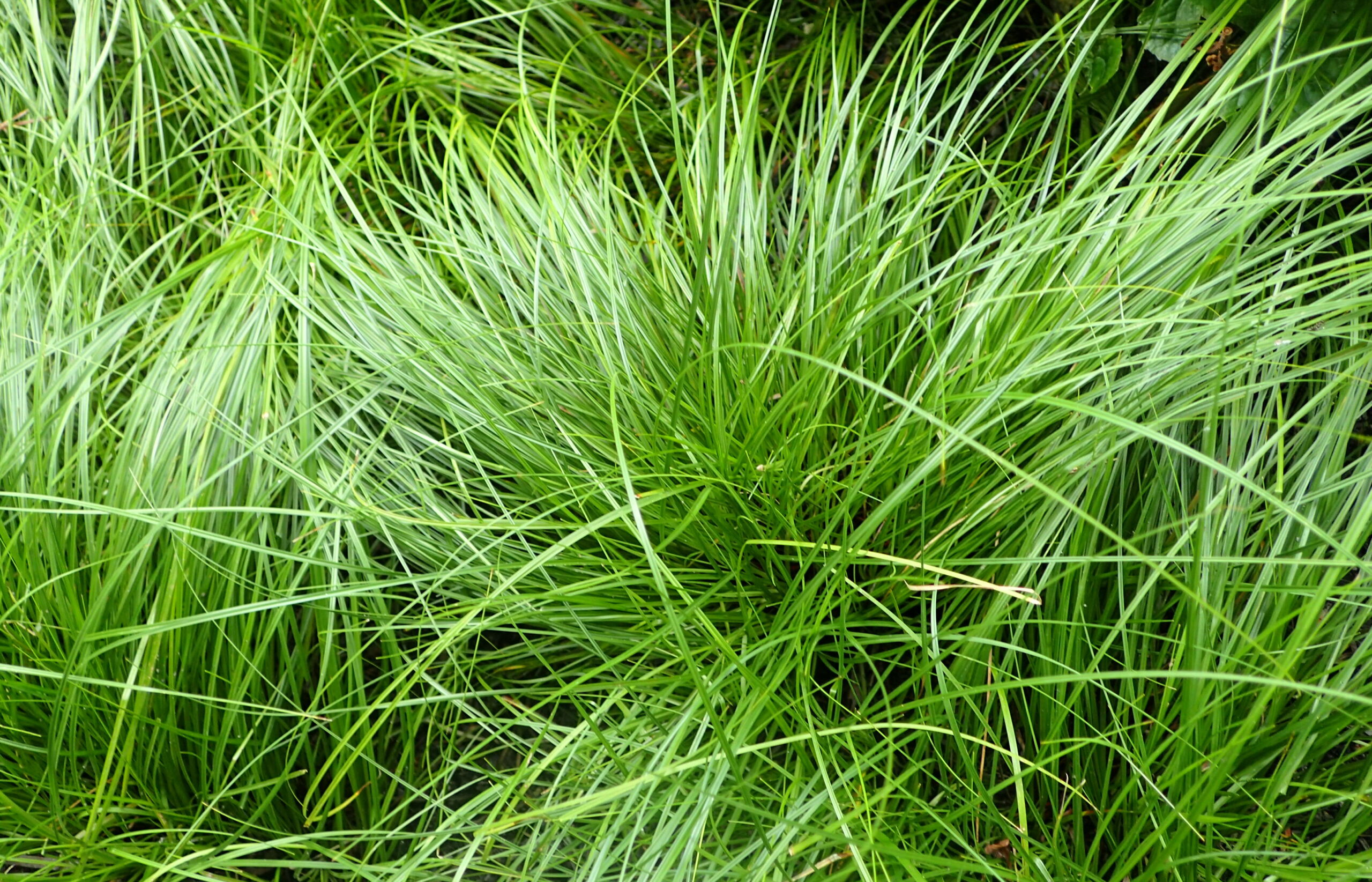
Sedges look like grasses at a glance, and that glance has fooled many a gardener. Look closer and the differences announce themselves. Sedges belong to the family Cyperaceae, not the grass family Poaceae, and most Carex species carry the field botanist’s favorite party trick: a stem that is triangular in cross-section, solid rather than hollow, with no swollen nodes along its length. Roll a stem gently between thumb and forefinger and you can feel the edges. Their leaves are arranged in three ranks around the stem, where grasses arrange theirs in two, and their flowers are borne in spikes — often a narrow male spike on top and fatter female spikes below — with each female flower tucked inside a little sac called a perigynium. Those perigynia, with their shapes, beaks, and colors, are how botanists tell the hundreds of Carex species apart, and why sedge identification has a reputation as a beautiful, maddening puzzle.
The genus Carex is enormous — one of the largest genera of flowering plants, with well over a thousand species worldwide — and it covers an astonishing range of habitats. Some sedges stand in standing water and build tussocks in marshes. Some carpet dry woodland shade where no lawn grass will grow. Some edge mountain streams, some fill rain gardens, some hold the banks of ponds. What unites them is toughness, persistence, and a willingness to grow where fussier plants quit. They are also butterfly plants in the quiet way grasses and sedges often are: tussock sedge alone is a larval host for skippers including the black dash, the dun skipper, the eyed brown, and the mulberry wing, and Pennsylvania sedge hosts satyr butterfly caterpillars while feeding birds and small mammals with its seeds.
How to grow
The first rule of growing sedges is: match the sedge to the site, because there is no single “sedge care” that fits them all. A wetland sedge planted in dry shade will sulk, and a dry-shade sedge planted in a pond will drown. Read the species, not just the genus. Wetland and fen species — tussock sedge, Buxbaum’s sedge, woollyfruit sedge, bristly-stalked sedge, prairie sedge, sterile sedge — want wet feet: marsh edges, rain garden bottoms, pond margins, wet meadows, and soils that stay moist to wet. Woodland species — Pennsylvania sedge above all — want the opposite end of the spectrum: dry to medium, well-drained soil in part to full shade, the classic “nothing grows under this oak” spot.
Planting is straightforward. Set plugs or pots at the same depth they were growing, space them 12–18 inches apart for groundcover (closer for a faster lawn-like fill, wider for specimen clumps), and water them in well. Most sedges are best planted from plugs rather than seed, which can be slow and fussy, and many garden species spread steadily by rhizomes to form colonies — Pennsylvania sedge spreads by long rhizomes into soft, flowing mats, while tussock sedge builds dense clumps that grow into elevated tussocks as old leaves die and pile up around the living crown. Give tussock-forming species room to become their architectural selves; do not plant them cheek-by-jowl and then wonder why they are elbowing each other.
Light follows the species too. Tussock sedge wants full to part sun. Pennsylvania sedge wants part shade to full shade and actually struggles in hot full sun. Japanese sedge (C. morrowii) is a shade garden classic. If a sedge is thinning or yellowing, the first suspects are always light and moisture mismatch, not disease. Get those two right and most sedges are gloriously low-maintenance: no pampering, no fussy pruning, just a plant doing its job.
Florida note: Florida has its own native sedges, and the wetland species in this guide — particularly the fen and marsh types — will feel more at home in Florida’s wet soils than the cold-climate woodland types will. Pennsylvania sedge, hardy roughly in zones 3–8, struggles south of zone 8 and is not a good Florida lawn substitute; Florida gardeners should choose sedges native to or proven in Florida’s heat and humidity rather than importing a northern woodland plant and hoping for the best.
Water & feeding
Water according to the species’ address, not the genus label. Wetland sedges want consistently moist to wet soil and tolerate standing water; tussock sedge is easily grown in moist to wet spots including standing water, and it forms its best tussocks where the ground is seasonally flooded. Woodland sedges like Pennsylvania sedge want dry to medium soil once established and are drought-tolerant in shade; they do not tolerate consistently wet or poorly drained soil, which is the mirror image of their marshy cousins. When in doubt, check the species’ native habitat — marsh, fen, woodland, or streambank — and water to match it.
Feeding: sedges are light feeders. Most need no fertilizer at all in a garden with reasonable soil, and a yearly topdressing of compost or leaf mulch is plenty for even the hungriest of them. Heavy fertilizer produces soft, floppy growth and invites weeds, and it does nothing for the plant’s real strengths, which are persistence and structure. Think of sedge feeding the way you think of feeding a tortoise: a little, occasionally, and never with enthusiasm.
A soil note for the nerdy: sedges are superb soil builders in their habitats. Tussock sedges literally build land — their accumulating dead leaves and roots raise tussocks above the surrounding marsh, creating drier micro-habitats that other plants and animals then use. In woodlands, Pennsylvania sedge’s rhizome mats hold soil on slopes and under trees where rain would otherwise wash it away. The plant is not just sitting in the soil; it is engineering it.
Common problems
- Wrong site, wrong sedge. The overwhelming majority of sedge failures are a wetland species in dry soil or a dry-shade species in a bog. Match species to moisture and light first, and most other problems disappear.
- Heavy foot traffic. Pennsylvania sedge makes a lovely low-traffic lawn alternative, but it will not tolerate heavy play, sports, or constant trampling. Use it for paths and sitting areas with light use, not soccer practice.
- Slow fill. Sedges spread steadily, not explosively. A groundcover planting looks sparse in year one and lush later; plant closer together if you want fast coverage, and be patient.
- Winter browning in cold zones. Pennsylvania sedge is semi-evergreen: it stays green in zones 7–8 but browns and goes dormant in colder zones. Cut back dead foliage in early spring before new growth emerges.
- Confusion with grasses and rushes. If you cannot tell what you have, roll the stem: edges mean sedge, round and hollow with nodes means grass, round and pithy means rush. That one test settles most arguments.
Harvest
There is no crop to pick, but there is a seasonal harvest of sorts. In late winter or early spring, cut back dead or tattered foliage before new growth starts — tussock sedges and evergreen types both benefit from a tidy-up, and the removed material makes fine compost. If you are dividing an overgrown clump, spring is the time: lift, split with a sharp spade, and replant the divisions, which is also the cheapest way to expand a sedge groundcover. And if you leave seed heads standing into fall and winter, birds will harvest them for you — sedge seeds feed juncos, cardinals, turkeys, and ducks, among others, which is a perfectly good reason to put off the tidying until spring.
Browse all plant & pest guides
Saving seeds
Genus-level honesty first: Carex is a huge genus — roughly 2,000 species — and seed needs vary by species, so this is the genus playbook, not a promise for one particular sedge. Most sedges need a cold, moist chill to break dormancy, commonly 30 to 90 days depending on the species, and most need light to germinate. Sow on the surface of moist mix, press the seed in gently, and do not bury it.
The easy route is to sow in fall outdoors and let winter do the chilling — scatter seed in a prepared bed or a pot left outside, and watch for sprouts in spring. Or fridge-stratify: mix seed with damp sand or vermiculite in a bag, refrigerate for a month or three, then sow warm. Germination can be slow and staggered, sometimes stretching over weeks, so do not throw the tray out after the first month of nothing.
Division is the practical route for a plant you already own. Sedges divide readily in spring or fall — lift the clump, pull or cut it into pieces with roots and shoots attached, and replant. Division keeps the form true, which matters for named selections and for the tidy clumping kinds that would otherwise come up as a rabble of seedlings.
Save seed only from a species you can identify, and label it — a packet marked “sedge” is a mystery, not a plan. In Florida, sedges are the workhorses of wet ground and dry shade alike, and several species are native here; match the species to the spot, wet or dry, and let the seed follow the plant’s own habits.
Species in this group
Tussock sedge (Carex stricta) — the wetland architect: 2 to 3 feet tall, forming elevated tussock mounds in marshes, bogs, and wet meadows across eastern North America; a larval host for several skipper butterflies.
Buxbaum’s sedge (Carex buxbaumii) — a wetland and fen sedge of northern and cool regions, at home in wet meadows and calcareous fens.
Woollyfruit sedge (Carex lasiocarpa) — a slender wetland sedge of bogs, fens, and marshy shores, named for its hairy, woolly fruit sacs.
Bristly-stalked sedge (Carex leptalea) — a delicate bog and fen sedge with fine, bristle-like stalks, happiest in wet, acidic places.
Prairie sedge (Carex prairea) — a fen and wet-prairie sedge of calcareous wetlands, a plant of open, sunny, wet ground.
Sterile sedge (Carex sterilis) — a dioecious fen sedge (male and female flowers on separate plants) of calcareous fens and wet meadows.
Pennsylvania sedge (Carex pensylvanica) — the dry-shade lawn alternative: 6 to 12 inches tall, fine-textured and semi-evergreen, spreading by rhizomes into soft mats in part to full shade, hardy roughly in zones 3–8.
Japanese sedge (Carex morrowii) — the evergreen shade-garden classic: tidy, arching, variegated forms available, a staple for shady borders and containers.