
🌸 Wright’s Buckwheat
What it looks like
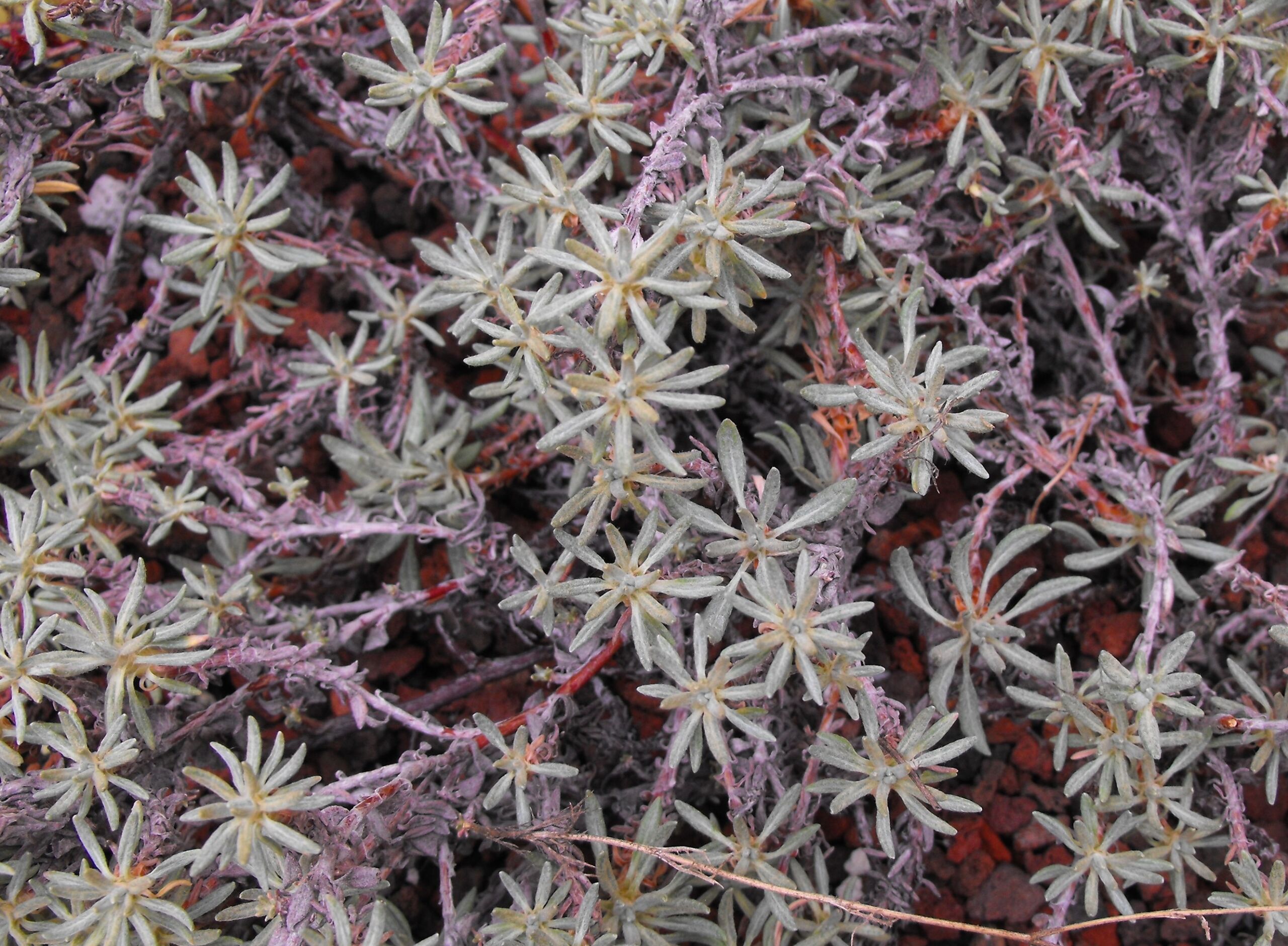
Wright’s buckwheat is not the buckwheat you eat. That one is Fagopyrum, a crop plant grown for grain. This one is Eriogonum, a genus of wild buckwheats — some 250 species, nearly all North American — and Wright’s is one of the most widespread members of the clan, a desert native that has learned to make a living where the soil is thin, the rain is rare, and the sun does not negotiate. It is a perennial subshrub: woody at the base, herbaceous above, and built low to the ground like something that has decided dignity is best expressed at knee height.
The plant itself is a study in desert thrift. The leaves are small, narrow and woolly — covered in fine hairs that slow water loss and give the foliage a silvery, grey-green cast, like felt that photosynthesises. They cluster at the base and along the lower stems, and in the early summer, before the flowers arrive, the plant can look wiry and sparse, as if it were still deciding whether to bother. Then it bothers. From July into October it throws up long, straight, wiry flowering stalks, branched and airy, carrying clusters of tiny flowers that are usually white to light pink, each with six ruffled, petal-like tepals and protruding stamens. From a distance the effect is a cloud of pale lace hovering over a silver mound; up close it is a constellation of tiny stars, each one a nectar station.
Size is where you must accept variability, because this species refuses to be one size. Flora of North America describes plants from a single decimetre tall when matted to a full metre tall and a metre and a half wide when happy. Garden sources are more modest: about 1.5 feet tall and spreading about 2 feet, with one Texas reference giving up to 30 inches tall and 48 inches wide for the typical variety. The honest summary is that Wright’s buckwheat is a low, spreading mound, usually knee-high or less in gardens, occasionally bigger in the wild, and always wider than it is tall. Plan for a 2-foot spread, and if your plant decides to be grander, take it as a compliment.
The flowers age beautifully, which is more than can be said for most garden plants. The white to pink blooms fade to russet-red seed heads that persist into winter, so the plant gives you two shows: the pale summer cloud and the rust-coloured autumn skeleton. That second show is not just decorative. The seed heads feed birds and the dried stalks catch frost and low light in ways that make a rock garden look deliberate rather than abandoned. A plant that looks good dead is a plant that understands desert gardening.
How to grow
Start with the plant’s home address, because it tells you almost everything about its care. Wright’s buckwheat is native to the desert Southwest — Arizona, New Mexico, Texas, California, Nevada, Utah and Colorado, and south into northern Mexico — where it grows on rocky desert slopes, mesas, canyon margins, sandy flats, washes and gravelly hillsides, from roughly 2,000 to 8,000 feet of elevation. It lives in desert scrub, chaparral and pinyon-juniper woodland, which is to say it lives where the soil drains instantly, the air is dry, and the rain, when it comes, comes all at once. Your job is to imitate that, not to improve on it.
Sun is non-negotiable. Give it full sun, with a little afternoon shade tolerated in the hottest spots. Six or more hours of direct sun keeps the growth compact and the flowering generous; shade makes it leggy and shy, which is not the look anyone plants a buckwheat for. In a rock garden, on a slope, or at the edge of a gravel path, it will be at home. In a rich, irrigated perennial border, it will be confused and probably short-lived, because everything about this plant is tuned to lean conditions.
Soil is the whole game. Wright’s buckwheat demands fast drainage above all else: sandy, gravelly or rocky soil, on a slope or a mound if your ground is heavy. The Arizona Native Plant Society advises amending the planting area or working the plant into a mound or rock garden if your soil is heavy, and that is good advice worth following literally. A plant sitting in wet winter soil will rot, and no amount of desert toughness saves a root system that is drowning. The soil reaction it prefers is neutral to alkaline, roughly pH 6.5 to 8.5 by one variety-level account, which suits most desert and limestone soils and warns you off acidic, peaty mixes. Do not enrich the soil heavily. A lean, mineral soil is not a punishment for this plant; it is the native condition, and rich soil plus regular water produces soft, floppy growth that flops, rots, or both.
Hardiness is a genuine muddle in the sources, so here it is plainly. One native-plant guide gives zones 5 to 11; another gives zones 7a to 10b; a specialist nursery says only that it is hardy to at least 0 degrees Fahrenheit, and the Arizona Native Plant Society lists a minimum temperature of 0 degrees Fahrenheit. Those numbers do not all agree, because the species spans an enormous elevation and latitude range and its varieties differ in cold tolerance. The safe reading is that Wright’s buckwheat is hardy to about 0 degrees Fahrenheit, that low-desert varieties are the least cold-hardy, and that high-elevation forms take considerably more cold. In very dry or cold situations the plant often behaves as an annual or a short-lived perennial, reseeding or dying back and returning from the base, which is not failure — it is the desert life strategy, and you should let it happen rather than fighting it.
Plant in spring after the soil has warmed, or in fall in mild-winter regions, and water to establish, then back off. Seed sown in place or plants set out in a prepared, gravelly bed will both work; the plant is not fussy about propagation so much as it is fussy about drainage. Once established, treat it as a low-water plant. In its native range it survives on rainfall that would make most garden plants file a formal complaint, and in cultivation it wants the same deal: occasional deep watering in extended drought, and otherwise benign neglect. Overwatering is the single fastest way to kill it, and the most common mistake made by gardeners who love it too much.
Water & feeding
Water like a desert rainstorm, not like a lawn sprinkler. That means an occasional deep soak that wets the root zone thoroughly, followed by a long dry period in which the soil dries out completely. In most desert and Mediterranean gardens, established plants need little to no supplemental water beyond what falls from the sky, and the California native-plant references rate its water needs as low to very low. In a container, the same rule applies with more vigilance: a fast-draining cactus mix, a pot with generous drainage holes, and watering only when the mix is dry through. A saucer full of standing water is a death sentence, delivered slowly.
Feeding is mostly unnecessary, and that is a feature, not a gap in this guide. Wright’s buckwheat evolved on lean, mineral soils, and it does not want fertiliser. A light top-dressing of compost or gravel mulch in spring is plenty; a dose of high-nitrogen fertiliser will push soft, leggy growth that the plant cannot support and that pests will enjoy. If you must feed, feed the soil, not the plant: a thin gravel mulch keeps the crown dry, suppresses weeds, reflects a little heat, and looks like the plant’s native ground, which is to say it looks right. Keep organic mulch away from the crown itself, where it holds moisture against the woody base and invites rot.
Pruning is light and mostly cosmetic. After flowering, you can cut back the spent stalks to tidy the mound, and in spring you can remove any winter-killed stems before new growth starts. The plant is slow-growing, so do not shear it into a ball; you are editing, not sculpting. Left alone, it will form a woody-based mound that gets a little woodier and a little more characterful each year, and the rust-coloured seed heads you leave standing through winter are doing a job — feeding birds and holding the garden’s structure — so consider leaving them until spring.
Common problems
- It rotted. Almost always wet soil, especially wet winter soil. Move it to a slope, a mound or a rock garden with fast drainage, and cut back on watering. Do not try to save a rotted crown with more water.
- It looks wiry and sparse in early summer. That is normal. The plant puts its energy into the late-summer flower stalks, and it looks thin before they arrive. Blend it with spring and early-summer flowers so the bed does not look empty while it gathers itself.
- It died after a cold, wet winter. Cold alone it can often take; cold plus wet it cannot. Sharp drainage and a gravel mulch are the protection, not a blanket. In marginal spots, let it reseed and treat it as a short-lived perennial.
- It flopped. Too much water, too much fertiliser, or too much shade. Lean soil, full sun and a dry regime keep it compact.
- It is not the buckwheat you eat. A confusion problem, not a plant problem. Eriogonum is wild buckwheat, not the grain crop Fagopyrum, and it is grown for flowers and pollinators, not for pancakes.
- Aphids or other small pests on the flower stalks. Usually minor on a healthy plant in full sun. A strong jet of water or simply leaving them for the ladybirds and other predators is often enough; avoid broad-spectrum sprays on a pollinator plant.
Harvest
There is no kitchen harvest here, and this guide will not pretend otherwise. Wright’s buckwheat is not a food crop in the garden sense, though its seeds have a documented history of use by Native peoples — the Kawaiisu are recorded as pounding the seeds, probably of the subscaposum variety, into a beverage or dry meal, and the Kayenta Navajo used one variety medicinally as an emetic. Those are ethnobotanical records, not recipes, and they belong in the history books rather than in your kitchen. The harvest that matters to a gardener is seed, if you want more plants, and flowers, if you want a vase of desert lace.
For seed, let some flower heads ripen fully on the plant until they turn russet and dry, then strip them into a paper bag and store the seed dry and cool. The plant self-sows gently in suitable ground, and a few volunteers in a gravel path are a gift, not a weed problem — move them while small if they are in the wrong place. For cutting, take the flowering stalks when the lower flowers are freshly open; they last well in water and dry well too, holding their shape and colour as everlastings. And leave plenty of seed heads standing for the birds and for the plant’s own plans, because a desert garden that feeds nothing but its gardener is a garden that has missed the point of a pollinator plant.
Browse all plant & pest guides
Saving seeds
Wright’s buckwheat seed is easy. Let the flower heads ripen on the plant until they are dry and brown, then strip them into a paper bag. No cold treatment is needed; sow in fall or spring in a gritty, well-draining mix, barely covered, and keep it warm — germination usually comes in one to two weeks.
It self-seeds lightly, so deadhead if you do not want volunteers, or let a few plants go and see what comes up. Save from the plants with the best flowers — the fullest heads, the clearest whites and pinks — and dry the seed thoroughly before storing; it keeps a few years in a cool, dry jar.
Seedlings will vary, and the named forms come only from cuttings. Cuttings root readily in a gritty mix, and every cutting is a clone of the parent. Seed is for the species itself and for the patient gardener. A seedling will be a Wright’s buckwheat, but it will not be a named cultivar.
And the Florida honesty: Wright’s buckwheat is a dry-land native of the western deserts, for zones 5 to 9, and it does not grow in Florida. This section is for the reader in a dry, western climate, where buckwheat comes back year after year.
Varieties of this species
Wright’s buckwheat is a variable species with several named varieties, and Flora of North America warns that the boundaries between some of them are indistinct and not yet fully resolved — which is taxonomy’s polite way of saying the plant has not finished arguing with itself. The varieties below are all real, published names; garden plants are most often sold simply as the species, so check the variety name if it is given, because size and cold tolerance follow it.
Var. wrightii — The typical variety, found from southeast California to west Texas, with white-tomentose (densely woolly-white) stems; the form most often meant by the plain species name in Arizona and New Mexico gardens.
Var. nodosum — Knot-stem buckwheat, also called bastardsage; found in the low deserts of southwestern Arizona and southeastern California, told apart by grey-tomentose flowering stems and branches.
Var. subscaposum — A widespread variety of the interior West; the variety whose seeds are recorded in Kawaiisu use, and a common form in cultivation.
Var. trachygonum — The common expression of the species in the Coast Ranges of California, flowering July to October on gravelly to rocky flats and slopes, in grassland, chaparral and oak and conifer woodland, at low elevations.
Var. membranaceum — Foothill buckwheat, also called ring-stem buckwheat, named for the sheathing petiole bases that ring the stems; found in California’s Peninsular Ranges and in Baja California, and unusual in flowering mainly in the coldest months in its southern California populations.
Var. brevifolium — San Borja buckwheat, an uncommon endemic from the Sierra de San Borja in Baja California.
Var. dentatum — La Mision buckwheat, a rare endemic of the mesas and bluffs above the Pacific coast between La Mision and Ensenada in Baja California.
Var. linearifolium — Linear-leaf island buckwheat, a rare endemic of Angel de la Guarda Island in the Gulf of California.
Var. olanchense — A named variety of the species; not yet widely in cultivation, and described by one flora account as the most elegant variety, still awaiting its garden debut.
Var. oresbium — San Pedro Martir buckwheat, an uncommon endemic of the Sierra de Juarez and Sierra de San Pedro Martir in Baja California, distinct in its broadly elliptic to nearly oval leaf blades.
Var. taxifolium — Yew-leaf buckwheat, a rare endemic of Cedros Island and the Punta Baja area near El Rosario in Baja California.
Note on the name: nursery and garden sources disagree about which Wright the species honours — one names the California lepidopterist William Greenwood Wright, another names the botanist Charles Wright. This guide does not pick a winner, because the sources do not agree, and a guide that invents certainty where its sources disagree is a guide you should not trust.