
🌾 Andropogon
What it looks like
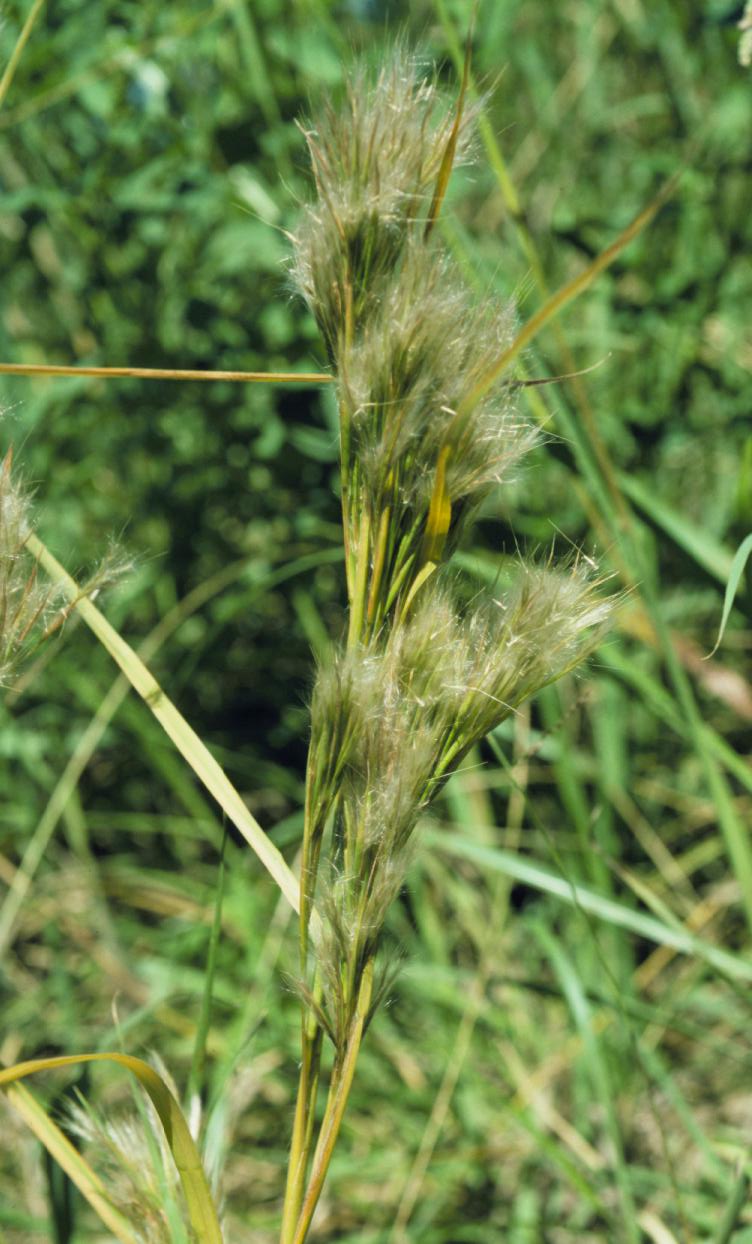
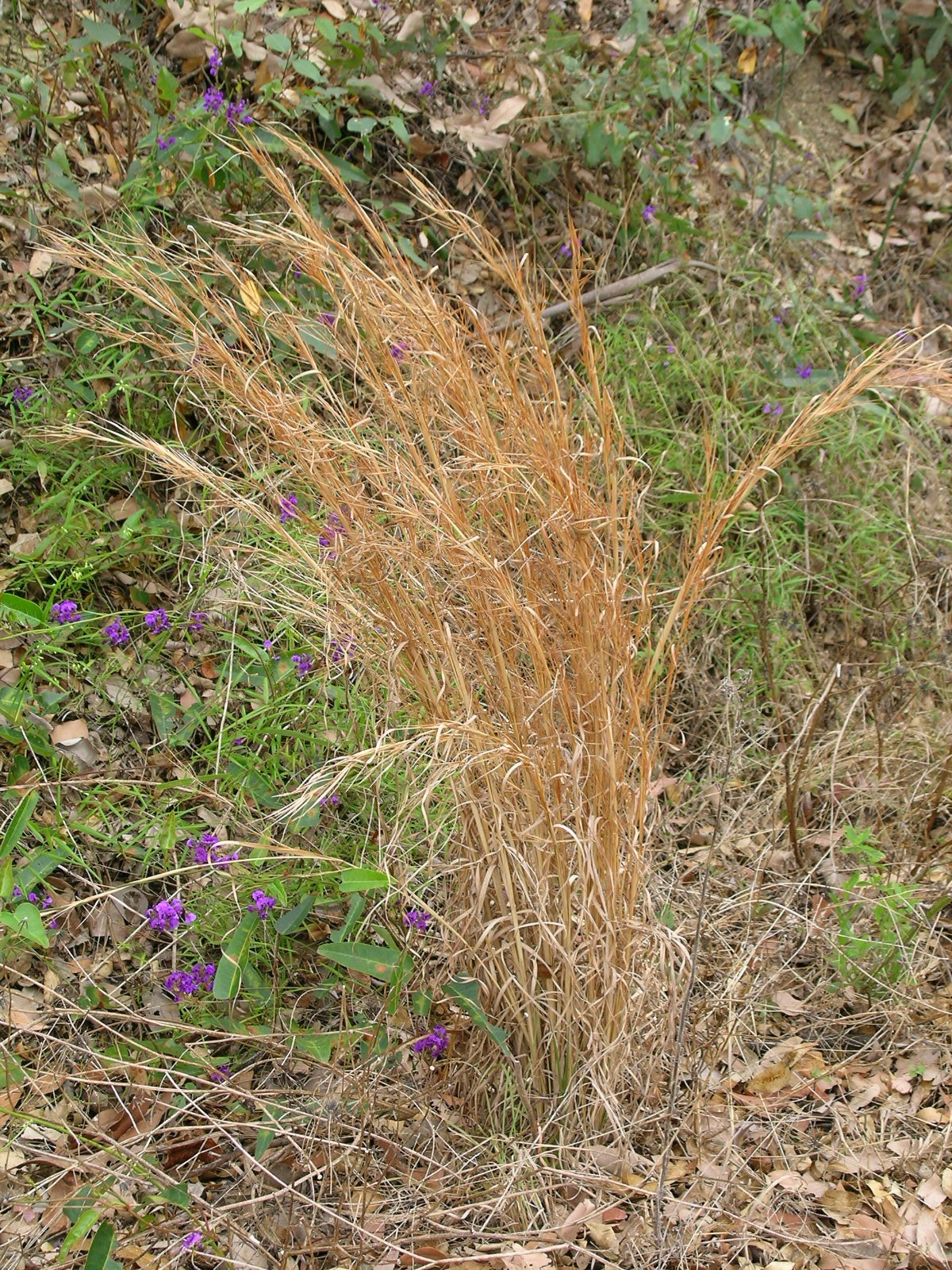
Andropogon is a genus of grasses, and its name tells you what to look for: from the Greek andros, meaning man, and pogon, meaning beard, because the spikelets wear stiff hairs that reminded some botanist of a beard. It is a good name. These are bearded grasses — warm-season perennials of the grass family, Poaceae, that carry their flowers in narrow, spike-like racemes with hairy joints, and that turn the trick of looking both tough and graceful at the same time, which is not easy for a plant that is essentially a bundle of stems.
The genus is a prairie genus at heart, though its members range well beyond the prairies. The plants are bunchgrasses and sod-formers, with narrow, upright leaves and stems that rise from a dense base, and they are warm-season grasses, which means they do not really get going until the summer heat arrives. In spring they are slow and unremarkable; by late summer they are the tallest thing in the border that is not a tree, and by autumn they have changed colour entirely, from blue-green through green to copper, orange, rust and deep red. A bluestem in October is a different plant from the one you planted in May, and that seasonal transformation is half the reason to grow it.
The flowers are the diagnostic feature, and they are worth learning. In big bluestem, the inflorescence is a cluster of two to six, most commonly three, narrow spike-like racemes at the top of the stem, spreading like the toes of a turkey’s foot — hence the common name turkeyfoot. Each raceme holds pairs of spikelets, one stalkless and fertile with a bent awn, one stalked and sterile or male, and the whole head is often purplish when fresh. In broomsedge, the seed heads are different: two to four short racemes, each partly enclosed in an inflated bract, emerging from the leaf sheaths like small, fluffy afterthoughts. Learn those two heads and you can tell the common bluestems apart at a glance, which is a satisfying party trick at prairie garden gatherings, if those are the parties you attend.
Underground, Andropogon is even more impressive than it is above ground, which is saying something. Big bluestem’s main roots reach 1.8 to 3 metres deep, and the plants send out strong, tough rhizomes that form very strong sod. That root system is why bluestems hold soil against erosion, why they survive drought that kills shallower grasses, and why a prairie planting of them feels permanent in a way that a flower border never does. You are not just planting a grass; you are installing infrastructure, and the infrastructure happens to be beautiful.
How to grow
Start with sun, because there is no shade-tolerant bluestem worth the name. Andropogon wants full sun — at least six hours of direct light — and it is shade-intolerant, which is the polite botanical way of saying it sulks, stretches and thins out in shade. A sunny, open border, a prairie planting, a gravel garden or a sunny bank are all right. A spot under trees or on the north side of a wall is wrong, and no amount of good soil will compensate for missing light.
Soil is where Andropogon repays a relaxed attitude. These grasses tolerate a wide range of soil conditions — sand to clay, rich to poor — provided the drainage is decent, and they are famously at home on poor, infertile soils where fussier plants fail. Broomsedge in particular is an indicator of low-fertility soil, thriving where the ground is thin and the phosphorus is low, and big bluestem grows well on deep to shallow, sandy to fine-textured and even rocky soils. The one thing to avoid is standing water. Bluestems will grow in mildly wet places, but not in a bog, and a site that stays waterlogged will rot them. If your soil is heavy clay, plant on a slight rise and let gravity help.
Hardiness varies by species, so read the species, not just the genus. Big bluestem is listed for zones 3 through 9, which covers most of the United States east of the Rockies and a good deal beyond, and it is native from southern Canada to Mexico. Broomsedge is a southeastern and eastern species, native across the lower forty-eight states, and it is hardy enough to be weedy in places — it is listed as an invasive alien of Union concern in Europe and is ranked among the top invasive plants in parts of Australia, which is a reminder that a tough native in one place is a weed in another. Choose the species for your region, and do not plant broomsedge where it is listed as invasive.
Plant in spring, after the last frost, or by dormant seeding in fall or winter for prairie plantings. Seed should be sown shallowly — about a quarter inch deep — on a firm seedbed, because bluestem seed needs soil contact and light to germinate well, and a loose, fluffy seedbed leaves it stranded. Nursery plants go in at the same depth they grew in their pots, and they need regular water through their first growing season while their roots go down. After that, established plants are drought-tolerant and need water only in extended dry spells, about once a week at most, and often less. Overwatering a bluestem is like overfeeding a camel: unnecessary, and faintly insulting to the animal.
One caution that belongs in every bluestem guide: these are big grasses, and big grasses need room. Big bluestem reaches 1 to 3 metres tall depending on soil and moisture, and a mature clump is a substantial object. Do not plant it in a small border and expect it to behave like a fountain grass from the garden centre. Give it space, plant it in groups of three, five or seven for a natural look, and let it be the tall, rustling backdrop it evolved to be. In a meadow planting, mix it with other prairie grasses and flowers and let it compete; it is a mid-successional species that forms tall, dense stands, and it will hold its own.
Water & feeding
Water to establish, then stand back. Newly planted bluestems need steady moisture through their first year — check the soil regularly and water when the top few inches dry out, especially in hot weather. Once the roots are down, and they go down a long way, established plants tolerate quite dry conditions and need supplemental water only during extended drought. A deep soak once a week in a severe dry spell is plenty; daily sprinkling is worse than useless, because it keeps the roots shallow and the plant dependent. In a meadow or prairie planting, established bluestems generally need no irrigation at all.
Feeding is where restraint pays off twice over. Bluestems need little fertiliser, and over-fertilising harms them — it pushes soft, floppy growth, encourages weed competition in a prairie planting, and in the case of big bluestem seed production, nitrogen in the establishment year is specifically advised against because it feeds the weeds more than the grass. A light application of compost in spring is plenty for a garden border, and in a prairie or meadow planting, no fertiliser at all is the correct amount. These grasses evolved on soils that other plants consider poor, and they have the root systems and the patience to make a living there. Feed them like a lawn and you will get a lawn’s problems: lush growth, weak stems, and a plant that falls over in the first storm.
Maintenance is mostly a spring haircut. Andropogon is deciduous and dies back in autumn; cut the old stems back to about 10 centimetres above ground level in spring, before the new growth starts, to make way for fresh leaves. In a meadow, the traditional alternative is fire: burn off the old foliage in February or March, which is how the prairie did it for millennia and which bluestems are superbly adapted to, being fire-tolerant and quick to regenerate from their root systems. Do not burn where it is illegal or unsafe, obviously, but do understand that a bluestem that has been burned is not a damaged plant — it is a plant that has just had its favourite treatment. Leave the autumn and winter stems standing until spring if you can, because they give winter structure, catch frost beautifully, and shelter overwintering insects.
Common problems
- It flops. Too much water, too much fertiliser, or too much shade. Rich soil makes big bluestem taller and weaker; poor soil keeps it upright. Move it to full sun, stop feeding it, and let it be a little hungry.
- It is slow in spring. Normal. Warm-season grasses wait for heat. Do not dig it up in May assuming it died; it is just not awake yet.
- It spreads more than you expected. Big bluestem forms strong sod by rhizomes in good conditions, and broomsedge self-sows freely. Site it where spread is welcome, and edge the bed if it is not.
- It looks scruffy in winter. That is the plant’s winter clothing, and it is supposed to look like that. Cut it back in spring, not in autumn, and enjoy the tawny seed heads through winter.
- Rust fungus on the leaves. The rust Puccinia andropogonis forms black telia on bluestem leaves. It is usually cosmetic on a healthy plant; improve airflow, avoid overhead watering, and remove badly affected leaves.
- It outcompetes everything around it. Big bluestem forms tall, dense stands that shade out neighbours, which is a feature in a prairie and a problem in a small border. Give it room, or choose a smaller species.
- Wrong bluestem, wrong place. Broomsedge is weedy and invasive outside its native range, and it is a poor forage grass — low in nutrients, unpalatable to livestock except as new growth. Do not plant it as a lawn or pasture grass, and do not plant it where it is listed as invasive.
Harvest
There is no kitchen harvest here, but there is a harvest of sorts, and it has fed people and animals for a very long time. Big bluestem is good forage for horses and cattle and can be cut for hay, though it cannot tolerate overgrazing — graze it hard and it declines, which is the plant’s way of insisting on respect. For seed saving, collect the seed heads as soon as they turn colour and begin to dry; the seed strips easily from the stem when ripe. Spread it out in a protected spot until completely dry, then store it cool and dry. In a prairie planting, the real harvest is not something you take but something you leave: standing stems through winter for birds, which eat the seeds when little else is available, and nesting material and cover for quail, turkeys and other ground birds, which broomsedge in particular is noted for providing.
Broomsedge has one more historical harvest worth knowing, because it is charming: its stems were used as the straw base for handmade brooms in the southeastern United States, which is where the common name comes from. A grass that sweeps the floor and feeds the birds and holds the soil is a grass that has earned its place, even if modern gardeners mostly grow it for its autumn colour. Cut a few stems for a dried arrangement if you like — they hold their tawny colour well — and leave the rest standing for the winter birds.
Browse all plant & pest guides
Saving seeds
Grasses in the genus Andropogon — big bluestem (Andropogon gerardii) is the famous one, the turkeyfoot-topped giant of the tallgrass prairie — are generous seed producers, and saving their seed is mostly a matter of timing your harvest ahead of their shattering habit. Seed heads ripen in fall, roughly October into November for big bluestem, and once they start to shatter from the top down on dry, windy days, the seed is on its way whether you are ready or not. Cut whole heads just as they turn brown and dry, before shattering gets serious, and let them finish drying in a paper bag in a cool, dry place. The seed is chaffy and bristly, complete with awns, so expect a fluffy handful rather than clean grain — you can rub it gently to break up the heads, but do not fuss over getting it perfectly clean. A little chaff sows just fine.
Here is where sources disagree, and you deserve to know it: some recommend about a month of cold-moist stratification to break dormancy, while others report good germination with no stratification at all, especially from southern ecotypes. The simplest honest path is to let winter do the work — sow in late fall or late winter so the seed gets its cold spell outdoors — or, if you are sowing in spring, chill the seed in barely damp sand in the fridge for a few weeks first. Sow shallowly, about a quarter to a half inch deep, press it into good contact with the soil, and keep it consistently moist until it sprouts, which can take a few weeks. Be patient with the result, too: big bluestem is slow to establish, often taking two to three years to become the towering clump you pictured, and first-year seedlings are small and easily outcompeted by weeds, so give them a clean, firm seedbed and room to grow.
Species differences are modest but real. Big bluestem is the tall, warm-season bunchgrass most gardeners mean when they say Andropogon; its smaller cousins share the same basic recipe — fall-collected seed, shallow sowing, patience — but differ in height, moisture preference, and how aggressively they self-sow, so check the species before you promise a neighbor a plant. Division is the faster backup for any of them: dig a clump during winter dormancy, saw or split it into sections with roots and shoots attached, and replant at the same depth. And the usual seed-saving rules apply in miniature: named cultivars will not come true from seed, while seed from an open-pollinated species planting grows true to species, with the caveat that grasses cross readily with nearby relatives in flower. In Florida, dry seed thoroughly, store it airtight with a desiccant in a cool, dark place, and sow it the following spring — Florida humidity is the enemy of stored grass seed, and a jar left in a hot shed is a jar of dead seed.
Species in this group
Big bluestem — Andropogon gerardii — The tallest and most famous bluestem, 1 to 3 metres, with the turkeyfoot seed head, roots 1.8 to 3 metres deep, zones 3 to 9, state grass of Illinois and Missouri and official prairie grass of Manitoba. This species has its own separate growing guide in this project and is listed here in plain text only, not merged into this genus guide.
Broomsedge bluestem — Andropogon virginicus — A slender, vase-shaped bunchgrass, 2 to 4 feet tall, with narrow leaves and tawny-bronze autumn colour; seed heads of 2 to 4 short racemes partly enclosed in inflated bracts. A poor-soil indicator and a useful erosion-control and wildlife grass, but weedy and invasive outside its native range — do not plant it where it is listed as invasive.
Bushy bluestem — Andropogon glomeratus — Named for the dense hairs and many spikes terminating the lateral branches, which give it a bushy appearance; a warm-season bunchgrass of the southeastern United States.
Splitbeard bluestem — Andropogon ternarius — A southeastern bluestem with feathery, split seed heads; a smaller, airier member of the genus for sunny, well-drained sites.
Note: this site already has native-plant profiles for splitbeard, bushy and broomsedge bluestems; this genus guide covers the Andropogon clan as a whole, and the separate big bluestem species guide covers that species in full.