
💜 Ironweed
What it looks like
Ironweed is the plant that makes you stop the car. All summer it minds its own business as a tall, leafy stalk, and then in late summer it detonates into flat-topped clouds of intense purple — no ray petals, no daisy face, just hundreds of tiny tubular disc florets packed into heads that glow like someone spilled grape soda across the meadow. The name is a compliment, not a warning: the stems are famously tough and iron-stiff, holding those flower clouds upright through storms that flatten everything around them. The genus name honors William Vernon, an English botanist who collected plants in North America in the 1600s, which means every ironweed is quietly named after a guy who never got to see a garden center.
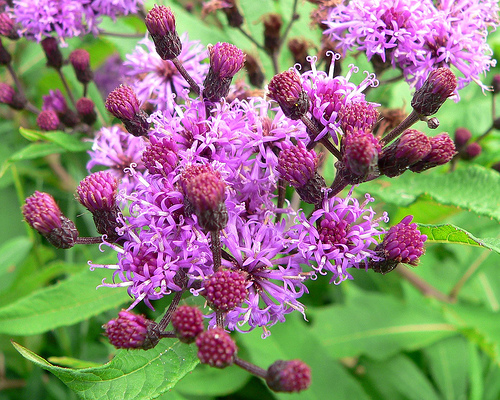
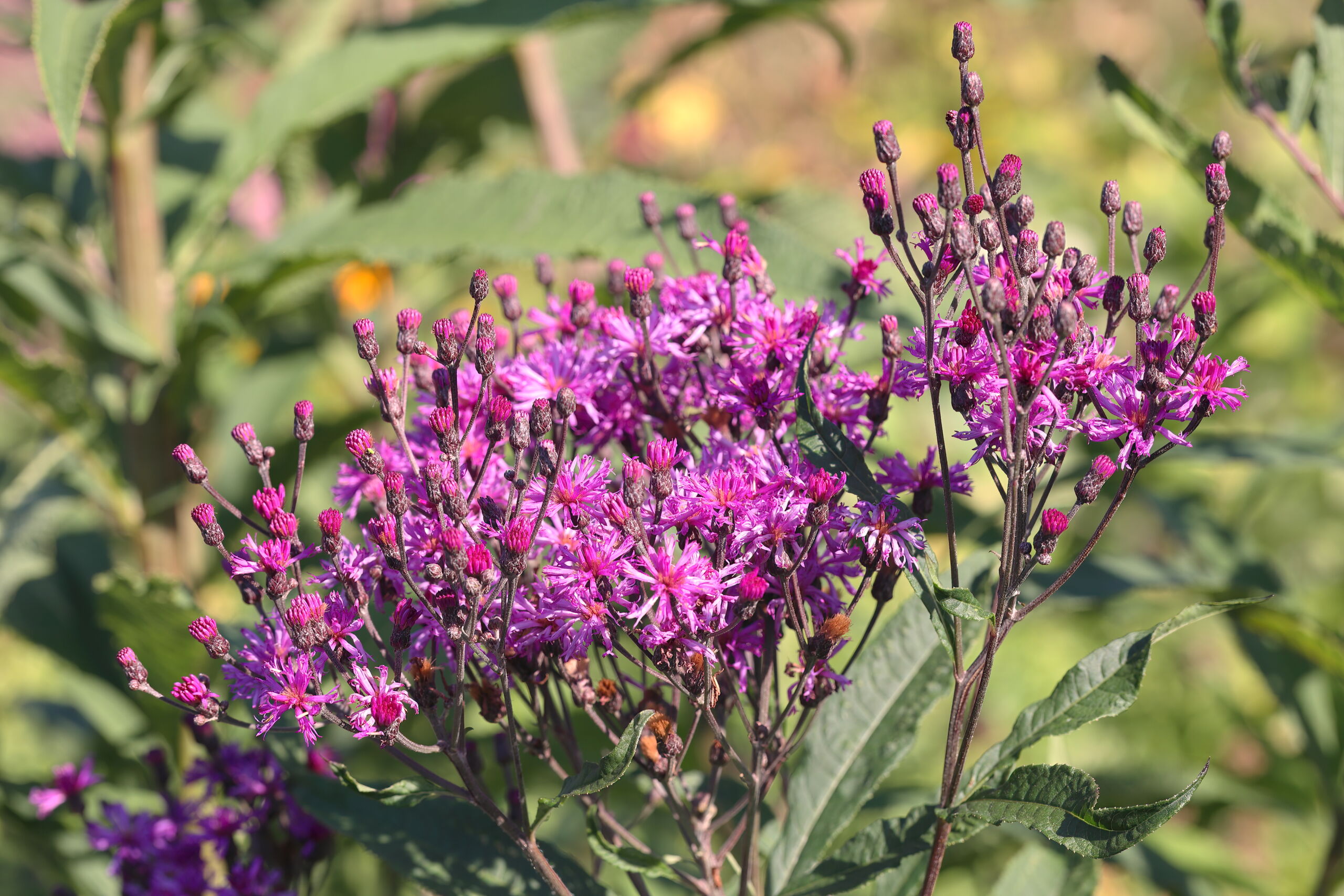
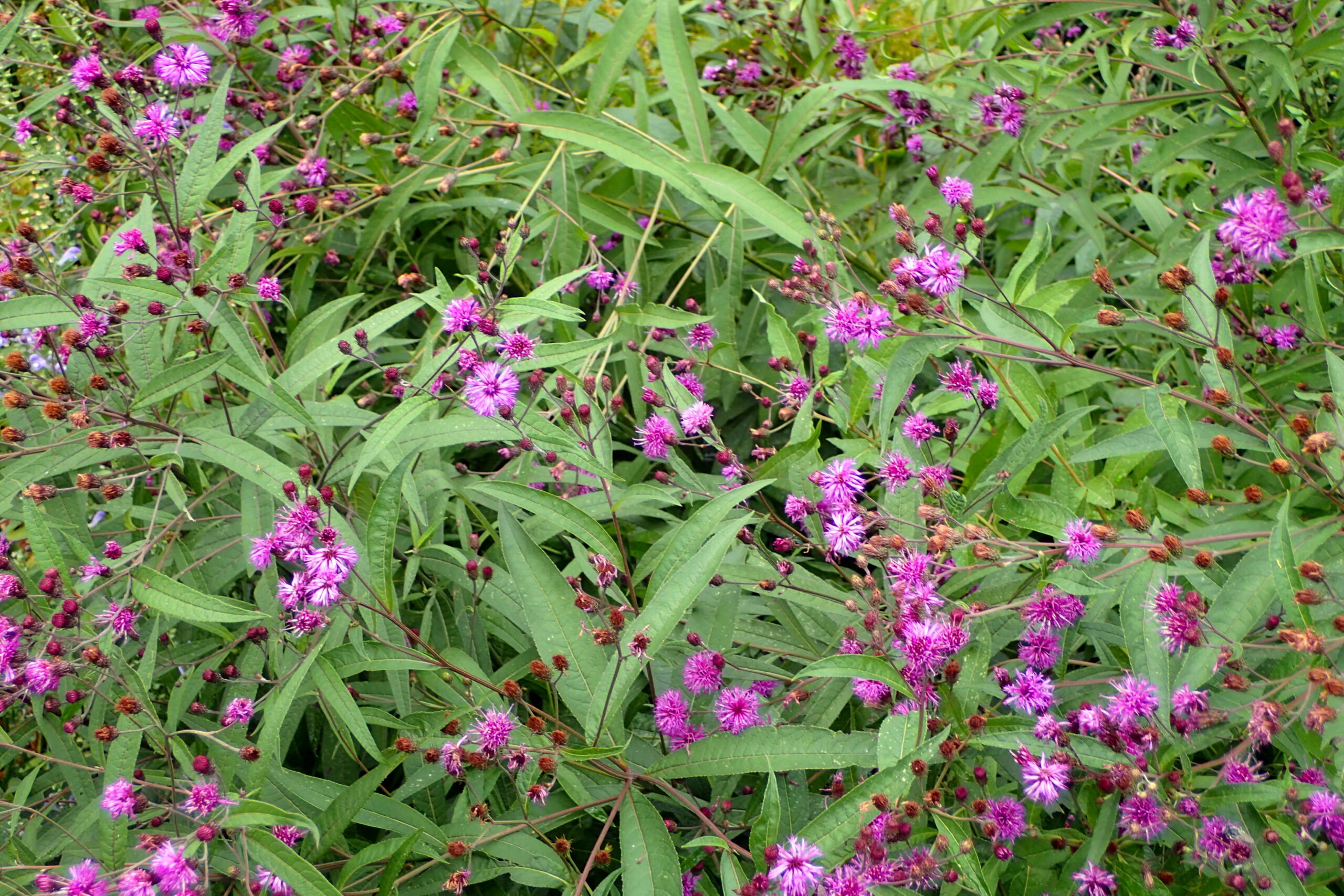
Up close, an ironweed flower head is a masterclass in daisy-family engineering. Each head holds anywhere from about a dozen to fifty small florets, depending on the species, and each floret is a five-lobed purple tube — no white rays, no yellow center, just purple all the way down. The leaves are lance-shaped, toothed, and arranged alternately up stems that can be green or flushed with purple, and the whole plant has a coarse, confident texture that says it has never once asked a gardener for help. Height is where ironweeds get silly: giant ironweed is described anywhere from 3 feet to 10 feet tall depending on the source, the soil, and possibly the enthusiasm of the person holding the tape measure, with Missouri sources reporting plants usually around 2.5 to 6.5 feet but sometimes reaching 10. Treat any single height number for this genus as a rumor with good intentions.
For butterflies, ironweed is a late-season lifeline. Its flowers open in July and run into October, exactly when many summer flowers are done and migrating butterflies are fueling up, and the nectar is rich enough that bees, wasps, butterflies, and skippers pile onto one plant at the same time. Ironweed is also a caterpillar host plant: the American lady butterfly uses Vernonia, and giant ironweed hosts the ironweed borer moth and the red groundling moth. Birds pick at the seed heads later in the season. If you want one plant that turns the back of a border into a pollinator airport in August, this is a strong candidate — provided you have the vertical room, because ironweed does not do subtle.
Florida note: Florida has its own ironweeds, including tall ironweed (Vernonia angustifolia) and giant ironweed (Vernonia gigantea), which reaches into northern Florida. In Florida, ironweed belongs in a sunny, moist meadow or rain-garden setting, not in a dry, manicured bed — it wants the damp feet its wild cousins enjoy along streambanks and pond edges. Gardeners in the far south of the state should check local native-plant sources before planting, since most ironweeds are creatures of the eastern and central United States rather than the subtropics.
How to grow
Ironweed is gloriously easy to grow and mildly alarming in how fast it takes its assignment seriously. Plant it in spring or fall in full sun — it tolerates part shade but flowers hardest in sun — in average to moist soil, and then mostly leave it alone. Rich, moist ground produces the tallest plants; average garden soil produces perfectly respectable ones. Give each plant 2 to 3 feet of elbow room, because a happy ironweed clump spreads by seed and by its perennial crown, and crowding it just means you will be editing seedlings later. Site it at the back of the border, along a meadow edge, or beside a pond or rain garden, where its height reads as drama rather than as a plant that has escaped and is now blocking the path.
Seed is the usual route: sow in fall or cold-stratify and sow in spring, and expect germination to be leisurely rather than instant — ironweed seed is not in a hurry, and first-year plants often spend their energy building roots before they bother flowering. Established clumps can be divided in spring, though the roots are tough (there is a reason for the name) and you will want a sharp spade and a certain grim determination. If your ironweed is threatening to outgrow its spot, use the Chelsea chop: cut stems back by about a third in late spring, and the plant will branch, bloom a little later, and stay a foot or two shorter. Cutting back up until early July still allows bloom, according to Tennessee extension guidance, so you have a generous window to negotiate with your plant.
Water & feeding
Ironweed likes moisture the way a golden retriever likes a lake: enthusiastically, but it will survive without a daily swim. In its wild haunts it grows along streambanks, pond margins, swamps, fens, and wet meadows, and it flowers best when the soil stays consistently moist. That said, established plants tolerate ordinary garden moisture and short dry spells — they just will not reach their full, towering potential in dry ground. Water new plantings until established, and water through drought if you want the big show. A plant in a dry bed that tops out at 4 feet while its cousin in the rain garden hits 8 feet is not a different species; it is the same plant telling you about its water bill.
Feeding is almost unnecessary. Ironweed in average soil needs no fertilizer, and rich feeding mainly produces taller, floppier stems that are more likely to lean. If your soil is genuinely poor, a spring top-dressing of compost is plenty. Mulch to hold moisture and suppress competing weeds, and skip the pampering — this is a plant that colonizes roadsides and ditches for fun.
Common problems
- Self-seeding enthusiasm: Ironweed seeds itself freely, especially in moist soil. Deadhead before the fluffy seed heads ripen if you do not want volunteers, or let a few heads stand for the birds and pull seedlings in spring where they are not wanted.
- Height surprises: That “5-foot” plant can hit 8 feet in wet, rich soil. Site ironweed where height is a feature — back of the border, meadow edge — and use the Chelsea chop if it starts auditioning for the role of garden canopy.
- Flopping in shade or rich soil: Plants grown in too much shade or overfed soil can lean. Full sun, average soil, and sturdy neighbors to lean on keep stems upright.
- Wet feet vs. dry feet: Ironweed sulks in truly dry, baking soil. Match the species to your moisture: giant and New York ironweed want moist ground, while narrowleaf ironweed tolerates dry, rocky sites.
- Wrong ironweed for your region: Some species are aggressive self-seeders in moist regions. Check whether your species is native to your area before planting, and never plant a species listed as invasive in your state.
Harvest
Ironweed is not a food crop, and this guide does not recommend eating it. What you harvest is ecological and ornamental: cut stems make striking, long-lasting late-summer flower arrangements, and the seed heads left standing through fall feed birds and give the winter garden some architecture. If you cut for arrangements, take stems when the flower heads are freshly open and expect the vase to become a pollinator conversation piece. In late winter, cut the dead stalks down before new growth wakes up, and compost the debris — or leave a few stalks standing as overwintering insect habitat if your garden style allows a little beautiful mess.
Saving seeds
This section uses the genus-level method for ironweed (Vernonia), and it says so, because the genus holds dozens of tall, purple-flowered species and the seed method is shared across them. Ironweed seed is the classic aster-family package: small dry achenes topped with fluffy pappus bristles that catch the wind. That fluff is both the collection challenge and the reason the plant wanders — save seed deliberately, or the wind will save it for you, everywhere.
Collect in fall when the flower heads have gone brown and fluffy and the seed pulls free easily. The simplest method is the paper-bag shake: slip a bag over a dried head, bend the stem, and shake or strip the seed into the bag. You will get a mix of seed and fluff; winnow it by pouring slowly in a light breeze or in front of a fan on low, letting the pappus drift off while the heavier seed drops. Dry the cleaned seed thoroughly before storage — in Florida humidity, spread it thin on paper until it feels completely dry, then keep it in a labeled envelope or an airtight jar with a desiccant packet, cool and dark. Seed stored dry and cool generally keeps for a few years, with the best germination from fresher seed.
For sowing, ironweed seed generally wants a cold period or a fall sowing that lets winter provide it. Sow in fall outdoors for natural stratification, or give it roughly a month or two of cold-moist stratification in the fridge (damp mix in a sealed bag) and sow in spring. Surface-sow or barely cover — light aids germination for many aster-family seeds — keep the mix moist, and expect sprouts over a few weeks in warm conditions, sometimes unevenly. Thin or transplant once seedlings are sturdy, and give them room: ironweed is a big plant that wants sun and space, not a crowded flat.
Seedlings vary, because ironweed crosses within the genus and a seedling is a reshuffle, not a clone. For an exact copy of a named selection, divide the clump in spring or fall — division is also the faster route to a flowering-size plant. And one stewardship note: ironweed self-seeds where it is happy, which is a gift in a meadow planting and a nuisance in a tidy border. Deadhead before the fluff flies if you want to keep it where you put it, or let a few heads stand for the goldfinches and deal with the volunteers in spring.
Species in this group
Ironweed is a big, taxonomically restless genus in the daisy family (Asteraceae). These are the species gardeners and butterfly watchers meet most often, all in plain text so you can shop by Latin name:
- Giant ironweed / tall ironweed — Vernonia gigantea (syn. Vernonia altissima): The big one. Eastern and central United States native of moist meadows, streambanks, and open woodlands. Height reports disagree wildly — 3 to 10 feet depending on source and soil — with Missouri sources giving usually 2.5 to 6.5 feet and occasionally 10. Zones 4 to 9 in most garden references, though individual sources list 3 to 9, 4 to 8, or 5 to 9; see the honest-gaps note.
- New York ironweed — Vernonia noveboracensis: Eastern United States native from Florida to Massachusetts and west to Tennessee and Ontario. About 6 feet tall, purple flowers in summer and fall, zones 5 to 9, and notably deer-resistant. A clumping perennial that spreads by seed and can be aggressive in moist soils.
- Missouri ironweed — Vernonia missurica: Central United States native with more florets per head (32 to 60) than giant ironweed and a hairier plant overall. Tops out around 6.5 feet.
- Narrowleaf ironweed — Vernonia lettermanii: The dry-site ironweed, native to Oklahoma and Missouri in dry, rocky, often calcareous ground. Shorter, around 2 to 3 feet, with narrow leaves. Zone 4 in perennial references.
- Tall ironweed (Florida) — Vernonia angustifolia: Southeastern native found in Florida and across the coastal plain. Not to be confused with giant ironweed, which is also sometimes called tall ironweed — another reason to shop by Latin name.
One disambiguation: this site also has native-plant profiles for giant ironweed and tall ironweed in its Florida natives collection. Those are species profiles, not this genus growing guide, and they cover the Florida angle in more detail.