
🌻 Wingstem
What it looks like
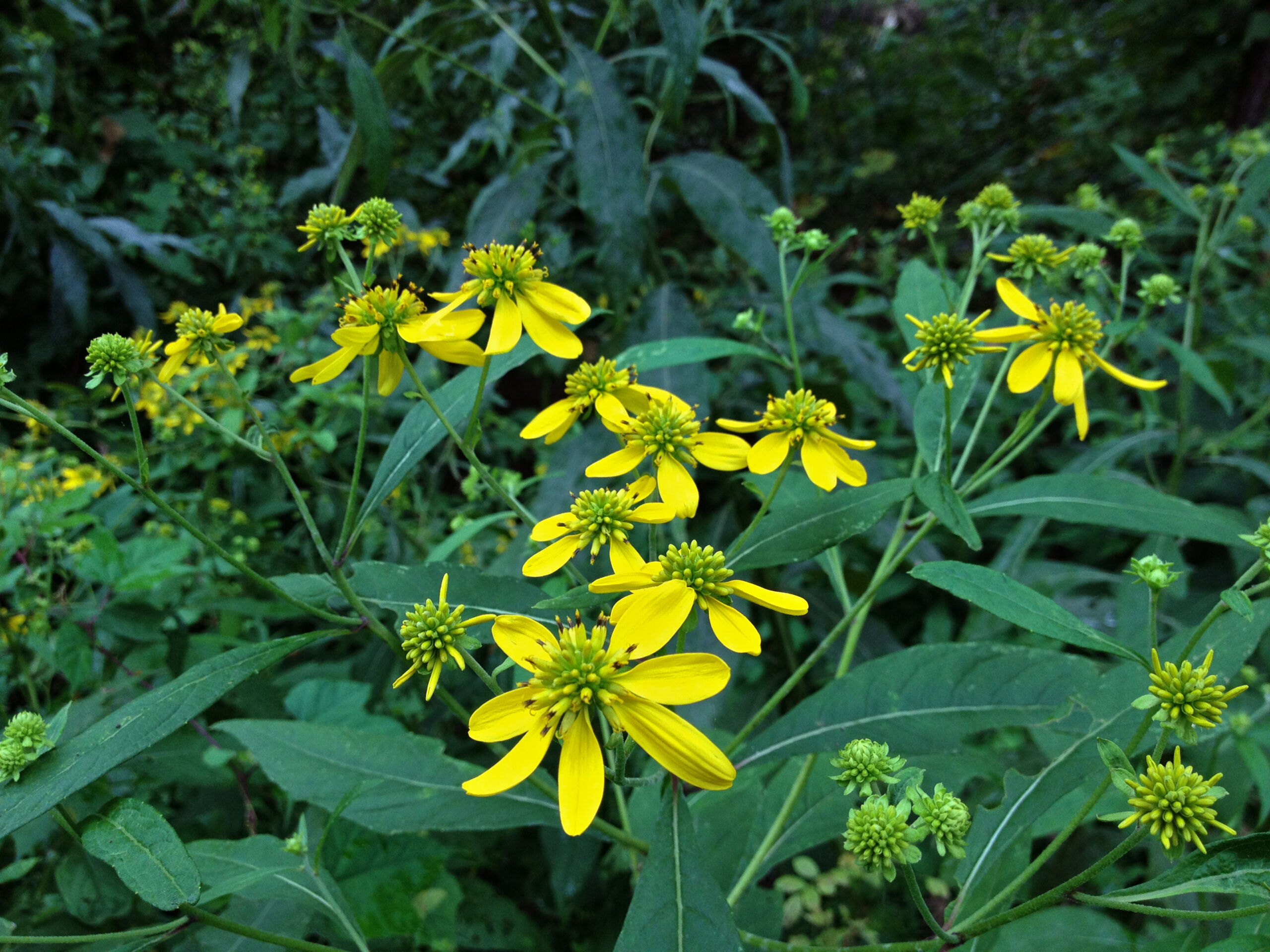
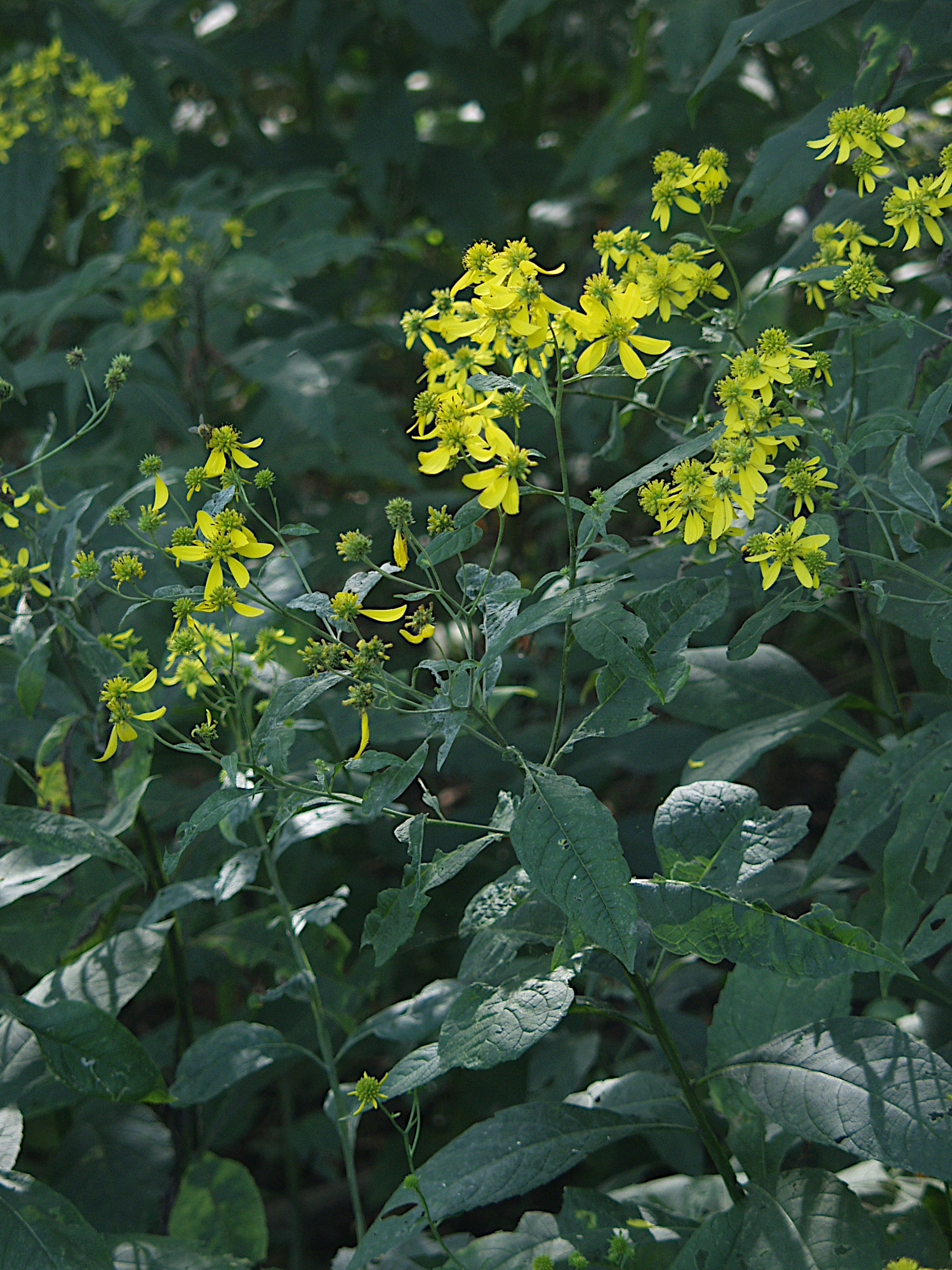
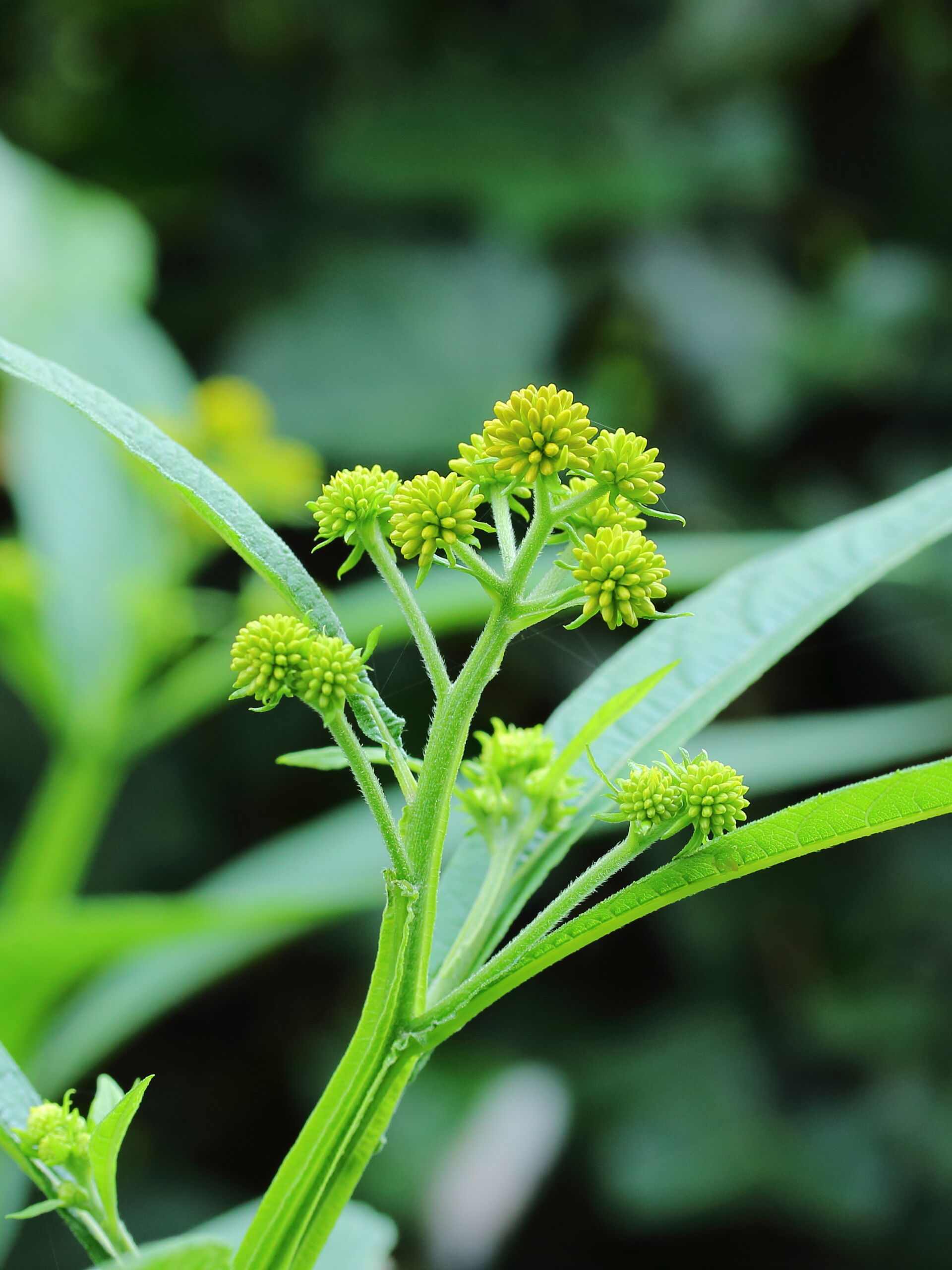
Wingstem is the plant that makes you stop the car in August and ask what that enormous yellow thing is. It is a tall, coarse, herbaceous perennial in the aster family (Asteraceae), native to eastern and central North America, and it earns its name in the most literal way possible: its stem carries thin, leafy wings running down its length, like a green ruler glued to each side of the stalk. Run a finger down the stem and you can feel them — flat flanges of leaf tissue that turn an ordinary stem into something that looks engineered.
The plant typically grows 3 to 8 feet tall, on a single unbranched stem that shoots straight up before branching near the top into a loose, flat-topped spray of flower heads. In rich bottomland soil with plenty of moisture, it can push taller still, and some floras report plants reaching 9 feet or more under optimum conditions — so when you site it, think background plant, not border edging. The leaves are alternate along the stem, which is exactly what the species name alternifolia means, and they are large, lance-shaped to oval, up to about 10 inches long, with toothed edges and a rough, sandpapery feel. That alternate arrangement is also your best field mark against its closest lookalike, because it is the one thing the impostor gets wrong.
The flowers arrive in late summer through early fall, and they are worth the wait. Each flower head is 1 to 2 inches wide, with a small number of bright yellow ray florets — usually up to around ten — that angle downward and end in a little notch, surrounding a spherical cluster of tubular yellow disk florets in the center. From a distance the top of the plant looks like a golden firework frozen mid-burst, and up close it is a busy insect airport: the tubular disk florets suit long-tongued visitors such as bumblebees and butterflies, which is precisely why butterflies show up. The plant blooms roughly from August into September and sometimes into October, depending on latitude, which makes it one of the last big yellow shows before fall really sets in.
In the wild, wingstem haunts the moist, fertile low ground: floodplain forests, streamside meadows, moist woodland edges and slopes, riverbanks, shaded lowlands, and the damp margins of fields and roadsides. It is strongly associated with places near water or woodland, and it spreads by underground rhizomes into substantial colonies, so a wild patch is rarely a single plant — it is a stand. Its native range runs from New York and southern Ontario west to Iowa and south through the Ohio Valley to the Florida Panhandle, Louisiana, and central Texas, which means it is an eastern plant through and through, and a plant of damp ground rather than dry prairie.
And then there is the reason this guide exists: caterpillars. Wingstem is a larval host plant for the Silvery Checkerspot, one of the two butterfly guides that list it by name, and the other is the Summer Azure, whose guide lists wingstem as a host plant as well. General sources also name the gold moth as a wingstem feeder, which fits the pattern: this is a plant that feeds insects at both ends of its life, as nectar for adults in late summer and as leaves for caterpillars earlier in the season. A wingstem stand in a moist meadow edge is therefore doing double duty, and the chewed leaves are a feature, not a failure.
One plain-text disambiguation, because wingstem has two famous cases of mistaken identity. First, it is often called yellow ironweed, but it is not an ironweed at all — true ironweeds are Vernonia species, with purple flowers, and the folk name comes only from wingstem’s coarse, upright, ironweed-like habit. Second, its close cousin stickweed (Verbesina occidentalis) looks very similar but has opposite leaves, more broadly oval leaf blades, and typically fewer ray florets, while wingstem’s leaves are alternate — so if the leaves sit opposite each other in pairs, you are looking at stickweed, not wingstem. This guide claims Verbesina alternifolia only, and no other Verbesina species, however similar.
How to grow
Site wingstem where the soil stays moist and the plant has room to be tall, and most of the work is done. Full sun to part shade suits it, with moist to mesic, fertile soil high in organic matter — a streamside edge, a pond margin, a moist woodland border, a rain-garden low spot, or the back of a naturalized meadow planting are all natural fits. It tolerates occasional flooding, which is why it is at home in floodplains, but it does not want a permanently waterlogged bog or a dry, sandy bed: think damp, not drowned, and rich, not starved. Give it the back of the bed, because a plant that can reach 8 feet will shade everything behind it and sulk if it is asked to behave like a front-row annual.
Plant in spring, space plants about 3 feet apart, and mulch to hold moisture while they establish. Wingstem can be grown from seed, and established plants can be divided, but the honest way most gardeners acquire it is as a transplant or division from a colony — and once it is happy, it will do the rest itself, spreading by rhizomes into a wider stand year by year. That colonizing habit is a feature in a meadow or streamside planting and a chore in a tidy bed, so site it where a colony is welcome, give it room to run, and divide or edge it when it outgrows its welcome. Cut the stems back in late winter before new spring growth, and leave the seed heads standing into winter if you can stand the look, because birds work them and the stems themselves persist as winter structure.
Florida note: in Florida, wingstem is a Panhandle plant only — floras trace its southern range to the Panhandle, not down the peninsula — so north Florida gardeners in the Panhandle can grow a genuine native, while gardeners in central and south Florida should treat it as out of range and choose a different late-summer yellow native instead. Even in the Panhandle, site it in genuinely moist ground, not a dry sandy bed, and remember that Florida’s heat and humidity will not rescue a plant that is short of water. This is a moist-soil plant first and a Florida plant only at the state’s northern edge.
One more management truth, stated before you plant a whole hedge of it: wingstem is sometimes considered weedy, and that reputation is earned honestly. It thrives in disturbed ground near moisture, competes well, and forms colonies by rhizome, which means a neglected patch can become a stand and a stand can become a takeover. That is a feature in a restoration planting and a warning everywhere else, so aim its enthusiasm at the moist back corner where a tall yellow colony is welcome, and do not plant it in a small formal bed and then act surprised when it behaves like the floodplain plant it is.
Water & feeding
Water is the whole game, as it is for every floodplain native. Wingstem wants moist soil that stays damp through the growing season — streamside moist, meadow-low-spot moist, rain-garden moist. In a genuinely moist site with normal rainfall it largely waters itself; in a dry spell, water deeply and do not let the root zone dry out, because wilting and scorched leaf edges are the plant’s first complaint, and a tall plant with a dry root zone will flop rather than stand. A thick mulch of wood chips or leaf litter helps enormously, holding moisture and cooling the roots, and it doubles as habitat for the soil life that keeps moist soil healthy rather than sour.
Feeding: modest. Wingstem prefers fertile soil high in organic matter, and a spring topdressing of compost is the right scale of feeding — not a heavy fertilizer program, which mostly produces taller, leggier stems that flop sooner. In a floodplain or streamside site, the nutrients arriving with runoff and leaf litter are often plenty on their own. The plant’s real fertilizer is water and organic matter: give it the moisture it wants and a soil rich in humus, and it will do the rest, growing tall, blooming in yellow sprays through late summer, and feeding the butterflies that show up for the flowers and the caterpillars that show up for the leaves.
Soil science note: moist, fertile low ground is not just wet dirt — it is a nutrient highway. Floodplains and streamside soils are regularly replenished with silt and organic matter, and the microbes, fungi, and invertebrates of that soil cycle nutrients fast in warm, damp conditions. Wingstem’s deep, rhizomatous root system lives in that community, and its yearly dieback returns a large crop of biomass to the soil as organic matter, feeding the next cycle. Planting wingstem at a moist meadow edge is therefore not just decorating a wet spot — it is installing a tall, late-season nectar tower on top of a soil-building machine.
Common problems
- Drying out. The number-one problem, by a wide margin. Wilting or scorched leaf edges usually mean the soil dried. Mulch deeply, site it moist, and water in dry spells — or do not plant it.
- Flopping. A tall plant in rich soil with too much nitrogen, or a plant reaching for light in too much shade, will lean and fall. Site it in sun to light shade, feed lightly, and let neighboring plants support it in a naturalistic planting.
- Spreading beyond its welcome. Rhizomes form colonies that widen year by year. Edge the patch, divide when it outgrows its space, and site it where a colony is welcome.
- Weedy reputation. It thrives in disturbed, moist ground and competes well. In a restoration or meadow planting that is a feature; in a formal bed it is a chore, so choose the site accordingly.
- Powdery mildew and leaf spot. Tall asters in humid, crowded air can pick up foliar problems late in the season. Give plants air circulation, avoid overhead watering late in the day, and cut back affected stems in winter — the plant usually returns fine in spring.
- Deer and rabbits. Wingstem is not a first-choice browse plant in most sites, but young shoots in a hungry spring can get nibbled. Protect new plantings if deer pressure is high, and expect established colonies to outgrow occasional browsing.
Harvest
Wingstem’s harvest is seed, divisions, and butterfly-watching — in that order, and with one firm boundary. This is not a food or medicine plant, and no part of this guide recommends eating it or brewing it just because it is a native wildflower: its value is ecological and ornamental, not culinary. If you want seed, collect the dry seed heads in fall after the yellow fades, and sow them in spring or fall in moist soil. If you want more plants, divide the rhizomatous clumps in spring, when the new shoots are just emerging and the divisions re-establish fastest. And if you want stems for a tall, wild-looking cut arrangement, cut them in full flower — but wear gloves and long sleeves, because the foliage is coarse and rough, and a tall aster stem is not a bouquet flower that forgives bare arms.
The simplest harvest, though, is a late-summer afternoon beside a wingstem stand with no agenda at all: bumblebees working the disk florets, butterflies nectaring on the yellow heads, and the knowledge that the tallest, least “useful” corner of the yard is now a nectar tower and a caterpillar nursery at once. Leave most plants standing through the season for the insects, cut back in late winter, and let the colony come back taller next year. That is the crop, and it arrives without a single spray.
Browse all plant & pest guides
Saving seeds
Wingstem seed needs winter. Let the seed heads ripen on the plant until they are dry and brown, then strip them into a paper bag. Give the seed a cold, moist chill — a few weeks is the common figure — by mixing it with damp mix in a bag and refrigerating it, or by sowing in fall outdoors and letting winter do it. Sow on the surface of moist mix, because the seed needs light, and germination usually comes in a few weeks after chilling.
It self-seeds freely, so deadhead if you do not want a patch of it everywhere, or let it go and pull the volunteers you do not want. Save from the plants with the best flowers — the clearest yellows, the fullest heads — and dry the seed thoroughly before storing; it keeps a few years in a cool, dry jar.
Seedlings will vary, and the named forms come only from cuttings or division. Division is easy for the clump-forming kinds — lift and split in spring or fall, and every piece with roots and shoots attached becomes a plant.
And the Florida honesty: wingstem is an eastern wildflower for zones 4 to 8, happiest in the cooler part of the range with moist soil. In Florida it is marginal at best, happiest in the Panhandle with some winter chill. This section is for the reader in a colder climate, where wingstem comes back year after year.
Varieties
No named garden varieties or cultivars of wingstem were verified for this guide. The plant is grown as the straight species, Verbesina alternifolia, from nursery stock, seed, or divisions, and its variation in height — sources report anywhere from about 3 feet to 8 feet or more depending on site, moisture, and fertility — is a response to growing conditions, not a catalog of cultivars. Botanists have filed this plant under older names, including Actinomeris alternifolia and Ridan alternifolia, but those are synonyms for the same species, not varieties to shop for, and the similar species most often confused with it, stickweed (Verbesina occidentalis), is a different species with opposite leaves, not a wingstem variety. Plant the species, keep it moist, and let it be tall.