
🌿 Angelicas
What it looks like
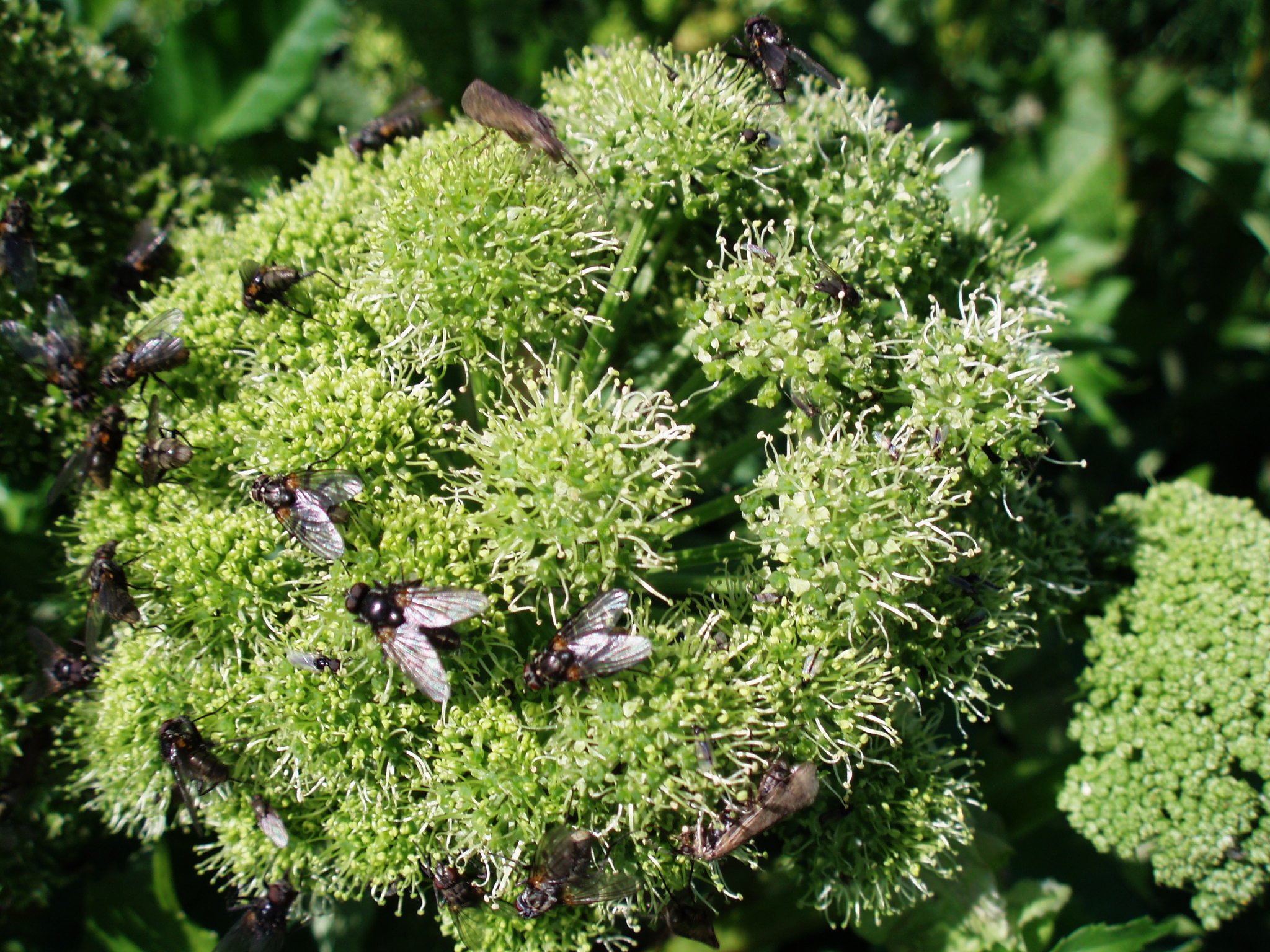
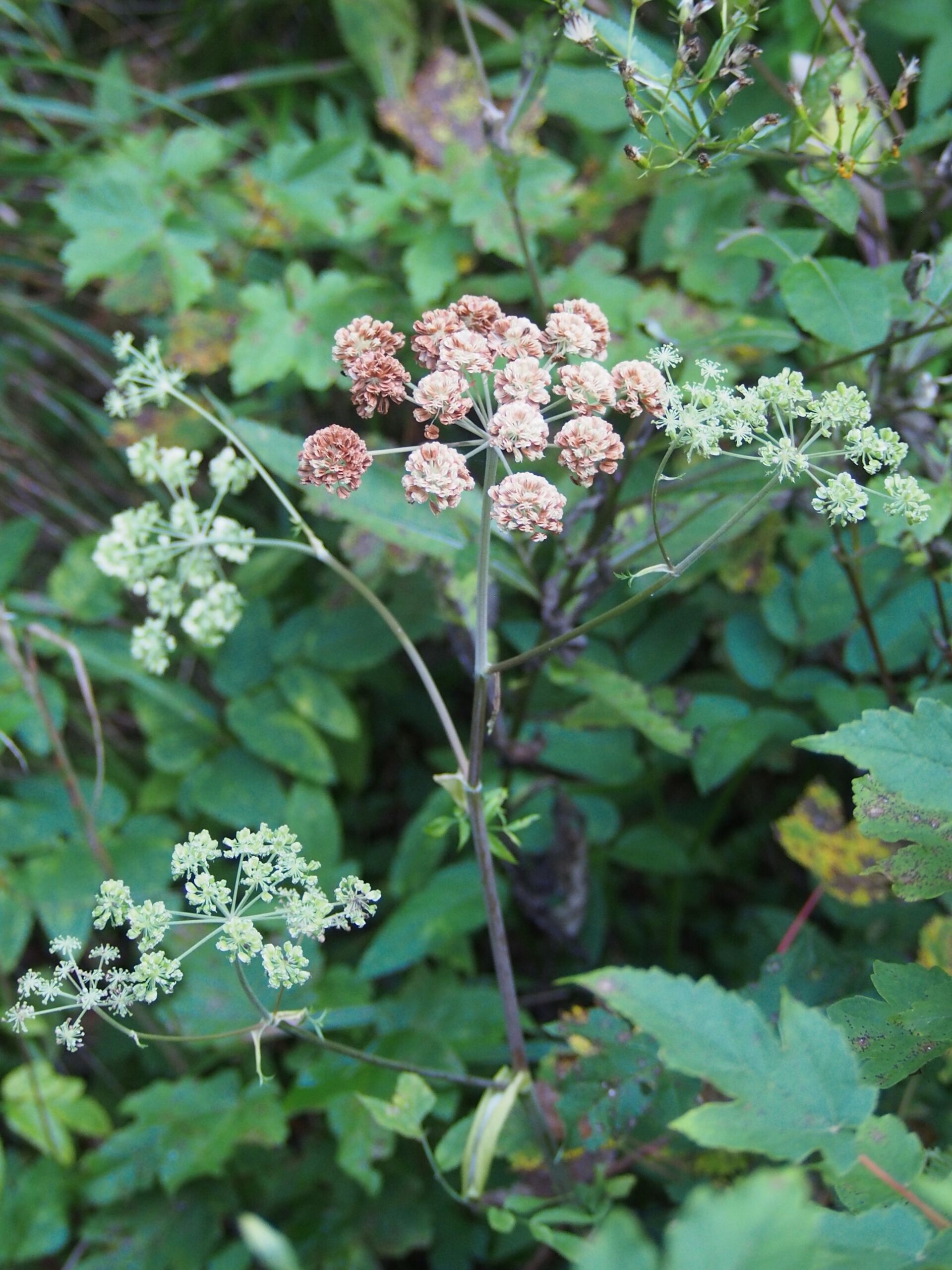
Angelicas are the genus Angelica, a clan of tall biennial and perennial herbs in the carrot family, Apiaceae — the family that also gives us carrots, parsley, celery, fennel, and dill, which is your first clue about both the smell and the company these plants keep. The usual count is about 90 species, though ask a splitter, a lumper, and a checklist and you will get different numbers, anywhere from about 50 to well over 100, because the Asian members of the genus have been divided and re-divided for decades. Either way, it is a big northern clan, native to temperate and subarctic regions of the Northern Hemisphere, reaching as far north as Iceland and Greenland, and most of its members are built on the same plan: a big basal rosette of large, divided, bipinnate leaves in year one, then a tall, hollow, fluted stem in year two, topped with a huge compound umbel — an umbrella of umbrellas, dozens of little flowers radiating from one point, each of those points radiating again.
That umbrella is the family signature, and it is also the reason angelicas are so good at feeding insects. One umbel is a landing pad with hundreds of tiny nectar cups, and it draws bees, hoverflies, wasps, beetles, and butterflies the way a food truck draws a lunch crowd. Most angelica flowers are white or greenish-white, sometimes yellowish-green, and they smell aromatic and musky-sweet, a scent quite unlike fennel or parsley. The great exception to the white-flower rule is Korean angelica, Angelica gigas, which breaks ranks with deep purple-red umbels on purple stems and looks like it wandered in from a different, more dramatic genus. Stems across the clan are often ribbed and hollow, like celery stalks scaled up to architecture, and some species wear purple stems or purple sheaths where the leaves wrap the stem, which is handsome but — as the next section insists — is not an identification you should ever gamble on.
Height is where the genus earns its reputation. The clan as a whole runs about 1 to 3 metres tall, roughly 3 to 10 feet, and the individual species sort themselves along that range: wild angelica to about 8 feet, garden angelica commonly 5 to 6 feet with some accounts to about 8, purplestem angelica to about 6 feet and sometimes more, Korean angelica a more manageable 3 to 6 feet. These are not plants for the front of the border. They are back-of-the-border exclamation marks, and in their second year they grow fast enough that you will swear you can watch them do it.
The lookalike warning — read this first
Angelica has a safety note that matters more than any growing tip in this guide, and it is the same warning carried by the existing garden angelica guide: angelica closely resembles poison hemlock and water hemlock, two deadly relatives in the same carrot family, and the resemblance is close enough that even experienced foragers get it wrong. The rule is simple and absolute. Grow only plants you bought labeled from a reputable nursery, and never gather, eat, or use a wild plant you think might be angelica. If you did not plant it from labeled stock, it is not angelica for your purposes, no matter how convincing it looks.
Two smaller cautions ride along with that big one. First, the sap of angelica and its relatives contains furanocoumarins, compounds that can make skin extra sensitive to sunlight, so some people develop a rash after handling the plants and then spending time in the sun; gloves and sleeves are cheap insurance when you are cutting stems. Second, do not let the “medicinal herb” label do your thinking for you. Several angelica species have long histories in traditional herbal practice, but traditional use is not a prescription, and this guide is a growing guide, not a dosing guide. Grow it, admire it, cook with the culinary species from your own labeled plants if that is your practice — and leave the medicine cabinet out of it.
How to grow
Angelicas want what their northern homelands give them: cool air, rich soil, and water that never quite goes away. Give them deep, fertile, moisture-holding soil with good drainage — the classic “moist but well-drained” that gardeners repeat because it is true — and a spot with full sun in a cool climate or part shade to afternoon shade anywhere the summers get warm. A streamside edge, a rain-garden margin, or a bed you can keep watered through dry spells suits them far better than a hot, dry, neglected corner. They are not drought plants. Let the soil dry out and they sulk, wilt, and bolt; let it sit stagnant and waterlogged and the crown rots. The sweet spot is soil that stays cool and damp under a mulch blanket, like the floor of a northern woodland edge.
Start from seed, and start with fresh seed, because angelica seed loses viability fast — seed that sat in a packet for a year is a lottery ticket, not a plan. The usual advice is to sow soon after the seed ripens, in late summer or fall, so it gets a cold period over winter, or to chill stored seed for several weeks before sowing in spring. Sow where the plants are to grow, or in deep pots you can plant out whole, because angelicas grow a deep taproot and resent being moved once it is established. Press the seed lightly into moist soil, keep it moist until seedlings appear, and be patient: germination can be slow and uneven, and the first year gives you only a rosette of leaves. That is not failure. That is the plant building the root it will spend in year two.
Space plants 2 to 3 feet apart, and give the giants the wider end of that range — a 6-foot plant with leaves like green dinner plates does not share gracefully. In year two the flower stalk rockets up, the umbels open, pollinators arrive in force, and then the biennial members of the clan typically set seed and die, which is the deal you signed. If you want angelica every year, you have two honest strategies: let some plants self-sow so the next generation is already waiting in the wings, or deadhead the flower stalks before seed sets, which can stretch a biennial into a short-lived perennial. The true perennials in the clan, like purplestem angelica, come back from their roots anyway, but even they are not immortal — plan on renewing the patch every few years and you will never be caught without a rosette in reserve.
For butterflies, angelicas pull their weight on the caterpillar side of the ledger. Swallowtail caterpillars feed on members of the carrot family, and angelica shows up as a host plant in swallowtail guides — the genus is caterpillar food, not just a nectar stop. If you grow angelica in a butterfly garden, expect some of those big leaves to get chewed, and consider that a success, not damage. A plant that feeds a swallowtail caterpillar and then feeds a hundred pollinators from its umbels is doing the whole life cycle a favor.
Notable species
Garden angelica, Angelica archangelica, is the famous one, and it has its own species guide — this genus guide does not replace it. It is a biennial from northern and central Europe, grown for its sweetly scented stems, which are candied for cakes and desserts, and for its leaves, roots, and seeds, which flavor liqueurs such as Chartreuse and gin. It is the species most gardeners mean when they say “angelica,” and it is the one behind most of the culinary lore.
Korean angelica, Angelica gigas, is the ornamental star: a biennial or short-lived perennial from Korea, China, and Japan, 3 to 6 feet tall, hardy roughly in zones 4 to 9, with dark purple stems and dense, globe-shaped umbels of deep purple-red flowers in late summer. If you want one angelica purely for looks, this is the one most gardeners plant, and it is the reason the genus cannot be described as “white flowers” without an asterisk.
Purplestem angelica, Angelica atropurpurea, also called great angelica or American angelica, is the North American native of the group: a perennial of moist woodlands, swamps, and riverbanks in eastern North America, with a smooth, hollow, purple stem and white to greenish umbels, growing to about 6 feet and sometimes taller. It is the species most likely to be the “wild angelica” of a North American wetland, and it is also the one most often confused with water hemlock, which brings us right back to the warning above.
Wild angelica, Angelica sylvestris, is the European and central Asian wildflower of damp meadows and woodland edges: a biennial or short-lived perennial to about 8 feet, with purplish stems and rounded umbels of tiny white or pale pink flowers in late summer. The cultivar ‘Ebony’, with dark purple-black foliage and pink flowers, is the garden form most often offered, and it is a good reminder that “wild” in a common name does not mean “plant it anywhere” — this is still a cool-climate, moisture-loving plant.
East Asia contributes the rest of the famous names. Dong quai, Angelica sinensis, is the perennial of Chinese herbal tradition, grown for its root. Bai zhi, Angelica dahurica, is a biennial or perennial likewise grown in East Asia for its root. Japanese angelica, Angelica acutiloba, is a smaller perennial of Japan and nearby regions. Seacoast angelica, Angelica lucida, is a North American coastal species of shores and headlands. None of these is a substitute for another: same genus, different plant, different habits, and different uses, which is exactly why the genus guide exists alongside the species guides rather than instead of them.
Water & feeding
Water is the whole game with angelicas. Keep the soil consistently moist — damp to the touch, never dust-dry, never a puddle — and mulch generously to hold that moisture and keep the roots cool. In a dry spell, water deeply rather than sprinkling, because the taproot lives down where sprinklers do not reach, and a plant that has to choose between wilting and bolting will do both, in that order. A spot near a downspout overflow, a rain garden, or a bed you already water for other thirsty plants is a better home than the driest corner of the yard.
Feeding is the easy part, which is a nice change after the watering lecture. Work compost into the planting hole and top-dress with compost in spring, and that is usually enough; these are plants of rich, humusy soils, and they respond to organic matter the way a sponge responds to water. There is no need for a heavy synthetic feeding program, and rich soil plus steady moisture will do more for an angelica than any fertilizer schedule. If the leaves look pale and the growth is thin despite steady water, a light balanced feed is reasonable, but start with compost and water before you reach for anything stronger.
Common problems
- Drying out — the number one angelica problem, and it looks like wilting, scorched leaf edges, and a plant that bolts early and dies small. Mulch, water deeply, and give it afternoon shade in warm climates.
- Crown and root rot — the opposite failure, in soil that stays stagnant and waterlogged. Angelicas love moisture, not a swamp with no drainage; if the crown turns soft and the plant collapses, the spot was too wet, not too dry.
- Slugs and snails — the big soft leaves are a buffet, especially in the damp spots angelicas love. Check under the mulch, pick them off, and accept some nibbling as the price of a moist garden.
- Aphids and leaf miners — the usual carrot-family visitors, along with reports of powdery mildew, leaf spots, and carrot rust fly larvae in the genus. Rarely fatal on a vigorous plant; a strong jet of water, good airflow, and removing badly affected leaves covers most cases.
- Bolting and dying after flowering — not a problem, exactly, but the biennial life cycle doing what biennials do. Let some plants self-sow, deadhead others to stretch their lives, and keep a new rosette coming on behind every flowering stalk.
- Self-sowing where you did not invite it — a healthy angelica patch seeds itself, sometimes generously. Deadhead before the seed ripens if you want one clump rather than a colony, and pull volunteers while they are small, before the taproot makes its argument.
Harvest
Harvest depends on which part you are after, and on the species you actually planted, so treat this as the genus pattern, not a promise for every member. Leaves can be picked in the first year and again in spring of the second, before the flower stalk takes over. Young stems are the candied-stem crop of garden angelica, cut while they are still tender in the second year, before they turn woody. Seeds are gathered when the umbels have ripened and dried, shaken into a bag before they scatter themselves across the bed — which they will do with enthusiasm if you dawdle. Roots, where they are the crop, are traditionally lifted in autumn, and for garden angelica that means the autumn of the first year or after the second season, from plants you grew yourself from labeled stock.
Two harvest rules never change. First, the lookalike rule applies at harvest exactly as it applies at planting: if you are not certain it is the labeled plant you grew, do not eat it, do not brew it, do not candy it. Second, wear gloves when you cut stems and handle foliage, wash up afterwards, and keep the sap off bare skin in bright sun. A plant this generous with pollinators deserves a gardener who treats it with the same respect it gets from the bees — admiration first, appetite second, and only ever from your own labeled patch.
Saving seeds
Saving seed across the genus Angelica follows one big rule with a few species-sized footnotes: the seed is short-lived, light-hungry, and best sown fresh — everything else is detail. Angelicas flower in great umbrella heads (umbels), and when those heads turn brown and the seed loosens, that is your window. Bag the head before it shatters — a paper bag slipped over the umbel and shaken, or the whole head snipped into a bag — because angelica seed, once ripe, does not linger politely. Sow it fresh in fall if you can: press it onto the surface of moist, rich soil and do not bury it, since angelica seed needs light to germinate, and seed tucked even a little too deep is seed that rots. Freshly fallen seed often germinates without any special treatment, the way it does when it drops naturally in late summer.
Stored seed is a different story. Once angelica seed has been dried for storage, it develops a dormancy that fresh seed does not show, and its viability slides downhill within months, not years. If you must store it, refrigerate it promptly in an airtight container, and before spring sowing give it a few weeks of cold-moist chilling — seed mixed with barely damp sand in a sealed bag in the fridge — to break that dormancy. Sow generously, keep the soil lightly moist, and expect staggered emergence over several weeks rather than a tidy single flush; a warm spell followed by cold seems to help wake it, which is why fall sowing outdoors works so well where winters are genuinely cold. And because so many angelicas are biennials or short-lived perennials that die after flowering, the patch-level skill is relay sowing: start a few plants every year, so first-year rosettes are always waiting in the wings while the older plants flower, seed, and bow out.
Species differences are worth a sentence each. The garden angelica most people mean, Angelica archangelica, is a classic biennial: rosette year one, towering flower year two, then death. Others in the genus are longer-lived perennials that return for several years, and for those, seed saving is less urgent — you can afford to let one plant seed while the others carry on. What they share is the carrot-family hazard, and it is serious: angelicas look alarmingly like poison hemlock (Conium maculatum) and water hemlock (Cicuta spp.), both deadly, and some angelicas also carry sap that can irritate skin in sunlight. So the genus rule is absolute — only save seed from plants you planted yourself from labeled stock, never from a wild plant you think might be an angelica, and wear gloves and sleeves when handling armfuls of seed heads. Angelicas are usually grown as open-pollinated species rather than F1 hybrids, so saved seed from an isolated planting usually grows true, but if several angelica species flower together, expect crossing. In Florida, dry stored seed thoroughly, keep it airtight with a desiccant in the fridge (never in a humid shed), and accept the climate honesty: most angelicas want cool, moist soil and real winter cold to flower, so in Florida they are a warm-edge gamble even before seed saving enters the picture.
Florida honesty check
Here is the honest Florida paragraph, and it is not the paragraph a Florida gardener wants to read. Angelicas are a cool-climate genus, built for northern summers, damp woodland edges, and real winters, and most of Florida is none of those things. In North Florida, a cool-season trial is a reasonable experiment: afternoon shade, deep mulch, soil that never dries out, and modest expectations, planted so the plant can do its work in the cooler months rather than fighting a Florida summer. In Central and South Florida, the heat, humidity, and lack of a cold season stack the deck hard against the genus, and even a plant that survives is unlikely to behave like the perennial or biennial the catalog describes.
That does not make angelica a forbidden plant in Florida; it makes it a poor bet for most Florida gardens, and a plant to buy as a labeled nursery trial rather than a landscape anchor. If you try it, buy the species, not the dream: Korean angelica for ornament, garden angelica for the kitchen garden experiment, and whichever one you choose, give it the coolest, dampest, shadiest corner you have and judge it by whether it thrives, not by whether it merely survives a season. And if it fails, the failure is the climate’s, not yours — some plants are simply northerners, and angelica is one of them.