
🌵 Arizona Yucca
What it looks like
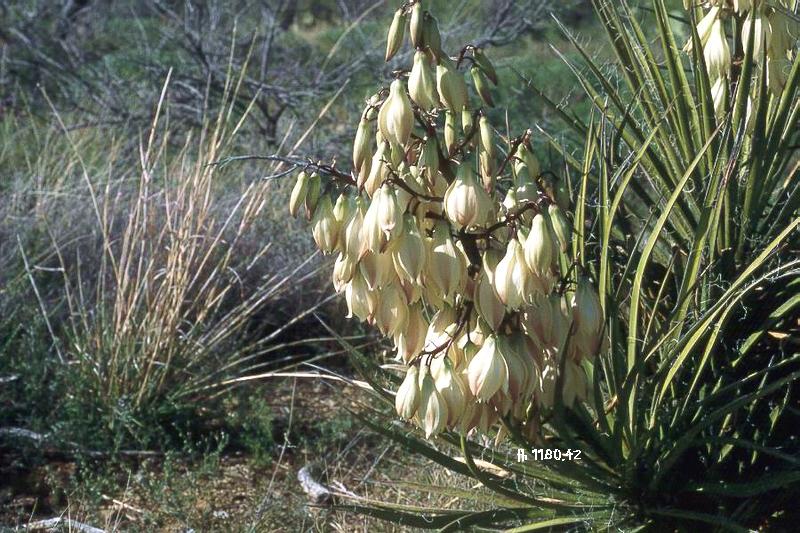
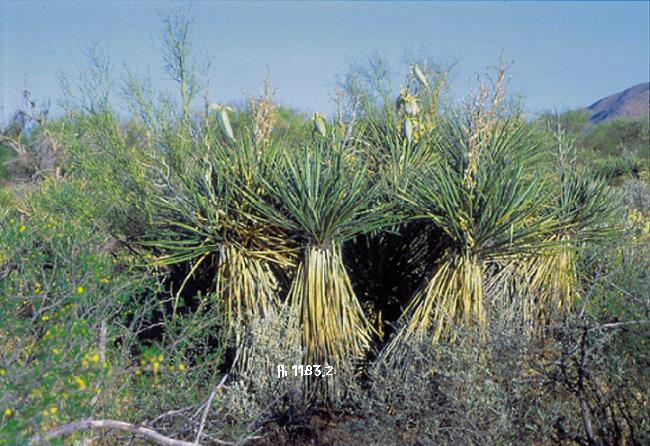
Arizona yucca is a semisucculent desert perennial of the asparagus family, Asparagaceae, and the first thing to know about it is that it is a cluster plant, not a single rosette and not a tree. It usually occurs as dense clusters of stems to about 8 feet tall, each stem tipped with rigid, bluish to yellowish leaves, so that a mature plant reads as a fountain of swords rather than a lone spike. It is a variable species — desert plants usually are, because a yucca in a wash and a yucca on a rocky slope are living different lives — but the cluster habit, the rigid blue-green leaves, and the half-hidden flower stalk are the marks that hold it together.
The leaves are the plant’s whole personality: rigid, sword-shaped, bluish to yellowish-green, tipped with a sharp point and edged sharply enough to demand respect. Individual rosettes carry leaves about 60 centimetres long and about 3 centimetres wide, in the nursery descriptions, and the rosettes sit atop short stems that lengthen as the cluster ages, so that an old plant is a thicket of stems rather than a flat rosette on the ground. That stemmed, clustering habit is one of the easiest ways to separate Arizona yucca from its relatives: banana yucca, its closest cousin, is usually stemless or recumbent, sprawling rather than standing, while Arizona yucca stands up in a cluster and owns its space.
The flowers are showy and white, borne on a tall stalk that rises above the leaves — and the stalk has a quirk worth knowing. The lower half of the wide inflorescence is typically concealed within the leaves, so the bloom looks like it is erupting from the heart of the plant rather than standing clear above it. Like all yuccas, the flowers are bell-shaped and pollinated by yucca moths, in one of the most famous mutualisms in the plant kingdom: the moth pollinates the flowers and lays its eggs in them, and the developing seeds feed the moth’s caterpillars, so that neither partner reproduces without the other. A yucca without its moth is a yucca that sets no seed, and a garden yucca far outside its native range may bloom beautifully and seed nothing at all — which is not a failure, just a reminder that the plant’s real life happens in the desert, with its moth.
For butterflies — or rather, for skippers, which are butterflies’ stout-bodied cousins — Arizona yucca is a host plant, not a nectar plant. In the butterfly guides it appears as a host plant for the ursine giant skipper, listed under the forms “Arizona yucca” and Yucca arizonica. Giant skippers are yucca specialists: their caterpillars feed on yuccas, and the ursine giant skipper’s guide names this yucca as its host. A yucca in a desert garden is not just a sculpture; it is a nursery for one of the largest skippers in North America, and the caterpillar’s presence is the plant doing its ecological job.
Do not confuse this yucca with its cousins, because the yucca genus is a hall of mirrors and the names tangle easily. Banana yucca (Yucca baccata) is the closest relative — Arizona yucca was formerly treated as a subspecies of banana yucca, and some treatments still fold it there — but banana yucca is more widespread and usually stemless or recumbent, while Arizona yucca forms stemmed clusters. Narrowleaf yucca (Yucca angustissima) is a different, Colorado Plateau species: a low, stemless or short-stemmed rosette plant with needle-thin leaves, not the stemmed blue clusters described here, and its range and habit do not match Arizona yucca’s. Small’s yucca (Yucca smalliana), covered by its own species guide, is a southeastern species, not a desert one. Bailey’s yucca (Yucca baileyi) and banana yucca (Yucca baccata) are separate tail units in this project, slated for their own guides, and no Yucca genus guide exists yet — this guide claims Yucca arizonica only, under the butterfly-guide name, and it states the banana-yucca history openly rather than pretending the taxonomy is settled.
How to grow
Arizona yucca is a plant for a hot, dry, sunny garden with sharply drained soil, and it rewards neglect on a scale few ornamentals can match. Plant nursery-grown stock in full sun — more than six hours of direct sun a day — in well-drained sandy soil, with room for a spreading cluster 3 to 5 feet across at maturity. It is a desert plant, so the planting hole should be no deeper than the root ball, the soil should drain fast, and the mulch, if any, should be gravel or rock rather than wood chips, which hold moisture against a plant that wants to dry out. Give it space from paths and patios, because the leaf tips are sharp and a yucca by a walkway is a yucca that will eventually meet someone’s leg.
Once established, Arizona yucca is a drought-tolerant plant that wants the desert’s rhythm: deep, infrequent watering, long dry spells between, and soil that dries out fully. It tolerates heat, poor soil, and neglect, and it holds its blue-green swords through every season, which is no small thing in a landscape where summer turns most plants gray or bare. Do not fertilize heavily, do not water it like a lawn plant, and do not prune it except to remove dead leaves and spent flower stalks — a yucca pruned into a shape is a yucca insulted, and the cluster’s natural fountain form is the whole point. If a stalk has finished flowering, cut it at the base once it is fully dry; the rosette that flowered will often decline afterward, and the cluster’s offsets will take its place, which is how a yucca colony renews itself.
Florida note: Arizona yucca is not a Florida plant, and this guide says so plainly. It is a desert plant of the Sonoran Desert and the oak-pine woodlands above it, built for dry air, sharp drainage, and low summer water, and Florida’s humidity, wet summers, and heavy rains are the opposite of what it wants. A desert yucca in Florida would sit in wet soil, breathe wet air, and rot from the roots up, and no amount of sand in the planting hole makes a desert plant into a Florida garden plant. This guide exists because a butterfly guide mentions it, not because it belongs in a Florida bed. Gardeners in Florida who want the same job done — a tough, sword-leaved evergreen that feeds a giant skipper — should plant a Florida native yucca built for Florida rain, and leave the Arizona yucca to the desert gardens it was made for.
Water & feeding
Water needs are low once established, and that is the plant’s whole selling point. Arizona yucca is a drought-tolerant desert plant that thrives in dry conditions and well-drained sandy soil, and it is grown as a low-water ornamental precisely because it does not need the irrigation that keeps most garden plants alive in the desert. Water deeply and infrequently to establish — a good soak, then let the soil dry out completely — and once the roots are down, water only in extended drought or extreme heat. Good drainage is the rule: it tolerates poor, shallow, sandy soils, but it does not tolerate standing water or heavy, waterlogged clay, and a yucca in a lawn’s irrigation zone, watered daily with the grass, will rot while the grass thrives.
Feeding: none, or close to it. A desert native in sandy soil needs no fertilizer program, and its own dead leaves, left to decay at the base of the cluster, return what little the plant needs. If a garden plant looks pale or weak, check drainage and watering first, because a yucca in wet, overwatered soil will look hungry no matter how much you feed it, and the fix is less water, not more fertilizer. A desert plant fed like a rose is a desert plant on its way out.
Common problems
- Overwatering and rot. Arizona yucca is a low-water desert plant, and daily lawn irrigation, soggy clay, and low spots will rot it from the roots up. Plant it in sharp drainage, water deeply and rarely, and keep it out of the lawn’s sprinkler zone.
- Sharp leaves by paths. The leaf tips are sharp and the leaf edges are unforgiving, so site a yucca away from walkways, patios, and play areas. A yucca by a path is a lawsuit with leaves.
- It is not a Florida plant. Humidity, wet summers, and heavy rain are the opposite of its native climate. Do not plant it in Florida and expect desert performance; the guide exists for the butterfly connection, not as a Florida recommendation.
- Confusion with other yuccas. Banana yucca is the closest relative and was once its parent species; narrowleaf yucca is a different, stemless, Colorado Plateau plant; Small’s yucca is southeastern; Bailey’s yucca is its own species. Check the Latin, the habit, and the range together, and do not assume every blue yucca is this species.
- No seed without the moth. Yucca flowers need yucca moths to set seed, and a garden plant far outside its native range may bloom and seed nothing. That is normal, not a failure — propagate by offsets and division instead, and let the flowers be the show.
- Post-flowering decline of a rosette. A rosette that has flowered often declines afterward, which alarms gardeners who think the whole plant is dying. It is not: the cluster’s offsets replace it, and the colony goes on. Remove the spent stalk and let the offsets do their work.
Harvest
Harvest, for Arizona yucca, is about fiber, food, and sculpture — in that order of traditional relevance. Yucca roots and leaves have been used for fiber for as long as people have lived with yuccas: the roots of this species’ relatives were used for red fiber in Tohono O’odham baskets, and yucca leaf fiber in general has served for cordage, baskets, and brushes across the Southwest. The flowers and fruit of yuccas in general have been eaten traditionally, but this guide does not present Arizona yucca as a food crop, because no specific, verified food use for this species was established in this pass, and a desert plant should not be eaten on the strength of its cousins’ reputations. The harvest this guide recommends without reservation is the ornamental and ecological one: a cluster of blue swords that needs almost no water, a tower of white bells for the moths, and a nursery for the ursine giant skipper. A yucca that feeds a skipper, survives a drought, and looks like sculpture doing it is a better yield than a basket — and it renews itself by offsets, year after year.
Browse all plant & pest guides
Saving seeds
Arizona yucca (Yucca arizonica) saves its seed the desert way: patiently, in a pod, on a stalk, daring you to wait. After flowering, the seed capsules dry on the stalk and turn brown and papery. Leave them alone until they are fully dry — harvesting green pods is how you get immature seed and a lesson in regret. When the pods split, shake out the thin, flat, dark seeds, pick out the chaff, and let them dry a few more days in a shaded, airy spot before storing them cool and dry.
Yucca seeds wear armor. Their hard coat is a desert survival strategy — it keeps them from sprouting during a single teasing rainstorm — and it means you should give them a hand before sowing. Nick each seed lightly with sandpaper or a sharp knife, taking care not to gouge the embryo inside, then soak in warm water for about a day. Sow shallowly in a gritty, fast-draining mix — a cactus or succulent mix with extra perlite or coarse sand is perfect — and keep it warm, roughly 70–80°F, and lightly moist but never wet. A soggy yucca seedling is a rotting yucca seedling, and the desert does not forgive overwatering.
Now comes the yucca virtue: patience. Germination is famously erratic, anywhere from a few weeks to a few months, and not every seed will play along. Sow more than you need, keep the tray warm and barely moist, and resist the urge to dig seeds up to check on them — they are not being rude, they are being yuccas. Once seedlings are a few inches tall with real sword-shaped leaves, pot them up individually and grow them on before planting out. They will be slow. They will be worth it.
A few honest caveats. Saved seed comes from open-pollinated plants, so seedlings will vary a bit from the parent, and if several yucca species flower near each other, some seedlings may be hybrids — fine for a garden plant, but don’t promise a buyer a pure species from mixed company. And if your yucca flowers but never sets a pod, pollination is the usual suspect: yuccas and their pollinators have one of the plant kingdom’s great partnerships, and a lonely bloom without its partner may simply stay a bloom. The fast route to more yuccas, by the way, is offsets — the pups at the base — which are exact clones and years ahead of seedlings. Seeds are for the patient gardener who wants the full story, from flat black flake to sword-leaved desert sentinel.
Species in this group
Arizona yucca (Yucca arizonica) — the species described in this guide, the stemmed, clustering blue yucca of southern Arizona to central Sonora, host for the ursine giant skipper.
Banana yucca (Yucca baccata) — the closest relative and former parent species, more widespread and usually stemless or recumbent; a separate tail unit in this project, slated for its own guide, and a different species from Arizona yucca under the treatment followed here.
Narrowleaf yucca (Yucca angustissima) — a low, stemless or short-stemmed rosette plant of the Colorado Plateau with needle-thin leaves; a different species, not Arizona yucca, and not a form of it.
Small’s yucca (Yucca smalliana) — a southeastern yucca covered by its own species guide; a different species, not a desert yucca, and not covered by this guide.
Bailey’s yucca (Yucca baileyi) — a southwestern yucca and a separate tail unit in this project, slated for its own guide; a different species, not Arizona yucca.
Other Yucca species — the genus holds dozens of species, from Adam’s needle to Spanish bayonet, and no Yucca genus guide exists yet in this project; a species guide for any one of them does not cover Arizona yucca, and this guide does not cover them.