
🍌 Banana Yucca
What it looks like
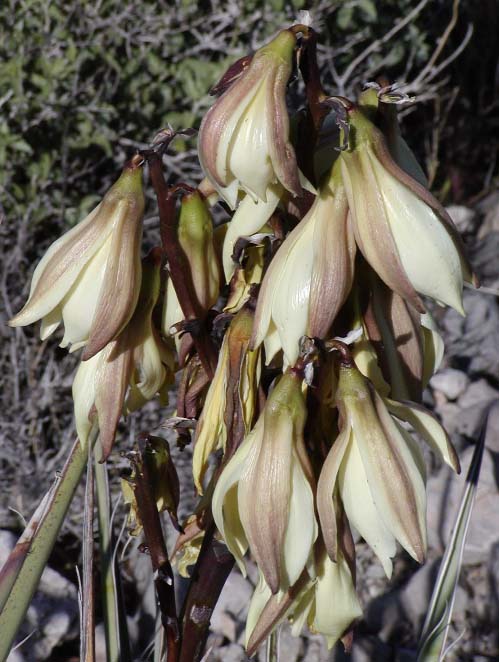
Banana yucca is a common, rugged yucca of the deserts of the southwestern United States and northern Mexico, in the asparagus family, Asparagaceae. It is also called datil yucca, blue yucca, and broadleaf yucca — and, in some sources, Spanish bayonet, a name it shares with other yuccas, which is your first warning not to buy by common name alone. It grows across the Great Basin, the Mojave, Sonoran, and Chihuahuan Deserts, and the Arizona and New Mexico mountains, in pinyon-juniper woodland, desert grassland, creosote bush scrub, sagebrush, and ponderosa pine colonies, at elevations generally between 1,500 and 2,500 meters. It is, in short, a desert plant, and it looks like one.
The plant forms open colonies of rosettes, stemless or short-stemmed, shorter than 2.5 meters overall, with stems, if present, decumbent or subterranean, simple or sometimes branched. The leaves are the signature: stiff, sword-like, blue-green, 30 to 100 centimeters long and 2 to 6 centimeters wide in the Flora of North America description — commonly 50 to 76 centimeters — erect, rigid, scabrous or glaucous, with brown, fibrous margins that peel into curling threads and a vicious, needle-like tip about an inch long. They are broader and bluer than Bailey’s yucca’s narrow leaves and thicker than most garden yuccas, and they radiate from a rosette that typically stands 2 to 4 feet tall and 3 to 5 feet wide, sometimes developing a short woody trunk over many years in a sheltered spot. Do not brush past it. The leaf tips mean it.
The flowers come in spring, April to July depending on locality and altitude, on a flower stalk that is not especially tall for a yucca — typically 1 to 1.5 meters — and often stays level with the top of the plant or rises only a little above it. The flowers are pendent, bell-shaped, 5 to 13 centimeters long, nearly as wide, with tepals joined at the base into a shallow floral cup, usually cream-colored, occasionally tinged with purple, in a dense, hairless cluster. Then comes the fruit, and the fruit is the whole point of the common name. It is fleshy, succulent, indehiscent — it does not split open — elongate, 5 to 23 centimeters long and 4 to 7.5 centimeters across in the flora description, commonly 8 to 18 centimeters, cylindrical, green turning yellow-green and softening as it ripens in late summer to early fall, surrounding numerous flat, shiny black seeds. It looks like a short, fat, green banana. It is, by a wide margin, the largest yucca fruit in North America, and unlike most yucca fruits, which are dry and woody, it stays fleshy. The seeds are dull black, obovate, 7 to 11 millimeters across, rough and wingless, ripening in 6 to 8 weeks.
A note on varieties, because it matters to the rest of this library: Yucca baccata has been divided into varieties, including var. baccata and var. brevifolia, but as of 2023 their status is uncertain, and Plants of the World Online lists only var. brevifolia and the autonym as accepted. Some treatments list Yucca arizonica among the synonyms of var. brevifolia — while this project’s tail treats Arizona yucca as its own unit. This guide follows the butterfly guides, which list banana yucca as Yucca baccata, and it does not fold Arizona yucca into it. If a tag says arizonica, treat it as a separate conversation, not as a synonym to file away.
How to grow
Give banana yucca what the desert gives it: full sun, heat, and drainage, and very little water or food. Plant it in full sun in lean, gritty, rocky, well-drained soil — average soil is fine, rich soil is not an improvement — setting the crown level with the surrounding soil and never burying it. It tolerates intense desert heat and, in dry soil, cold down to about minus 20 degrees Fahrenheit, which is why it is grown well beyond the Sonoran Desert, into Colorado, Utah, Kansas, and parts of the Great Plains. The hero range here is zones 5 to 10; some sources extend it to 11, and that disagreement is recorded rather than smoothed over, because a plant at the edge of its range in wet soil behaves nothing like the same plant in dry desert soil.
Space plants 4 to 6 feet apart, and site them with respect for the leaf tips and for the colony habit. A mature rosette is 3 to 5 feet wide, colonies spread, and the spines will puncture skin and snag clothing. Keep rosettes back from paths, play areas, and anywhere people brush past in shorts. If fruit is the goal, plant at least two: banana yucca is not reliably self-fruitful, and it needs cross-pollination by one of several yucca moth species, or by hand, from a second plant to set fruit. One nursery puts the spacing for fruiting pairs at about 6 feet apart, so the rosettes do not overlap into a single spiny mass. Once established, banana yucca is slow-growing, drought tolerant, deer and rabbit resistant, and asks for very little: no staking, no spraying program, no annual ritual beyond removing dead leaves and, after flowering, the spent stalk. It may not bloom every year — heavy fruiting and low rainfall can leave the roots short of the carbohydrate reserves a bloom demands — and that is normal, not failure.
The Florida warning is blunt, and this guide states it plainly: banana yucca is a desert Southwest plant, and Florida is a poor bet for it. It wants low humidity, sharp drainage, and dry air; Florida offers humid summers, heavy rain, and soils that stay wet. A plant that survives minus 20 degrees in dry desert soil will rot in a wet Florida summer. It can be grown in a pot of gritty mix under cover, or in a raised, covered rock garden where rain is kept off, but it is not a sensible Florida landscape plant, and this guide does not recommend it as one. It belongs in this library because a butterfly — the ursine giant-skipper — uses it as a host, not because it belongs in a Keystone Heights bed. In the Southwest, by contrast, it is one of the toughest, most architectural natives available: a blue-green sculpture that asks for sun and neglect and gives back bells, fruit, and wildlife.
Propagation is by seed, offsets, or division. Colonies produce offsets that can be separated with roots attached and replanted. Seed is the slower route, and it comes with the yucca catch: flowers are pollinated by particular yucca moths, and where the right moth cannot live, seed will not set unless flowers are pollinated by hand. Seed-grown plants may take about five years, with sufficient rainfall, before they flower. If your yucca blooms gloriously and never makes a banana, the moth, not your gardening, is the missing piece.
Water & feeding
Water deeply but rarely while the plant is establishing, then back off hard. An established banana yucca is drought tolerant and prefers dry soil; overwatering, especially in anything heavier than grit, is the fastest way to kill it. Occasional to low water is the honest schedule — in its home deserts, rainfall does most of the work, and in a garden it wants to be the plant you forget, not the plant you fuss over. A light spring mulch of compost or worm castings is plenty of feeding, and rich soil is actively counterproductive: it pushes soft growth on a plant whose whole design is lean and tough. Do not plant it in a bed that gets daily irrigation for thirstier neighbors, and do not site it under a downspout or at the foot of a slope where water collects. If the center of the rosette turns soft and mushy, that is rot from wet soil, and the honest remedy is to lift the plant, cut away the rot, and replant it higher and drier — or accept the lesson and plant the replacement on a mound of grit.
Soil pH is not the constraint here, and this guide does not invent a number for it. What matters is texture and drainage: gritty, lean, rocky, well-drained soil, with air around the crown. A banana yucca in a pot wants a cactus mix with extra grit, a drainage hole that actually drains, and a saucer that is emptied, not left full. In the ground it wants the highest, driest, sunniest spot you have, and it will punish generosity with rot.
Common problems
Root rot from wet soil is the problem that matters; everything else is footnotes. Leaf-spotting fungi can appear during wet periods — improve air circulation, avoid overhead watering, and remove spotted leaves rather than reaching for a spray. The sharp leaf tips are a hazard to people and pets, not a disease, but they belong in this section because they are the complaint most gardeners actually have: site the plant where nobody has to brush past it. All yuccas contain saponins that are toxic to dogs, cats, and horses, and banana yucca is no exception; the edible parts are the exception, not the rule, and they are covered in the Harvest section with their cautions, not as a general invitation to taste the plant.
The other common problems are expectation problems. First, fruit: banana yucca blooms only some years, and even in a flowering year it does not reliably set fruit — it needs the right moth and a second plant, and a flowering year can be followed by a quiet one while the roots rebuild. Do not grow it for the fruit alone. Second, identity: banana yucca is closely related to the Mojave yucca, Yucca schidigera, with which it is interspersed where their ranges overlap, and hybrids between them occur. A plant at the edge of the range may not key cleanly, and a nursery tag that says Spanish bayonet may mean this plant, or Spanish bayonet the southeastern species, Yucca aloifolia. Buy by the Latin, Yucca baccata, and by the fruit: fleshy and banana-shaped is the mark.
Harvest
Here the guide slows down, because the edibility framing is the signature fact and it needs care rather than enthusiasm. The fleshy fruit of banana yucca is the largest and most palatable of any yucca species, and it was a critical food source: the fruit can be eaten raw or cooked, and cooked it resembles sweet potato; the Paiutes dried the fruits for winter use, and it remains a popular food among Indigenous peoples of Mexico. Traditional preparation, as recorded in the sources, includes baking, roasting, drying, and boiling, with the seeds removed, and the fruit is described as ripe when it yields to gentle pressure — ripeness is not reliably indicated by color. The young flower stalks can be cooked and eaten with the tough outer rind discarded, and the flowers themselves are eaten by rural residents. The roots, by contrast, are a different story: they were used as soap and shampoo, saponin-rich, and the roots are described in growing guides as poisonous for eating — do not eat them. The leaves provided fiber for baskets, sandals, and cordage.
The cautions belong in the same paragraph as the invitation. Eat only the parts the references name — fruit and young flower stalks and flowers, cooked where the references say cooked — be certain of the species, and remember that a plant grown as a butterfly host has a job already: the ursine giant-skipper’s caterpillars feed on this yucca, and after feeding they pupate in its roots. A garden that harvests every fruit and stalk is a garden that has evicted its skippers. The better harvest, for most growers, is the plant itself: a blue-green sculpture, a short stalk of cream bells in spring, and, in a good year with the moths in attendance, a cluster of fat green bananas hanging where the flowers were.
Saving seeds
Banana yucca seed is worth saving, but only if you understand the deal the plant made with a moth millions of years before you showed up. Yucca baccata flowers are pollinated by yucca moths, and outside the plant’s desert home those moths may not be around — so a flower stalk with no fruit is not a failure of your seed-saving technique, it is a pollination problem. With two plants flowering and a little hand-pollination (moving pollen from one plant’s flowers to another’s), you can stand in for the moth yourself. No fruit, no seed: that is the whole equation, and it is worth knowing before you plan a seed crop around a single lonely yucca.
When fruit does set, let it ripen fully on the plant until the fleshy, banana-shaped pods are mature and beginning to dry, then split them open and shake out the flat, dark seeds. Clean off any clinging pulp, because pulp left on seed is an invitation to mold — a real concern in Florida humidity. Dry the seed thoroughly, then store it in a labeled, airtight container with a desiccant packet, kept cool and dark. Dry, cool storage is the difference between seed that wakes up next spring and seed that quietly gives up over winter.
Sow fresh seed shallowly, only about a quarter inch deep, in a gritty, sharply draining mix — think cactus mix with extra perlite or coarse sand, not rich potting soil that stays wet. Keep the mix lightly moist, never waterlogged, and warm, roughly in the 60 to 70 degree Fahrenheit range that sources agree suits germination. How long you wait is where sources disagree: some report sprouts in a week or two, others warn it can take a month or several months, so sow generously and do not throw the tray out in a fit of impatience at week three. Pot seedlings up once they have several strong leaves, and keep their first winter dry — wet feet in cold soil kill more young yuccas than drought ever will.
Two honest footnotes. First, seed-grown plants take several years to reach flowering size, so seed is the patient gardener’s route. Second, the offsets — the pups clustering around the base — are the fast route and the exact clone of the parent: separate one with roots attached, replant it at the same depth in gritty soil, and water sparingly. Seed gives you genetic variety and the satisfaction of the long game; offsets give you a new yucca this season. And while you are handling any of it, respect the leaf tips — those blue-green swords are genuinely sharp, so gloves and a little care around your eyes are not overkill.
Species in this group
- Banana yucca — Yucca baccata: This guide’s plant. A broad, blue-green southwestern yucca with stiff, sword-like leaves, a short flower stalk, and fleshy, banana-shaped fruit 8 to 18 centimeters long; host of the ursine giant-skipper.
- Mojave yucca — Yucca schidigera: The close relative banana yucca is interspersed with where their ranges overlap, with hybrids occurring. Similar desert country, different details; do not assume a plant at the range edge is one or the other without checking.
- Bailey’s yucca — Yucca baileyi: A much smaller, narrow-leaved Four Corners yucca with leaves under half an inch wide and a flower stalk that stays within or just beyond the leaves. Not banana yucca, despite sharing its desert country and its giant-skipper visitors.
- Small’s yucca — Yucca smalliana: A southeastern yucca with narrow leaves and peeling fibrous margins, and its own taxonomy tangle. Not banana yucca, and a reminder that narrow leaves alone do not identify a yucca.
- Adam’s needle — Yucca filamentosa: The familiar eastern garden yucca, with stiffer, broader leaves and curly filaments on the edges, and a taller flower stalk than banana yucca’s short one.
- Spanish bayonet — Yucca aloifolia: A taller, trunk-forming southeastern yucca with rigid, dagger-like leaves. It shares the Spanish bayonet common name with banana yucca in some sources, which is exactly why this guide insists on the Latin.