
🌵 Buckley’s Yucca
What it looks like
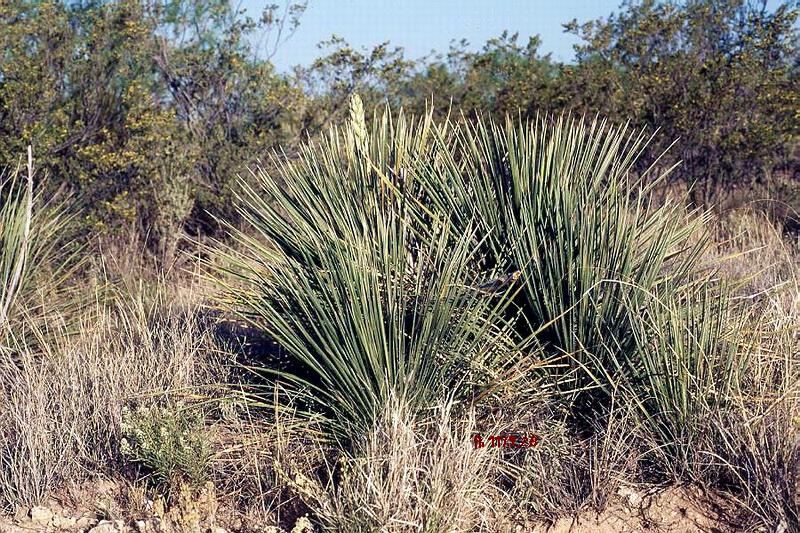
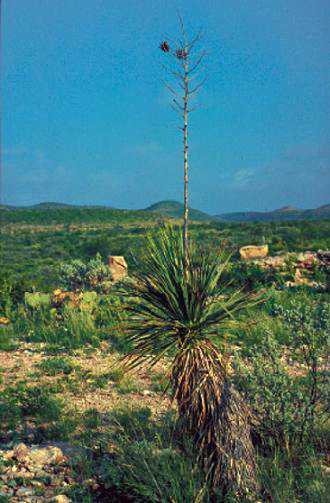
Buckley’s yucca is the yucca that grew up and got a trunk. Most yuccas gardeners meet are stemless rosettes — a burst of swords straight out of the ground, no trunk in sight — and Buckley’s yucca breaks that pattern: Yucca constricta is a trunk-forming species, native to central Texas, especially the Edwards Plateau, where it grows into a small, tree-like yucca with a visible woody trunk topped by rosettes of narrow, stiff, often twisting leaves. The leaves are the field mark that separates it from its cousins at a glance: long, narrow, and flexible compared with the broad, rigid swords of banana yucca, with fine fibers peeling from the margins, the way yucca leaves fray into threads as they age. In late spring and summer it sends up a tall flower stalk carrying clusters of creamy-white, bell-shaped flowers — the classic yucca bloom, waxy and nodding, pollinated by yucca moths in the ancient partnership that defines the whole genus — and afterwards it sets the dry, capsular fruit yuccas are known for, splitting to release flat, black seeds.
The butterfly context is one guide, one section, and a whole skipper menu that must not be folded. The Strecker’s Giant-Skipper guide lists “Buckley’s yucca” with the Latin Yucca constricta in its Host plants section, alongside soapweed (Yucca glauca), fineleaf yucca (Yucca angustissima), and Bailey’s yucca (Yucca baileyi). That is the mention this draft covers: Host plants section, exact forms “Buckley’s yucca” and “Yucca constricta”. Giant skippers are yucca specialists — their caterpillars bore into yucca roots and stems, feeding hidden inside the plant rather than grazing its leaves in the open — and a giant skipper female chooses her yucca species carefully. That is why this guide is a species guide, not a yucca genus guide: the skipper’s menu names four yuccas, and each one needs its own guide, because a caterpillar that eats constricta is not eating baileyi, and a gardener who plants the wrong yucca has planted the wrong host.
The yucca disambiguation is the most important section of this draft, because the site already has a small forest of yucca guides and this one must not swallow any of them. The species a gardener is most likely to confuse with Buckley’s yucca, in plain text: Arizona yucca (Yucca arizonica) — the Sonoran Desert species with dense stem clusters and bluish leaves, which has its own guide; Bailey’s yucca (Yucca baileyi) — a separate tail unit on the same skipper menu, with its own guide; banana yucca (Yucca baccata) — the broad-leaved, usually stemless species of the Southwest, which has its own guide; Small’s yucca (Yucca smalliana) — the southeastern species, which has its own guide; soapweed (Yucca glauca) — the Great Plains species, also on the Strecker’s menu; and fineleaf yucca (Yucca angustissima) — the narrow-leaved Colorado Plateau species, also on the Strecker’s menu. None of those species is covered by this guide, none of their guides covers constricta, and there is no Yucca genus guide on the site that would make a species guide redundant. Buy Buckley’s yucca by the Latin name Yucca constricta, and if the tag says only “yucca,” you do not know which one you are holding.
The name itself is worth a sentence, because it is a person, not a description. “Buckley’s” honors Samuel Botsford Buckley, a 19th-century American botanist and geologist who collected widely in Texas, and the species was named for him — the same way so many Texas plants carry the names of the botanists who first walked the Edwards Plateau with a plant press. The Latin constricta means constricted or drawn together, a nod to the plant’s form. Neither part of the name describes the flower, the leaf, or the habitat, which is exactly why the Latin, not the nickname, is the reliable part of the tag.
How to grow
Growing Buckley’s yucca means growing a central Texas dry-country plant, and the first rule is to believe its address. This is a yucca of rocky limestone hills, dry slopes, and open woodland edges on the Edwards Plateau and nearby central Texas — full sun, sharp drainage, thin rocky soil, and a climate with hot summers, mild winters, and rain that comes in bursts and then stops. Give it the sunniest, best-drained spot you have: a slope, a raised bed, a gravelly bank, a rock garden, anywhere water does not sit. Plant it in spring or fall, space specimens 4 to 6 feet apart so each trunked plant has room to become a specimen, and then mostly leave it alone. It is not a plant for a rich, irrigated border or a wet low spot; pampering it with frequent water and fertilizer produces soft growth and crown rot, and a yucca that rots at the crown does not come back politely.
Establishment is the only fussy stage. Water deeply but infrequently through the first season so the roots chase water downward, then taper off hard — an established Buckley’s yucca largely waters itself from rainfall in a Texas garden, and in a garden with summer irrigation it should sit where the sprinklers do not reach. A gravel mulch suits it far better than a thick wood-chip mulch, which holds moisture against the crown. Do not prune the trunk: the trunk is the plant’s achievement, built over years, and cutting it back does not make a bushier yucca, it makes a wounded one. Remove only dead leaves from the rosette skirt, carefully — the leaf tips are sharp, the fibers are tough, and garden gloves are not optional with a yucca. Propagation is by seed or by offsets: seed sown in spring in gritty mix, or offsets divided from the base of an established plant. Seed-grown plants take years to trunk up, which is a good reason to buy a nursery plant if you want the tree-like form soon, and a good reason to be patient if you grow from seed.
The pollination story deserves its own paragraph, because it is the reason yuccas flower at all. Yuccas and yucca moths are obligate partners: the moth pollinates the flower deliberately, laying eggs in the ovary, and the developing seeds feed a few moth caterpillars while the rest of the seeds mature for the plant. Neither partner reproduces without the other, and the partnership is millions of years old. A garden yucca that never sets seed may simply lack its moth, which is normal outside the native range and no cause for alarm — the plant itself is the garden value, and the giant skipper caterpillars, which bore into roots and stems rather than visiting flowers, do not need the moth’s help. If you are growing Buckley’s yucca for Strecker’s giant skipper, plant it in a group rather than as a lone specimen, and leave the plants undisturbed for years: a skipper caterpillar living inside a yucca root needs a plant that is not being dug up, divided, or moved.
Florida note, stated plainly: Buckley’s yucca is a central Texas dry-country native, and Florida’s humid summers, summer rain, and wet soils are a poor match for a trunked yucca that wants sharp drainage and dry air. It is not recommended as a Florida landscape plant, and no figure in this guide should be read as a Florida promise. Its place in this project is as the Strecker’s giant skipper host, for gardeners in its native range — and as a reminder that the yucca genus is not one plant, but a whole family of specialists, each with its own skipper, its own soil, and its own Latin name.
Water & feeding
Water: little, and never standing. Once established, Buckley’s yucca largely waters itself from rainfall, and in a dry summer a deep soak every few weeks is generous. The failure mode is always the same — soggy soil, especially in winter, rotting the crown and roots from the base up. If your yucca starts collapsing in the middle, check drainage before you check anything else, and do not water it back to health: a rotting yucca wants dry soil, not sympathy. A gravel mulch helps enormously, keeping the crown dry and reflecting a little heat, and looking like the plant’s natural limestone slope, which is not a coincidence.
Feeding: essentially none. This is a plant of thin, rocky, mineral soil, and fertilizer produces soft, weak growth that flops, rots more easily, and loses the stiff, narrow-leaved form that defines the species. No compost heap, no liquid feed program, no rich potting mix. If the plant looks pale and thin, the cause is almost always too much water or too much shade, not hunger. The soil science is the dry-country story: in a lean, mineral, sharply drained soil, the yucca’s deep roots chase episodic rain, its stiff leaves lose little water, and its slow growth builds a trunk over years rather than a flush of soft leaves in one season. Feed it like a perennial and you will get a perennial’s problems; starve it like a limestone-slope plant and you will get a limestone-slope plant’s toughness.
Common problems
- Wet feet, especially in winter. The number-one killer. Crown and root rot in soggy soil. Gritty mix, drainage, gravel mulch, and no winter waterlogging.
- Buying the wrong yucca. “Yucca” alone is a genus, not a species. Check the Latin: constricta is Buckley’s, baileyi is Bailey’s, baccata is banana, arizonica is Arizona, smalliana is Small’s — and the guides are separate for a reason.
- Too much shade. Rosettes stretch, weaken, and lose form. Full sun is not a preference for this yucca, it is a requirement.
- Rich soil and fertilizer. Soft, weak growth that rots easily. Lean, mineral soil is the point.
- Sharp leaves. Yucca leaf tips and fibers are genuinely hazardous to hands and eyes. Gloves and care when working around the plant, and site it away from paths where children run.
- Disturbing established plants. Giant skipper caterpillars live inside roots and stems. Digging, dividing, or moving a host plant destroys the caterpillars it shelters; leave host plants undisturbed for years.
- Florida humidity. Not a Florida plant. Hot, humid summers and wet soils are a poor match; do not plant it in Florida expecting Texas performance.
Harvest
The harvest here is seed, offsets, and skipper-watching — with one honest boundary. Collect the dry capsules after they split, sow the flat black seeds in spring in gritty mix, and wait: seed-grown Buckley’s yucca takes years to trunk up, and patience is part of the crop. Divide offsets from the base of established plants for true-to-type specimens. Yucca species in general have a long history of human use — fibers, food, and soap from various species — but this guide does not present Buckley’s yucca as a food or fiber crop, because no species-specific use was verified in this pass and a host plant for a giant skipper is more valuable standing than harvested. Leave the plants standing through the skipper seasons, let the white bells bloom in summer for the yucca moths, and watch a trunked yucca do what it has done on central Texas limestone for a very long time: hold a dry slope, feed a moth, shelter a skipper, and ask for nothing but drainage in return.
Browse all plant & pest guides
Saving seeds
Buckley’s yucca gives you two honest routes to more plants, and they could hardly be more different in temperament. Offsets are the fast, faithful route. Seed is the slow, romantic one — and it comes with a pollination plot twist worth knowing before you bother.
Start with the twist. In its Texas home, yucca flowers are pollinated by yucca moths, a partnership so specific that a yucca blooming far from its moths may set no seed at all. If your plant flowers gloriously and then produces nothing, that is probably why, not a failure on your part. Gardeners outside the moth’s range can play moth themselves: dab pollen from flower to flower with a small soft paintbrush while the blooms are open, and check back for swelling capsules later in the season.
When capsules do form, leave them alone until they are dry and brown and starting to split — that is the plant telling you the seed inside is finished. Split the capsules open, shake out the flat dark seeds, and discard any that are shrivelled or broken. A soak in warm water overnight before sowing is a traditional nudge that may shorten the wait, and it costs nothing to try.
Sow in spring in a gritty, free-draining mix — think cactus mix with extra grit, not rich potting soil — and cover the seed only lightly. Keep the mix barely moist, never soggy, and warm. Then practice the gardener’s least favourite virtue: patience. Some yucca seed sprouts in a few weeks; some takes months, and published germination windows for this species stretch from about a month to most of a year. Do not throw the pot out in disgust at week six. Pot seedlings on once they are big enough to handle, grow them on in pots for at least a season or two, and give young plants some winter protection for their first winter outdoors.
Offsets, meanwhile, are the route for anyone who wants a new yucca rather than a science project. Buckley’s yucca clumps by producing pups at the base. Wait until a pup is a decent size with some roots of its own, sever it from the parent with a clean sharp knife or spade, and let the cut dry for a few days before potting it in the same gritty mix. Wear gloves — the leaf tips are not decorative. Water sparingly until it is clearly growing, and you have a genetically identical copy of the parent, no moth required.
One note on trueness: this guide covers the species, not a named cultivar, so seed-grown plants are still Buckley’s yucca — but they are individuals, not clones, and they will vary a little, as wild plants do. If you want an exact copy of a particular plant, take an offset. For storage, dry saved seed thoroughly, seal it in an airtight container with a desiccant packet, and keep it cool and dark. In Florida humidity, that drying step is not optional: seed tucked away even slightly damp is seed composting in a jar. And wherever you grow it, remember the plant’s one non-negotiable — sharp drainage. Wet feet kill yuccas faster than drought ever will.
Varieties
Buckley’s yucca is sold essentially as the species, and this section does not invent cultivars to fill it. No cultivar is named here because none was verified in this pass as distinct, stable, and widely available under the name Yucca constricta — and a guide that invents a variety list would be worse than one that admits the list is just the species. The related species a gardener is most likely to meet are named in plain text so they are not mistaken for this one: Yucca baileyi (Bailey’s yucca — separate tail unit, own guide), Yucca baccata (banana yucca — own guide), Yucca arizonica (Arizona yucca — own guide), Yucca smalliana (Small’s yucca — own guide), Yucca glauca (soapweed — also on the Strecker’s menu), and Yucca angustissima (fineleaf yucca — also on the Strecker’s menu). None of those species is covered by this guide, and none of their guides covers constricta. Grow constricta for the Strecker’s Giant-Skipper host listing; grow the others for their own listings; and never let a bare “yucca” tag decide which one you bought.