
🌿 Dioecious Sedge
What it looks like


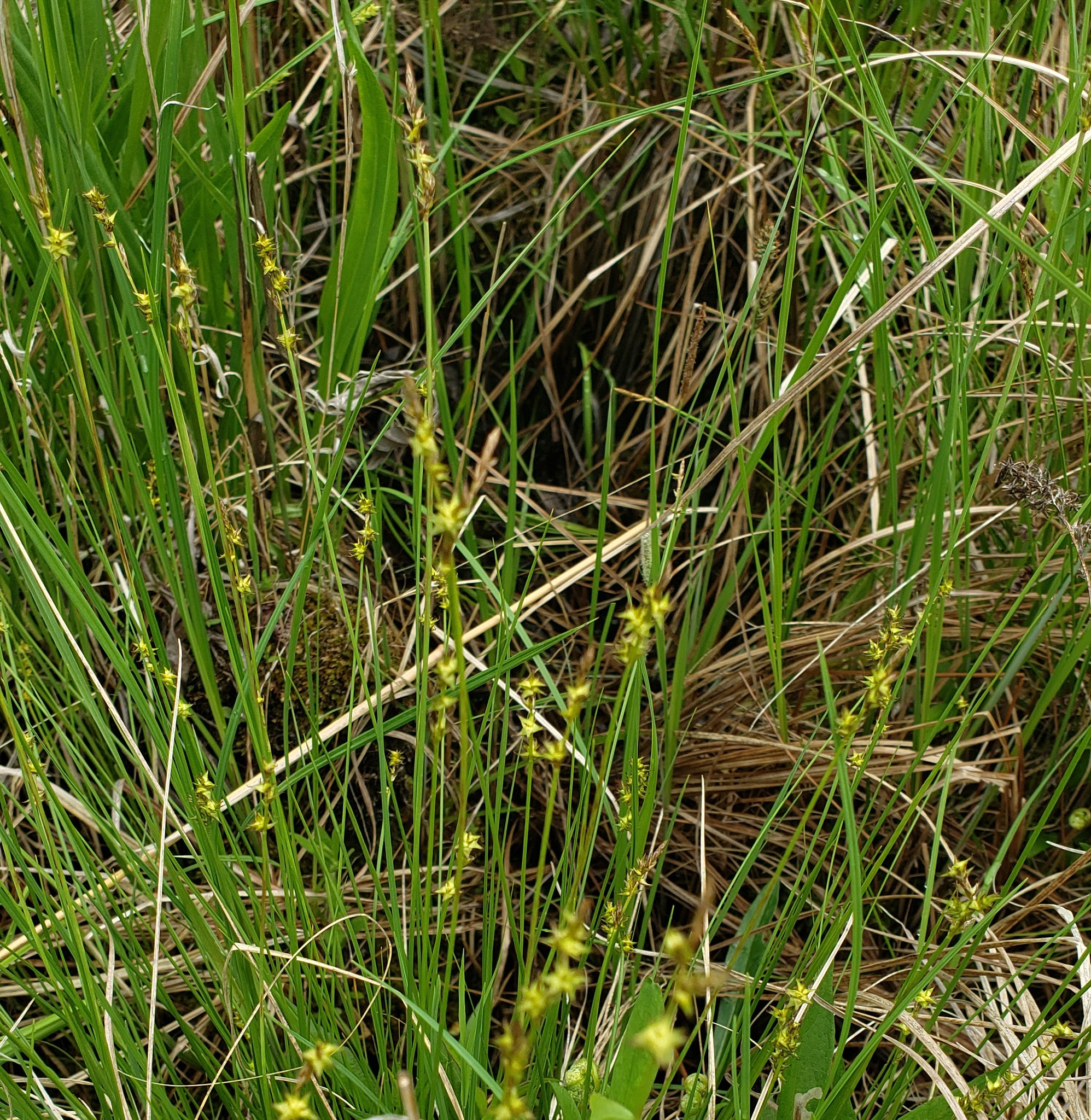
Dioecious sedge is a sedge with a reproductive life that reads like a logic puzzle, and its common names are the clues. It is a perennial of the sedge family (Cyperaceae), in the genus Carex, and it grows as a rhizomatous, tuft-forming plant up to about 30 inches tall, forming dense tufts of many plants. The leaves are alternate, flat, and smooth, up to about 10 inches long and no more than about an eighth of an inch wide, folded like a fan, with tightly wrapped sheaths, and the basal stems carry brownish sheaths. The stems are stiffly erect, triangular in cross-section — sedges have edges, and this one has them sharply — and brown at the base, and the whole tuft has a stiff, upright, almost military posture that separates it at a glance from its softer, more sprawling neighbors.
The flower head is where the puzzle gets interesting. The inflorescence at the stem tip usually carries four easily distinguished, stalkless spikes, and the plant is dioecious: male and female flowers grow on separate plants. A female plant carries pistillate spikes whose perigynia — the little sacs enclosing each achene — are plump, dark reddish-brown, 2.1 to 3.8 millimeters long, and two-toothed at the tip. A male plant carries staminate spikes and makes pollen and no seed. And here is the riddle inside the riddle: some clumps are all staminate, produce no seed, and are therefore sterile — which is why the plant is called both dioecious sedge and sterile sedge, and why the Latin name sterilis, which looks like an accusation, is actually a field observation. The terminal spike is usually all male or all female but may include a few flowers of the opposite sex, because sedges, like all living things, are less tidy than their textbooks. The fruit is an achene, appearing in June to July, on the female plants only — which means that a colony’s seed crop depends on having both sexes present, and that a planting of only male divisions will never set seed at all.
The habitat is calcareous fen, almost exclusively. Dioecious sedge is a plant of moist to wet calcareous areas — open portions of calcareous fens where cold, calcium-rich, nutrient-poor water seeps to the surface, calcareous river and lake shores, calcareous swamps, and, occasionally, more forested rich swamps. It is a calciphile and an obligate wetland species, and in New York it is almost completely restricted to open rich fens. Its range runs from Newfoundland west to Saskatchewan and south to Pennsylvania, West Virginia, Tennessee, Illinois, and Missouri, with the central portion of the range the only place it is common. At the edges it is rare and listed: threatened in Maine, Massachusetts, and Minnesota, endangered in Pennsylvania, a special concern in Connecticut, historical in Rhode Island, and endangered and possibly extirpated in Tennessee. Globally it is assessed as Least Concern, which is the same split this whole batch of sedges shows — a species secure across a continent and vanishing at the margins where its fen habitat has been drained, and a reminder that a global assessment is not a local all-clear.
The butterfly context is the Mitchell’s satyr story, and dioecious sedge is one of its six tested food plants. The Mitchell’s satyr guide lists, in its Host plants section, sedges including tussock sedge (Carex stricta) and other Carex species such as Carex buxbaumii, Carex lasiocarpa, Carex leptalea, Carex prairea, and Carex sterilis, plus bulrush in some records. The Mitchell’s satyr is a federally endangered butterfly of prairie fens and sedge meadows, and captive food-preference trials found that six Carex species — including this one — support normal larval development through to the third-instar diapause in August. In a fen, a caterpillar does not care which sex its sedge is; it cares that the sedge is there, and that the fen is wet, open, and calcium-rich. Protect the fen and the sedge follows; drain the fen and both go.
One plain-text disambiguation, because this sedge’s names are a minefield. This guide covers Carex sterilis only, under the clean slug carex-sterilis. The site’s Sedge genus guide lists sterile sedge among its group members, but a genus listing is not a species guide, and this guide is the species unit. The common name “dioecious sedge” is also used for Carex dioica, a European and west Siberian species — a different plant on a different continent — so buy by the Latin name Carex sterilis, not by the common name alone. The plant is also called sterile sedge and Atlantic sedge, and older names include Carex elachycarpa and Carex muricata var. sterilis. And the lookalike to watch for is inland sedge (Carex interior), which often grows at the same site: it is less stiffly erect, has even narrower leaves, and usually has only three spikes per stem, with a narrow, club-shaped staminate portion at the base of the terminal spike. Four spikes, stiff and erect, fan-folded leaves: that is sterilis.
How to grow
Growing dioecious sedge starts with three questions: do you have wet ground, is it calcareous, and do you have both sexes? The first two are the fen questions, and the third is this species’ special twist. It wants moist to wet calcareous ground — an open calcareous fen edge, a calcareous swamp margin, a wet prairie restoration on limestone soils, a rain garden over hard-water soils — in full sun to part shade. Plant nursery-propagated stock in spring into wet, organic, calcium-rich soil, and plant more than one tuft: because male and female flowers grow on separate plants, a single division may be a single sex, and a planting that is all male will never set seed. A small colony, with several tufts from different stock, is the honest planting, and it is also the planting that behaves like a fen — dense tufts, mixed sexes, seed in June and July on the female plants.
Leave it alone after planting, beyond keeping aggressive competitors out until it is established. Dioecious sedge forms dense tufts from rhizomes, and it is not a runner; it is a tuft builder, and tufts work slowly. Do not mow it, do not divide it every year, and do not drain the ground to make the patch tidier. In a fen edge the tufts become the structure — stiff, upright, fan-leaved — and the seed heads on the female plants in summer are the quiet signal that the colony is complete, both sexes present, doing what a fen colony is supposed to do.
Propagation is by division in spring, with the sex caveat attached: divide a tuft, replant into wet, calcareous ground at the same depth, and label which divisions came from female plants if you can tell — the female plants are the ones that carried seed the previous summer. Seed is the slower road and the honest one for a dioecious plant: collect seed from female plants in summer, sow fresh into moist soil in fall, and let winter stratify it, and expect seedlings to stay small for a season or more. Either way, the first year is establishment, and the second and third years are when the tufts start to look like the dense, stiff colonies of the fen rather than a handful of grasslike leaves.
Florida note, stated plainly: dioecious sedge is not a Florida plant. Its range runs south only to Virginia and Tennessee on the eastern side, and it belongs to northern calcareous fens, not to Florida gardens. Florida readers should take the Mitchell’s satyr lesson — protect the fens, plant the wetland sedges native to your own region — and leave this northern fen sedge to the glaciated, limestone country it belongs to.
Water & feeding
Water is the job, with a chemistry chaser. Dioecious sedge wants moist to wet calcareous ground that stays wet — saturated soil, seeping groundwater, a fen edge that never fully dries — and it wants that water calcium-rich, as fen groundwater is. In a genuinely wet site with normal rainfall it largely waters itself once established. If the ground dries for weeks in summer, the tufts thin; if the ground is wet but acidic, the plant may persist without thriving. The soil life of wet, organic, calcium-rich ground — the microbes, fungi, and invertebrates that cycle nutrients in fen peat — is the plant’s feeding system, and it works slowly, which suits a tuft builder.
Feeding: none from a bag. Do not fertilize a fen sedge. Fen plants live in nutrient-poor water by design, and added fertilizer mostly feeds algae and aggressive competitors. If a colony looks thin, check water first, check calcium second, check competition third, and check sexes fourth: a colony of only male plants will never set seed, and that is not a feeding problem, it is a planting problem. Fix the water and the mix, and the tufts will do the rest.
Common problems
- Drying out. The usual killer. A fen sedge in dry ground is on borrowed time. Site it wet, keep it wet, or pick a different sedge.
- Acid ground. A calciphile in an acidic bog is out of its element. If your water and soil are soft and acidic, this is the wrong sedge for the site.
- Single-sex planting. The special trap of a dioecious plant: an all-male planting never sets seed. Plant several tufts from different stock, and watch for seed heads in summer to confirm females are present.
- Wild collection. Never dig this plant from a fen or wet prairie. Calcareous fen habitat is rare and protected in many places, and this species is listed as threatened or endangered across much of its range. Buy nursery-propagated stock, and only where the species is native.
- Name collisions. Dioecious sedge also means Carex dioica in Europe. Sterile sedge, Atlantic sedge, dioecious sedge — buy by the Latin name Carex sterilis.
- Lookalike confusion. Inland sedge (Carex interior) grows at the same sites but is less stiff, narrower-leaved, and usually three-spiked with a club-shaped male base. Four spikes, stiff and erect, is sterilis.
Harvest
There is no food or medicine harvest here, and this guide recommends eating or brewing no part of the plant. The harvest is division in spring — lift a tuft section, replant into wet, calcareous ground, and keep track of the sexes — and seed in summer, collected from female plants and sown fresh into moist soil in fall. The real harvest is a fen patch of dense, stiff tufts, female plants carrying dark reddish-brown seed heads in July, male plants carrying pollen in May and June, and, in the fens where it still flies, the caterpillars of one of North America’s rarest butterflies eating the leaves without caring which sex they belong to. Leave the wild tufts standing, keep the calcium-rich water where it belongs, and let the riddle-named sedge keep its boys and girls straight in peace.
Saving seeds
A note on method first: the seed technique below is genus-level Carex practice, applied here because dioecious sedge follows the same pattern as its relatives. But this species carries a catch that the others do not, and it belongs at the top: dioecious sedge bears male and female flowers on separate plants, and a clump that is all male produces no seed at all, which is exactly how it earned its other common name, sterile sedge. Seed saving here requires a colony with both sexes present and flowering within wind-pollination range of each other. If your planting is a single division of unknown sex, you may wait forever for seed that cannot exist.
When both sexes are present, the sedge version of a seed is a small nutlet tucked inside a perigynium, the little bottle-shaped sac that gives each spike its texture. On female plants, collect the spikes in summer, when the perigynia are ripe, plump, and dark reddish-brown. Cut whole spikes into a paper bag, not plastic, and let them dry in a shady, airy spot. Once dry, rub the spikes gently to free the seed, and pick out the larger bits of stem and scale by hand. No water, no fermentation: sedge seed wants dry handling, and wet processing only invites mold. And a boundary to match: propagate only garden-grown plants. Wild calcareous fen colonies are rare habitat, not a nursery, so leave wild stands standing.
Fresh seed is the best seed. Sow it in fall, on the surface of constantly moist mix or directly into wet, calcareous ground where the plants are to grow, pressing it into contact with the soil rather than burying it, since many sedges germinate best with light. If you are holding seed over winter instead, give it a cold, moist stratification first: mix it with damp sand or sphagnum in a sealed bag in the refrigerator for several weeks. Sources range from about a month to six weeks or more, so treat a full six weeks as the safe end of the range, then sow into warmth, light, and unrelenting moisture. Germination after chilling typically takes a few weeks, and the seedlings must never dry out, not once, not briefly.
For storage, keep seed cool and dry in an airtight container with a desiccant packet, and sow it the following season rather than banking it for years; sedge seed viability in home storage is not well documented, and fresh seed outperforms old seed by a wide margin. Seedlings will resemble their parents in the broad strokes, since this is a wild species rather than a cultivar, but a seed-grown sedge is a genetic individual, and its sex is a surprise until it flowers. If you want an exact copy, or if you specifically want more female plants, or more males, divide instead: in spring, lift a tuft with roots and shoots attached and replant it straight into wet, calcareous ground, keeping it soaked until it takes hold. Division preserves sex, which seed cannot promise, so for this species division is not just the reliable route. It is the route that lets you plan the colony.
Browse all plant & pest guides
Species in this group
Dioecious sedge (Carex sterilis) — the species described in this guide, the dioecious calcareous fen sedge with four stalkless spikes, fan-folded leaves, and plump dark reddish-brown perigynia on female plants.
Woollyfruit sedge (Carex lasiocarpa) — a colony-forming fen sedge with woolly perigynia, another Mitchell’s satyr host, covered by its own species guide, not by this one.
Bristly-stalked sedge (Carex leptalea) — a delicate single-spiked fen and swamp sedge, another Mitchell’s satyr host, covered by its own species guide, not by this one.
Prairie sedge (Carex prairea) — a tussock-forming calcareous fen sedge, another Mitchell’s satyr host, covered by its own species guide, not by this one.
Tussock sedge (Carex stricta) — the dominant sedge of many satyr fens, covered by the Sedge genus guide’s group listing, not by this guide.
Buxbaum’s sedge (Carex buxbaumii) — a northern fen and wet-meadow sedge, another tested Mitchell’s satyr food plant, not covered by this guide.
Inland sedge (Carex interior) — the closest lookalike, less stiffly erect, narrower-leaved, usually three-spiked; not covered by this guide.