
🌿 Cut-leaved Toothwort
What it looks like
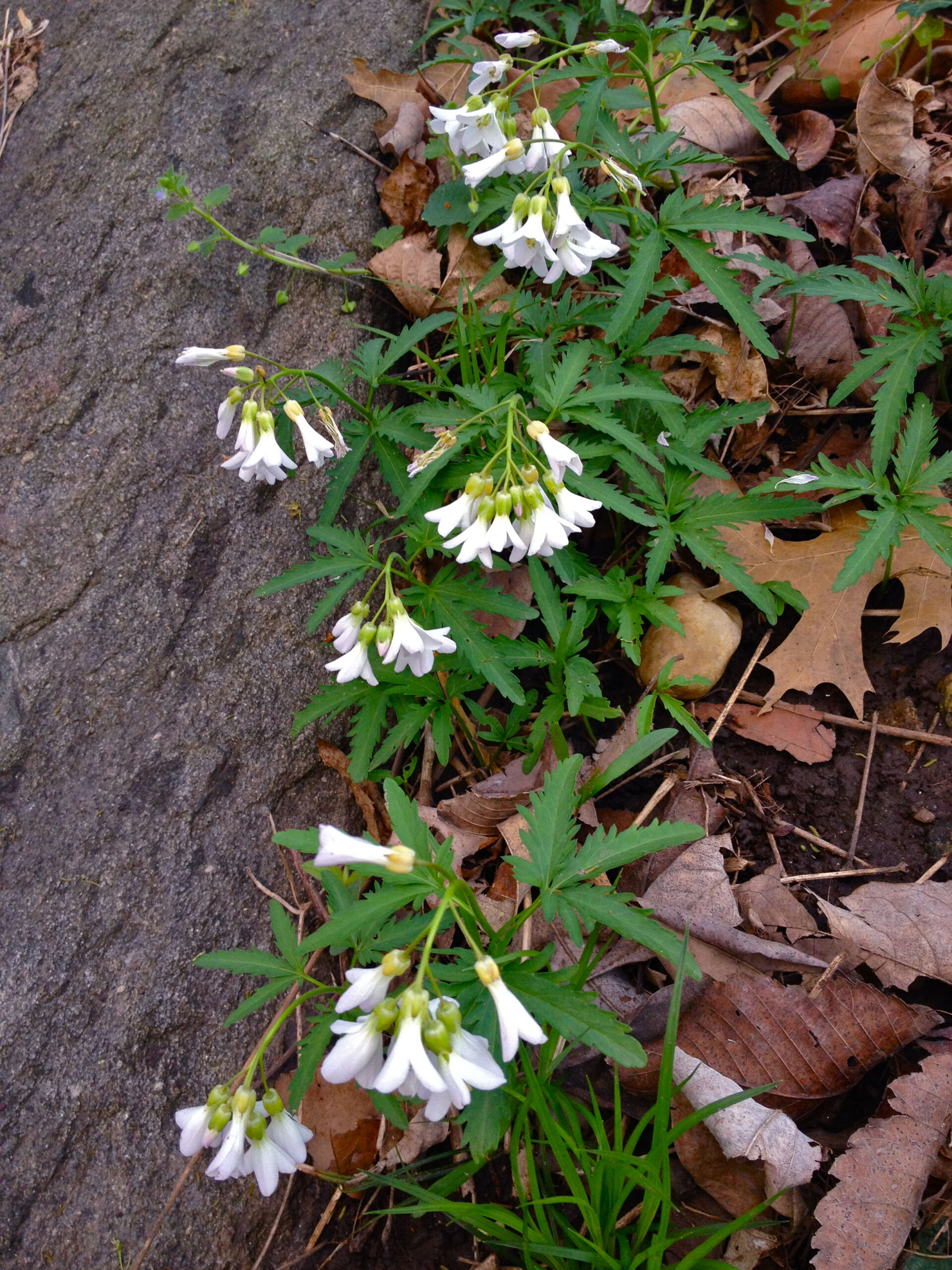
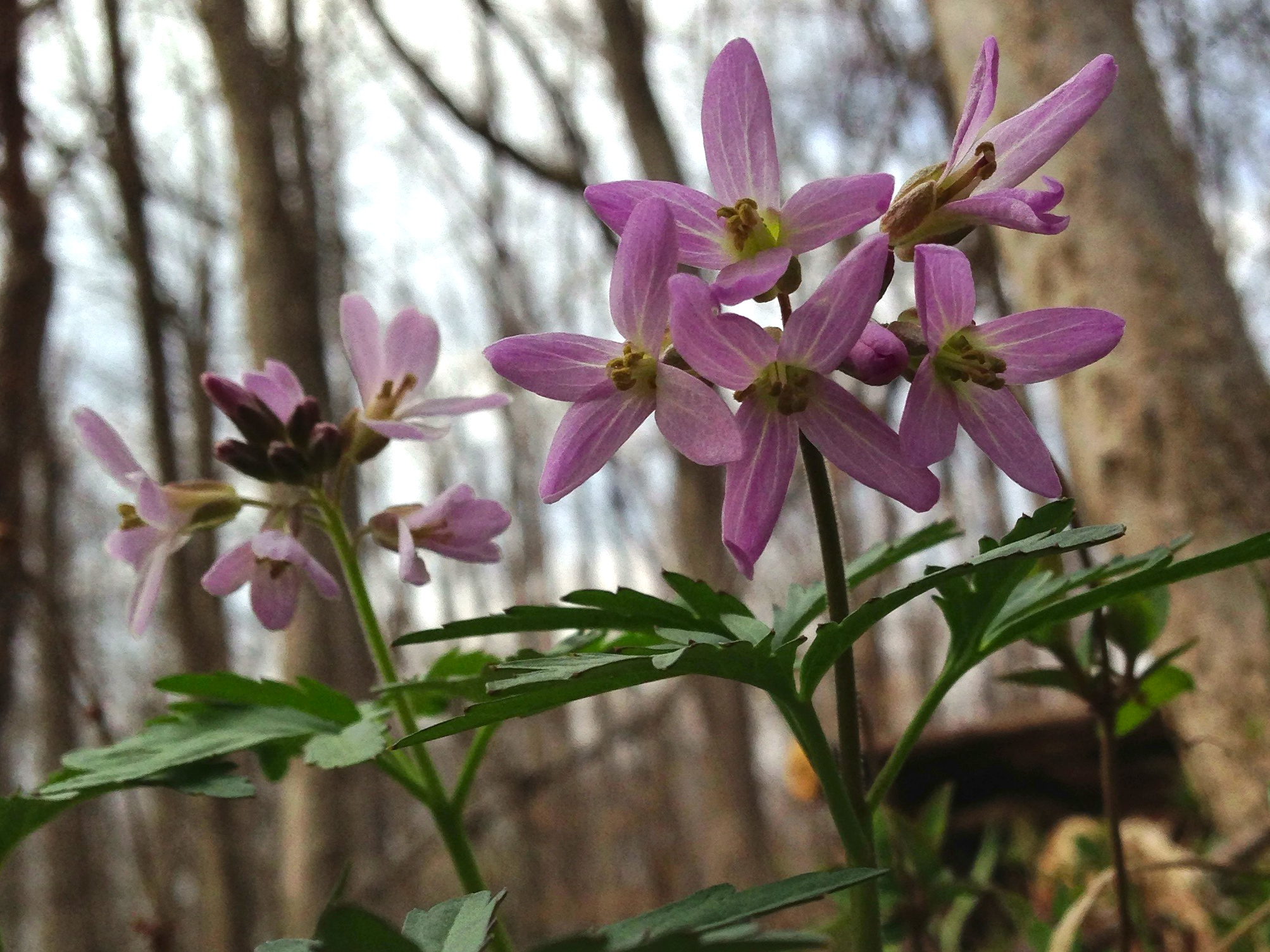
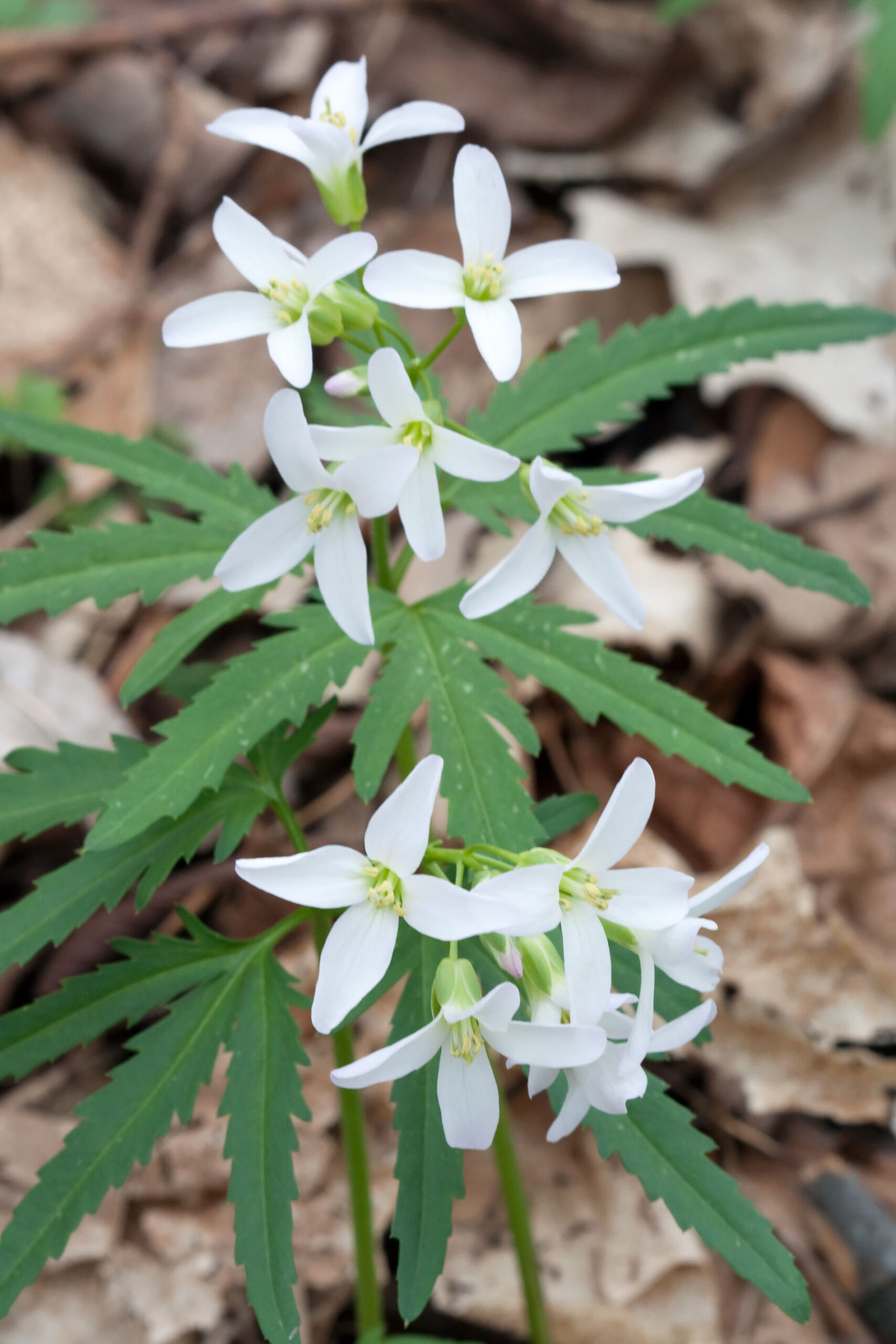
Cut-leaved toothwort is a spring ephemeral, and spring ephemerals are the woodland’s way of showing off on a deadline. It rises from a rhizome in early spring, flowers in a loose cluster of white to pale-pink four-petalled blooms, sets seed in a slim upright pod, and then — job done — goes dormant by early summer and vanishes underground until next spring. If you plant it and then panic in July because it is gone, congratulations: it is doing exactly what it is supposed to do. Mark the spot, the way you would mark the spot where you buried treasure, because the treasure is still down there.
The plant itself is small and unmistakable once you know the leaf. It grows roughly 8 to 16 inches tall on an erect, unbranched stem, with stem leaves in a whorl of two or three, each leaf deeply and palmately cut into segments with large teeth on the margins — five-parted, coarsely toothed, like a hand that got creative with scissors. The flowers sit above the foliage in a terminal raceme that elongates as the blooms open: four petals, white to pale pink (pinkest in bud), each flower about half to three-quarters of an inch across, with six stamens in the classic mustard arrangement — four long, two short — tipped with yellow anthers. The fruit is an elongated pod, a silique, up to about an inch and a half long, holding small black seeds. It blooms from February to May depending on latitude, one of the first wildflowers of the year in rich woods, and one of the first nectar stops for the early bees, bee flies, spring azures, and mourning cloaks that are out in the same cold weeks.
Underground is where the name comes from, and the underground part is the best part of the story. The rhizome is segmented and chained — the species name concatenata means linked together — and the leaf scars left on it as it grows form tooth-like projections, like a string of knobby white beads with teeth. That is the toothwort: not the flower, not the leaf, but the rootstock, which looks like a pulled tooth and, in the old doctrine-of-signatures logic, was therefore supposed to cure toothaches. It does not cure toothaches. What the rhizome does do is taste peppery — crunchy, spicy, horseradish-adjacent — which earned the plant its other common names, pepper root and pepperwort, and which made it a spring food for Indigenous peoples and settlers alike, roots eaten like a condiment and leaves cooked as a green. This guide reports that history; it does not send you into a public woodland with a trowel, because wild collection is exactly how a slow, colony-forming ephemeral gets loved to death, and nursery-grown stock exists for a reason.
The butterfly story is the reason this guide exists, and it is a story about pickiness as a survival strategy. The West Virginia White guide lists, in its Host plants section, toothworts as essentially the butterfly’s only food: mainly two-leaved toothwort and cut-leaved toothwort, with smooth rock cress used in some areas. The caterpillar is yellow-green with a green stripe along each side, and it feeds only on toothwort leaves — a caterpillar that hatches anywhere else starves. Cut-leaved toothwort is also a recorded host for the Falcate Orangetip and the Mustard White, fellow mustard-family specialists. And the conservation twist, straight from the West Virginia White guide, is garlic mustard: females lay eggs on the invasive garlic mustard at even higher rates than on toothwort, but the larvae invariably die on it, while the garlic mustard also displaces the toothwort itself. So a toothwort patch is not just a pretty spring colony. It is a nursery under siege, and every patch a gardener plants from nursery stock is one more nursery that is not a trap.
One plain-text disambiguation, because toothworts are a family of lookalikes and this guide claims exactly one of them. This guide covers cut-leaved toothwort only, the deeply cut, five-parted species. Two-leaved toothwort (Cardamine diphylla) is a separate species unit — its leaves are two-parted, not cut into five toothed segments, and it is not covered here. The Cardamine genus guide covers toothworts and bittercresses as a genus only and does not replace this species guide. Cuckoo flower (Cardamine pratensis) is a meadow species, not a woodland toothwort, and it is not covered here. Garlic mustard (Alliaria petiolata) is not a toothwort at all; it appears in this guide only as the trap plant that kills the butterfly’s caterpillars. Buy and plant by Latin name, and check the leaf: if it is not deeply cut and toothed, it is not this plant.
How to grow
Growing cut-leaved toothwort starts with accepting its calendar, not fighting it. This is a rich-woods plant: part shade to shade, moist humus-rich soil that drains well, a woodland floor of leaf litter, and neighbors like trillium, Dutchman’s breeches, and spring beauty rather than sun-loving perennials. Plant nursery-grown stock in fall or very early spring, tuck it into a shaded woodland edge or shade garden, mulch with leaf litter, and then leave it alone. It wants the conditions of a deciduous forest floor — dappled light in spring before the canopy closes, soil that stays moist but never soggy, and organic matter replenished by falling leaves. It does not want a sunny bed, a container on a patio, or a gardener who digs it up in July to check whether it is still alive. It is alive. It is asleep.
Propagation follows the plant’s own habits. The honest way to multiply a clump is to divide the chained rhizome while the plant is dormant, in late summer or fall, and replant the segments shallowly in humus-rich soil — each knobby segment carries the buds for next spring’s stems. Seed is the slower road, and it comes with a warning the plant states plainly: seeds need warm followed by cold to germinate, so they wait for the following spring, and they last only about a year in the soil. Sow fresh seed where it is to grow, do not store it in a drawer for three years and then wonder why nothing came up, and expect the colony to build slowly — a patch that looks modest in year one can become a drift in a few years as the rhizomes chain outward. Nursery stock is the honest source for a first planting; wild collection is not, and a species that builds its colonies one rhizome segment at a time does not forgive being dug up.
Florida note, stated with the range in one hand and the plant’s temperament in the other. Range lists include Florida among the states where cut-leaved toothwort occurs, but this is a cool-climate woodland spring ephemeral hardy in zones 3a to 8b, and a Florida garden is, for this plant, the far southern edge of its world. In Florida it belongs, if anywhere, in a shaded north Florida woodland garden with rich, moist, humus-heavy soil and realistic expectations — it will never be a statewide garden plant, and a central or south Florida gardener planting it in sun should expect disappointment rather than a colony. The toothwort story in Florida is mostly the butterfly’s story at the edge of its range, not a planting recommendation for every yard.
Water & feeding
Water, for a woodland ephemeral, is a question of moisture without sogginess, and of timing. Cut-leaved toothwort wants soil that stays moist through its spring growth and flowering — streamside moist, woodland-edge moist, leaf-litter moist — and in a genuine woodland site with normal rainfall it largely waters itself, while in a dry spring it wants deep watering and a root zone that does not dry out, because a thirsty ephemeral cuts its season short and goes dormant early, which defeats the purpose of planting it. A thick mulch of leaf litter helps enormously, holding moisture and cooling the roots, and it doubles as the plant’s own fertilizer program: as the litter breaks down, it feeds the soil community the plant lives in. Once the plant goes dormant in early summer, stop fussing. Dormant rhizomes in moist soil do not want to be watered into rot; they want to be left alone under their leaf litter until next spring.
Feeding: modest, and mostly already handled by the site. Rich woodland soil, replenished yearly with leaf litter and organic matter, is the whole fertilizer program — a spring topdressing of compost or shredded leaves is the right scale, not a heavy fertilizer schedule, which mostly produces soft growth in a plant that never asked for it. The soil science here is the woodland story: a humus-rich forest floor is a nutrient highway, regularly replenished with leaf litter, and the microbes, fungi, and invertebrates of that soil cycle nutrients fast in warm, damp spring conditions. Cut-leaved toothwort’s rhizomes even develop mycorrhizae as they senesce, an unusual pattern — the plant hands its aging underground stems over to fungal partners as it shuts down for the summer, which is either a retirement plan or a particularly elegant way of feeding the soil that fed it. Planting a toothwort drift in a shady corner is therefore not just decorating a woodland edge — it is installing a butterfly nursery on top of a soil-building machine, and the pepper in the roots is the nursery’s signature scent.
Common problems
- Panicking in July. The plant goes dormant in early summer and vanishes. That is normal. Mark the spot at planting time so you do not dig into the rhizomes by accident.
- Too much sun. A sunny bed is the wrong address for a woodland ephemeral. Thin growth, scorched leaves, and an early shutdown usually mean the site is too bright or too dry.
- Drying out in spring. The plant wants moist soil through flowering. Mulch with leaf litter, site it moist, and water in dry springs — or pick a different plant.
- Garlic mustard nearby. The invasive mustard lures West Virginia White females to lay eggs that die, and it displaces toothwort itself. Pull garlic mustard before it seeds, and keep it out of the toothwort patch.
- Wild collection. Digging toothwort from the wild damages slow colonies and, in some places, breaks the law. Buy nursery-grown stock and divide your own clump when it is established.
- Wrong toothwort. Two-leaved toothwort has two-parted leaves, not deeply cut five-parted ones. Check the leaf before you buy, and buy by Latin name.
- Stale seed. Seeds last only about a year in the soil and need warm then cold to germinate. Sow fresh, sow where it is to grow, and do not hoard seed.
Harvest
Cut-leaved toothwort’s harvest is a spring walk, a butterfly sighting, and — for the gardener with an established, nursery-grown clump — a peppery root, in that order, and with one firm boundary. Historically the crunchy, peppery rhizomes were eaten as a condiment and the spicy leaves cooked as a green, and this guide reports that history because it explains the names pepper root and pepperwort. But a plant whose butterfly depends on every patch, and whose colonies build one rhizome segment at a time, is not a crop to be mined. If you taste it, taste it from your own established clump, take little, and leave the colony to do its real job, which is feeding caterpillars and carpeting a woodland corner in white flowers every spring.
The simplest harvest, though, is a spring morning in a woodland garden with no agenda at all: white four-petalled flowers nodding over deeply cut leaves, early bees working the blooms, and the knowledge that the knobby chained rhizome under your feet is both the plant’s pantry and its namesake, and that somewhere nearby a yellow-green caterpillar may be eating the very leaves you are admiring. Leave most plants standing through the season for the caterpillars, let the seed pods ripen and split, let the plant go dormant in its own time, and let it come back bigger next spring. That is the crop, and it arrives without a single spray — because spraying it would kill the very thing you planted it for, and because a plant that has run its spring-ephemeral calendar for longer than there have been gardens does not need your intervention, only your willingness to plant the right species, in the shade, and then get out of its way.
Browse all plant & pest guides
Saving seeds
Cut-leaved toothwort (Cardamine concatenata) saves its own seed with a trick that will catch you out if you are slow: its slender pods, called siliques, ripen in late spring and then split open with a twist, flinging their seeds away from the parent plant. Each pod holds a single row of roughly ten to fourteen small, flattened, brown seeds, and the window between ripe and gone is short. The reliable way to catch them is to check daily as the pods turn from green to brown, or to slip a small paper bag or muslin pouch over a ripening pod cluster and let the pods eject their treasure into the bag. Shake the bag, pick out the pod fragments, and you have seed — but do not admire it for long, because this is a seed with no patience for storage.
Toothwort seed loses viability quickly once it leaves the plant, and it lasts only about a year even in the soil, so the rule is to sow fresh, sow promptly, and sow where the plants are to grow. It also wants a two-act germination story: a spell of warm, moist conditions followed by a cold spell, roughly six to eight weeks of cold, before it will sprout the following spring. The easiest way to give it that story is to sow outdoors right after collection, in humus-rich, moist woodland soil in shade, and let the seasons do the work — nature invented this sequence, and it is better at it than your refrigerator. If you must sow indoors, mimic the seasons with a warm, moist period followed by a cold stratification in the fridge, then bring the pots into cool spring conditions and wait. Either way, be patient on a longer scale too: seedlings take three to four years to flower, which is a long time to tend a patch of leaves, but the payoff is a self-renewing colony of one of spring’s loveliest woodland flowers.
For most gardeners, though, the honest recommendation is that division beats seed. Toothwort spreads by shallow, fleshy, beaded rhizomes — the knobby, jointed, tooth-scarred chains that give the plant its name — and dividing them while the plant is dormant is faster and far more reliable than seed. Dig gently, because the rhizomes are fragile and snap easily, and replant each segment at the same depth in rich, moist, shaded soil, keeping it watered until established. One boundary matters more than any technique: never dig toothwort from the wild. Use nursery-grown plants, leave wild colonies exactly where they are, and remember that those colonies feed the caterpillars of specialist mustard-family butterflies — the plant’s real job in the world is bigger than your garden. Seed-grown plants, being the species rather than a named variety, will broadly resemble their parents, but expect natural variation rather than identical copies, and expect the colony, not any single plant, to be the reward.
Species
Cut-leaved toothwort (Cardamine concatenata) is a single species, and this guide claims it alone, in plain text, with its relatives named only to keep them separate. Two-leaved toothwort (Cardamine diphylla) is the other toothwort of the West Virginia White host list, with two-parted leaves rather than deeply cut five-parted ones, and it is a separate species unit, not covered here. Cuckoo flower (Cardamine pratensis) is a pale pink meadow species of the same genus, not a woodland toothwort, and it is not covered here. Hairy bittercress (Cardamine hirsuta) and Pennsylvania bittercress (Cardamine pensylvanica) are weedy relatives of the same genus, not toothworts, and they are not covered here. Smooth rock cress (Boechera laevigata) is a secondary host named in the West Virginia White guide, not a toothwort, and it is not covered here. No garden varieties of cut-leaved toothwort are sold under this name; buy the species, by its Latin name, from nursery stock, and let the species guide be the whole story.