
🌵 Desert Agave
What it looks like
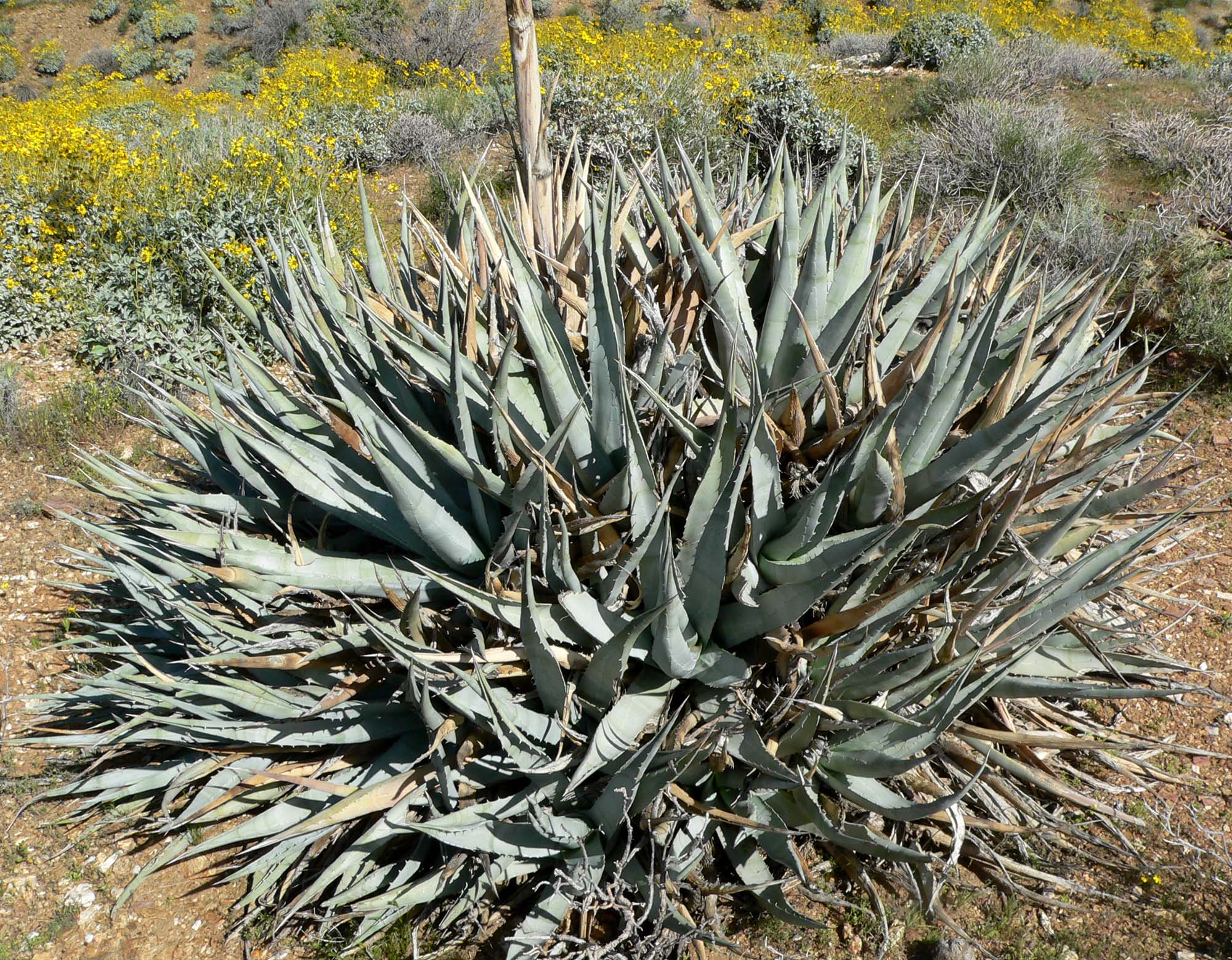
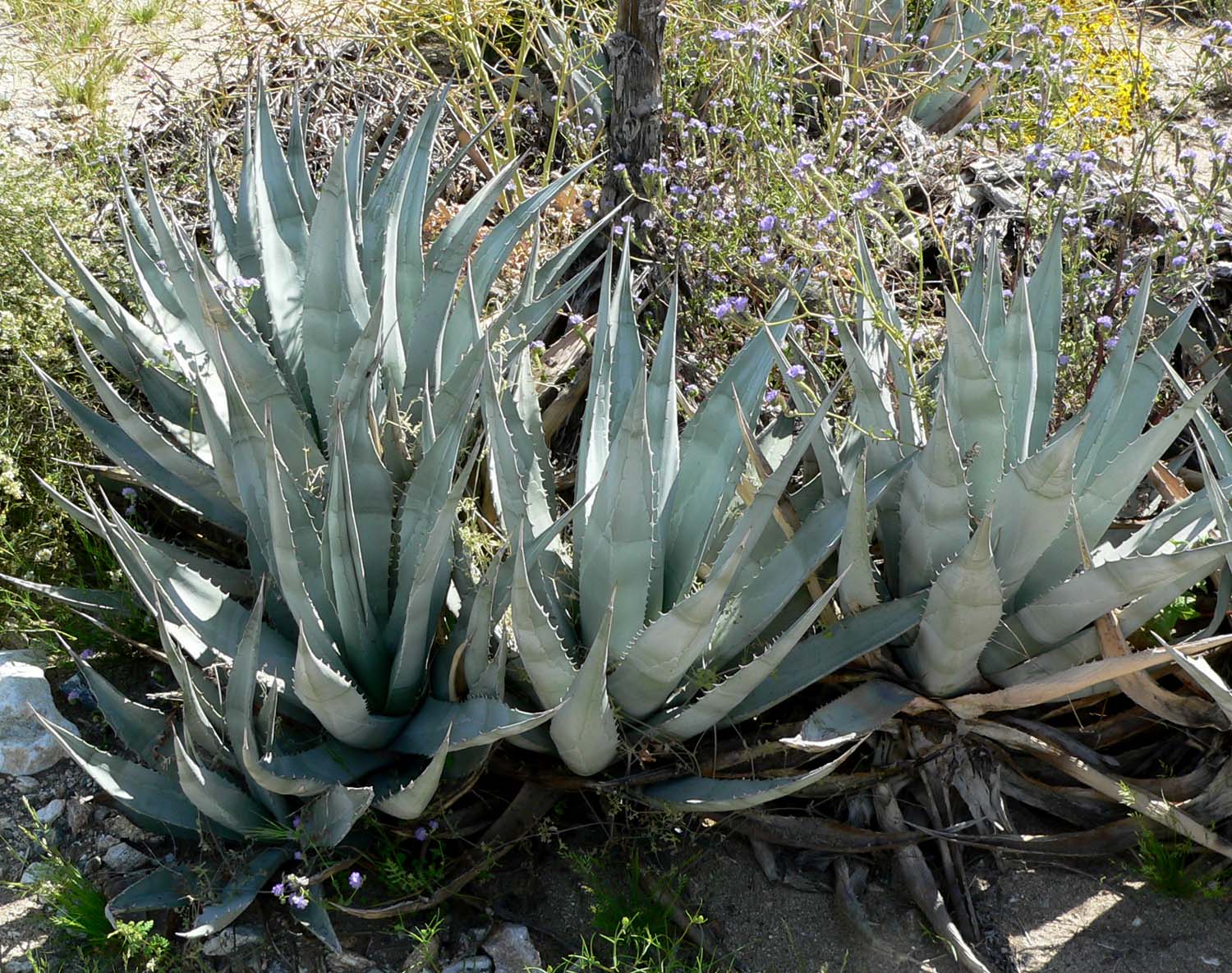
Desert agave looks like a small, blue-gray star that fell into the gravel and decided to stay. It is a stemless, evergreen succulent in the asparagus family (Asparagaceae), and it grows as a compact rosette of thick, rigid, fleshy leaves, gray-green to blue-glaucous, each leaf 20 to 70 cm long and 4.5 to 10 cm broad, widest at the base and tapering to a sharp terminal spine, with sharp teeth along the margins. The rosette itself is small for an agave — rarely more than about a foot and a quarter across in the Desert Museum’s description, up to about 2 feet in garden accounts — and that smallness is part of its character: this is not a landscape-devouring century plant but a ground-hugging desert citizen, often found in colonies, where one rosette’s offsets spread into a clump that can reach 8 to 10 feet across. Some forms sucker freely near the base into dense colonies; others offset by long underground rhizomes; a few rarely offset at all, which is why two clumps of desert agave can look like different plants while being the same species.
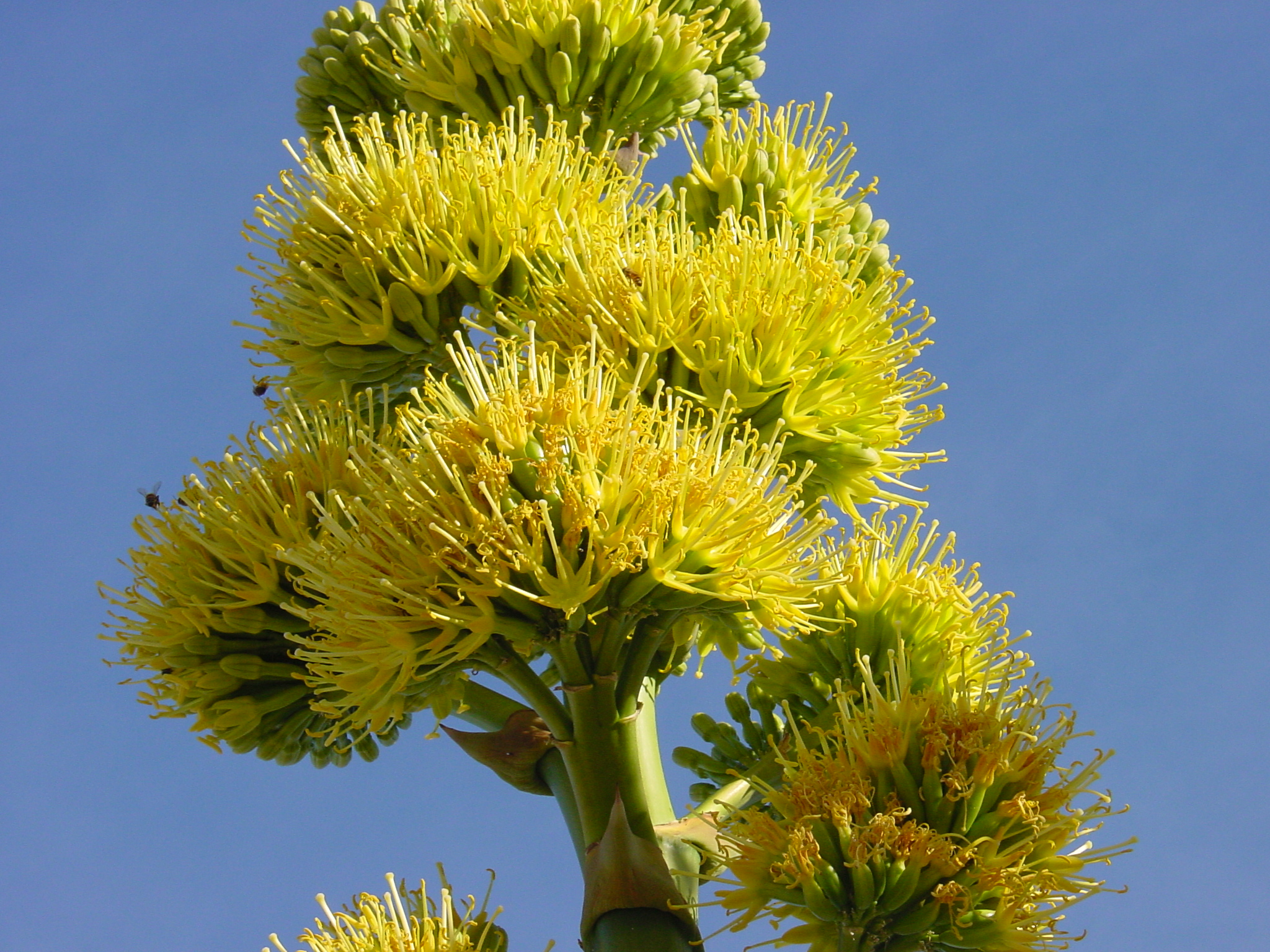
It is native to desert regions in southern California, Arizona, and Baja California, growing on rocky or gravelly soils in the Lower Colorado River Valley subdivision of the Sonoran Desert, in desert washes, on canyon walls, and on rocky slopes, with its range extending marginally into the Arizona upland and the Mojave Desert. It is also known as mescal, century plant, and maguey, and by the Spanish name amul. The flowers are the event the whole plant waits for: a tall, branched stalk 2 to 6 metres high, bearing numerous yellow, funnel-shaped flowers 3 to 6 cm long, opening in spring to summer. Some populations carry red buds that contrast beautifully with the yellow flowers, and the whole display draws bats, hummingbirds, and insects the way a desert waterhole draws everything else. And then, having flowered, the rosette dies — monocarpic, one bloom and done — while the offsets around it carry the colony forward, which is less a tragedy than a relay race run very, very slowly.
How to grow
Desert agave grows where the sun is brutal, the rain is rare, and the soil is mostly rock, and that is the whole cultivation brief. Give it full sun — it tolerates reflected heat off walls and gravel that would cook a softer plant — and soil that drains like a sieve: rocky, gravelly, mineral soil, planted slightly proud of the surrounding ground, on a slope or a raised bed if your soil is at all heavy. Water it like a desert plant, which is to say, rarely and deeply, and mulch with gravel rather than bark, which holds moisture against the crown. Space rosettes about 2 feet apart and allow room for the colony to spread, and site it away from paths and patios: the marginal teeth and terminal spines are not decorative suggestions. Gloves and long sleeves are the uniform.
Propagation is where desert agave repays your patience, slowly. It produces offsets — pups — around the parent rosette, and the easiest way to get more plants is to remove those offsets with a sterile, sharp knife and pot them up or plant them out. Seed is possible too, but slow, and offsets are genetically identical to the parent, which is what you want if you fell in love with a particular rosette. Do not expect quick results: this is a very slow-growing species, and even in cultivation with generous irrigation it takes at least 20 years to flower, according to the Desert Museum. A desert agave that looks unimpressive in its first year is not failing. It is just getting started on a timeline measured in decades.
Florida note: Stated plainly, because Florida gardeners deserve it straight: desert agave is not a Florida plant, even though its hardiness zones overlap the state. Zones measure cold, not humidity, and Florida’s wet, humid summers and rainy season are the enemy of a plant that evolved on rocky desert slopes with almost no summer rain. In most of Florida it will struggle with rot even in a raised bed of pure gravel, and it is not a plant to bet a garden bed on in the peninsula. This guide exists because butterfly guides list it as a host plant, not because it is a Florida garden staple, and pretending otherwise would be dishonest.
Water & feeding
Water needs are low, and the plant’s own chemistry explains why. Like other agaves, desert agave uses CAM photosynthesis, opening its leaf pores at night to take in carbon dioxide and keeping them shut during the heat of the day, which is a water-saving strategy so effective that it makes the plant look lazy while it is actually being brilliantly thrifty. Water deeply but rarely during the first growing season to establish roots, then back off hard: in its native desert, rainfall of only about 90 to 250 mm a year is enough, and a deep soak every few weeks in a long dry spell is plenty. In winter, keep it dry. Wet cold is far more dangerous than dry cold, and a rosette sitting in cold, wet soil is a rosette on its way out.
Feeding: barely, or not at all. Desert agave evolved on lean, rocky, mineral soils, and rich soil or heavy fertilizer produces soft, floppy growth that is more vulnerable to rot. A light top-dressing of gravel mulch is more than enough. The soil science here is the desert story: the plant stores water in its thick leaves, fixes carbon at night, and builds its architecture out of sunlight and stone, while its roots partner with desert soil microbes that cycle nutrients in pulses after rare rains. It does not want your compost pile. It wants drainage, sun, and to be left alone for twenty years, at which point it will thank you with a fifteen-foot flower stalk.
Common problems
- Rot from wet soil. The big one, and almost always fatal. Soggy soil, bark mulch holding moisture against the crown, or a low spot where water pools will rot the heart of the rosette. Plant high, plant gritty, and mulch with gravel.
- Agave snout weevil. The weevil whose grubs bore into the heart of agaves can kill even a healthy rosette, and a plant that collapses suddenly with a foul-smelling, mushy core is the classic sign. There is no easy cure once grubs are inside; remove and destroy affected plants, and do not replant agave in the same spot immediately.
- Spine injuries. Not a plant problem, a people problem. The terminal spines and marginal teeth are sharp enough to puncture skin and snag clothing. Site the plant away from walkways and wear gloves and eye protection when working around it.
- It dies after flowering — on purpose. Desert agave is monocarpic: a mature rosette sends up a flower stalk, blooms, sets seed, and dies. This is not a problem to fix. It is the life cycle, and the offsets around the base are the plant’s succession plan.
- Impatience. A rosette that has not flowered in ten years has not failed. It is a slow plant on a desert clock, and the colony it builds in the meantime is the garden.
- Wrong region. A Sonoran Desert plant in a humid garden is a plant out of place. Check the native range before you buy, and buy by Latin name.
Harvest
The traditional harvest of desert agave is the heart of the rosette and the young flowering stalk, pit-roasted until sweet, along with the flower buds and flowers, and the leaf fibers, which were made into cloth, bowstrings, and rope. That harvest belongs to the cultural traditions of the desert peoples of its native range — notably the Cahuilla, for whom it was a dietary staple even in drought years — and it kills the rosette, so it is not a backyard experiment: nothing is eaten raw, the sweet juices were also fermented into drinks, and a plant that took decades to mature deserves more respect than a casual tasting. The home gardener’s harvest is different: offsets for propagation, and, once in a plant’s lifetime, the flower stalk itself. A mature rosette, after decades, sends up a stalk 2 to 6 metres tall, crowned with branches and yellow funnel-shaped flowers that feed bats, hummingbirds, and insects by the hundred, and then the rosette dies, leaving its offsets to carry on. Cut the spent stalk at the base once it is done, leave the offsets, and let the next generation take the stage. That is the harvest, and it is enough.
Browse all plant & pest guides
Propagation
Desert agave is a propagation plant, not a seed-saving plant, and the distinction matters, because the plant itself has already voted. A desert agave rosette lives for many years, flowers exactly once on a towering stalk, sets seed, and then dies, which is a dramatic exit but a slow way to make more plants. Long before that finale, it quietly does something far more useful: it makes pups. Little offset rosettes appear around the base of the parent, each a genetic clone, each ready, when it has its own roots, to be lifted and grown on. If you want more desert agave, take the pups. Seed is the backup plan, the genetic lottery, and the long game, in that order.
Wait until a pup is a decent size and has some roots of its own before you separate it, because a tiny, rootless pup is a slow starter and a rot risk. Wear gloves and long sleeves for this job, because the marginal teeth and the terminal spine on every leaf are not decorative suggestions, and a desert agave does not forgive bare hands. On a dry day, cut the pup away with a sharp, clean knife, keeping as much of its own root tissue as you can, and then do nothing for a few days. Lay the pup in a dry, shaded spot and let the cut surface callous over, forming a dry skin, because planting a fresh, wet wound into moist soil is an invitation to rot, and rot is the agave killer. Once calloused, pot the pup into a very gritty, free-draining cactus mix, burying it just deep enough to stand upright, and water sparingly, only when the mix is dry, until you feel resistance when you tug gently, which means roots have taken hold. Give it bright light and warmth, keep it out of cold, wet weather for its first winters, and plant it out at the start of the growing season once it is well established and a good hand-span across.
That pup method is also how the colony survives the parent’s death. When a mature rosette sends up its flower stalk, enjoy the spectacle, let the bees and bats do their work, and do not panic about losing the plant, because the pups around its base are already the next generation. Cut away the dead rosette afterwards if you like, and let the pups fill the gap. For a single specimen, remove pups as they appear; for a colony, leave them and give the clump room.
Seed, for completeness, works like this: let the capsules on the flower stalk dry fully, collect the flat, black seeds, and sow them fresh on the surface of a gritty mix in a warm, bright spot in spring, keeping the mix lightly moist rather than wet. Germination is slow and uneven, often taking one to three months, seedlings are vulnerable to damping off if kept too wet, and they grow slowly, needing protection and patience for a season or more before they are sturdy enough to plant out. Seedlings from a species plant will be desert agave, but they will vary naturally, and they will not be exact copies of a particular parent rosette, which only pups can promise. For storage, dry any seed thoroughly, keep it cool, dry, and dark in a labelled envelope inside an airtight jar, and sow it sooner rather than later. And a Florida note: desert agave is a Sonoran Desert plant, and Florida humidity is its hardest test, so in Florida give pups and seedlings the grittiest mix you can make, rain shelter or a raised, sharply drained spot, and water only when dry, because in a humid garden it is wet feet, not drought, that kills an agave. Pups, calloused properly and kept dry at the neck, are still your best bet here, just as they are in the desert.
Species in this group
Desert agave (Agave deserti) — the species this guide covers: the small, blue-gray, spine-tipped rosette of rocky Sonoran Desert slopes and washes, and the host plant named in the California Giant-Skipper guide.
Desert agave, typical variety (Agave deserti var. deserti) — plants usually with numerous rosettes, found in southern California only, and the more colony-forming of the two varieties.
Desert agave, simplex variety (Agave deserti var. simplex) — plants usually with one or only a few rosettes, found in southern California and Arizona, and the less offsetting of the two varieties. Nursery sources also use subspecies names for these forms, but the two varieties above are the split this guide follows.
Parry’s agave (Agave parryi) — NOT desert agave: a separate species with its own guide, a larger, artichoke-shaped rosette of colder mountains, and the host of the Huachuca and orange giant-skippers rather than the California giant-skipper.
Lechuguilla (Agave lechuguilla) — NOT desert agave: a separate species with its own guide, narrower and more upright than desert agave.
Agave cerulata — NOT desert agave: a Baja California species whose straight-leaved varieties can be confused with desert agave there, listed here only so nobody confuses the two.