
🌿 Gray Dogwood
What it looks like
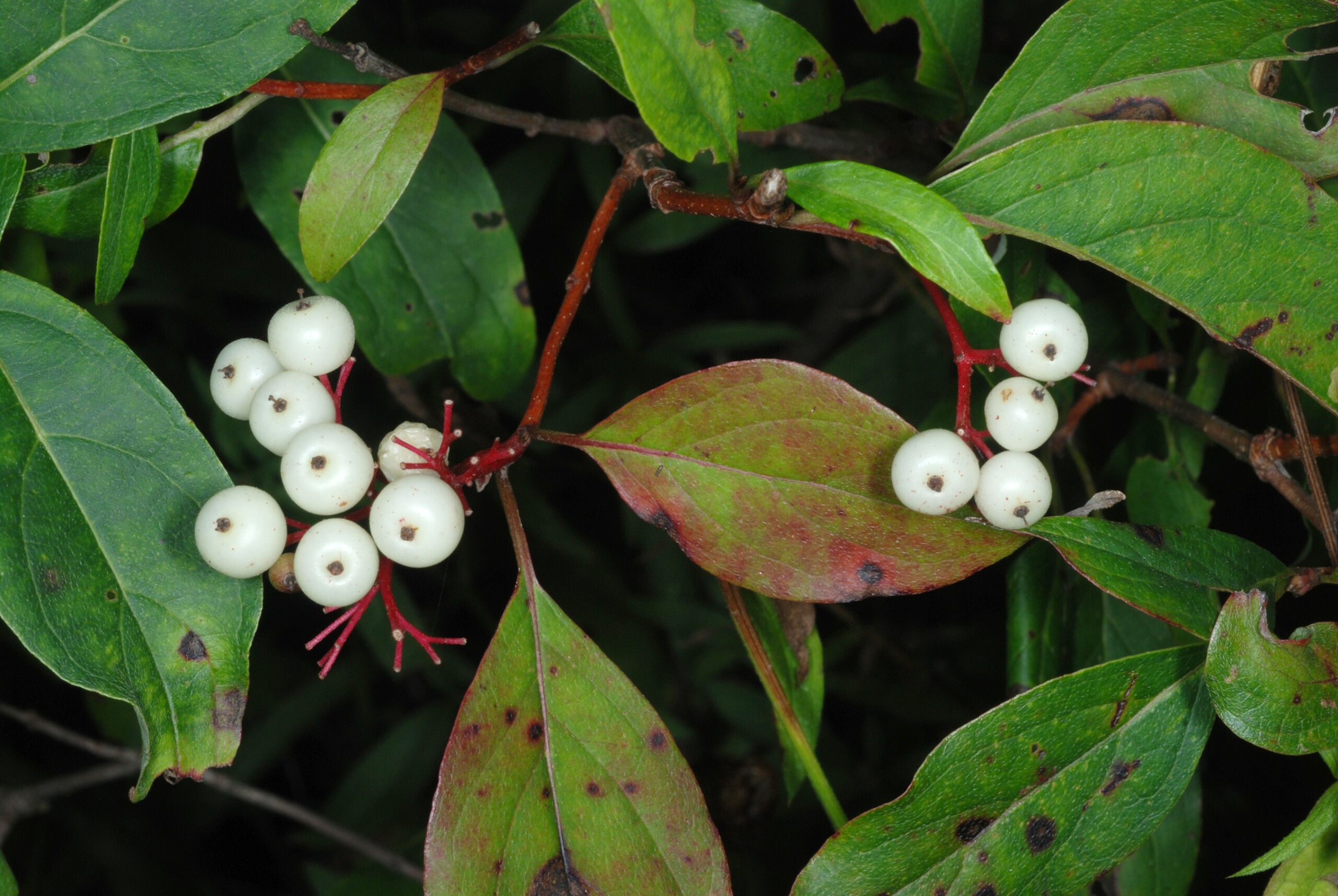
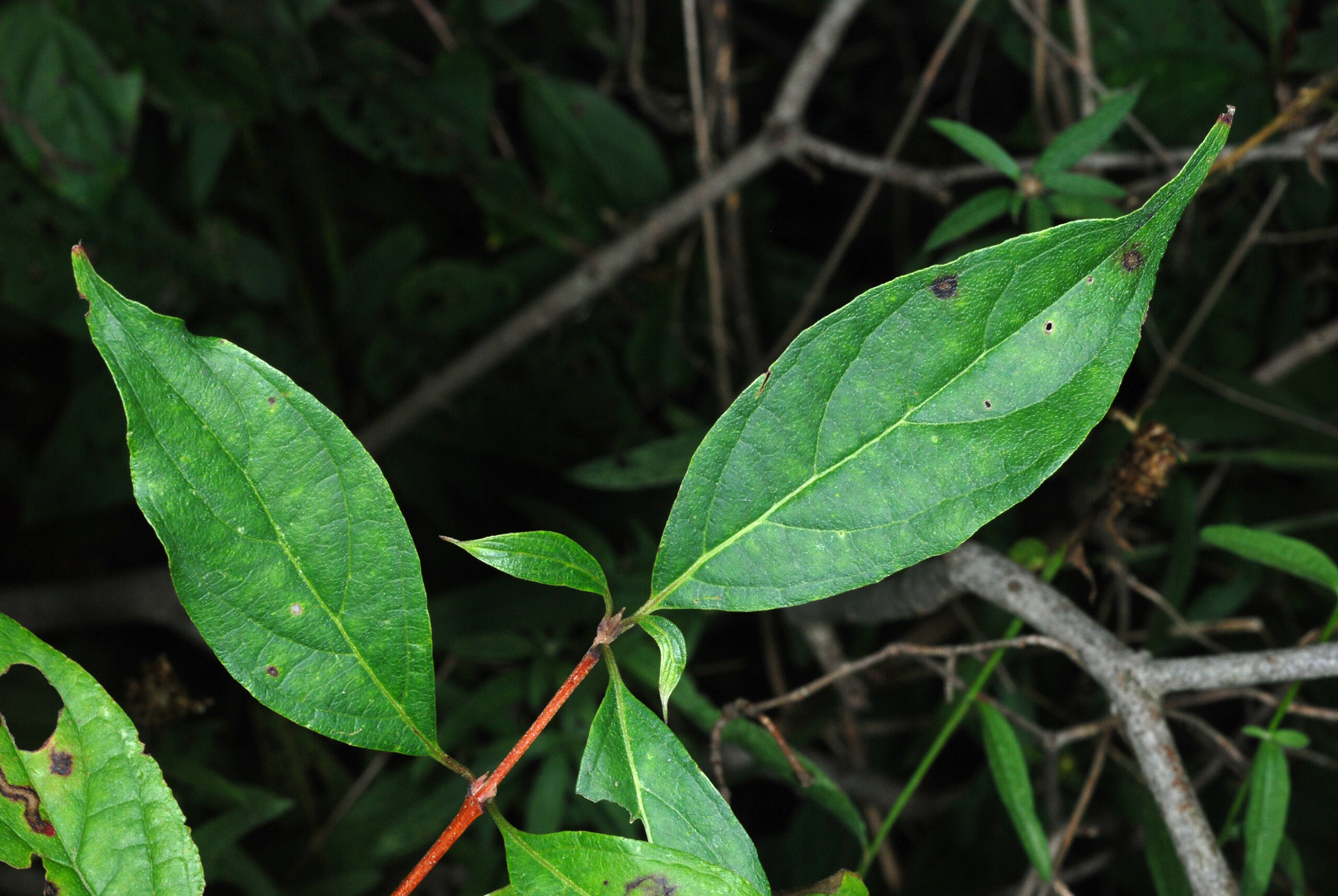
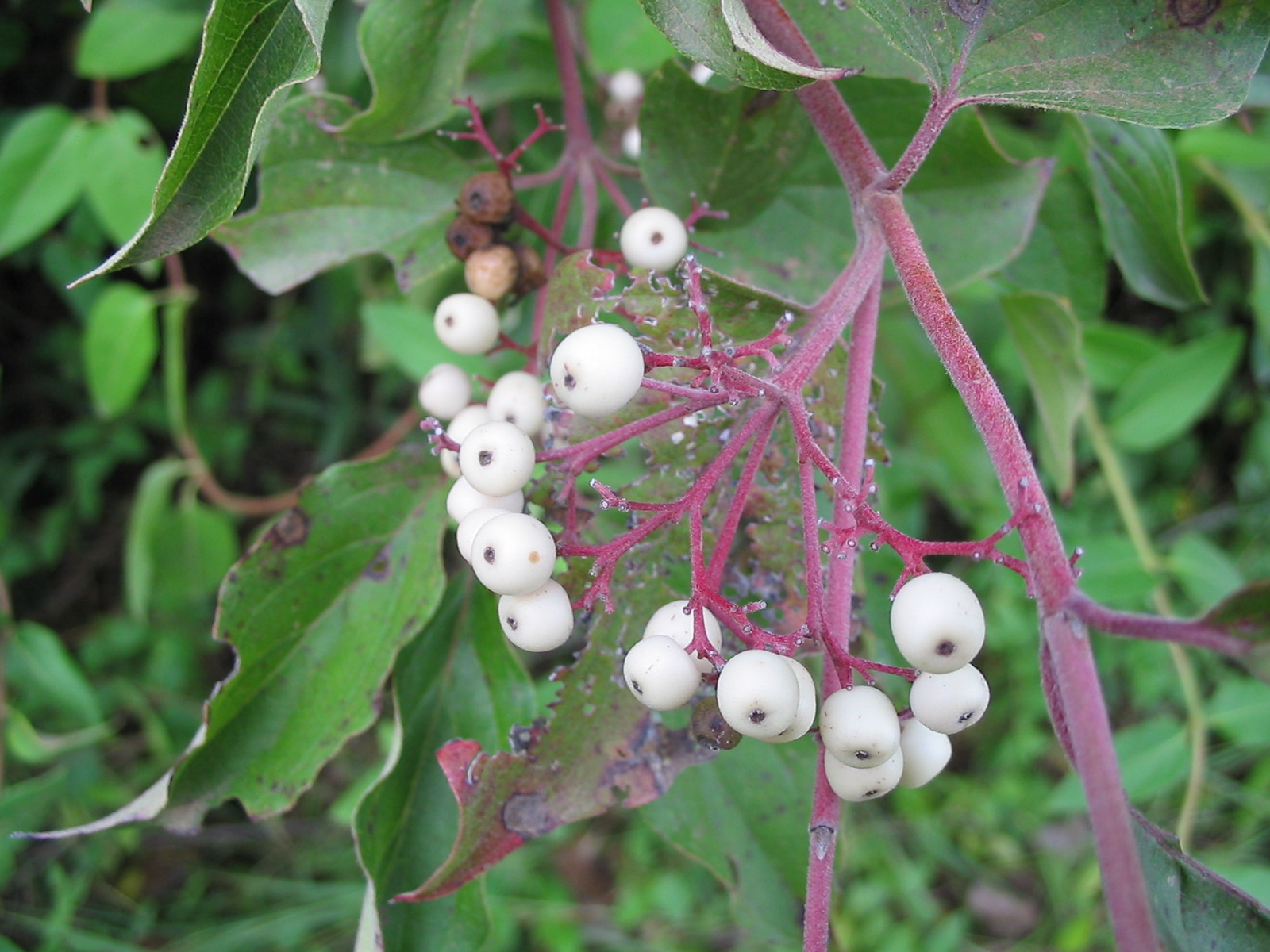
Gray dogwood is the dogwood that skipped the flower show and went straight to being useful. It is a deciduous, multi-stemmed shrub of the dogwood family, Cornaceae, native to southeastern Canada and the northeastern United States, typically 4 to 10 feet high and rarely taller, and it grows where the ground stays moist: along streams and ponds, in wet meadows, on glade and prairie margins, in thickets and on rocky bluffs. The common name comes from the bark: mature stems turn smooth and gray to gray-brown, a quiet winter feature, while the young twigs flush reddish — gray bark plus red twigs is the winter identification in one glance. In early summer it flowers white, not in the big showy bracts of the flowering dogwood but in open panicles — branching clusters where each small flower sits on its own stalk, which is what the species name racemosa is getting at, even though botanists will tell you the branching really makes it a panicle. By late summer those flowers become white berries on red stalks, a combination birds notice immediately, and that is the whole shrub in one sentence: gray bark, white flowers, white berries, red stems, and wildlife everywhere.
The butterfly context for this species is the Summer Azure guide, whose Host plants section lists shrubby dogwoods, especially gray dogwood, first among the caterpillar foods, alongside New Jersey tea (Ceanothus americanus), meadowsweet and steeplebush, viburnum, sumac, blackhaw, and wingstem, among many other shrubs and herbs in bloom. This guide claims only the gray dogwood half of that list. The Summer Azure is a generalist in the best sense: its caterpillars feed on the flowers and buds of a wide range of shrubs and herbs, following the bloom calendar the way a bee follows a flower calendar, and gray dogwood is the shrub the guide names first — a thicket shrub that blooms when the azure flies, in exactly the shrubby edges the butterfly haunts.
One plain-text disambiguation, because the dogwood names are a tangle and this species guide must not swallow its relatives. This guide covers Cornus racemosa only, also called gray dogwood, panicled dogwood, northern swamp dogwood, and red-panicled dogwood, with the older synonym Cornus paniculata in some treatments. Flowering dogwood (Cornus florida) is a different species with its own growing guide — the site’s Dogwood guide is florida only — and it is not covered here. Red osier dogwood (Cornus sericea) is a different species with its own growing guide, and it is not covered here. Kousa dogwood (Cornus kousa) is a different species with its own growing guide, and it is not covered here. Pagoda dogwood (Cornus alternifolia) and silky dogwood (Cornus obliqua, sometimes called pale dogwood) are different species, and neither is covered here. Buy and plant by Latin name, and let this guide be the gray one, not a substitute for the genus.
How to grow
Grow gray dogwood the way a thicket shrub wants to be grown: sunny to partly shaded, moist, and given room to sucker. Plant in fall or early spring in moist, ordinary to rich soil — it tolerates a wide range of soils, including clay, as long as the ground does not stay bone-dry — in full sun to part shade, and space plants several feet apart if you are making a hedge or thicket, because a multi-stemmed shrub that suckers will fill its allotted space and then ask for more. Water well until established, mulch to hold moisture, and then let it do what thicket shrubs do: send up new stems from the base, flower white in early summer, fruit white in late summer, and turn the border into a bird cafeteria. Prune in late winter to remove the oldest, grayest stems at the base, which keeps the thicket young and the red twig color coming; a gray dogwood never pruned becomes a gray thicket in the most literal sense, all old wood and no color.
The zone question is one of the few in this series with a clean answer, and this guide gives it with the usual qualifier: gray dogwood is commonly listed for USDA zones 3 to 8, which covers most of the eastern United States from cold winters to warm summers. It is a northern shrub by nature — southeastern Canada and the Northeast are its home — and in the deep South it is out of its range. Florida note, stated plainly rather than hopefully: gray dogwood is not a Florida shrub. North and central Florida are warmer than its listed range, and a Florida gardener who wants a wildlife dogwood should grow a Florida native shrub instead. The Summer Azure’s host list is a description of an eastern butterfly’s caterpillar foods across its range, not a planting list for a subtropical garden, and this guide says so rather than pretending otherwise.
For the wildlife gardener, the honest translation is a thicket, not a specimen. A gray dogwood hedge along a moist edge, unsprayed, allowed to sucker and fruit, is a Summer Azure nursery, a bird feeder that refills itself, and a pollinator stop in early summer — and the spraying rule is absolute: a host shrub sprayed during bloom is a host shrub emptied of caterpillars. Do not spray it, do not shear it into a box in the growing season, and do not expect a formal look from a plant whose whole strategy is becoming a thicket.
Water & feeding
Water, for gray dogwood, is a question of steady moisture. This shrub grows along streams and in wet meadows for a reason: it wants soil that stays moist, and it sulks in ground that dries out hard. Water deeply until established and through dry spells, mulch generously to hold moisture, and site it where the ground naturally stays a little damp — a low edge, a rain garden margin, a stream bank — rather than on a dry hilltop where you will be watering it forever. Once established in moist ground, it mostly waters itself through its season.
Feeding: little to none. Gray dogwood grows in ordinary to rich moist soil and needs no fertilizer program; a layer of mulch and the leaf litter it drops each fall are the whole feeding system. If growth is poor, check water first, because a gray dogwood that looks hungry is usually a gray dogwood that is thirsty. The soil science here is the thicket story: dogwoods are understory and edge shrubs that succeed by putting roots into moist, humus-rich ground and leaves into sun, and a shrub that feeds birds all late summer does it on ordinary soil, not on a fertilizer schedule.
Common problems
- Dry soil. The most predictable problem in this species. Gray dogwood wants moist ground and sulks, wilts, and thins out in ground that dries hard. Site it moist or water it; do not plant it on a dry hilltop and hope.
- Suckering enthusiasm. A multi-stemmed shrub that suckers will fill its space and keep going. Prune old stems at the base in late winter and give it room, or it will give itself room.
- Wrong dogwood, wrong tag. Flowering dogwood is Cornus florida, red osier is Cornus sericea, kousa is Cornus kousa, pagoda is Cornus alternifolia, silky is Cornus obliqua. Check the Latin name, and buy by Latin name, not by common name alone.
- Spraying the host shrub. The flowers and buds that feed Summer Azure caterpillars are the point of the shrub. Spraying during bloom empties it of the visitors this guide exists to feed.
- Shearing into a box. A thicket shrub sheared like a hedge in the growing season loses its flowers, its berries, and its point. Prune old stems at the base in winter, not the whole shrub in summer.
- Out of range in the South. Gray dogwood is a northern shrub, commonly listed zones 3 to 8. In the deep South and Florida it is out of its range, and no amount of care changes that.
Harvest
Gray dogwood’s harvest is a wildlife harvest, not a human one, and this guide says so on purpose: the white berries are bird food, not people food, and no culinary or medicinal use is claimed here. The harvest is white panicles in early summer, white berries on red stalks in late summer, gray bark and red twigs in winter, and, across the eastern United States, Summer Azure caterpillars eating the flowers and buds the way the butterfly guide describes. Leave most shrubs to flower and fruit, prune only the oldest stems in winter, and let the gray dogwood do what it has always done — sucker, bloom, fruit, and feed the birds. That is the crop, and it arrives without a single spray, because spraying it would kill the very thing that makes the thicket worth standing in.
The simplest harvest is a late summer afternoon with no agenda at all: a thicket edge in fruit, white berries on red stalks, birds working the branches the way they have all season, and the knowledge that the shrub beneath you is the first plant the Summer Azure guide names. That is enough, and it is honest.
Browse all plant & pest guides
Saving seeds
Gray dogwood seed saving starts with a theft, and the thieves are welcome to it. The white berries on their red stalks are bird food, not people food, so you are not collecting a crop — you are negotiating with the local bird population for a share of theirs. Watch the shrubs in late summer into fall, and collect when the berries are fully white and slightly soft, before the birds finish the job. Take berries from a healthy, vigorous shrub, and take plenty, because dogwood germination is a patience test rather than a certainty. A berry usually holds a single hard stone seed, so a handful of berries is a handful of chances, not a sackful.
Cleaning is the unglamorous part, and skipping it is the classic mistake. The pulp around the seed inhibits germination and invites mould in storage, so it has to come off. Soak the berries in water for a few days until the flesh softens, then rub it away and rinse the stones clean. In nature a bird’s gut does this job, which is a good reminder that seed saving is often just polite imitation of an animal. Once cleaned, you have two honest routes, and sources disagree about the exact recipe, so this guide will not pretend there is one magic number. The simplest reliable home method is to sow the cleaned seed outdoors in fall, lightly covered, in a spot protected from mice and birds, and let a real winter do the stratifying. Expect sprouts the following spring, and do not give up on the stragglers — some dogwood seed waits out a second winter before it bothers to germinate, which is not failure, it is dormancy doing its job.
The refrigerator route needs more bookkeeping. Cleaned seed goes into barely damp sand or vermiculite in a sealed bag or container in the refrigerator, and the cold, moist period sources recommend ranges widely — from about two months of cold alone to a warm period followed by a cold period totalling three to four months. That spread is not a typo in this guide; it reflects real disagreement between references, and it reflects the fact that seed collected at different ripeness and from different places behaves differently. If you stratify indoors, keep the medium damp, never wet, check for mould, and sow in spring in a free-draining seed mix, barely covered, kept consistently moist. If nothing comes up, hold the tray for another season before declaring defeat. Dogwood seed has humbled more confident gardeners than you.
For storage, dry cleaned seed thoroughly before it goes anywhere near a container, then keep it cool, dark, and dry, and use it as soon as you reasonably can — dogwood is a sow-fresh-or-sow-in-fall plant, not a seed-bank showpiece. In Florida, where a real winter is in short supply, the refrigerator route is the honest one, and the plant itself is a northern shrub at or beyond the warm edge of its range, so grow it as an experiment with shade and moisture rather than a guaranteed thicket. Seedlings, finally, will be gray dogwood, but not clones: this is a wild species with no named garden variety claimed here, so expect normal variation in vigour and form, and remember the shrub also spreads by suckers. If you want an exact copy of one particular shrub, a cutting or a dug sucker beats seed every time. Seed is for making a thicket, with all the gloriously unstandardised variation a thicket implies.
Species
Gray dogwood (Cornus racemosa, also called panicled dogwood, northern swamp dogwood, and red-panicled dogwood; older synonym Cornus paniculata) is the species this guide covers, and it is listed here for completeness alongside its relatives, in plain text, with the naming warning repeated because it matters. Flowering dogwood (Cornus florida), red osier dogwood (Cornus sericea), kousa dogwood (Cornus kousa), pagoda dogwood (Cornus alternifolia), and silky dogwood (Cornus obliqua) are different species with their own growing guides or listings, and none is covered here. The site’s Dogwood guide is Cornus florida only. No named garden varieties of the wild species were verified, and none is claimed here. This guide covers Cornus racemosa only.