
🌿 Hairy Ceanothus
What it looks like
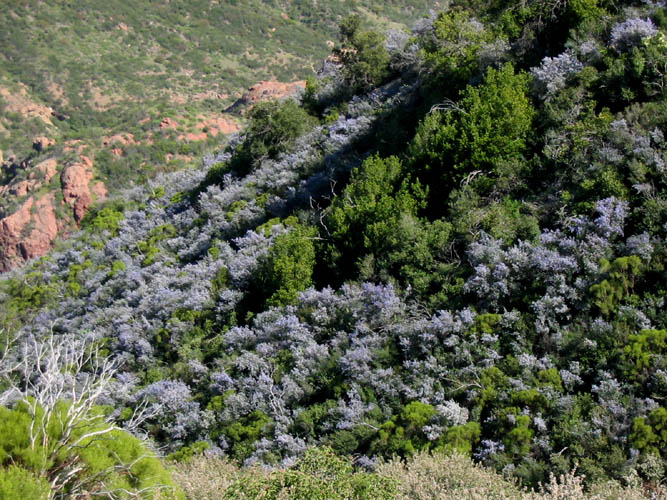
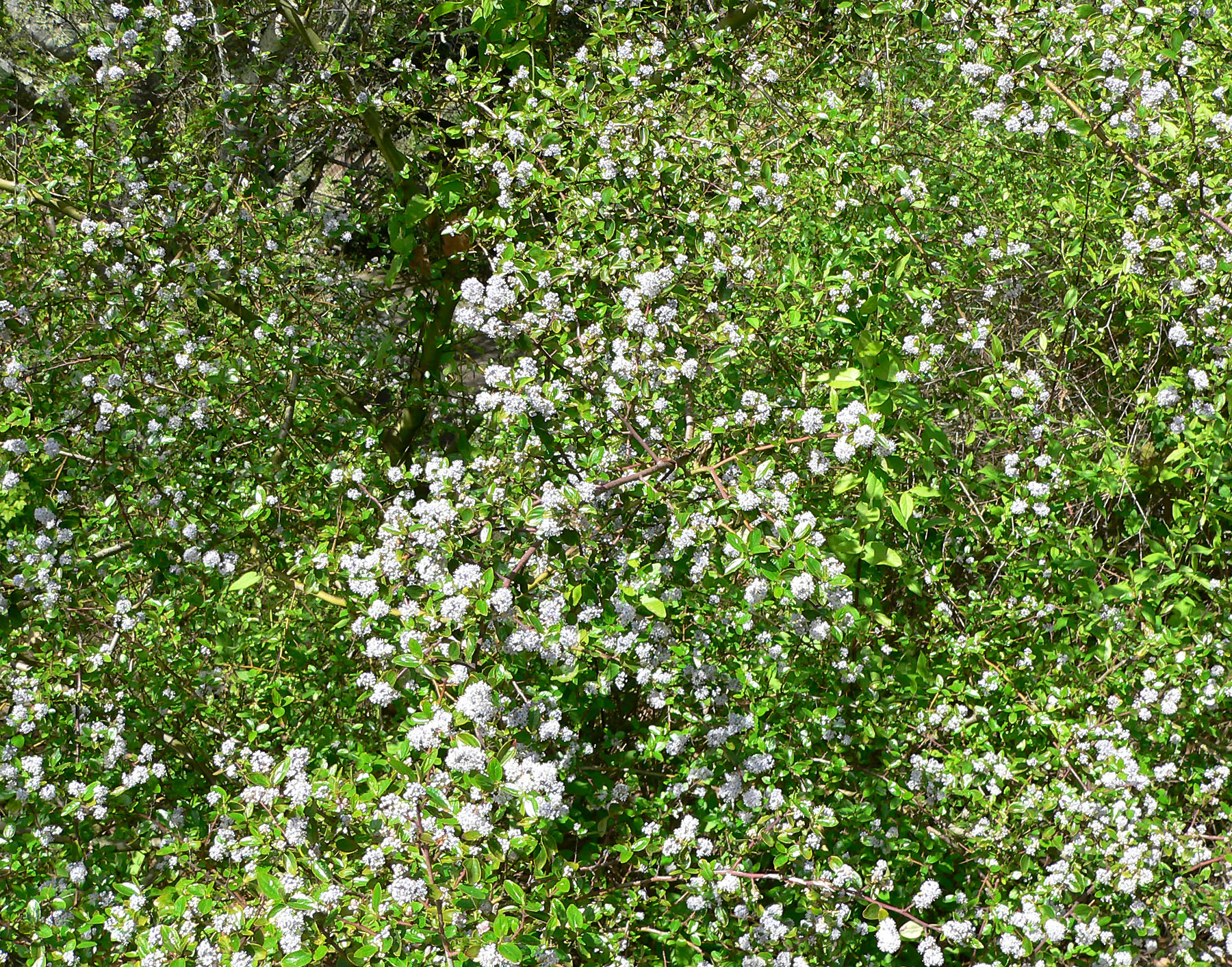
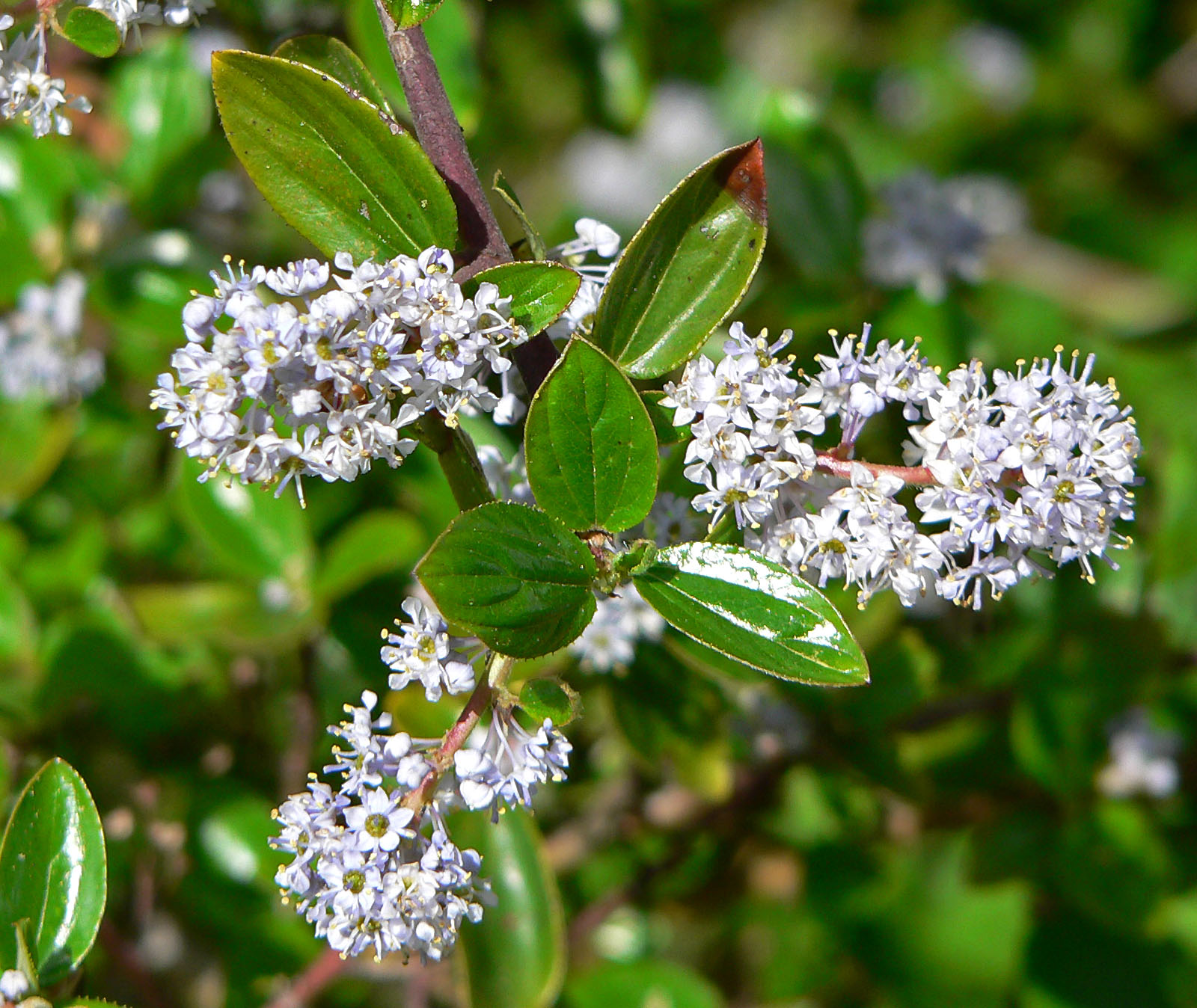
Hairy ceanothus is the shaggy, blue-flowered shrub of California chaparral, and its name is literal. Ceanothus oliganthus, in the buckthorn family Rhamnaceae, is an evergreen shrub, sometimes tree-like, with hairy young branches and leaves that are dark green above and paler and hairy underneath, edged with small teeth. The leaves are three-veined from the base, the Ceanothus family trait, up to about 4 centimetres long, and the flowers are pale to deep blue, in small dense clusters, carried in loose panicles. It is endemic to the California Floristic Province in the broad sense, native to California and adjacent Baja California, in coastal sage scrub and chaparral, most commonly in the central and southern parts of the state, on north-facing slopes, in gullies, and on well-drained ridges from about 40 to 1,500 metres elevation.
Size varies with variety and site, and this guide does not pretend otherwise. The species as a whole is described as an erect shrub up to about 6 metres (20 feet) tall, with reddish-tinted branches and a tree-like trunk on older plants, while the low, dense form sold as var. sorediatus is described at 3 to 8 feet in the wild, sometimes taller. That spread is the point: buy by variety, check the mature size of that variety, and do not assume a Jim brush will become a 20-foot tree or that a tall oliganthus will stay a groundcover. Flowering is similarly variety-dependent, roughly February to April in some accounts and December to June for var. oliganthus, January to May for var. sorediatus, in others. The safe statement is spring bloom, with the exact window depending on variety and site.
One disambiguation, in plain text: the Ceanothus genus guide already exists, and New Jersey tea, Ceanothus americanus, has its own species guide. Neither covers oliganthus. The genus guide is the place to compare Ceanothus species; this guide is the place for this one California shrub. Also, oliganthus is often confused with, and probably hybridizes with, woollyleaf ceanothus, Ceanothus tomentosus, and the separation between the two is weak in places like Orange County, where many plants identified as one may be hybrids. If a plant in the wild looks intermediate, it may well be.
How to grow
Plant hairy ceanothus in full sun to part shade, in well-drained, lean soil. Sandy to rocky soil suits it, slightly acid to slightly alkaline, and it tolerates the dry, rocky, nutrient-poor soils of chaparral, including serpentine soils in some accounts. The non-negotiable rule, repeated for the whole genus, is drainage: Ceanothus dies in wet, soggy, or heavily amended ground. Do not plant it in a low spot, do not enrich the hole with rich compost, and do not mulch it into dampness. On clay, plant on a slope, a berm, or a raised bed, or pick a different shrub.
It is a California Mediterranean-climate plant, with dry summers and mild, wet winters, and it is commonly listed for zones 8a to 10b. That rating comes with the usual caution: it is a composite listing, and the exact variety and provenance matter. It is not a Florida plant. Florida humidity and summer rain are a poor match for a chaparral shrub that wants dry summers and sharp drainage, whatever a catalog photo promises, and this guide does not recommend it for Florida gardens. In California, plant in fall or early winter in mild climates so winter rain establishes the roots, and in spring in cold climates after the worst frost. Space 6 to 10 feet apart by form, water deeply at planting, and then practice the Ceanothus skill that matters most: leaving it alone.
Water & feeding
Water to establish, then water sparingly. Through the first growing season, water deeply once a week or when the top few inches of soil are dry, and then back off. Once established, hairy ceanothus is drought-tolerant, and supplemental summer watering can shorten its life, especially in heavy soil. Do not fertilize. Like the rest of the genus, it fixes its own nitrogen through Frankia bacteria in root nodules, in actinorhizal nitrogen fixation, and fertilizer pushes soft, floppy growth and invites disease. A light mulch of gravel or coarse bark, kept off the crown, helps keep the root zone cool and dry, which is what this shrub actually wants.
Pruning is light and late: prune after flowering, since flowers form on previous season’s wood in many Ceanothus, and never cut a mature plant hard back into old, leafless wood, because many species will not resprout from it. Remove dead wood, shape lightly, and leave the rest alone.
Common problems
- Wet soil. Root rot in soggy ground is the most common cause of death, and the most preventable. Drainage is the cure; there is no spray that substitutes for it.
- Wrong zone and wrong climate. A zone 8 California shrub planted in a humid summer climate or a cold winter will decline, and no mulch reliably saves it. Match the variety to your climate before you buy.
- Fire and regeneration confusion. Hairy ceanothus is an obligate seeder: after fire, it regenerates from a persistent seed bank, with heat stimulating germination, and it does not resprout from a burned stump. Do not expect a burned plant to come back from the base; expect seedlings, in quantity, from seed.
- Hybrid confusion. Plants intermediate between oliganthus and tomentosus are common in overlap zones. A nursery plant of uncertain identity may not match either species description exactly.
- Pampering. Rich soil, frequent water, and fertilizer produce fast, weak growth and a short-lived plant. Lean and dry is the long-life recipe.
Harvest
There is no fruit or vegetable harvest from hairy ceanothus, and the harvest here is the flower show, the pollinator traffic, and the soil improvement the plant performs through its nitrogen-fixing roots. For butterfly gardeners, the value is direct: the pacuvius duskywing’s host list names hairy ceanothus, Ceanothus oliganthus, outright, which is why this guide exists, and the flowers feed adult butterflies and bees in spring when little else is blooming so profusely. Seed production begins at about five years, the capsules split explosively and cast seed, most of which drops beneath the parent to form the seed bank that carries the species through fire. That seed bank is the plant’s real legacy, and a garden that lets fallen seed lie is a garden that understands chaparral.
Propagation is by seed, with scarification to break the hard seed coat, followed by cold-moist stratification, and germination is slow and irregular, or by softwood cuttings from new growth in summer. For most gardeners, a nursery plant of the exact variety suited to the site is the honest route.
Saving seeds
Hairy ceanothus (Ceanothus oliganthus) does not want your help the way most garden plants do; it wants a fire. This is an obligate seeder: the parent shrub does not resprout from a stump after fire the way many chaparral shrubs do. It dies, and the next generation comes entirely from the seed bank in the soil and leaf litter, woken by heat. That single fact explains why a packet of ceanothus seed sown like lettuce seed, with warmth and water and optimism, mostly sits there doing nothing.
Collect in late spring into summer, after flowering, when the small capsules have dried and darkened but before they pop. The capsules are explosively dehiscent: they split and fling seed away from the parent, most of it landing beneath the crown to join the seed bank. To beat the explosion, tie a small paper or fine-mesh bag over a cluster of nearly ripe capsules and let them pop into the bag, or clip whole clusters just as they start to dry and finish them in a paper bag indoors. Clean out the chaff, keep only plump, hard seed, and label it with the variety if you know it: var. oliganthus, var. sorediatus (Jim brush), or the southern var. orcuttii, limited to the Peninsular Ranges of southern California and adjacent Baja California, which should never be wild-collected. Save seed only from garden-grown plants, and remember that Ceanothus species hybridize freely, so seed from a garden with several ceanothus species flowering together may grow up to be a hybrid.
Storage is the easy part. Ceanothus seed is famously long-lived in the soil seed bank, and cleaned, dry seed stored cool and dry in an airtight jar keeps for years, which makes sense for a plant whose whole strategy is waiting decades for a fire. In humid climates, dry the seed thoroughly first and add a desiccant packet; a seed built to wait out a drought will still mold if jarred damp. Germination is the hard part, and it is a heat story. In nature, heat cracks open the hilar fissure, the tiny valve on the seed coat, and lets water in for the first time; without that, the coat stays waterproof and the seed stays asleep. The home-scale stand-in is a hot-water soak: pour freshly boiled water over the seed and let it cool and soak with the seed in it, and test the method on a small batch first, because sources differ on exact temperatures and times, and too much heat kills seed just as surely as too little leaves it dormant. Some growers follow heat with cold, moist stratification; others report germination with heat alone, so if your first batch is patchy, a chilled batch is the next experiment, not proof the seed was bad. Expect germination over weeks, unevenly, and do not throw the tray away early.
Seedlings will not reliably come true where hybridization is possible, and they take several years to reach flowering size; plants typically begin producing seed at around five years old. If you need an exact copy of a particular shrub, softwood cuttings from new summer growth are the faithful route, and for most gardeners a nursery plant of the variety suited to the site remains the honest shortcut this guide already recommends. But if you want to understand chaparral, there is no better teacher than a tray of ceanothus seed that ignores every normal gardening kindness until you give it the one thing it evolved for: a little heat, and then patience.
Species in this group
This is a species guide, and the varieties below are the ones worth knowing, in plain text. No named garden cultivars of Ceanothus oliganthus are verified or claimed.
- Hairy ceanothus, var. oliganthus — Ceanothus oliganthus var. oliganthus: The hairy-leaf form. Leaves short-hairy on both sides, green to red-brown hairy twigs, flowering roughly December to June. The taller form, to about 20 feet in favorable sites.
- Jim brush — Ceanothus oliganthus var. sorediatus: The smoother form, formerly treated as its own species, Ceanothus sorediatus. Leaves smooth or sparsely hairy above and downy below, twigs generally grayish green and often not hairy, flowering roughly January to May, dense evergreen shrub 3 to 8 feet in the wild. Photos 2 and 3.
- Ceanothus oliganthus var. orcuttii: The southern form, limited to the Peninsular Ranges of southern California and adjacent Baja California, distinguished by short-hairy flower parts and wrinkled fruits.
- Not this species — Ceanothus tomentosus (woollyleaf ceanothus): A close relative, ecologically and morphologically similar, included in the same vegetation alliance. Often confused with oliganthus, and hybridization blurs the line. Not covered here.