
🌿 Hercules Club
What it looks like
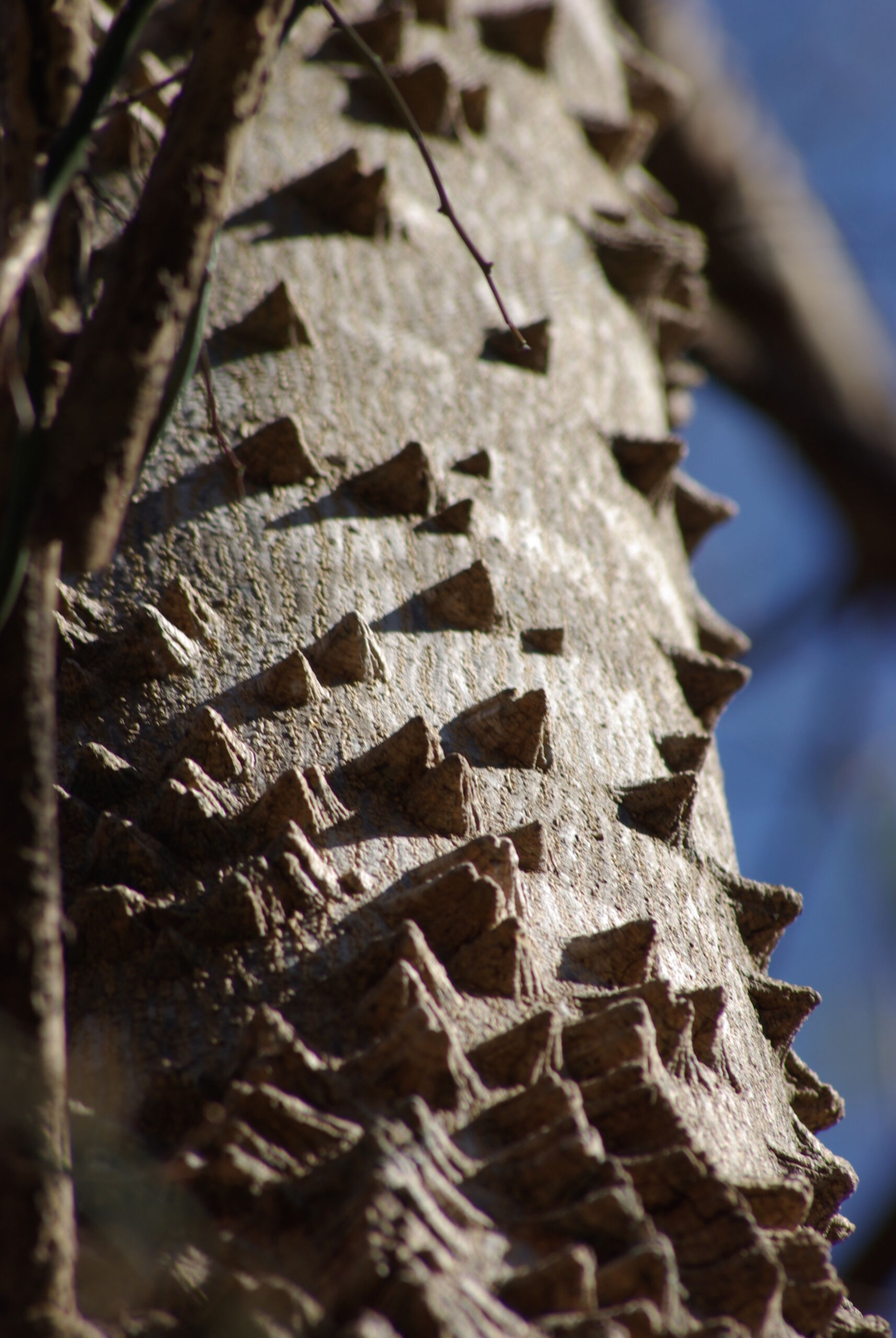
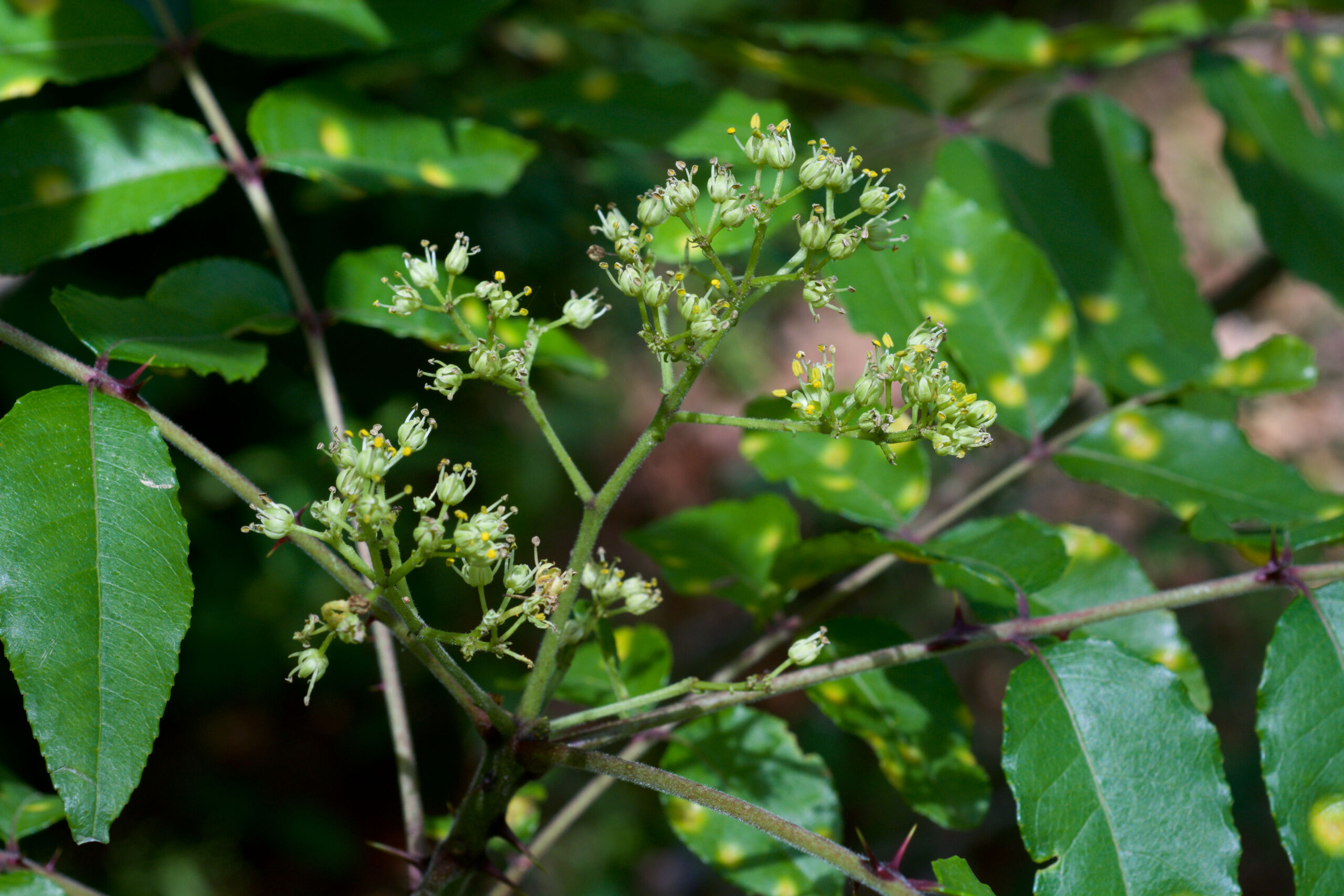
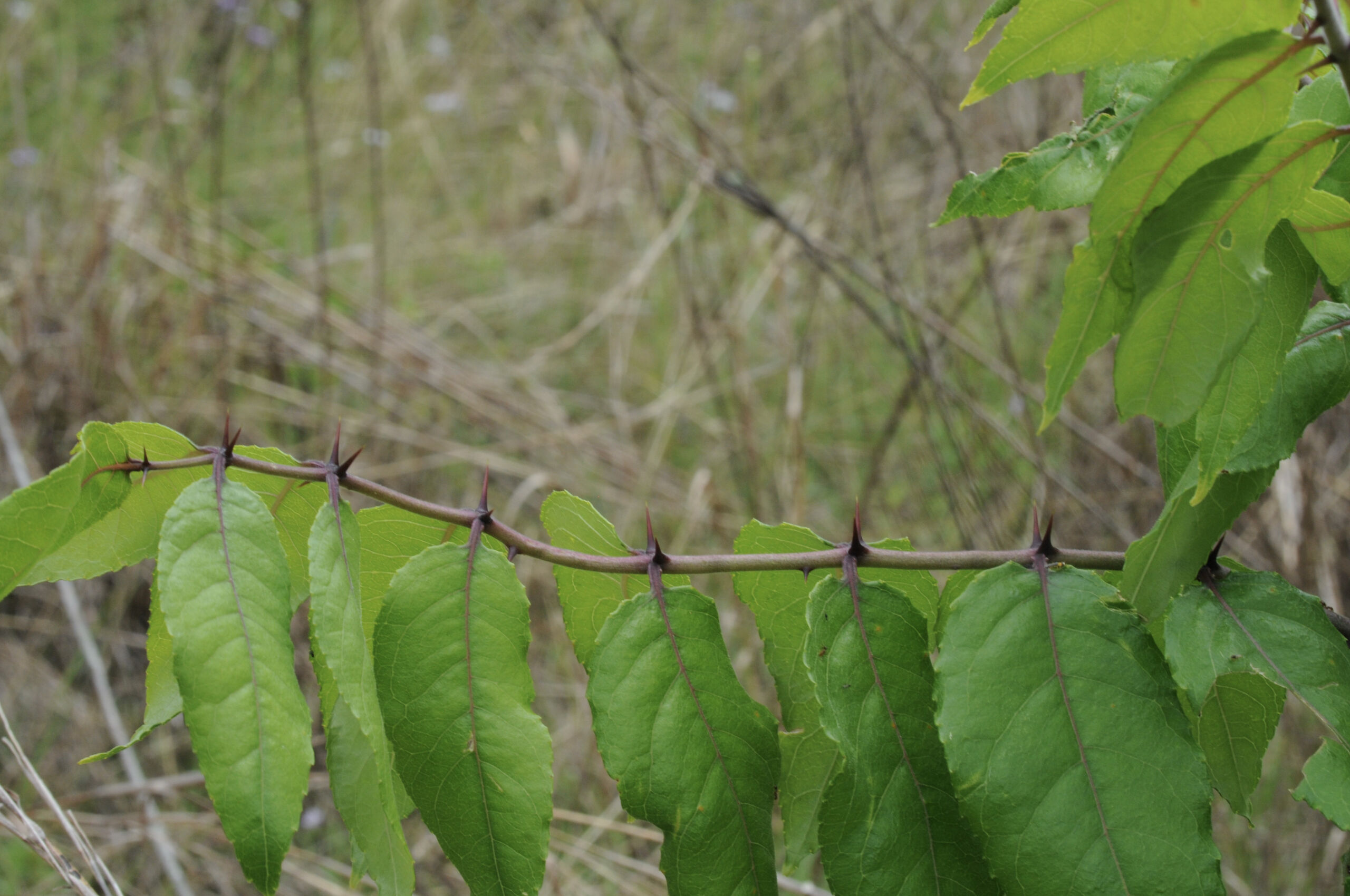
Hercules club is a tree you identify by touching it — carefully. It is a small, deciduous tree, usually fifteen to thirty feet tall, in the citrus family, and its bark is its signature: gray-brown bark studded with thick, corky, wart-like projections, each tipped with a prickle, like a medieval club left out in the woods. The species name says it: clava-herculis means “club of Hercules,” and the trunk really does look armed. The branches carry prickles too, and the pinnate leaves — seven to nineteen leaflets on a prickly stalk — smell of citrus and spice when crushed, because this is a Zanthoxylum, kin to the Sichuan peppers and the citrus trees, and the whole genus runs on aromatic oils.
The flowers are small and greenish-white, in clusters in spring, and they are the point of this guide twice over: they feed the adults of the Great Purple Hairstreak, and they feed a crowd of other pollinators besides. The fruit is a small, reddish capsule that splits to show a black seed, and it carries the genus’s famous tingle — Zanthoxylum fruits are the source of the numbing, citrusy spice in Sichuan cooking, and Hercules club’s own fruits and bark have a long folk history as a peppery, numbing remedy for toothache, which is why it also answers to “toothache tree” in the old herbals. The fall color is yellow, the form is open and spreading, and the whole tree has the air of a plant that does not mind being noticed.
The butterfly context is the Great Purple Hairstreak guide, whose Nectar plants section says, in its Florida sentence, “In Florida, reported nectar plants include goldenrods, Hercules club, coastal sweetpepperbush, American plum, and weedy native nectar plants such as Spanish needles.” This guide claims only one member of that list: Hercules club itself, resolved by research to Zanthoxylum clava-herculis — the identification that the University of Florida’s Featured Creatures account, the Florida Wildflowers pollinator profile, and the Institute for Regional Conservation all give for the Great Purple Hairstreak’s Hercules club nectar, in exactly this Florida context. Goldenrods, sweetpepperbush, American plum, and Spanish needles have their own guides, and none is covered here.
One plain-text disambiguation, because the Hercules club name causes real confusion and this species guide must not swallow the other claimant. This guide covers Zanthoxylum clava-herculis only, the southern prickly ash of the southeastern coastal plain. Devil’s walkingstick (Aralia spinosa) is also called Hercules club in much of its range, and it is a different plant in a different family — a tall, spiny, tropical-looking shrub-tree with huge compound leaves — and it is not covered here. The Florida evidence settles this guide’s scope: the Great Purple Hairstreak’s Florida nectar list names the Zanthoxylum, not the Aralia, and the guide’s own Florida sentence is the sentence this draft wires to. The site’s Zanthoxylum genus guide covers the genus, and it is not this species guide. Buy and plant by Latin name, and let this guide be the southern Hercules club, not the devil’s.
How to grow
Hercules club is a tough, undemanding small tree for the warm Southeast — and it is a genuine Florida native, which makes it one of the few trees in this batch a Florida gardener can plant without apology. Plant nursery-grown stock in spring or fall in full sun to light shade, in well-drained soil — it tolerates sandy coastal soils, dry spells once established, and the salt air of the coastal plain better than most trees, because the coastal plain is where it evolved. Give it fifteen to twenty-five feet of room: it is a small tree, but it spreads its prickly branches wide, and a Hercules club planted against a walkway will remind every passerby, sharply, that it is armed.
It needs almost no care beyond siting it wisely. Water until established, then water through dry spells in its first years; after that it largely takes care of itself. Prune only to remove dead wood and to keep its shape — and prune with thick gloves and long sleeves, because the prickles are not decorative. It is dioecious in effect if not in strict botany — plant more than one if you want reliable fruit, since male and female flowers are often on separate trees — and the fruit is worth having: birds eat it, and the tingle it gives is the genus’s calling card.
For the garden, the honest translation is a conversation-piece native tree for a sunny, out-of-the-way corner. Plant it where its bark can be admired and its prickles cannot ambush anyone — the back of a border, the edge of a natural area, a coastal garden that needs a tough native with character. Let it flower in spring for the hairstreaks and the bees, let it fruit in fall for the birds, and let its knobby trunk be the thing visitors ask about. A tree that looks like a club and smells like citrus is not a background plant, and it should not be planted like one.
Water & feeding
Water Hercules club like a coastal-plain tree: generously until established, then moderately. It prefers well-drained soil and tolerates dry spells once its roots are down, but it grows fastest with consistent moisture in its first years. In sandy Florida soils, mulch thickly to hold moisture and water through dry spells; in heavier soils, make sure drainage is good, because wet feet in stagnant soil rot the roots while the prickles above ground look perfectly healthy.
Feeding: modest. A little compost at planting and a mulch of leaves each winter is plenty for a native tree in decent soil. Heavy fertilizer produces soft, fast growth with weak wood and more prickles per inch, which is not an improvement on any axis. The soil science here is the citrus-family story: Zanthoxylum makes aromatic oils and alkaloids — the compounds behind the citrus scent when you crush a leaf, the tingle when you bite a fruit, and the toothache remedy in the herbals — and those compounds are the plant’s chemical defense, the reason most herbivores leave it alone and the reason the insects that can eat it, like the giant swallowtail caterpillars that feed on Zanthoxylum, are specialists. The tingle is the defense, the spice is the accident, and the tree is the treaty between them.
Common problems
- Prickles. The commonest complaint, and it is not a defect. Site the tree away from walkways, play areas, and anywhere anyone brushes past in shorts. Prune with thick gloves.
- Wrong Hercules club, wrong tag. Devil’s walkingstick (Aralia spinosa) shares the common name and is a different plant. Check the Latin name: clava-herculis, not spinosa.
- Poor fruit set. Male and female flowers are often on separate trees. Plant more than one, or accept flowers without fruit — the hairstreaks come for the nectar, not the capsules.
- Giant swallowtail caterpillars. They feed on Zanthoxylum leaves, and they look like bird droppings, which is the point. Do not spray a host tree: the caterpillars are the crop, and a few eaten leaves never hurt a healthy tree.
- Wet feet. Well-drained soil is non-negotiable. In heavy, stagnant soil, plant on a mound or choose a drier site.
- Genus-species confusion. A genus guide does not cover a species, and a species guide does not cover the genus. The site’s Zanthoxylum genus guide covers the genus; this guide is clava-herculis only.
Harvest
Hercules club’s harvest is a tingle and a story: the fruits, dried and ground, give a citrusy, numbing pepper — the southern cousin of Sichuan pepper — and the bark has a long folk history as a toothache remedy, chewed to numb a sore tooth. Both uses come with the usual honesty clause: traditional use is not a medical recommendation, the tingle is real, and a tree that numbs a tooth deserves respect, not casual experimentation. The simplest harvest is a spring afternoon with no agenda: a knobby, prickly tree in flower, a Great Purple Hairstreak flashing blue in the canopy above the mistletoe it came from, and the knowledge that the tree below it fed the butterfly on its way down.
Saving seeds
First, the handling warning, because Hercules club does not give its seed away gently: this is a tree armored with corky spines, and its small round fruits sit among them. Wear sturdy gloves and long sleeves when you collect, and use secateurs rather than bare hands to snip fruiting clusters. The tingle that makes the dried fruit a pepper substitute is charming on the tongue and far less charming in a scratch, so treat the harvest like you would a rose with ambitions.
One more fact shapes the whole project: Hercules club is dioecious, meaning individual trees are male or female, and only female trees bear fruit — and only if a male tree is flowering nearby. A lone tree in a garden will give you shade, spines, and stories, but no seed. If you want to save seed, you need a fruiting female with a male in pollinator range, and you need to confirm your tree actually sets fruit before you plan a seed-saving season around it.
Seeds ripen in autumn, roughly September to October, when the small fruits split or darken and the hard black seed inside is fully formed. Collect ripe fruits, strip away the pulp, and rinse the seeds clean — the pulp is not doing the seed any favors in storage, and leftover fruit flesh invites mold. Spread the cleaned seed to dry for a week or two in a dry, airy spot out of direct sun. Florida humidity demands extra care here: seed that goes into a jar even slightly damp will mold, so dry thoroughly and store in an airtight container with a desiccant packet, kept cool and dark. Properly dried seed keeps for at least a season or two; like most tree seed, it is best used sooner rather than hoarded for years.
Sowing is where Hercules club tests your patience, and honesty requires saying so up front. Fresh seed sown as soon as it is ripe in autumn is the best bet — sow in pots of well-drained mix, keep them moist but not soggy, and protect them from rodents, which consider your seed pots a pantry. Stored seed needs help waking up: references generally call for up to about three months of cold, moist stratification in the fridge (seed mixed into damp sand or peat in a sealed bag), and scarification — nicking or lightly abrading the hard coat, or a warm-water soak — may also improve results. Even then, germination may wait until late spring, and some seeds take a second year before they stir. This is not failure; it is a tree that evolved to hedge its bets across seasons. Sow more seed than you think you need, label the pots, and resist the urge to throw them out after one quiet spring.
When seedlings do appear, prick them out into individual pots once they are large enough to handle, and grow them on in a sheltered spot for their first winter before planting out in early summer. Remember that seedlings are genetically variable: they will be Hercules club, unmistakably, but not a clone of the parent tree, and their spines, vigor, and fruiting will vary. If you need an exact copy of a particular tree — say, one with especially good pepper fruit — take suckers in late winter or half-ripe cuttings in summer instead; seed is for new trees, cuttings are for copies. Either way, plant your young trees where their future spines will not ambush a walkway. A toothache tree beside the path is funny exactly once.
Species
Hercules club (Zanthoxylum clava-herculis, also called southern prickly ash and toothache tree; older spelling Xanthoxylum clava-herculis in some sources) is the species this guide covers. Devil’s walkingstick (Aralia spinosa), also called Hercules club in much of its range, is a different plant and is not covered here. Other Zanthoxylum species (including northern prickly ash, Zanthoxylum americanum) are different plants, and none is covered here. The site’s Zanthoxylum genus guide covers the genus, and it is not this species guide. No named garden varieties of the wild species were verified, and none is claimed here. This guide covers Zanthoxylum clava-herculis only.