
🌿 Hoary Vervain
What it looks like
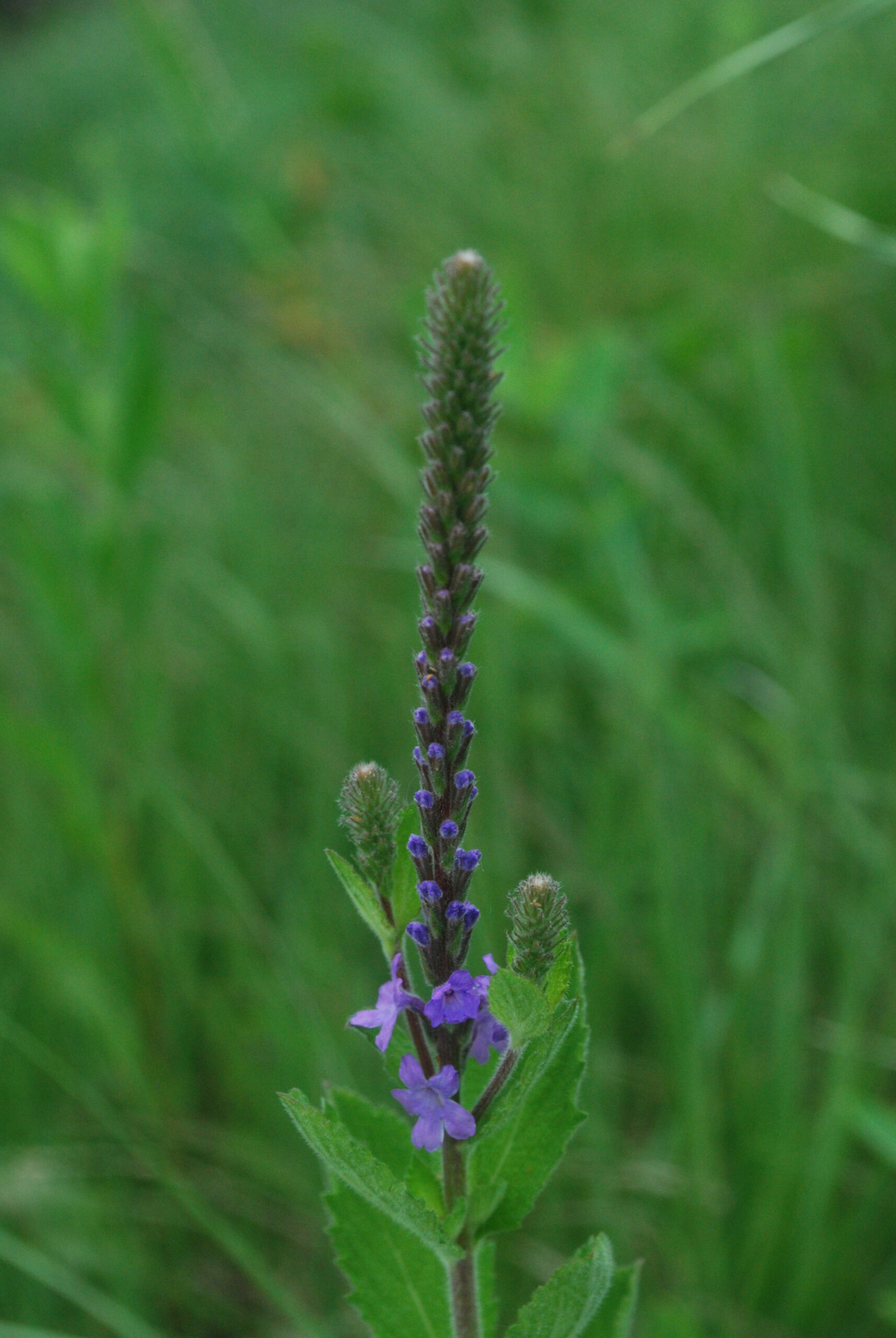
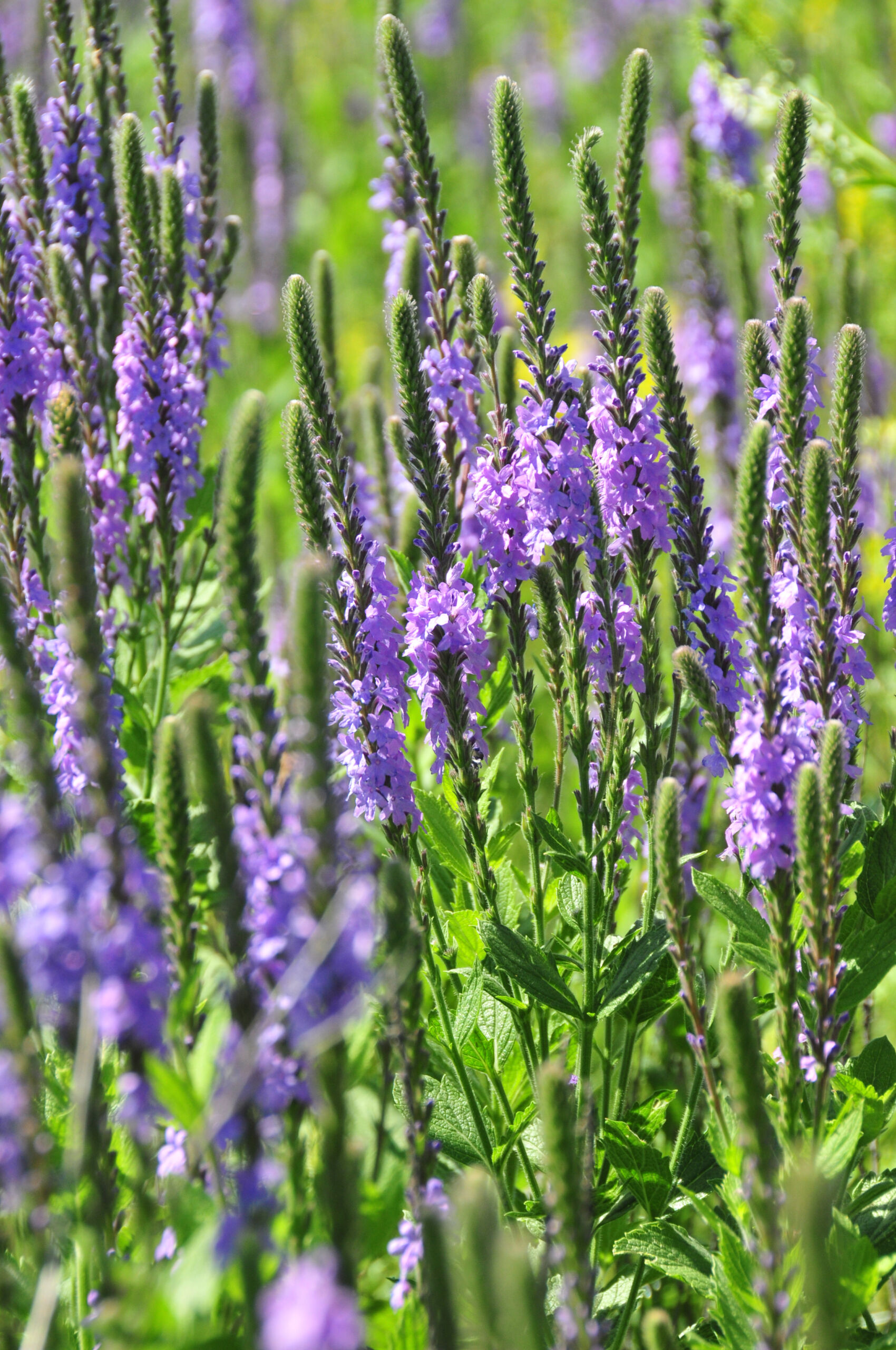
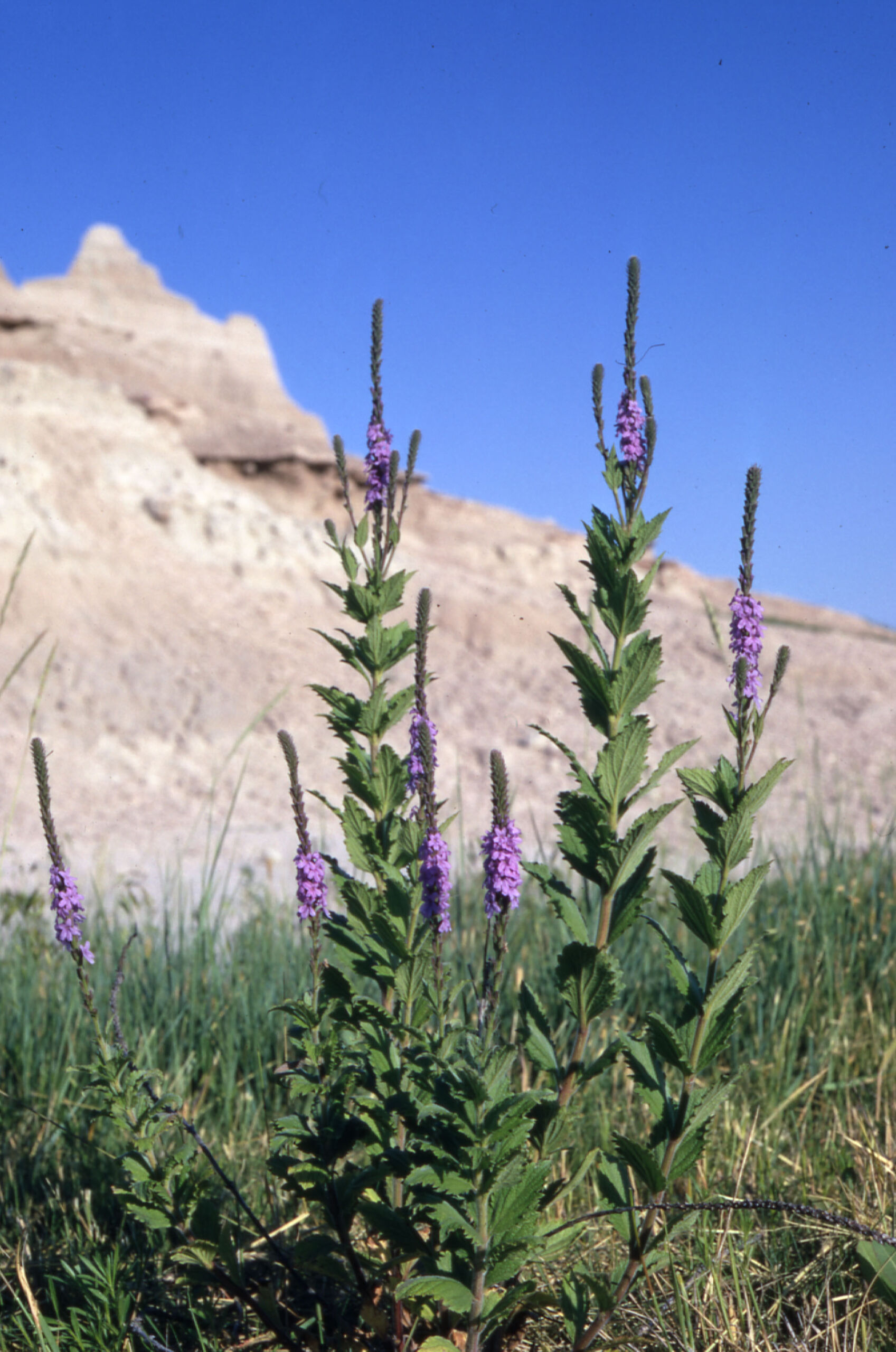
Hoary vervain looks like it got caught in a frost in July. It is a native erect annual to short-lived perennial forb, growing on stout, square stems — the mint-family signature, though vervain is in its own family, Verbenaceae — up to three feet tall and sometimes more, with stems green to reddish-purple and dusty-looking with long whitish hairs. The leaves, stems, and flowers all carry those hairs, which is where the common name comes from: “hoary” means gray-white with age or frost, and this plant wears its frost all summer. The species name stricta means erect or rigid, for the stiff, upright stem that does not sprawl, does not flop, and does not apologize.
The flowers are small and purple-blue, packed into long, narrow spikes at the top of the stem, opening from the bottom of the spike upward over a long season — June through September in most of its range — so a single spike carries buds at the top, open flowers in the middle, and seed below, all at once. The leaves are oval to oblong, toothed, and sessile or short-stalked, and the whole plant has a rough, sturdy, prairie look: not a garden flower bred for tidiness, but a wildflower built for prairies, glades, barrens, pastures, and roadsides, where it thrives on disturbance and poor soil.
The butterfly context is the Mottled Duskywing guide, whose Nectar plants section says adults nectar on “bush houstonia, gromwell, hoary vervain, and other flowers.” This guide claims only one member of that list: hoary vervain itself, resolved by research to Verbena stricta — the name every major flora gives for hoary vervain, hoary verbena, tall vervain, and woolly verbena alike. Bush houstonia and gromwell have their own guides, and neither is covered here. Duskywing skippers are generalists at the flower, with a preference for small, open flowers they can reach with a short proboscis — and hoary vervain’s small, open, spike-packed flowers are exactly that kind of flower.
One plain-text disambiguation, because the vervain names are a thicket. This guide covers Verbena stricta only, also called hoary verbena, tall vervain, and woolly verbena. Blue vervain (Verbena hastata) is a different, wetland species, and it is not covered here — the two are sometimes confused in old herbals, and one old source even labels stricta as “blue vervain,” which is why the Latin name matters more than the common one here. Lemon verbena (Aloysia citrodora) is a different genus entirely, a scented shrub, and it is not covered here. Other Verbena species — prostrate, white, and blue vervains among them — are different plants, and none is covered here. Buy and plant by Latin name.
How to grow
Hoary vervain is a plant for sunny, poor, open ground — and it is almost embarrassingly easy in the right place, which is a prairie garden, a meadow strip, or a sunny corner that nothing else wants. Sow seed directly where it will grow, in fall or early spring — it benefits from a period of cold, so fall sowing is the easy path — in full sun in well-drained soil of almost any type: it grows in all soil types, from sand to clay, and tolerates the overgrazed rangeland and disturbed sites where fussier flowers quit. Thin seedlings to eighteen inches to two feet apart, water until established, and then leave it alone. It is a short-lived perennial that behaves like a biennial in many gardens: rosette first, then the stiff flowering stem, then seed, then a new generation from the seed it dropped.
It asks for almost nothing beyond sun and open ground, and it will punish pampering: rich soil and heavy water make tall, rank growth that flops, while lean soil and sun make a tighter, sturdier plant with more flowers. It self-seeds freely, which is the whole system and the whole warning in one sentence: a patch that reseeds itself is a perennial planting made of short-lived plants, and a patch that reseeds itself beyond its corner is a weed problem you planted on purpose. In a prairie or meadow planting that is a feature; in a small border, pull extras before they seed.
Florida note, stated plainly rather than hopefully. Hoary vervain is a central North American prairie plant — abundant in the central United States, sparse on the Atlantic coast, and essentially a plant of the interior — and it is not a Florida garden plant. Its range reaches the Southeast only marginally, and a hot, humid Florida summer is not its address. A Florida gardener who wants a vervain should look to the site’s Florida-native verbenas instead, and leave hoary vervain to the prairies it belongs to. The Mottled Duskywing’s hoary-vervain nectar record is a central-continent story, not a Florida planting list, and this guide says so rather than pretending otherwise.
For the garden, the honest translation is a tall purple spike for the sunny meadow edge. Plant it at the back of a prairie border, in a meadow strip, or along a sunny fence where its frosted stems can catch the light, let it bloom all summer, and let the skippers, bees, and butterflies do what they do. It is not a specimen plant and does not try to be; it is a prairie plant, and its beauty is the spike against the sky, not the individual flower.
Water & feeding
Water hoary vervain like a prairie plant: enough to establish, then very little. It prefers well-drained soil and tolerates drought once its roots are down; it grows in pastures and roadsides, which is a plant telling you it does not need pampering. In a rainy climate, plant it on a slope or in gritty soil and it will be happier than in a rich, irrigated border, where wet feet and rich soil conspire to make it flop.
Feeding: none. Hoary vervain grows in poor, disturbed soils, and no fertilizer program at all is the right scale of feeding for it. The soil science here is the hair story: the long whitish hairs that give the plant its “hoary” look are not decoration — they slow water loss, reflect harsh sun, and deter small herbivores, which is why a plant covered in frost-looking hairs thrives in open, sunny, windy prairies where a smooth-leaved plant would dry out. The frost is the sunscreen, the hairs are the armor, and the purple spike is the reward for surviving.
Common problems
- Self-seeding enthusiasm. A patch that reseeds itself freely. Pull extras before they seed if the patch outgrows its corner.
- Flopping. Rich soil or too much water makes tall, rank stems. Grow it lean and sunny for a sturdier plant.
- Short life. Hoary vervain is a short-lived perennial that behaves like a biennial. Let it reseed, or replant every couple of years — a patch that does not reseed is a patch that disappears.
- Wrong vervain, wrong tag. Blue vervain (Verbena hastata) is the wetland lookalike; lemon verbena (Aloysia citrodora) is a different genus. Check the Latin name: stricta.
- Spraying the nectar patch. The flowers that feed skippers and bees are the point of a nectar patch. Spraying during flowering empties it of the visitors this guide exists to feed.
- Folk-medicine claims. Hoary vervain has a folk history as “feverweed,” but those medical claims are not scientifically backed. This guide makes no medical claim, and neither should a gardener.
Harvest
Hoary vervain’s harvest is not a crop but a season: tall purple spikes for the prairie border, stems for wildflower arrangements — the frosted stems and purple spikes dry well — and seeds for the birds if you leave the heads standing. The simplest harvest is a prairie afternoon with no agenda: a stiff, frosted stem against the sky, purple flowers opening up the spike, a duskywing skipper working the small open blooms, and the knowledge that the toughest corner of the garden is also one of the most beautiful.
Saving seeds
Hoary vervain is one of those prairie plants that already knows how to save its own seed — leave it alone and it will reseed itself around the garden, which is both the good news and the management plan. Saving seed yourself is simply a matter of catching that self-sowing habit in a bag instead of letting the wind have it all. The seeds are tiny, reddish-brown, and tucked into dry, four-chambered nutlets along the stiff flower spikes, and they stay put on the stem until wind shakes them loose, so you have a forgiving harvest window as long as you do not leave it until a storm does your collecting for you.
Wait until the spikes and much of the stem have turned brown and dry, usually in late summer into fall. Cut whole spikes into a paper bag on a dry day, let them dry indoors for another week or so in a warm, airy spot, then rub and crush the spikes over a tray to release the seeds. Winnow off the lightest chaff with a gentle breath or a fine sieve, but do not obsess over surgical cleanliness — a little chaff in the packet does no harm. Label the packet with the species and the year, because one brown dust of tiny seed looks exactly like every other brown dust of tiny seed by February.
Here is the part that trips people up: hoary vervain seed needs cold and light to break dormancy. Sources agree on roughly sixty days of cold, moist stratification, and the seed should be surface-sown, not buried — light is part of the wake-up signal. The easy Florida-friendly route is to sow outdoors in late fall and let winter do the work, but Florida winters are mild and unreliable for a prairie plant expecting a real cold spell, so the refrigerator is the safer bet: mix seed with damp vermiculite or sand in a labelled bag, chill for about two months, then press the seed onto the surface of a light, well-drained mix and keep it steadily moist, never waterlogged, until seedlings appear over the following few weeks. Dry the seed thoroughly before storage — in Florida humidity that means a full indoor drying period, then an airtight container with a desiccant packet, kept cool and dark — and sow within a season or two for the best germination, testing an old batch on a damp paper towel before committing a whole bed to it.
Will seedlings grow true? Mostly, yes, with one asterisk worth knowing. Hoary vervain is a wild species, not a hybrid cultivar, so seed from a healthy plant generally gives you hoary vervain. But where it grows alongside its close relative Verbena simplex, the two can hybridize into a different plant altogether, so if you are saving seed for a true-species patch, collect from plants growing away from other vervains, and rogue out any seedlings that look wrong. And a practical note for the gardener who loves it: deadhead if you do not want volunteers everywhere, because a plant this happy to reseed will happily reseed. That is not a flaw — it is a prairie plant doing exactly what prairie plants evolved to do, which is to make more prairie.
Species
Hoary vervain (Verbena stricta, also called hoary verbena, tall vervain, and woolly verbena) is the species this guide covers. Blue vervain (Verbena hastata) is a different, wetland species and is not covered here. Lemon verbena (Aloysia citrodora) is a different genus and is not covered here. Other Verbena species are different plants, and none is covered here. Hoary vervain hybridizes with Verbena simplex where they co-occur, forming the hybrid Verbena × moechina, which is a different plant and is not covered here. No named garden varieties of the wild species were verified, and none is claimed here. This guide covers Verbena stricta only.