
🚫 Kudzu
What it looks like
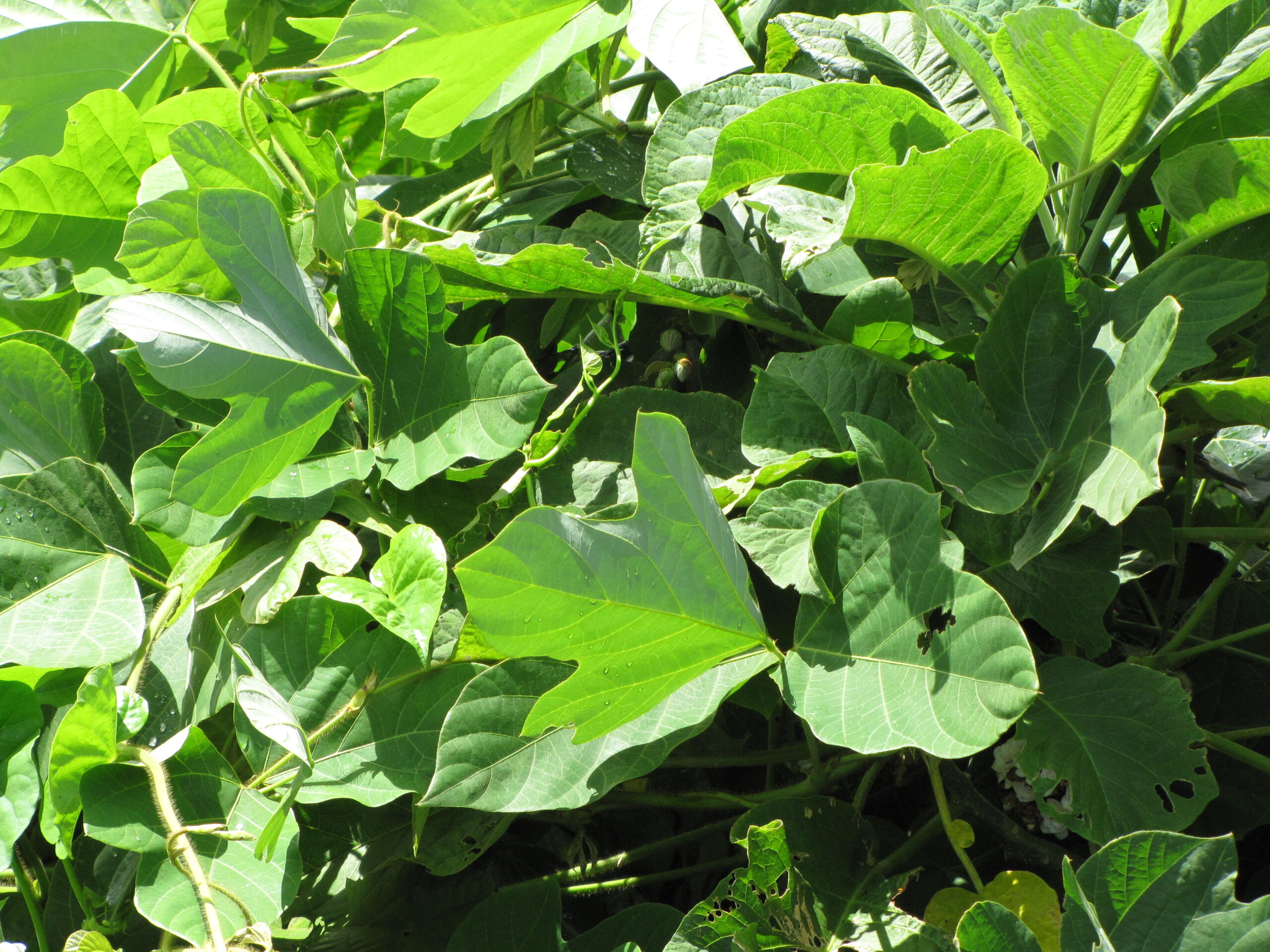

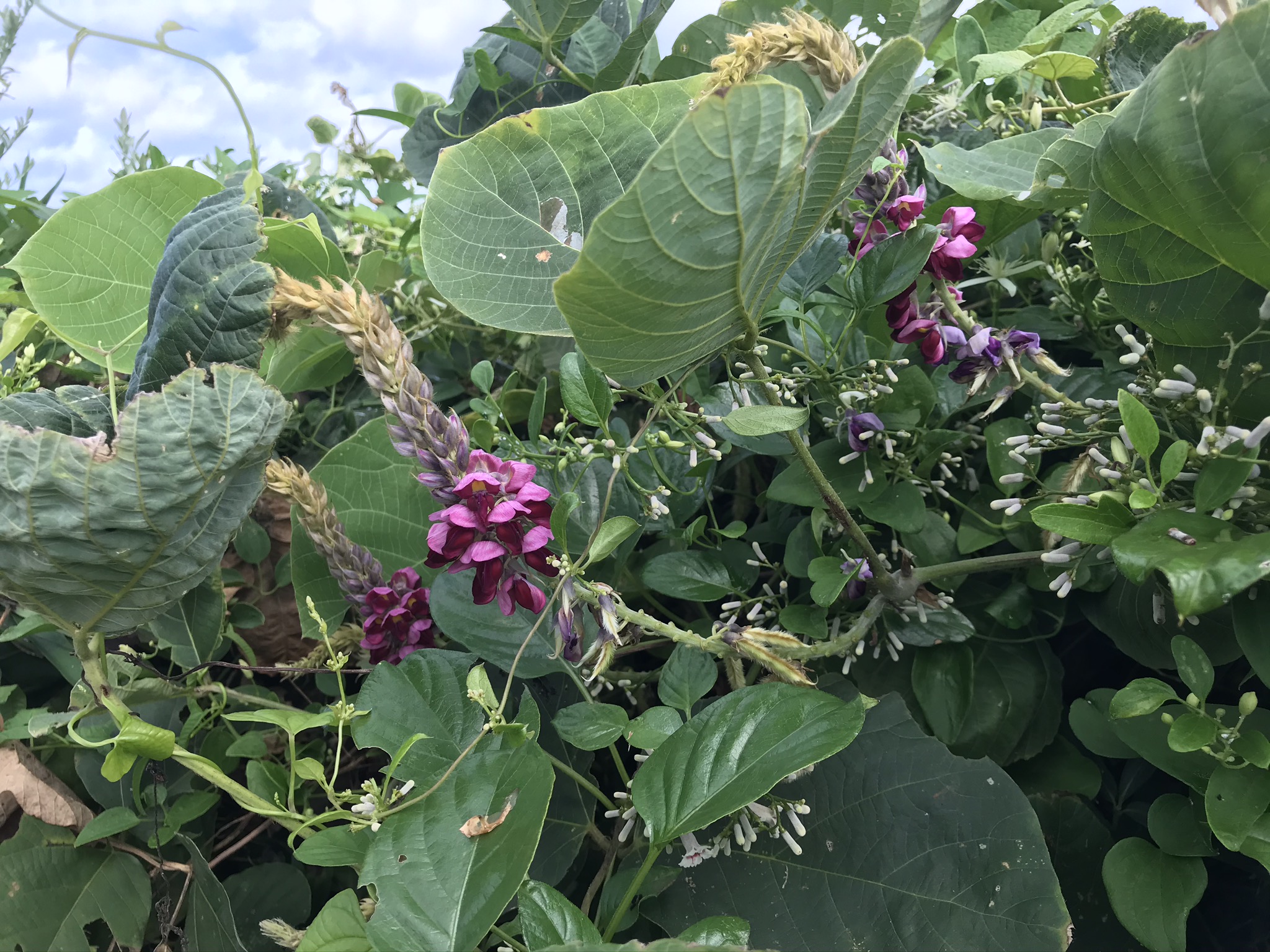
Kudzu is a deciduous, climbing, semi-woody perennial vine of the pea family, Fabaceae — the vine that ate the South, in the nickname it earned honestly. The United States form is Pueraria montana var. lobata, the East Asian arrowroot or kudzu vine, introduced from Asia at the 1876 Philadelphia Centennial Exhibition and then distributed across the South for erosion control, forage, and ornament, before it demonstrated, at landscape scale, that a vine that grows a foot a day and roots at every node is not erosion control but a smothering. Published accounts describe vine growth of up to 18 metres in a season, beginning at the root crown where vines meet the soil, with vines to 10 inches in diameter, taproots to 7 inches across and more than 10 feet underground, and tuberous roots that can reach depths of 16 feet and weights, in the most repeated accounts, of hundreds of pounds. A kudzu patch is not a vine. It is a root system wearing a forest.
The butterfly connection is real and it does not change the verdict. The silver-spotted skipper’s host list names kudzu, Pueraria montana, among its legumes — and the silver-spotted skipper also uses many other legumes, as skippers do, from wisteria to black locust and beyond. A caterpillar eating a vine does not make the vine a garden plant, any more than a caterpillar eating a crop makes the crop a weed. Do not plant kudzu for the silver-spotted skipper. If kudzu is already on your ground, the skipper will find it without your help, and your job is still to remove it.
Identification, because everything else depends on it. Kudzu leaves are alternate and compound, with three broad leaflets up to 4 inches across, sometimes lobed and sometimes entire — shade leaves tend to be unlobed, sun leaves lobed — with golden hairs, especially beneath, and a hairy stem that is yellow-green when young and rough, rigid, and dark brown when mature. The flowers are fragrant, purple, grape-scented, in long upright panicles in late summer, and the fruit is a flat, brown, golden-haired pod holding up to 10 hard seeds. The vine twines, trails, and climbs, forming thick mats along the ground and into trees, and it reproduces by vines rooting at nodes, by runners and rhizomes, and by seed — every one of which is a reason a single stem left alone becomes a patch, and a patch becomes a landscape.
Florida note: Kudzu is a southeastern problem, and Florida is in it — scattered dense infestations occur across the Southeast, and kudzu is a weed of forest edges, abandoned fields, roadsides, and disturbed ground throughout the region. If you garden in Florida and you see a fast-growing vine with three broad, hairy leaflets smothering a fence or a tree, assume kudzu until a closer look proves otherwise, and do not let it climb while you decide. Check Florida’s current listing and reporting guidance before you act: kudzu is regulated in several states, where sale, distribution, movement, and planting are prohibited, and landowners may have a duty to control it.
How to recognize it — and what it is not
Kudzu is confused with several native species, and the confusion matters because the natives deserve protection and the vine deserves removal. Poison ivy also has three leaflets, but poison ivy leaflets are smooth beneath, not golden-haired, and poison ivy climbs by aerial rootlets rather than by twining stems. Wisteria has 9 to 15 leaflets, not three, and longer hanging flower clusters. Virginia creeper has five leaflets and tendrils, not three leaflets and twining stems. Hog peanut, wild grape, and bur cucumber are further lookalikes in published accounts, all with different leaf, stem, or fruit characters. The combination that settles it is three broad, hairy leaflets plus twining, hairy stems plus grape-scented purple flowers in upright panicles plus a massive root crown: any two might be another vine, but all four together are kudzu, and a vine with all four should be treated as kudzu even before it flowers.
The damage is not theoretical. Kudzu smothers all other vegetation around it, climbing over seedlings and mature trees alike, killing the smothered plants by denying them light and disrupting their mutualistic interactions, and decreasing biodiversity across plants, animals, and insects in infested areas. An infestation that covers a tree is not shade. It is a slow killing, and the dead tree underneath is the receipt.
How to remove it
Removal is a multi-year project, and this guide will not pretend otherwise. For small infestations, cut vines to ground level and dig out the root crowns, located a few inches below the soil surface — removing the crown prevents regrowth, while removing only the tuberous taproot is not required for control, in published management accounts. Mow small infestations repeatedly, every month or every few weeks through the growing season for several consecutive years, to exhaust root reserves — published accounts describe cutting every 2 to 3 weeks for 2 to 3 years as the mechanical pattern that works. Smothering with heavy cardboard and deep mulch for 18 to 24 months blocks light and depletes root energy for small patches. Bag cuttings and seed pods for disposal or burn them where burning is legal — never compost kudzu vines with live nodes, because a node in compost is a planting, not a disposal.
For larger infestations, targeted herbicide, applied exactly by its label and timed to the plant’s growth — fall cut-stem treatment and mid-summer foliar treatment are the published patterns, with glyphosate, triclopyr, or clopyralid among the active ingredients used — can achieve high destruction rates, but published accounts warn that applications may have to be repeated for up to 10 years to achieve complete eradication, depending on the size and age of the population. Prescribed burning in spring can clear debris and sever climbing vines before summer treatment. Grazing by goats and sheep eats vines, but it does not remove root crowns, and it is a management tool, not an eradication. For a large infestation, especially near desirable natives or water, call your local extension service before you spray anything — the right product, timing, and buffer depend on your site and your state’s rules, and this guide does not substitute for that call. And never plant kudzu, never move it, and never share cuttings: in regulated states, that is not just bad gardening but a violation.
Common problems
- Node rooting. Every node that touches soil can root. Cut vines must be removed or killed, not left on the ground to reroot.
- Root crowns. Cutting vines without removing crowns guarantees regrowth. Dig crowns out of small patches; treat large patches repeatedly.
- Seed pods. Pods hold hard seeds that survive and spread by wind, animals, and water. Bag pods for disposal before they split.
- Climbing into trees. Vines in trees must be cut at the base and the cut stems treated — pulling vines out of a canopy by force damages the tree and showers the ground with nodes.
- Single-season thinking. Kudzu control takes years. A patch that looks dead after one cutting is a patch resting its roots, not a patch defeated.
- Mistaken identity. Spraying or pulling a native lookalike wastes a season and harms the plants kudzu threatens. Confirm the three hairy leaflets, twining stems, and root crown before you declare war.
Harvest
There is no garden harvest in this guide, and that is deliberate. Kudzu root is used in East Asian cuisine and herbal tradition as arrowroot starch, and kudzu has a history as forage and erosion control — and none of that makes a harvest recommendation responsible in a garden guide for an invasive vine. The only thing to take from a kudzu patch is the vine itself, bagged, for disposal — and the lesson, which is free: a plant introduced as an ornamental at a world’s fair, distributed for erosion control, and then left to grow a foot a day across millions of acres is not a crop that got out of hand. It is an introduction that was never properly questioned, and the correction is removal, repeated, for years.
Browse all plant & pest guides
Species
Kudzu is a single species complex, Pueraria montana, and this section names its forms in plain text, because the kudzu names are confusing and this guide will not pretend otherwise. The United States kudzu is Pueraria montana var. lobata, also published as Pueraria lobata — all names for the same invasive vine this guide covers. Pueraria montana var. montana and Pueraria montana var. thomsonii are other varieties of the species, not the United States kudzu, and are not covered here. Gardeners should identify by the combination of three broad, hairy leaflets, twining hairy stems, grape-scented purple flowers, and massive root crowns, and treat any vine with that combination as kudzu, whatever the nursery tag once said.