
🌿 Interior Live Oak
What it looks like
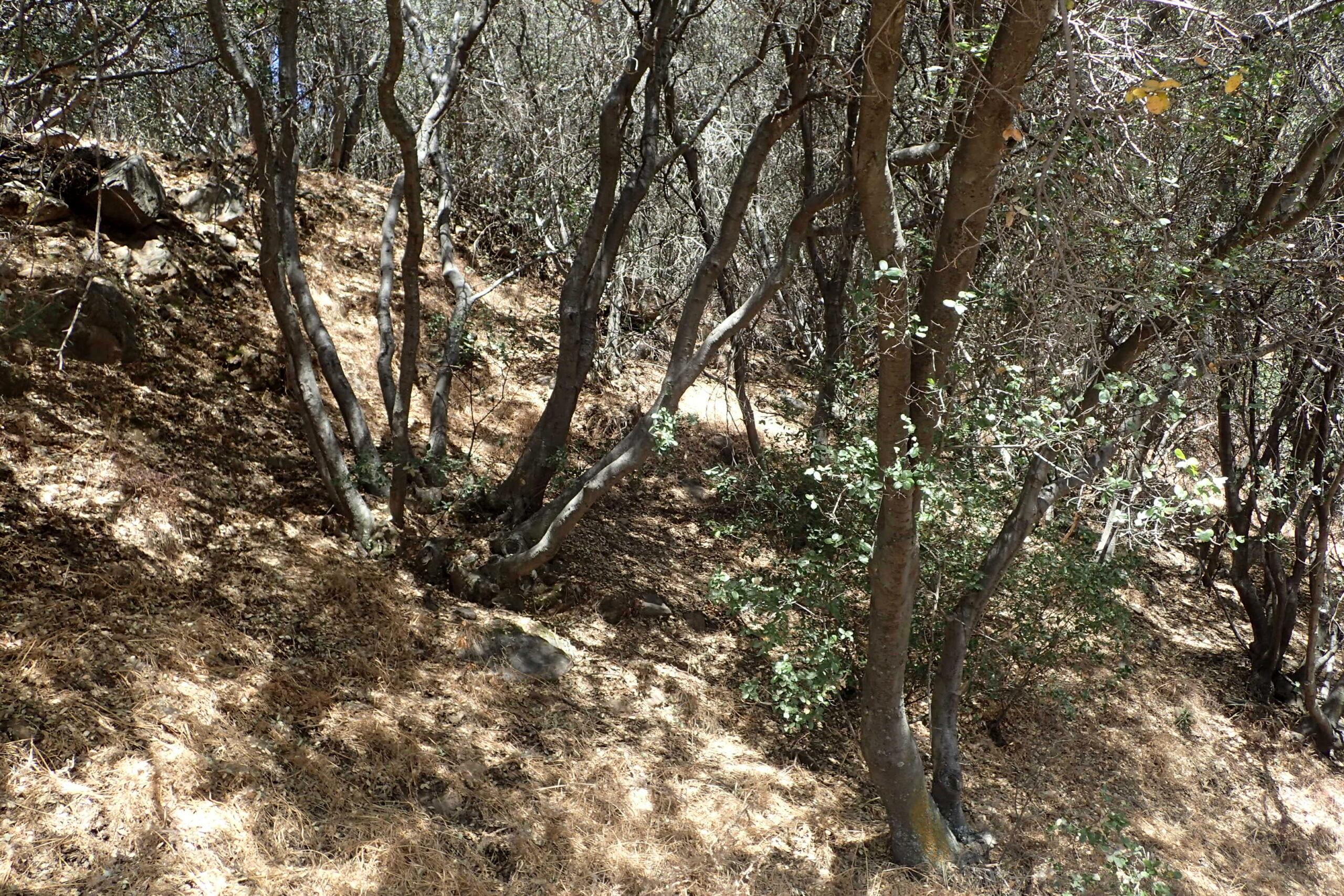

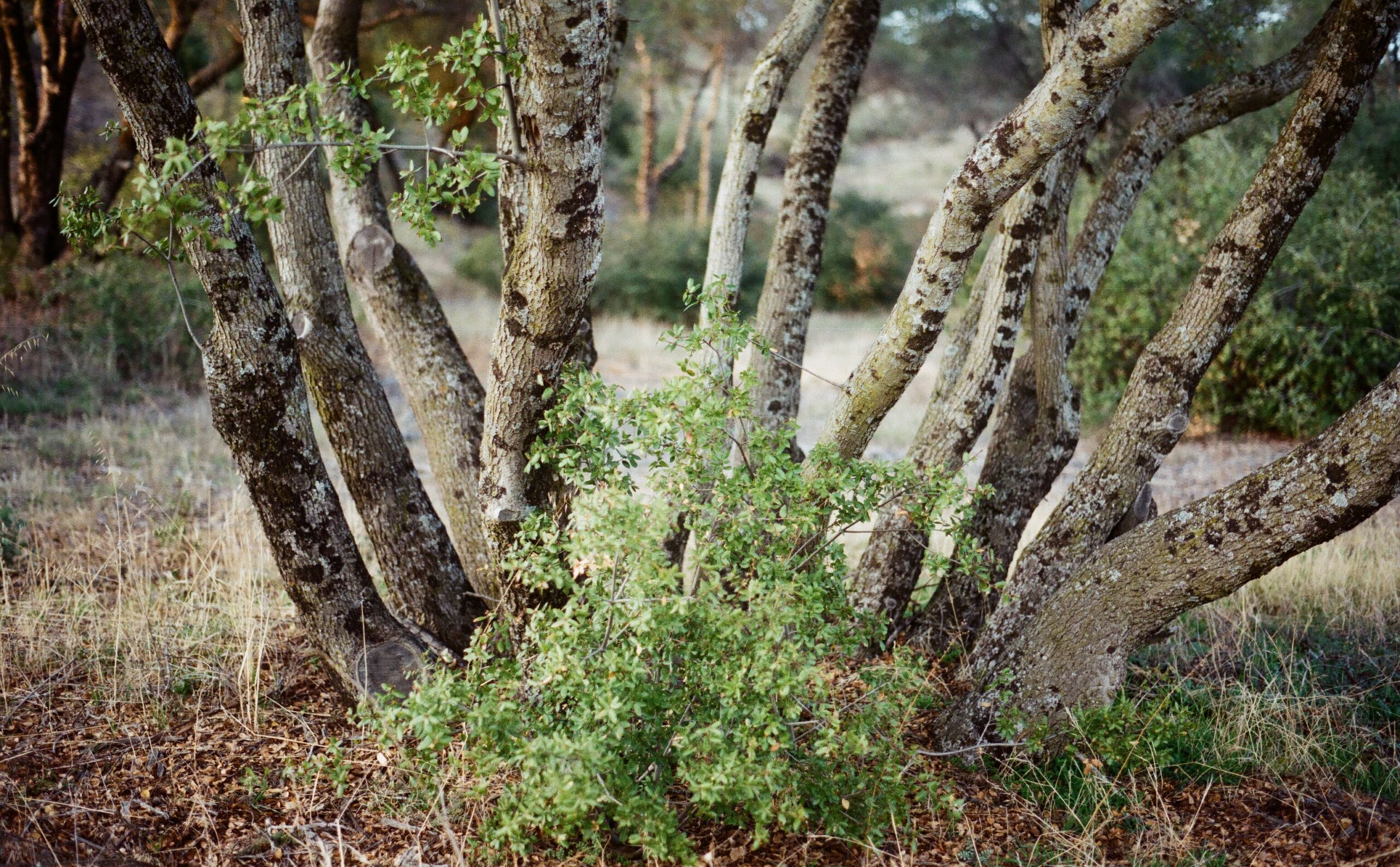
Interior live oak is a slow-growing, variable evergreen, and variable is doing real work in that sentence. On a good foothill site it grows as a large shrub or small to medium tree, thirty to seventy-five feet tall, with a short trunk and a broad, spreading, densely branched crown. On a dry chaparral slope it may stay a shrub eight to ten feet tall, which is not a different plant failing, it is the same plant answering a harder site. The leaves are evergreen, oblong to elliptical, two to five centimeters long, dark green and shiny above, lighter and shiny below, with margins from spine-toothed to entire and acute, pointed tips. The acorns are the oak story in miniature: food for deer, birds, and small mammals in fall, and the reason this tree anchors a whole food web.
The butterfly context is the California Sister guide, which names interior live oak (Quercus wislizeni) among its evergreen oak hosts above all, alongside canyon live oak and coast live oak. Those are different species with their own guides, and none is covered here. The site’s Oak guide is a different oak, and the genus-level oak story does not swallow this species. California Sister caterpillars eat oak leaves, and the oak chemistry that makes them unpalatable is why so many other species mimic them, which makes an interior live oak a butterfly tree in the most literal sense: plant it, and you plant the chemistry that protects a mimicry complex.
How to grow
Grow interior live oak where it already lives: California foothills, from Siskiyou and Shasta counties south along the Sierra Nevada foothills and the inner Coast Ranges, plus the Channel Islands, and south into northern Baja California, on dry slopes below about fifteen hundred meters, in oak woodland, chaparral, and mixed conifer forest. Give it full sun, well-drained soil, and room, and then give it time, because slow-growing is not a warning label here, it is the growth rate. A young tree planted today is a tree for a grandchild, and that is the correct way to think about it. Water through the first few dry seasons, then back off; this is a tree of hot, dry summers and cool, wet winters, and summer irrigation that keeps its feet wet is a worse friend than drought.
Florida note, stated plainly: interior live oak is not a Florida tree. It is a California Floristic Province oak, a red oak of the section Lobatae, and Florida’s heat, humidity, and summer rain are not its climate. A Florida reader who wants a live oak should look to the southern live oak already at home in the Southeast, not to this foothill species. The California Sister is a western butterfly, and this guide is for western gardeners and for readers who want to understand what that butterfly eats, not for a Florida planting list.
Water & feeding
Water is a story of seasons, not schedules. Interior live oak grows on soils roughly twenty to forty inches deep in the USDA accounts, on sites with twenty to forty inches of rain in the older plant guide, and it tolerates dry, well-drained ground once established. The practical rule is deep, infrequent water while young, and very little once the root system has found its depth, with no summer lawn irrigation over the root zone. Oaks and summer water are a classic bad marriage in California, because wet summer soil invites the root diseases that dry-summer oaks never evolved to meet. Let winter rain do the watering, and let summer be summer.
Feeding is none, in the ordinary garden sense. An oak in its native soil does not need fertilizer, and a fertilized oak mostly grows soft wood that breaks in wind and invites pests. The soil science that matters is mycorrhizal: oaks feed through fungal partners in the soil, and the leaf litter under an oak is not waste, it is the mulch that feeds that partnership. Leave the leaves, or compost them and return them, and do not rake an oak clean and then wonder why it sulks.
Common problems
- Variable form mistaken for a sick tree. A shrubby interior live oak on a dry slope is not a failed tree. Form follows site, and a ten-foot shrub in chaparral is the species doing its job.
- Summer water and root disease. The commonest garden mistake with California oaks. Keep irrigation, lawns, and sprinklers out of the root zone in summer.
- Wrong live oak, wrong tree. Coast live oak (Quercus agrifolia) and canyon live oak (Quercus chrysolepis) are different species with their own guides. Southern live oak (Quercus virginiana) is a different, southeastern tree. Buy by Latin name.
- Acorn litter. Acorns in fall are food for wildlife and a mess on a patio. Site the tree where acorns can fall, be eaten, and be left, not over a walkway you sweep daily.
Harvest
The harvest of an interior live oak is measured in decades, not seasons. Acorns in fall, shade in summer, a broad crown that shelters birds and insects, and wood that, in the old accounts, fed people who leached the tannins from the acorns and ground them into meal. This guide does not offer a home acorn recipe, because acorn processing is a skill with its own safety rules, and a casual paragraph would be a disservice to both the tree and the reader. The honest harvest is simpler: plant it, protect it from summer water and from the chainsaw, and let it become the tree that outlives the gardener who planted it. That is the crop, and it is a long one.
Browse all plant & pest guides
Saving seeds
Interior live oak acorns play by the same rule as every other oak acorn in this project: they are recalcitrant, which means they must never be dried out and stored in an envelope like a bean seed. An acorn that dries is a dead acorn. The whole method below is built around keeping them moist from the tree to the pot, and sowing promptly. If you can only remember one thing, remember that.
Collect acorns in fall as they drop, ideally by shaking a branch over a sheet or gathering freshly fallen nuts from the ground. Choose plump, undamaged acorns with their caps slipping off easily, and skip any with weevil exit holes, cracks, or a rattling kernel. Do the float test in a bucket of water: sinkers are keepers, floaters are usually hollow or insect-damaged and can be discarded. Do not let the keepers sit around drying on a counter. If you cannot sow the same day, hold them in a bag of barely moist sand, peat, or vermiculite in the fridge — cool and damp, never dry, never frozen solid.
Interior live oak sits in the white oak group, and white-oak acorns generally need little or no chilling before they germinate — many will sprout in the fall if sown promptly, sending a taproot down before winter while the shoot waits for spring. That is the easiest route: sow in fall in deep pots (a taproot needs depth; a shallow tray will spiral it into a knot), about an inch deep, in well-drained mix, and protect the pots from squirrels and jays, which regard your nursery as a buffet. If you must hold acorns over winter, the moist fridge hold described above works, with mold checks along the way — discard any that go soft or furry rather than letting rot spread to the batch.
Seedlings vary, because oaks hybridize freely within their group and a seedling is a genetic reshuffle, not a clone. If you have a particular tree whose form you love, grafting is the faithful route; seed is for species trees, wildlife plantings, and restoration. Expect a slow start above ground while the taproot does its work underground, and do not judge a seedling by its first season’s height. Plant out while young, because oaks resent transplanting once that taproot is established, and give the tree the space it will need in fifty years, not the space it needs today.
Species
Interior live oak (Quercus wislizeni) is the species this guide covers, with two recognized varieties in the USDA accounts: Quercus wislizeni var. wislizeni, the tree form, and Quercus wislizeni var. frutescens, the shrub form. Taxonomic work has noted that the original descriptions of these two forms may have been swapped, so the tree-form and shrub-form boundary is less clean than the variety names suggest, and this guide does not over-pin it. Older names sometimes attached to this plant include Quercus parvula and Quercus shrevei, and the Coast Ranges segregate Quercus parvula is treated as a separate species in some modern accounts, as noted above. Canyon live oak (Quercus chrysolepis) and coast live oak (Quercus agrifolia) are different species with their own guides, and neither is covered here. This guide covers Quercus wislizeni only.