
🌺 Turk’s Cap
What it looks like
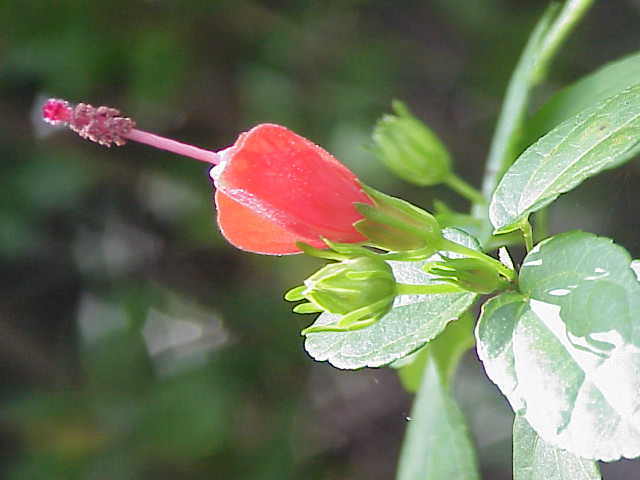
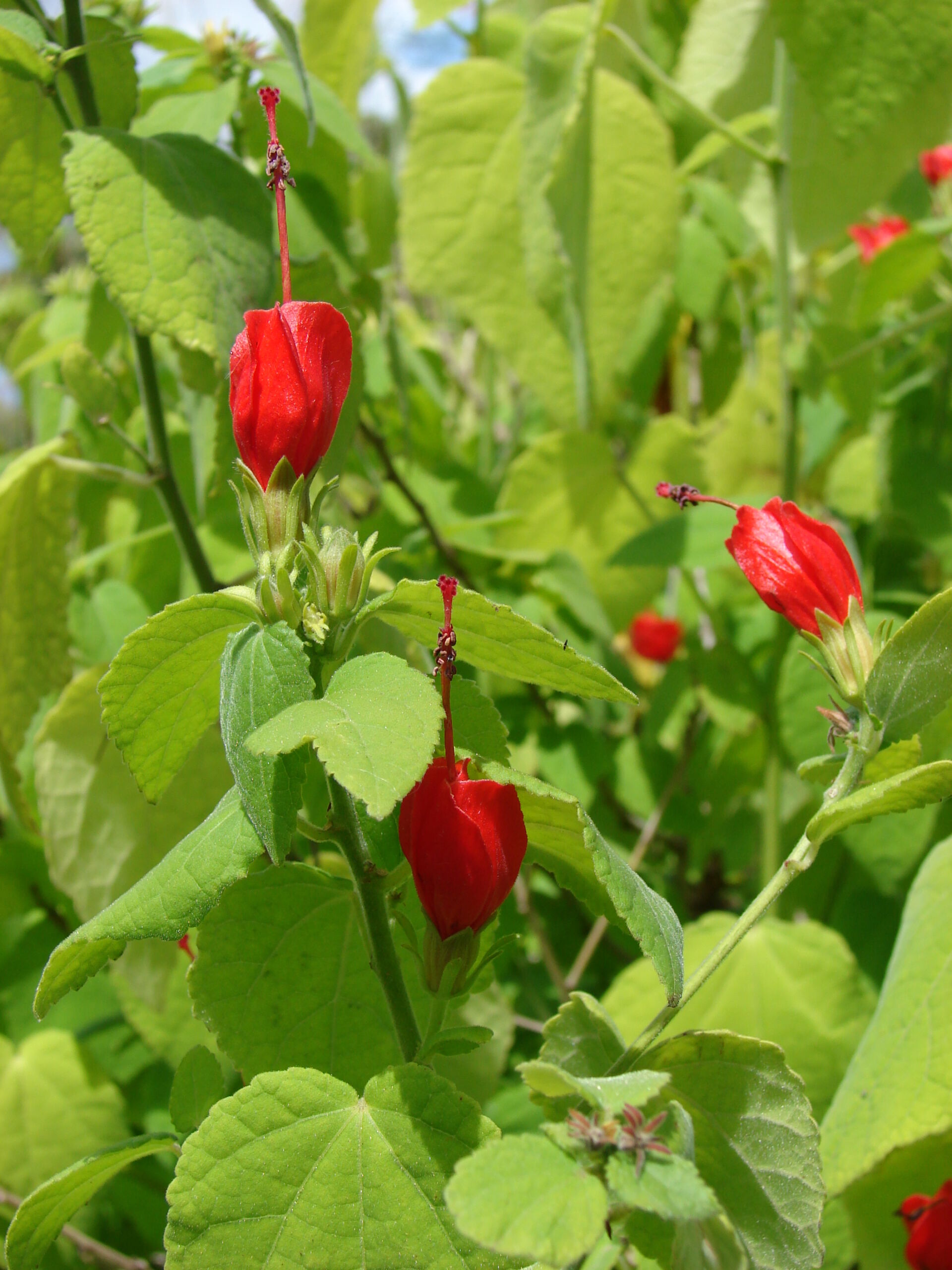
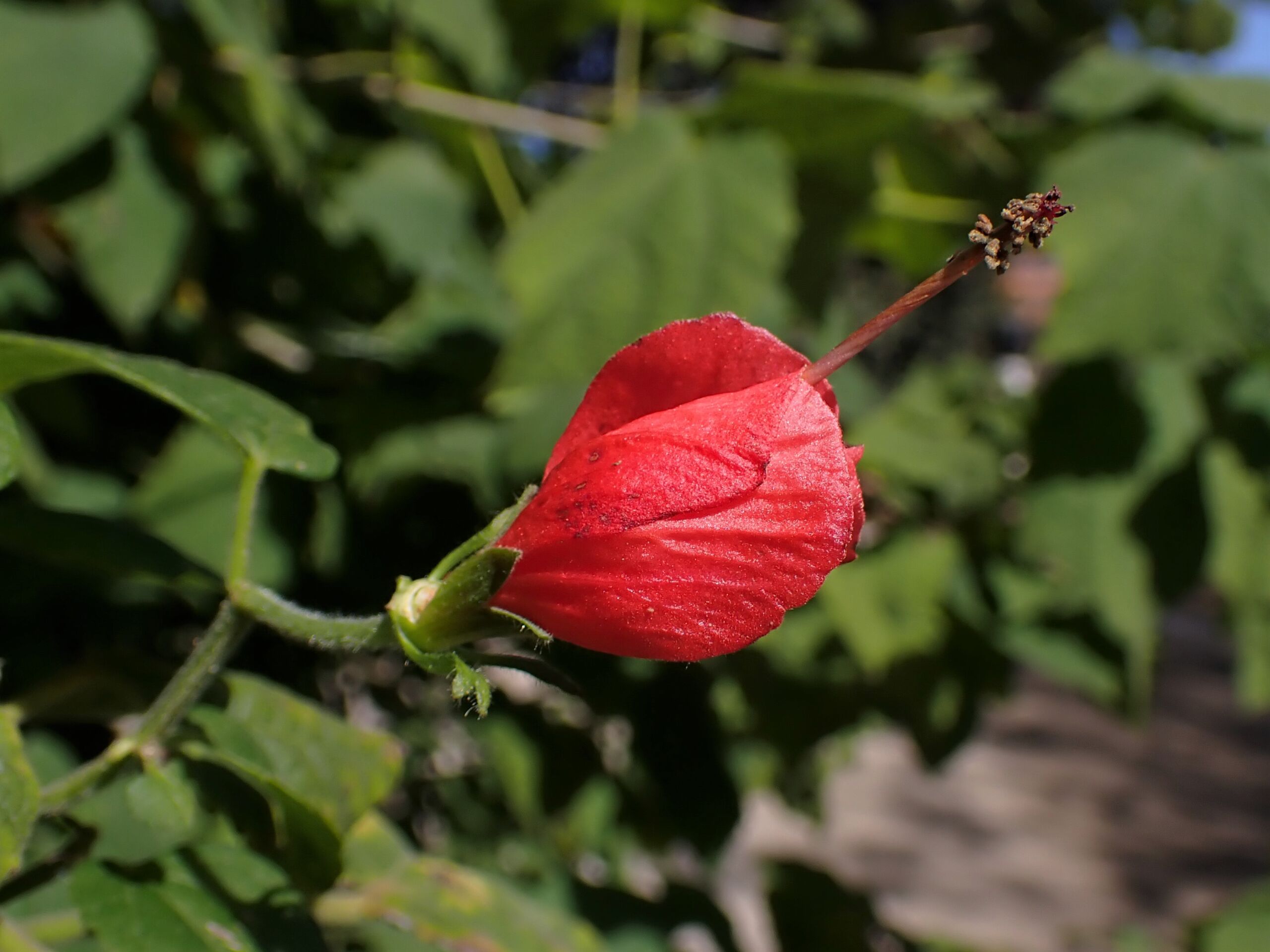
Turk’s cap is a shrub of the mallow family, Malvaceae, native from Texas south through Mexico and Central America into South America, and naturalised in warm gardens far beyond that range. It is a tough, multi-stemmed shrub, usually 3 to 6 feet tall in gardens and taller where it is happy, with soft, heart-shaped, slightly fuzzy leaves and a habit of blooming through the warm months and well into autumn. It is one of the few flowering shrubs that genuinely tolerates shade — not just survives it, but flowers in it — which is why southern gardeners plant it under trees where other shrubs give up and go green.
The flower is the whole show, and it is a trick flower: bright red, about two inches long, shaped like a Turk’s turban or a tightly furled umbrella, with the petals spiralled shut and never fully opening, and a long column of stamens poking out of the top like a tassel. Hummingbirds, with their long bills and longer tongues, get in perfectly well; bees mostly admire it from outside. The flowers are followed by small, apple-like red fruit, edible though not exciting, which birds eat with more enthusiasm than people do. The plant is sometimes called sleeping hibiscus, wax mallow, or ladies’ teardrop, all of which describe the same unopened flower from different angles.
The variety most gardeners in the southern United States actually grow is var. drummondii, the Texas native form, which is hardier than the tropical species — it dies back to the ground in a hard freeze and resprouts from the roots in spring, which is how it survives into zone 7 and sometimes colder with mulch. The species as a whole is a zone 9 to 11 plant; the drummondii variety is the reason the plant’s garden range stretches further north than its passport suggests. In Florida, Turk’s cap is a genuine landscape shrub, flowering in shade and sun alike, and it is the plant this site’s Academy profile covers as Turk’s Cap (Malvaviscus arboreus var. drummondii) — this growing guide is the plant-guides version for gardeners planting the species, and the two coexist.
How to grow
Start with shade — or at least, do not fear it. Turk’s cap flowers in full sun, part shade, and surprisingly deep shade, with part shade the sweet spot: enough light for abundant flowers, enough shelter to keep the leaves lush. A spot under high trees, a north- or east-facing border, or a shaded courtyard are all right. Full, blazing, all-day sun in a hot climate is tolerated but the plant looks better with afternoon shade, and deep, dark shade under evergreens will give you leaves and few flowers. For most southern gardens, “bright shade” is the instruction.
Soil should be moist, well-drained, and humusy — ordinary garden soil with compost worked in suits it fine, and it tolerates clay better than many shrubs provided it is not waterlogged. It is not fussy about pH, and it is not a plant to pamper with special mixes: compost, mulch, and steady moisture are the whole soil programme. Space plants 3 to 5 feet apart; a mature shrub spreads to a loose, multi-stemmed mound, and in a hedge or screen you can plant tighter and prune to shape.
Plant in spring, after the last frost, from a nursery plant — seed is slow and variable, and the named forms are worth buying true. Water well at planting and through the first growing season. In zones where it dies back in winter, mulch the crown heavily in autumn with leaves or straw, cut the dead stems back in early spring once new growth shows from the base, and do not panic in April if nothing has appeared yet: it resprouts late, and a plant that looks dead in March is often just being fashionably late. In frost-free zones, prune lightly after a flowering flush to shape it and encourage more blooms, and cut back hard every few years if it gets leggy — it resprouts vigorously from old wood.
Water & feeding
Water steadily through the growing season. Turk’s cap likes consistent moisture — a deep soak once or twice a week in dry weather, with mulch to hold it — and it sulks, dropping buds, if it dries out repeatedly while flowering. It is not a bog plant and does not want waterlogged roots, but it is also not a drought plant: “moist, not soggy” is the rhythm, and a rain garden margin or a bed you water anyway suits it well. In a container, water more often, since pots dry faster than beds.
Feeding is light and regular. A mulch of compost each spring and a balanced fertiliser in spring and midsummer is plenty for a flowering shrub; over-feeding with nitrogen gives you leaves at the expense of flowers, which defeats the purpose of planting it. In rich soil, compost alone may be enough. Watch for yellowing leaves in a container, which usually means hunger or pH drift, and feed lightly rather than heavily — this is a tough shrub, not a hungry annual.
Maintenance is mostly pruning and patience. Deadhead if you like tidiness, though it is not required for rebloom; cut back dead stems in spring in cold zones; and thin out the oldest stems every few years to keep the shrub vigorous and open. It self-sows lightly where it is happy, and seedlings are easy to move or remove. It is not invasive in the aggressive sense, but in a warm garden it will volunteer — which, for a hummingbird shrub, counts as a gift, not a problem.
Common problems
- It looks dead in spring. In cold zones it dies back to the roots and resprouts late. Wait until May before declaring it dead, and check for green at the crown before digging it up.
- Bud drop. Usually dry soil while flowering, or a sudden cold snap. Keep moisture steady through bloom and do not let the plant dry out in summer.
- Few flowers in deep shade. It tolerates shade, but very dark shade costs flowers. Move it to brighter shade or dappled sun if you want blooms rather than leaves.
- Aphids and whiteflies. Soft mallow growth attracts sap-suckers, especially in warm, sheltered spots. Wash off with a strong jet of water, encourage ladybirds, and avoid broad-spectrum sprays that kill the hummingbirds’ food along with the pests.
- Root rot. Waterlogged soil, especially in a container without drainage. Improve drainage and replant only firm roots.
Harvest & wildlife
The traditional harvest is the flower and the fruit: the red turban flowers are edible, mild and mucilaginous like other mallows, and are used fresh in salads or as a garnish, and the small red fruit is edible raw, apple-like and seedy, though birds usually get to it first. The leaves, like other mallows, are mucilaginous when cooked and have been used as a potherb. None of this is the reason most people plant it; the reason is the wildlife. Hummingbirds visit the unopened flowers constantly through the warm months, butterflies visit the open fruit and the occasional flower, and birds eat the fruit — it is a one-shrub wildlife station that also happens to flower in shade.
The butterfly connection is in the name. The Turk’s-cap White-Skipper’s caterpillars feed on mallow-family plants, with Turk’s cap (Malvaviscus arboreus) as the signature host, along with other mallows of the South, and the adults visit Turk’s cap blooms themselves for nectar. Where Turk’s cap grows, the butterfly guide says, this skipper can grow. That is a gardenable skipper in its range: plant Turk’s cap — a tough, shade-tolerant native shrub with red turban-shaped flowers — leave it unsprayed, and you have provided both caterpillar food and nectar in one plant. Hummingbirds will also thank you, which is a sentence that should be on more plant labels.
Browse all plant & pest guides
Saving seeds
Turk’s cap saves its seed the way a mallow does, and the harvest is easy to spot. After the red turban flowers fade, the plant sets small red fruit that ripens in fall. Wait until the fruit is fully red and soft, then pick it, mash it gently, and rinse the pulp away in a bowl of water. The seed sinks and the pulp floats, which makes cleaning simple. Dry the seed on a tray for a week before jarring it.
There is no stratification, no scarification, no fuss. Sow the seed after the soil has warmed in spring, barely covered, in rich moist soil in part shade. Germination is quick in warm soil. Self-seeding happens around an established shrub, and the volunteers transplant easily while they are small. Deadhead the spent flowers if you do not want volunteers, or let a few fruit ripen and enjoy the free plants.
Cuttings are the reliable route to more plants that are exactly like the parent. Semi-hardwood cuttings taken in warm weather root readily, and a cutting is a clone of its parent, flowers and all. Seed is the route to new genetics and to sharing plants with friends, and it is the route that costs nothing. Both work. Cuttings are certain, seed is an adventure.
Crossing happens within the species, so if you grow more than one Turk’s cap selection and save seed, expect some mixing. Grow one if you want seed that stays itself. Stored dry, the seed keeps well for a few years, and Florida humidity is the enemy of stored seed, so dry it thoroughly before jarring it, add a silica gel packet, and keep the jar cool and dark.
Florida is Turk’s cap country. The shrub thrives in shade and heat, flowers for months, and feeds hummingbirds all summer. The seed you save is next year’s hummingbird feeder, and it costs nothing.
Varieties & relatives
Texas Turk’s cap — Malvaviscus arboreus var. drummondii — The hardy form most southern gardeners grow, dying back in freezes and resprouting from the roots; covered by this site’s Academy native-plant profile, which coexists with this species guide.
Pink Turk’s cap — Malvaviscus arboreus var. mexicanus and pink-flowered forms — Pink rather than red turban flowers, same habit and toughness, less common in nurseries; listed here in plain text, not claimed as separate species.
Not this plant — Redvein Chinese lantern (Callianthe picta, formerly Abutilon) is a different mallow with lantern-like flowers and its own growing guide; it is not Turk’s cap, and a plant labelled Turk’s cap with fully opening, lantern-shaped flowers is mislabelled. True hibiscus (Hibiscus spp.) flowers open wide; Turk’s cap flowers, famously, do not.