
🌿 Mistletoe
What it looks like
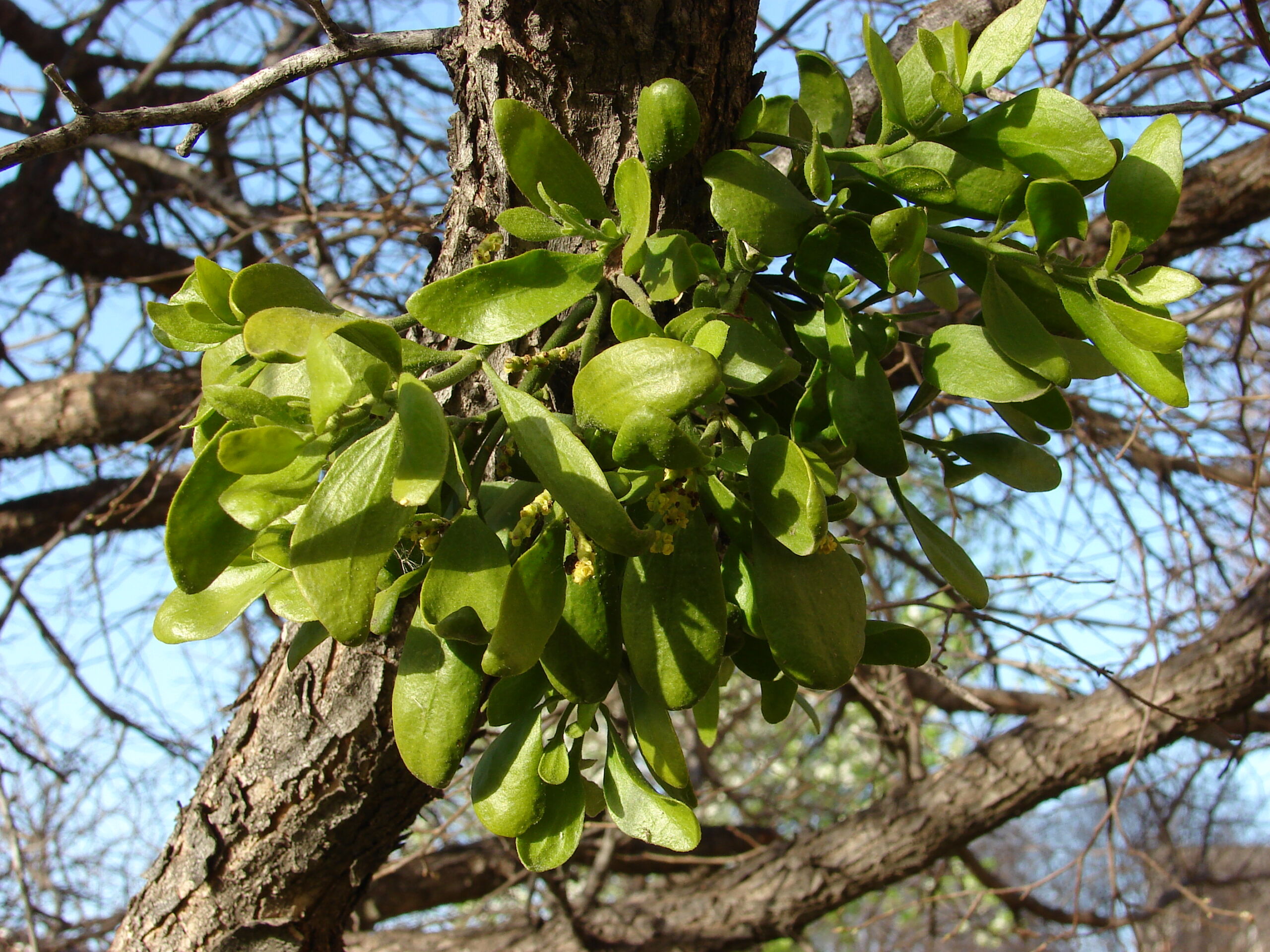
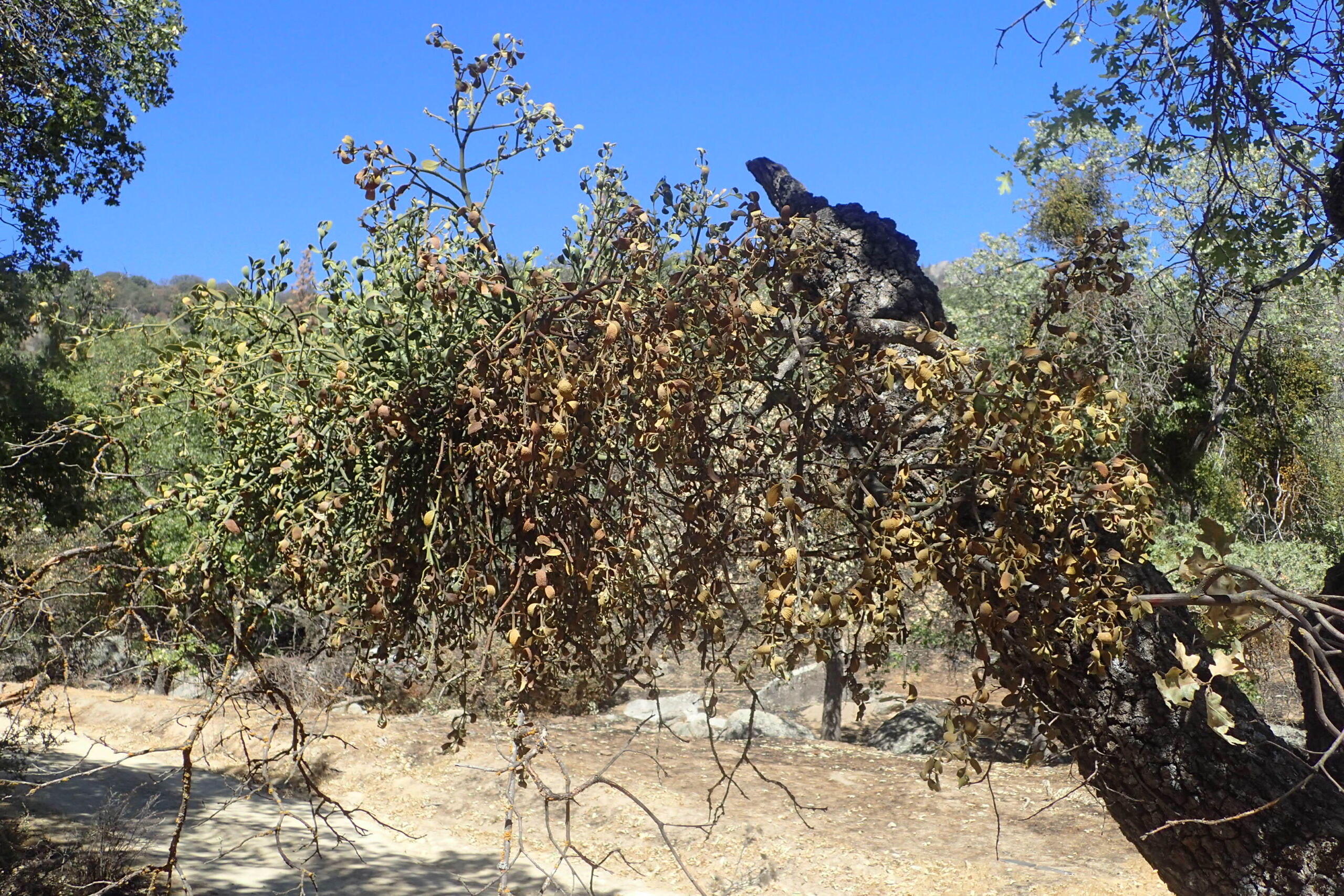
First, the most important correction in this guide, stated before anything else: this is not the dwarf mistletoe guide. Dwarf mistletoes belong to the genus Arceuthobium, they parasitize conifers, and they have their own genus guide and seven species guides on this site. The mistletoe in this guide is Phoradendron, the American mistletoe of hardwood treetops, in the family Viscaceae (formerly placed in Loranthaceae). The genus name is wonderfully honest about the lifestyle: from Greek phor, a thief, and dendron, a tree. Thief-tree. It earns the name, and it also earns a second look, because a thief that photosynthesizes is a more interesting character than a pure parasite.
Phoradendron species are hemiparasites, which is the technical way of saying they cheat only partly. They have green leaves and they photosynthesize, making their own sugars, but they sink root-like feeding organs called haustoria into the branches of their host trees and draw off water and minerals. Look up into a leafless winter oak and you will see them at once: big, evergreen, yellow-green balls of foliage sitting in the crown where no oak branch should be that green in January. The leaves are thick, leathery, and opposite, the stems jointed and brittle, and the plant forms a dense, rounded clump that can grow large over years. In late fall and winter it carries clusters of small, fleshy, sticky white berries, each with a single seed wrapped in glue. That glue is the whole business model, and it belongs to the birds.
The flagship species is oak mistletoe, Phoradendron leucarpum, whose epithet means white fruit, and it is the mistletoe of the eastern and central United States, from central Florida west to Texas and north into the Ohio Valley and mid-Atlantic, parasitizing more than 60 tree species, especially oaks, but also elms, hackberries, sycamores, wild cherry, maples, ashes, walnuts, pecans, cottonwoods, and mesquites. Mahogany mistletoe, Phoradendron rubrum, is the second name in the great purple hairstreak’s Florida story. Western species, including the hairy mistletoes of the tomentosum group pictured above, extend the genus across the Southwest and into Mexico. Wherever you are in the southern United States, if there is a green ball in a hardwood crown in winter, it is very probably a Phoradendron, and it got there the same way every mistletoe gets anywhere: a bird ate a berry somewhere else and wiped its beak, or dropped its business, on your branch.
How to grow
Here is the honest truth about growing Phoradendron, and it is the reason this guide’s hero stats refuse to give you a spacing or a soil pH: you do not grow it. Not in the garden-center sense. Nobody sells you a mistletoe in a pot, because a mistletoe in a pot is a contradiction: it needs a living branch to sink its haustoria into, and it needs years in a canopy to become the clump you recognize. The traditional method, for the determined and the patient, is to press fresh, ripe berries onto a suitable host branch in late winter and wait, and even then success is a matter of the right host, the right branch age, and several years of patience before you know whether it took. The Royal Horticultural Society and old orchard books describe exactly this, and they also describe how often it fails. For most gardeners, the realistic version of growing mistletoe is stewardship: if a host tree in your yard already carries it, you are its gardener whether you applied for the job or not.
That stewardship has a simple rule: a healthy host tree tolerates a moderate mistletoe load, and a stressed tree does not need the extra drain. Mistletoe typically does not kill its host outright, but a heavy infestation on a drought-stressed, old, or already declining tree is a real burden, because every gallon of water the mistletoe transpires is a gallon the tree does not get. Pruning out mistletoe clumps is possible, but it only works if you cut the branch well below the clump, because the haustoria live inside the wood and a clump cut flush will resprout from the embedded tissue. If you prune for the tree’s sake, prune for the tree, and do it in the dormant season with clean cuts. If you prune because mistletoe offends you on principle, consider the next section first, because you may be pruning out a butterfly.
Water and feeding
Mistletoe waters and feeds itself through its host, which is another way of saying that your watering can is irrelevant to it. It transpires freely, even greedily, which is part of why it stresses drought-hit trees: it keeps its stomata open and keeps drinking while the host is trying to conserve. You do not fertilize mistletoe, you do not mulch it, and you do not water it. You water the host tree, deeply and infrequently in dry spells, and you keep the host vigorous, because a vigorous host is the only mistletoe management plan that does not involve a saw. This is a plant whose entire horticulture is secondhand, and that is part of its charm: it forces you to garden the tree, not the decoration.
Common problems
The problems of mistletoe are mostly problems of perspective. To an orchardist or a forester, a heavy infestation is a pest problem, reducing growth and fruiting and, in severe cases, hastening a weak tree’s decline. To a wildlife gardener, the same clump is a bird feeder, a butterfly nursery, and a wintergreen landmark. Both views are true, and the right response depends on which tree and how much mistletoe. A young, vigorous oak with two clumps is a wildlife feature. An ancient, drought-stressed pecan smothered in dozens of clumps is a tree in trouble, and the mistletoe is one stressor among several, not a villain acting alone.
The one problem that is not a matter of perspective is toxicity. Mistletoe berries are poisonous to people and pets, and they have been known to cause serious illness, including seizures, when ingested. This is not a plant to bring indoors for the holidays and leave within reach of children or dogs, and it is not a plant to nibble out of folklore curiosity. The Christmas tradition of kissing under the mistletoe is charming; eating the mistletoe is not part of it. Handle cut branches with the respect due to any toxic plant, keep berries away from mouths and paws, and compost prunings where children will not play with them.
Harvest
There is no culinary harvest from Phoradendron, and the traditional medicinal uses that fill old herbals are not something this guide will dress up as a recommendation, because the plant is toxic and the line between a historical dose and a poisoning is not one to walk casually. The harvest that matters is ecological and observational: mistletoe berries feed birds through winter, including the cedar waxwings and robins that spread the seeds to the next tree, and the flowers attract pollinators, including wasps and bees. If you cut a sprig for the doorway in December, cut it from a vigorous tree, keep it out of reach, and compost it after the season. That is the whole harvest, and it is enough.
Propagation
Mistletoe is not a plant you propagate. It is a parasite that steals water and minerals from the branches of oaks and other trees while doing its own photosynthesis, and it arrives in your trees by bird, not by garden center. The white berries are eaten by birds, the sticky seed passes through, and it lands on a branch where it germinates and sinks a root into the wood. That is the whole method, and it is the bird’s job, not yours.
Deliberately planting mistletoe seed on a tree is not good gardening and not good stewardship. A heavy infestation weakens branches, and a tree already stressed by drought or disease does not need a parasite’s help. If mistletoe appears in your trees, the question is whether to leave it or remove it — not how to grow more of it. A light clump on a healthy oak is mostly harmless and feeds the great purple hairstreak, a butterfly whose caterpillars eat nothing else. A heavy load, or mistletoe on a young or struggling tree, is worth pruning out, cutting the branch a foot below the clump so it does not regrow.
If you want mistletoe for the holidays, cut a sprig from a tree that already has it, with the owner’s permission, and leave the rest for the birds. Do not try to seed it onto a new tree: the germination is fussy, the establishment is slow, and the result is a parasite on a tree that did not ask for one. The birds will plant it where it belongs, in their own time.
This is a stewardship note, not a seed-saving section, and deliberately so. Some plants are not for propagating, and a green parasite that lives by stealing from oaks is one of them. Enjoy it where it grows, protect the hairstreak that depends on it, and let the birds do the planting.
Species in this group
The genus Phoradendron holds roughly 200 species across the Americas, and only a handful matter to a North American gardener. Oak mistletoe, Phoradendron leucarpum, is the eastern and central species and the great purple hairstreak’s host across the Southeast, including Florida. Mahogany mistletoe, Phoradendron rubrum, is the second Florida host named in the butterfly guide. The western hairy mistletoes, grouped under Phoradendron leucarpum subsp. tomentosum (formerly Phoradendron tomentosum and Phoradendron villosum in older books), carry the genus across Texas and the Southwest. European mistletoe, Viscum album, is a different genus entirely, in the same family, and it is the mistletoe of European Christmas tradition; it does not grow wild in North America, and it is not the plant in this guide. And the dwarf mistletoes, Arceuthobium species, are not Phoradendron at all: they are small, leafless, conifer parasites with their own guides, and the Johnson’s hairstreak and thicket hairstreak depend on them, not on this genus. If your mistletoe is in a pine, it is almost certainly a dwarf mistletoe. If it is a green ball in an oak, it is almost certainly a Phoradendron. That one field mark sorts out most of the confusion in the whole mistletoe world.
The butterfly connection is the reason this guide exists at all, and it is absolute. The great purple hairstreak, Atlides halesus, eats mistletoe in the genus Phoradendron and nothing else, as caterpillars and, as adults, sipping nectar from mistletoe flowers themselves. Its map is the mistletoe’s map. You cannot plant a great purple hairstreak garden from a catalog, because you cannot buy this plant in a pot, but you can protect the mistletoe that birds have already planted in your oaks, and you can leave a vigorous host tree standing instead of removing it for tidiness. That is how you garden for this butterfly: by not gardening against its nursery.