
🌿 Musa
What it looks like
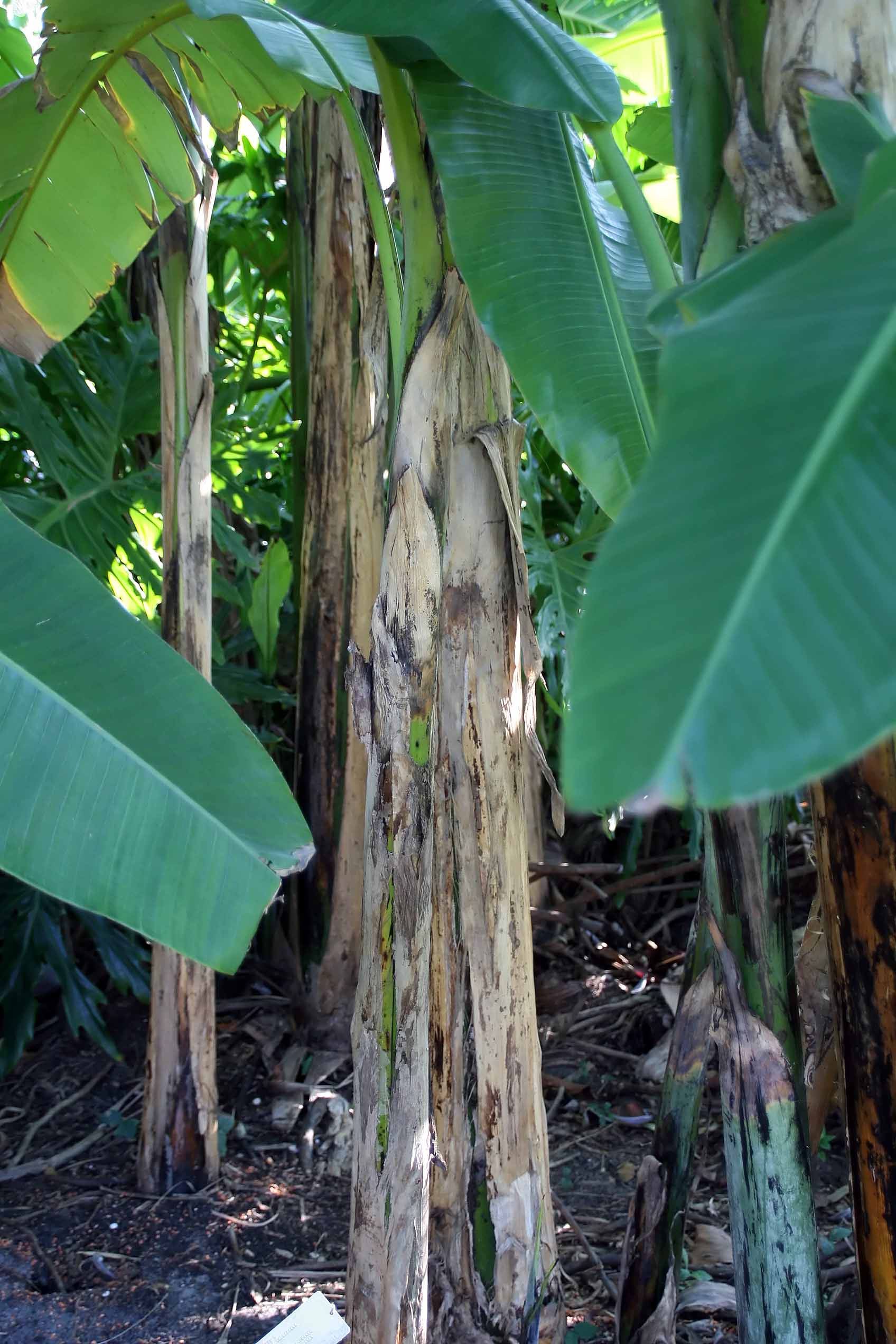
Musa is a genus of large herbaceous plants in the banana family, Musaceae, and the first thing to get straight is that a banana is not a tree. It has no woody trunk. What looks like a trunk is a pseudostem, a tight roll of overlapping leaf sheaths, rising from an underground corm, and the whole structure is a herb that happens to be enormous. The leaves are among the largest of any plant grown in gardens: great, paddle-shaped blades, often several feet long, that unfurl from the center of the pseudostem, catch the wind, and shred along the veins into ribbons, which is cosmetic, not damage, and is the reason a banana patch always looks a little windswept. The plant is, as the site’s banana guide puts it, the world’s largest herb pretending to be a tree, and doing it fabulously.
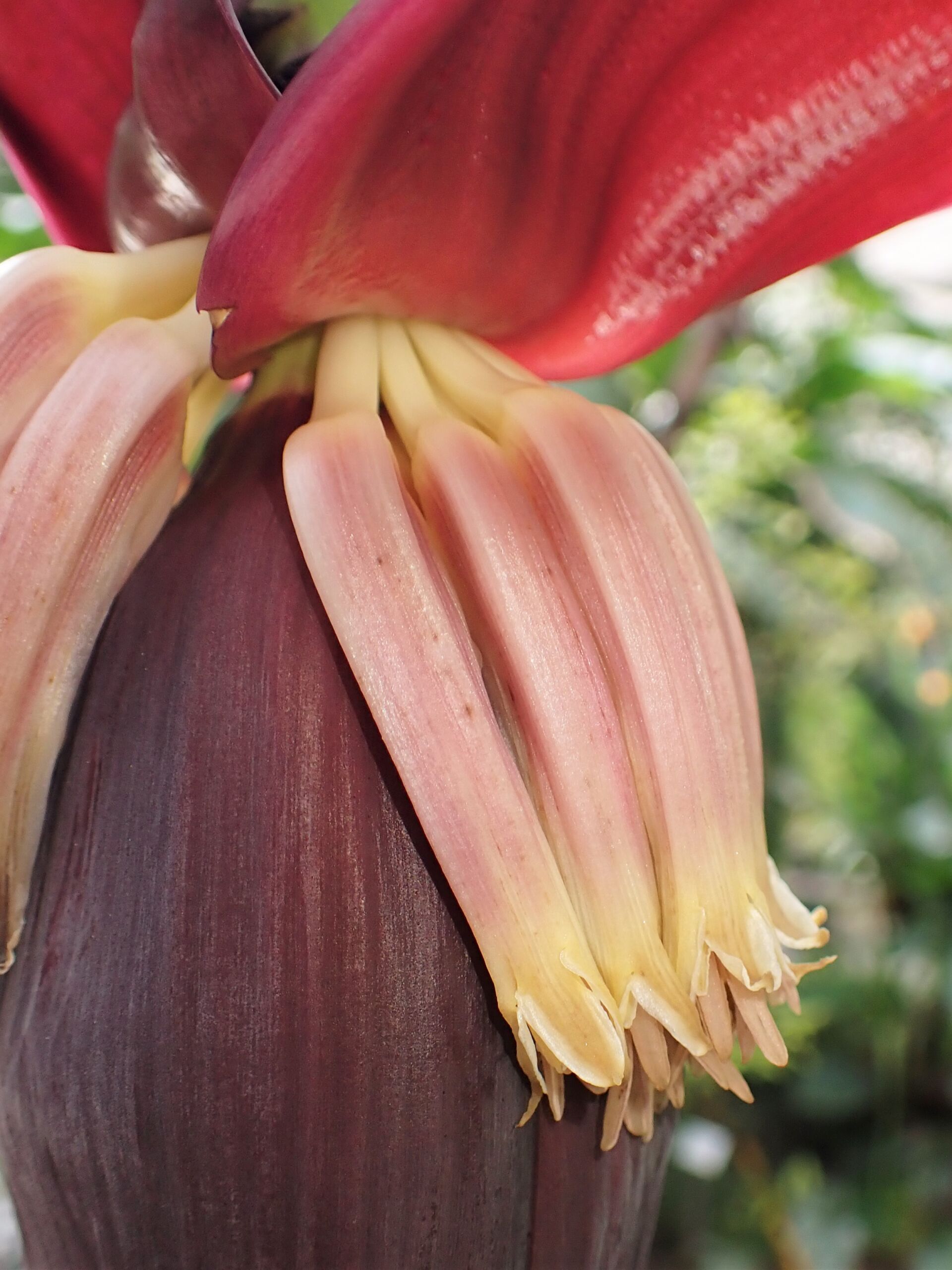
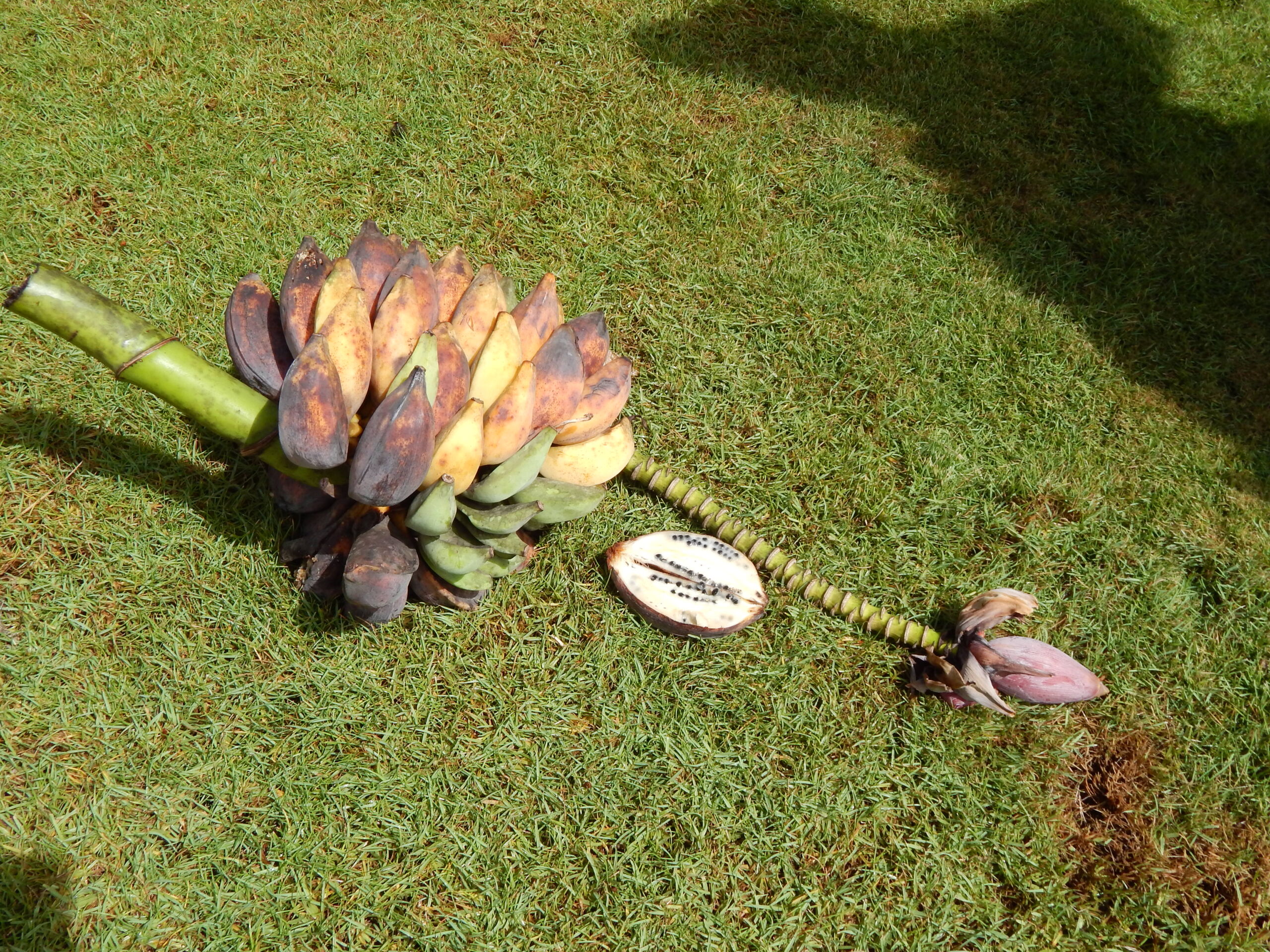
The genus holds roughly 70 species, native to tropical Asia, Southeast Asia, and the Pacific, with two wild species doing most of the work behind the fruit in your kitchen. Musa acuminata is the slim, sweet parent, contributing the A genome, and Musa balbisiana is the hardier, starchier parent, contributing the B genome. Nearly every edible banana is a hybrid or polyploid of those two: the Cavendish bananas of the supermarket are triploid acuminata types, plantains are acuminata-by-balbisiana hybrids grown for cooking, and the wild species themselves carry large, hard seeds, as the balbisiana fruit photo above shows, which is why you do not eat a wild banana the way you eat a Cavendish. The flowers are the other show: a great, pendulous inflorescence with purple bracts peeling back to reveal rows of flowers, the female flowers at the base setting fruit, the male flowers at the tip feeding pollinators, and the whole structure hanging like a lantern from the top of the pseudostem.
Each pseudostem fruits once and dies, which sounds tragic until you see the rest of the plan. Around the base of every fruiting stalk, the corm sends up pups, suckers that replace the mother stalk in a relay race that can keep a banana patch going indefinitely. A banana patch is therefore not a collection of trees but a single, clonal colony with stalks of several ages, and the gardener’s job is to manage the relay: leave one or two strong pups to replace each fruiting stalk, remove the extras, and chop the spent trunk for mulch, because it is basically a water-filled compost log. In Florida, that relay runs year-round in the south and seasonally in the north, where hard freezes kill the foliage but the corm often resprouts in spring.
How to grow
Plant Musa in full sun in rich, well-drained, moisture-holding soil, and plant pups, not seeds, for edible kinds. Dig a generous hole, work in compost and rotted manure, set the pup at the same depth it grew, water deeply, and mulch heavily with straw, leaves, or wood chips, keeping the mulch a few inches from the pseudostem. Space fruiting kinds 8 to 12 feet apart, because a banana patch spreads and a crowded patch is a shady, airless patch, which is an invitation to disease. In Florida, Dwarf Cavendish and Raja Puri are the kinds most often recommended for home gardens, handling the climate and the occasional cold snap better than the tall commercial kinds, and they should be protected from hard freezes with mulch over the corm and wraps around the pseudostem. Foliage that freezes back is not the end: cut the mushy leaves away in spring and wait for the corm to push new growth, because the corm is the plant and the leaves are just this year’s attempt.
Water is the main job, and it is a big one. Bananas are thirsty plants with huge leaves that transpire like crazy, and consistent moisture plus heavy mulch keeps them happy, while drought stalls growth and shrinks the bunch. In a Florida summer, that usually means deep watering several times a week in dry spells, and in a rainy season, it means making sure the drainage is good enough that the corm never sits in standing water. Wind is the second job, and it is mostly a matter of acceptance: big leaves shred in wind, and shredded leaves still photosynthesize fine, so do not panic at a tattered patch after a storm. Site bananas where a fence or a building breaks the worst wind, but do not site them in deep shade to protect them, because shade costs you fruit.
The butterfly connection is the reason this genus guide was written, and it is an agricultural story, not a wildflower story. The banana skipper’s caterpillars feed on banana, Musa species, and related plants, including heliconia, in Hawaii and across its tropical range. In Hawaii this is an agricultural host, not a wildflower: the caterpillar eats a crop plant, which changes the whole conversation about it. The caterpillars are conspicuous because banana leaves are large and the rolled shelters are obvious, and the skipper is, in Hawaii, a pest of banana plants as much as it is a butterfly. If you grow bananas in Florida, you are growing the skipper’s food plant whether you meant to or not, though the banana skipper itself is a Hawaiian and tropical insect, not a Florida garden regular. Grow bananas for fruit, for shade, and for the sheer tropical drama of them, and accept that a plant this big and this edible will always have eaters.
Water and feeding
Water lots, and feed lots. Bananas are heavy feeders that eat like teenagers, and a fruiting patch wants regular applications of a balanced fertilizer, plus compost and mulch, through the growing season. Potassium is the nutrient they crave most, because a bunch of bananas is a potassium warehouse, and a patch that is short of potassium shows it in small, poorly filled fruit. Do not let the soil dry out during fruiting: a drought during bunch-filling is the most common reason home bananas disappoint, and it is entirely preventable with mulch and a hose. In winter, ease off both water and fertilizer in the northern parts of the range, where growth slows, and resume in spring when new leaves push.
Common problems
Panama disease is the famous one, and it deserves its seriousness: it is a soil fungus, Fusarium, that has devastated banana plantations, and the site has a dedicated guide to its signs, hosts, and control. The home-garden defenses are the same as the plantation ones, scaled down: plant resistant varieties, never move soil between patches, and do not plant bananas where bananas have died of wilt. Banana weevils bore into the corm, and they are managed by clean planting material, removing spent pseudostems, and trapping. Cold damage is the Florida problem: foliage dies back in freezes, but the corm often resprouts, so do not dig up a frozen banana in January and declare it dead. Wait until spring, cut away the mush, and see what pushes. Wind shredding is cosmetic, as noted, and aphids and spider mites are occasional pests that rarely justify spraying on a plant this vigorous.
Harvest
Harvest a banana bunch when the fruit is plump but still green, because bananas ripen off the plant and a bunch left to ripen on the stalk will split, attract every fruit fly in the county, and feed the birds before it feeds you. Cut the whole bunch with a sharp knife or saw, hang it in a cool, shaded place, and let the hands ripen over days to weeks. Leave one or two pups to replace the mother stalk, chop the spent trunk for mulch, and start the relay again. Plantains are harvested green for cooking, and the flower bud, the banana blossom, is itself a vegetable in Southeast Asian cooking, though harvesting it ends that stalk’s fruiting. The leaves, too, are a harvest: banana leaves are used for wrapping food, for steaming, and for serving, and a patch that produces fruit also produces an endless supply of wrappers. Nine to fifteen months from planting to harvest is the usual span for a pup to fruit, which is a long time to wait for a banana, and exactly why the relay matters: once a patch is going, there is almost always a bunch on the way.
Propagation
This guide covers the banana genus, Musa, and the propagation advice starts with an honest headline: the bananas you eat have no seed worth saving. The edible bananas in every grocery store are sterile triploids — they were bred to be seedless, and they are. Cut one open and you will find only the faint dark specks where seeds would have been. That is a feature, not a flaw, and it means the whole seed-saving question is answered before it starts: there is no seed to save.
The way bananas multiply is by pups. A healthy banana clump constantly throws up suckers from the base, and those pups are the next generation. Wait until a pup is at least a foot tall and has a few leaves of its own, then dig it out with a sharp spade, making sure to take a chunk of the underground corm and some roots with it. Pot it up or plant it straight into its new spot, water it well, and keep it shaded for the first week or two while it establishes. A pup taken with roots will usually take off within a month; a pup taken without roots is a gamble.
Not every pup is worth keeping. The thin, sword-leaved pups with narrow leaves are the strong ones — they have a big corm and grow fast. The broad-leaved water suckers look lush but have a small corm and are slower to establish, so most growers remove them. And a clump left to itself will get crowded and unproductive, so thinning the pups is maintenance as much as propagation: keep one or two strong pups as the next generation and remove the rest.
Wild banana species do make seed, and it is famously stubborn stuff — hard-coated, needing scarification and warmth, and germinating slowly and erratically over weeks or months. That is specialist territory, not home seed saving. For the bananas in your yard, the pup is the seed, the division is the harvest, and the best propagation tool you own is a sharp spade.
Species in this group
The genus holds about 70 species, and these are the ones that matter to a gardener. Musa acuminata is the wild sweet banana, slim-fruited and seedy, and the parent of the Cavendish and most dessert bananas; the site’s banana guide covers the edible acuminata types, with hero Latin Musa acuminata, and it does not cover the genus, which is why this guide exists. Musa balbisiana is the wild starchy banana, hardier and more cold-tolerant, and the other parent of plantains and cooking bananas. Musa × paradisiaca is the hybrid name often given to plantains and cooking bananas, and the site’s plantain guide covers those. Musa textilis is abaca, Manila hemp, grown for fiber rather than fruit. Ornamental species include Musa ornata, the flowering banana, and Musa velutina, the pink velvet banana, grown for their flowers and their small, fuzzy, inedible fruit. Cultivars worth knowing include Dwarf Cavendish, the classic home-garden dessert banana, Ice Cream Banana, also called Blue Java, with its vanilla-ice-cream flavor, Raja Puri, a hardy, wind-tolerant kind for Florida, Goldfinger, a disease-resistant hybrid, and Horn Plantain, a cooking banana. The banana skipper’s host mention, banana, Musa species, maps to this genus guide, not to any one cultivar, because the skipper eats the genus, not the variety.