
If you have ever opened a car door, glanced at the window frame, and found yourself face to face with a spider that appears to be roughly 90 percent legs, you have probably met the cellar spider. It hangs upside down in a loose, messy web, looking like a tiny pale comma suspended in a tangle of fishing line, and it minds its own business with a dedication most roommates could learn from.
This guide is about the long-bodied cellar spider, Pholcus phalangioides — the usual suspect whenever a pale, long-legged spider turns up in a house, shed, garage, greenhouse, or car window anywhere in Florida. One honest note up front: pinning a spider to an exact species from a small photo can never be 100 percent certain, and several of its cellar-spider cousins look very similar. But Pholcus phalangioides is by far the most common one indoors, and the identification, behavior, and advice in this guide hold for the whole family, so you are on solid ground either way.
✅ SAFE & HELPFUL — Harmless to people and a friend to the garden: it eats pests, including other spiders, for free.
What it looks like
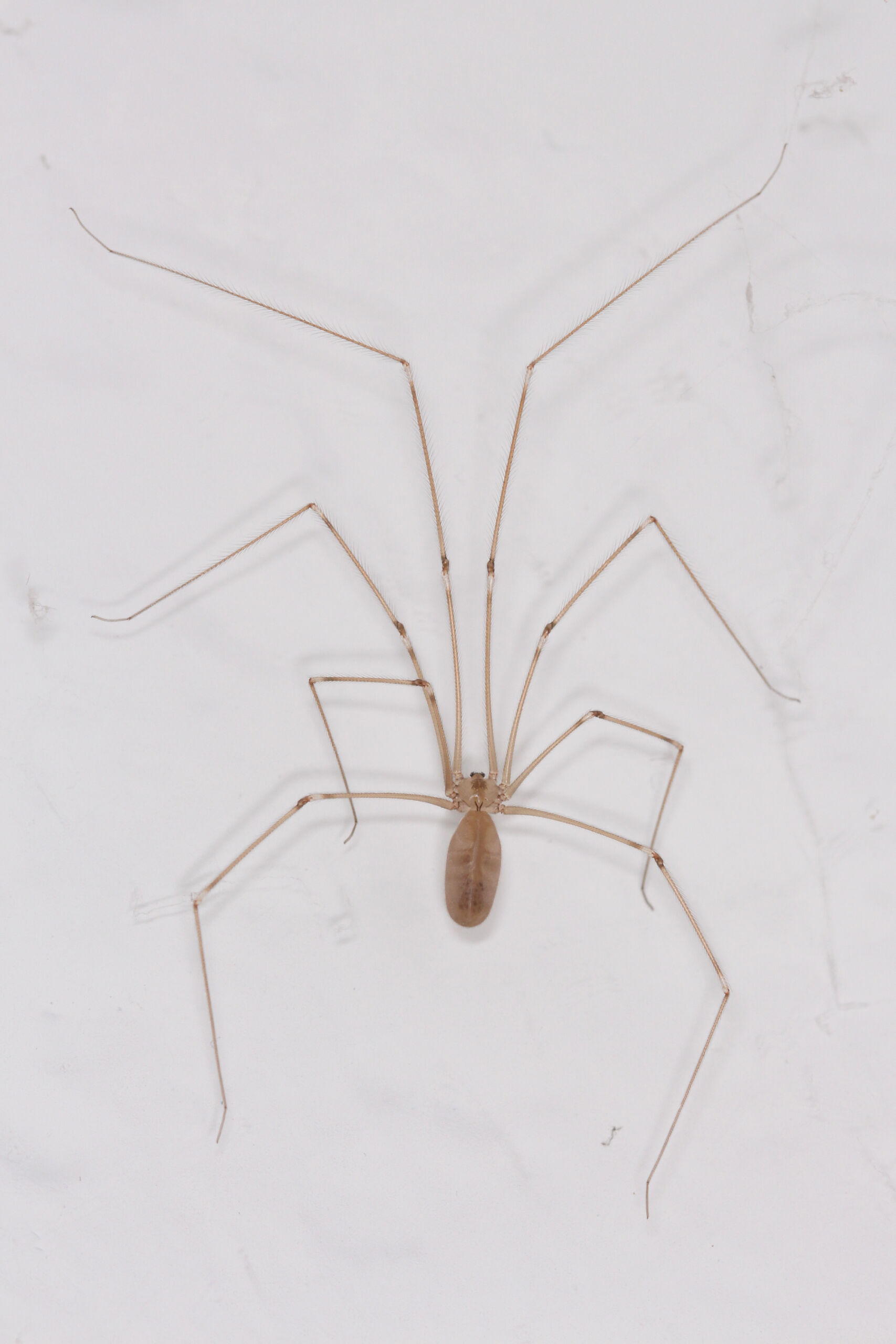
Almost everything you notice about a cellar spider is leg. The body itself is small — females run roughly 7 to 10 millimeters long, males around 6 millimeters, so the whole animal without legs is shorter than your pinky nail. The abdomen is cylindrical, about three times longer than it is wide, which is quite unlike the round, globe-shaped abdomen of most house spiders. There is usually a greyish mark in the middle of the carapace, the hard shield over the front of the body.
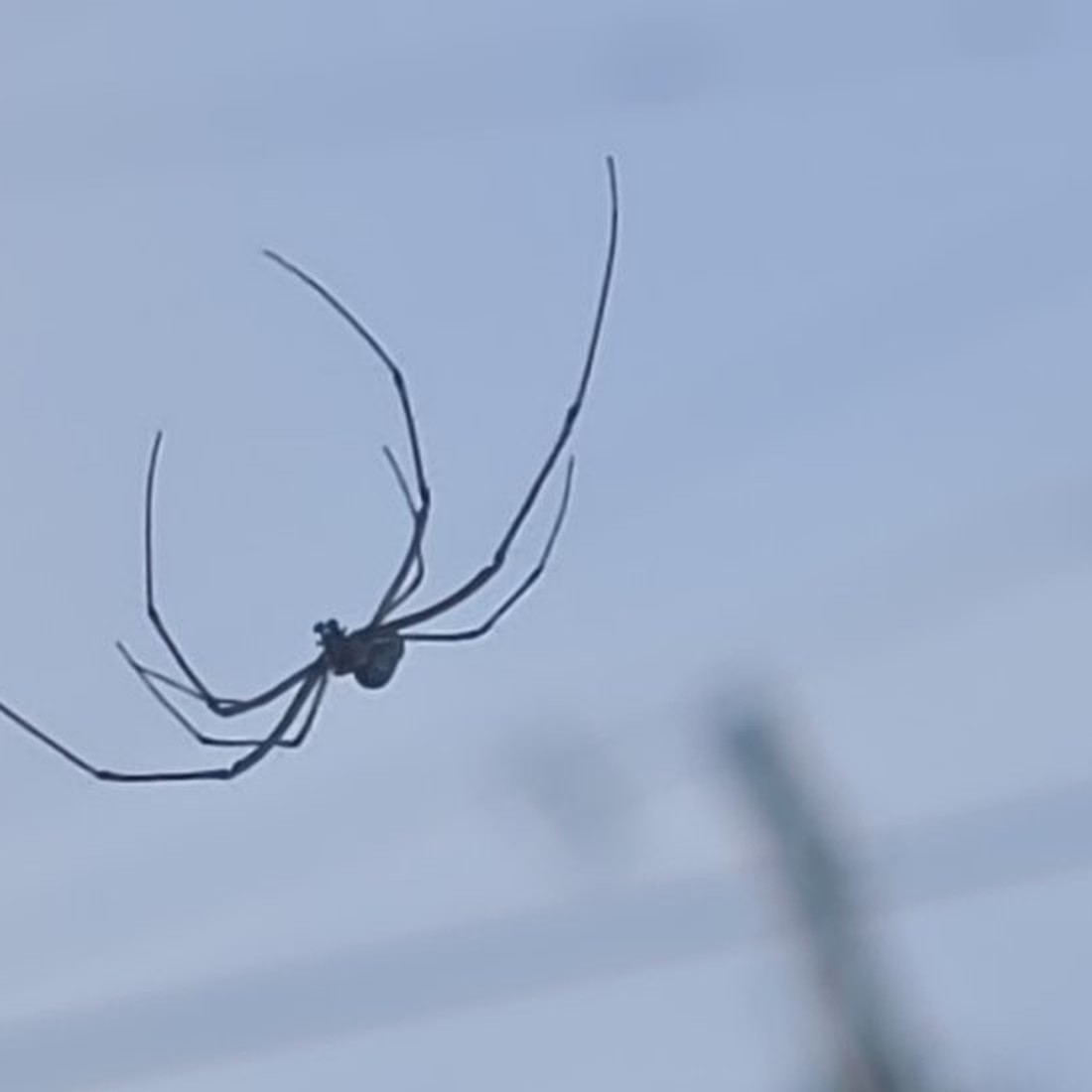
The color is pale: tan, yellowish, grey, or cream, and often semi-transparent. Young spiders can look almost like glass. Backlit against the sky — say, hanging in a car window — that pale, see-through body can pick up a greenish cast, which is why the spider in the window looked greenish and ghostly. It was not a green spider. It was a pale spider wearing the sky.
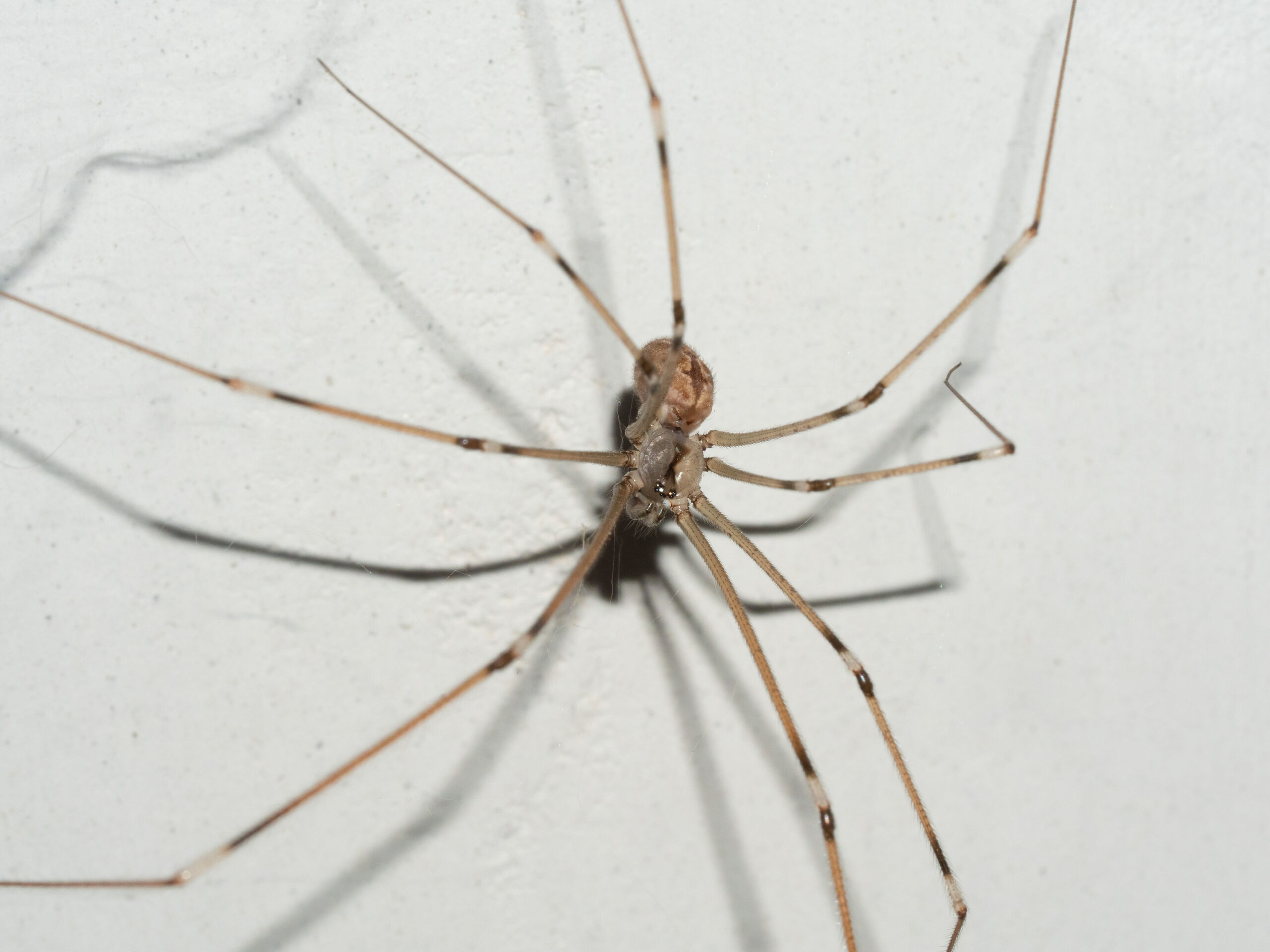
Then there are the legs. A female’s front legs can be five or six times her body length, and the total leg span can reach around 7 centimeters, nearly three inches. The legs end in flexible, finely divided tips that curl around a single silk thread, which is how such a fragile-looking animal hangs so confidently in midair. If you look very closely (a hand lens helps), you will find eight eyes arranged in two raised groups of three with a small front pair — the classic cellar-spider eye pattern.
The single best field mark, though, is the web. A cellar spider hangs upside down in a loose, three-dimensional tangle of non-sticky silk, in a corner, a ceiling junction, or a window frame. No neat orb, no radial pattern, no spiral — just a gloriously untidy scaffolding. If your spider is hanging in a messy tangle, you are most of the way to an identification already. If you are still unsure, snap a photo and run it through the What’s This? photo-ID tool.
Where it lives
Cellar spiders are cosmopolitan indoors — they live with humans on essentially every continent, and in Florida they are common statewide, indoors, all year round. They do not migrate or seasonally vanish the way some outdoor spiders do; a garage or shed population just quietly carries on through every month of the year.
They want the same things from a home that a shy houseguest wants: a quiet, undisturbed corner. Ceiling junctions, the tops of window frames, garage rafters, shed eaves, greenhouse framing, and yes, car window frames and side mirrors. Their webs accumulate over time, so an old, dusty tangle in a corner is usually a sign that a cellar spider has lived there happily for a while — or that several generations have. Outdoors they turn up in sheltered spots too, but the great majority of the ones you will meet are indoors, which is exactly where their pest-eating services are most useful.
The web, and how it hunts
A cellar spider’s web is not a sticky trap. It is a mechanical one. The silk has no glue droplets; instead, the loose three-dimensional scaffolding works by collapse. An insect blunders into the tangle, the threads give way around it, and the spider — hanging upside down underneath — flicks more silk over the struggling prey from a safe distance, using combs on its hind legs, and only bites once the prey is thoroughly immobilized. It is less like a net and more like a tripwire wrapped in extra tripwire.
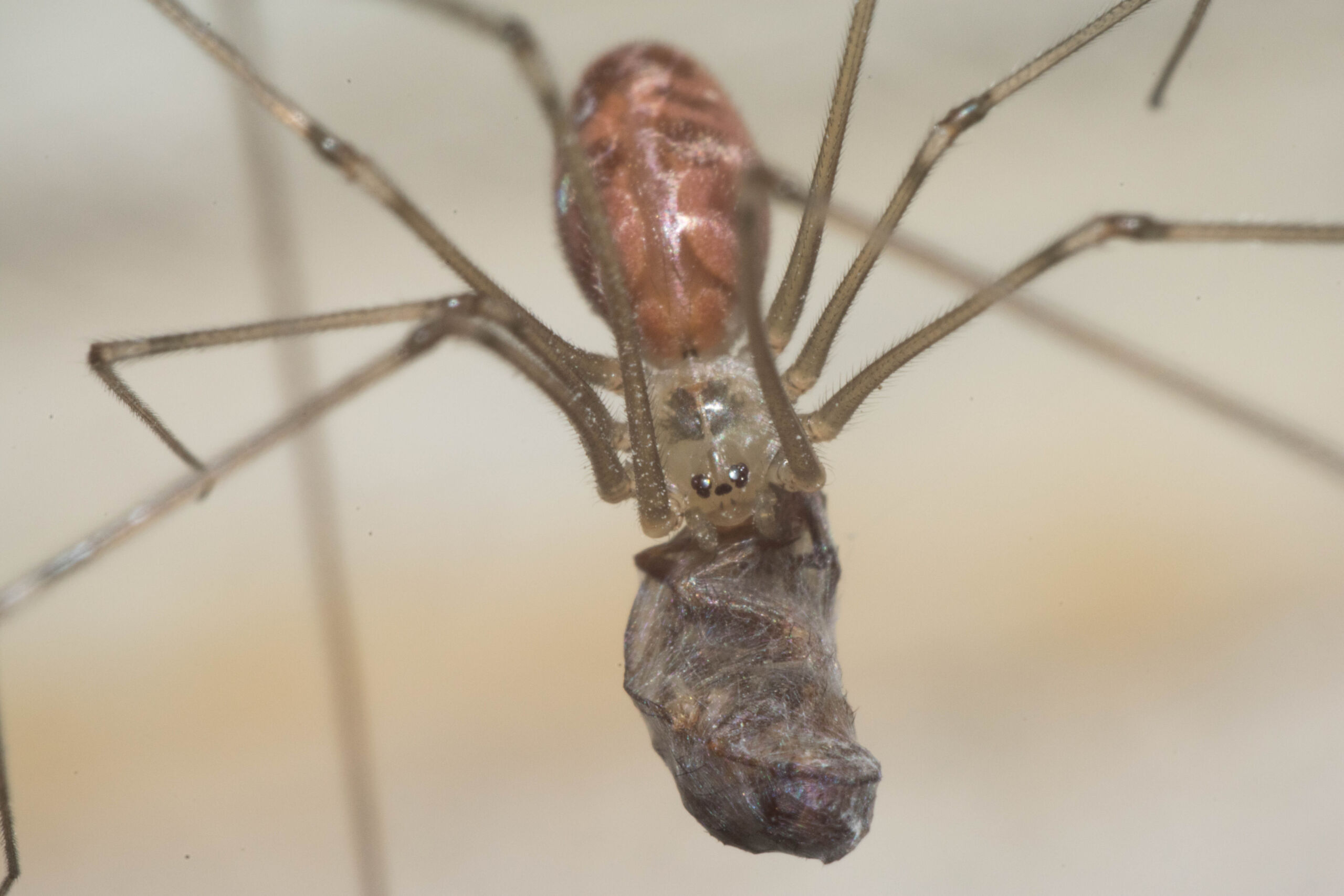
The menu is whatever small flying and crawling insects wander in: flies, mosquitoes, moths, midges, and anything else small enough to tangle. And then there is the cellar spider’s specialty, the habit that makes spider enthusiasts grin: it eats other spiders. A cellar spider will walk into a neighboring spider’s web, pluck the silk with its front legs in a rhythm that imitates a struggling insect, and ambush the resident spider when it comes to investigate. It has been observed taking down spiders considerably larger than itself, including species that people worry about far more. It wins those fights with silk and sneakiness, not brute force — the spider equivalent of winning a boxing match by being a better fisherman.
The vibrating defense
Touch a cellar spider’s web, or breathe too hard on it, and you may get the performance this family is famous for: the spider braces its legs and gyrates so fast that its whole body becomes a blur, then stops abruptly in exactly the same place. This is a defense, not aggression. A predator that had a visual lock on a small pale spider suddenly has nothing to grab — just a smear of motion where lunch used to be.
The behavior is shared across the cellar spider family and is why they are also called vibrating spiders. It is startling the first time you see it, especially when a spider you were looking at seems to vanish into a buzzing smudge, but it is completely harmless. The spider is not attacking. It is panicking in the most dramatic way available to an animal the size of a grain of rice.
Reproduction: the egg sac in her jaws
Cellar spider motherhood is distinctive enough to identify on its own. The female binds her eggs into a loose bundle with so little silk that the eggs stay visible through the wrapping, and then she carries the bundle in her jaws — her chelicerae, not her pedipalps, a detail that gets reported wrong surprisingly often. She carries it everywhere she goes, hanging in the web, until the spiderlings hatch.
Clutch sizes vary, and published figures range from about 13 to 60 eggs per bundle — call it roughly a few dozen, with the exact number depending on the female’s size and species. A female may produce two or three clutches in her life, and the eggs hatch in roughly two to three weeks. She cannot feed while she is carrying the bundle, which is a real maternal sacrifice for an animal that small. The spiderlings stay clustered around their mother for about a week after hatching, then drift apart to build their own tangles. Lifespans are often reported at around a year or two, which is a respectable run for a house spider.
Lookalikes: three animals, one nickname
Part of the cellar spider’s identity crisis is the nickname “daddy longlegs,” which is applied to at least three completely unrelated animals. Here is how to sort them out.
Harvestmen are the ones most people picture when they say “daddy longlegs,” and they are not spiders at all. They are arachnids in their own order, Opiliones, with a single fused body segment — no waist between front and back — no silk, no venom, no fangs, and a pair of eyes on a little turret. They walk on surfaces instead of hanging in webs. The quickest test in the world: if it is sitting in a web, it is not a harvestman, because harvestmen make no silk.
Long-jawed orb weavers (genus Tetragnatha) are true spiders with long legs and elongated bodies, and they are the lookalike most likely to fool you. The differences: a long-jawed orb weaver’s body is stick-like, even more elongated than a cellar spider’s, it builds a proper orb web, and it rests stretched out along a line with its legs extended fore and aft, usually near water or vegetation. A compact-oval body hanging in a loose tangle web by a window frame is a cellar spider, not this one.
Green lynx spiders (Peucetia viridans) are the answer to a different question. If you find a vividly bright-green, spiky-looking spider hunting on a plant in the garden, that is a green lynx — it stalks its prey on foliage and builds no capture web at all. A pale, ghostly spider in a tangle web is not a green lynx that lost its color. They are different animals with different lifestyles.
The venom myth, busted
You have probably heard the story: daddy longlegs have the most powerful venom of any spider in the world, but their fangs are too short to pierce human skin, so we are all safe by a technicality. It is false twice over, and the two halves fail for different reasons.
First, the name is the problem. “Daddy longlegs” covers three unrelated animals, and the myth gets retold about whichever one the teller is picturing. Harvestmen have no venom glands at all, so the story cannot possibly apply to them. Crane flies, the third animal with the nickname in some countries, are insects that do not bite. The myth only even gestures at cellar spiders.
Second, the venom claim itself has never been shown to be true. Research on cellar-spider venom has found it to be weak, not potent — the opposite of the legend. And the fangs are not too short, either: at around 0.25 millimeters they are tiny, but they have been shown capable of piercing human skin in tests, producing at most a faint sting lasting seconds with no mark afterward. The real reason cellar spiders are harmless is much less exciting than the myth: their venom is mild, they essentially never bite people, and no species in the family is considered medically significant anywhere in the world. Penn State Extension puts it plainly — they are not known to bite people. The most dangerous thing a cellar spider will ever do to you is startle you by vibrating.
What to do if you find one
Leave it be. That is the whole advice, and it is unusually easy advice to follow. A cellar spider in your garage, shed, greenhouse, or car is eating flies, mosquitoes, and other spiders for free, around the clock, without chemicals, and without asking for anything except an undisturbed corner. It is the rare houseguest that pays rent in pest control.
If one is genuinely in the way — say, parked across the exact window you need to see through while driving — relocate it gently. A cup and a stiff card, carried to a quiet corner, a shed, or a sheltered outdoor spot, is all it takes. They are fragile animals, so a gentle hand matters; squishing one does not just kill a harmless spider, it kills the thing that was eating your mosquitoes.
Do not spray for them. Insecticide sprays aimed at cellar spiders kill the pest-eater and leave the pests, which is the worst possible trade. And if the dusty old webs in the corners bother you, brushing them away is fine — the spider will either rebuild nearby or move somewhere quieter. Either way, you have not harmed anything, and your new roommate will find another corner. Given how many corners Florida houses have, it will not be homeless for long.
Frequently asked questions
Is a cellar spider dangerous to people or pets?
No. Cellar spiders are not considered medically significant anywhere in the world. Their venom is mild, they are not known to bite people, and on the rare occasions a bite has been induced in tests, it amounted to a faint sting lasting seconds. They are harmless to people and pets.
Why does it shake and vibrate in its web?
That is its defense. When disturbed, a cellar spider braces its legs and gyrates so fast that its body becomes a blur, breaking a predator’s visual lock, then stops abruptly in the same place. It is panicking, not attacking, and the behavior is why cellar spiders are also called vibrating spiders.
Is it the same thing as a daddy longlegs?
It depends who is talking, which is exactly the problem. “Daddy longlegs” is a nickname for three unrelated animals: cellar spiders (true spiders with webs and mild venom), harvestmen (arachnids that are not spiders, with no silk and no venom), and crane flies (insects). If yours is hanging in a web, it is a cellar spider.
How do I tell it from a long-jawed orb weaver?
Look at the web and the pose. A long-jawed orb weaver has a stick-like body, builds a proper orb web, and rests stretched out along a line, usually near water or vegetation. A cellar spider has a compact-oval body and hangs upside down in a loose, messy tangle web, usually in a building, garage, or car.
What does a cellar spider eat?
Whatever small insects blunder into its tangle: flies, mosquitoes, moths, and midges. It also eats other spiders, invading their webs and plucking the silk to imitate a struggling insect, then ambushing the resident. It is one of the few house spiders that regularly preys on spiders larger than itself.
Why is the female carrying a ball in her mouth?
That is her egg sac. A female cellar spider binds her eggs into a loose bundle with very little silk and carries it in her jaws until the spiderlings hatch, in roughly two to three weeks. She cannot feed while carrying it. Clutches run roughly a few dozen eggs, with published figures ranging from about 13 to 60.
How long do cellar spiders live?
Reports vary, but a year or two is the usual figure. They live indoors year-round in Florida, so a garage or shed population can quietly persist across every season without any help from you.
Why is there one in my car?
Because cars are quiet, sheltered, and full of corners — window frames, mirrors, and door seals are prime cellar-spider real estate, and small flies wander in through open windows and doors. It is not lost. It has found a perfectly good hunting spot that happens to have wheels.
Should I remove it, and how?
Ideally, leave it — it eats pests for free. If it is genuinely in the way, a cup and a stiff card carried to a quiet corner or shed will relocate it unharmed. Avoid sprays: they kill the pest-eater and leave the pests.
🌱 Keep learning
Three related guides worth reading next:
- Ponds, Ducks, Fish & Chickens — The backyard ecosystem guide: stacking animals, water, and garden into one system.
- Grow Your Own Chicken Feed — Cut feed costs with duckweed, forage crops, and fermented feed.
- The Living Root Reading List — Books and resources that make better gardeners without requiring a lab coat.
🪱 Your Soil Needs This
Reading about healthy soil is great. Growing in it is better. Our small-batch, traceable worm castings are the shortcut your garden deserves.
Shop Worm Castings Subscribe & SaveEvery bag comes with a lot certificate. Know what's in your soil.