
There is a millipede in the eastern United States that looks like a tiny freight train: flat-backed, dark brown to black, with white legs and a row of orange-red triangles down each side, trundling along the inside of a rotting hardwood log. Leach’s train millipede, Euryurus leachii, is one of the few North American millipedes you can deliberately go looking for — because it lives almost exclusively in decaying hardwood logs near water — and it is also one of the few that carries a genuinely dangerous chemical defense: hydrogen cyanide, the same poison that gives bitter almonds their smell, brewed in glands along its back. This guide is about a flat, bright, cyanide-carrying recycler that minds its own business inside dead logs, and why the orange spots are a warning you should respect but not fear.
And if you are reading this because you rolled a rotting log near a creek and found a flat, dark millipede with orange spots and white legs — stay with us. It is not a pest, it cannot bite, and the right thing to do with it is almost nothing at all: admire it, wash your hands, and roll the log back.
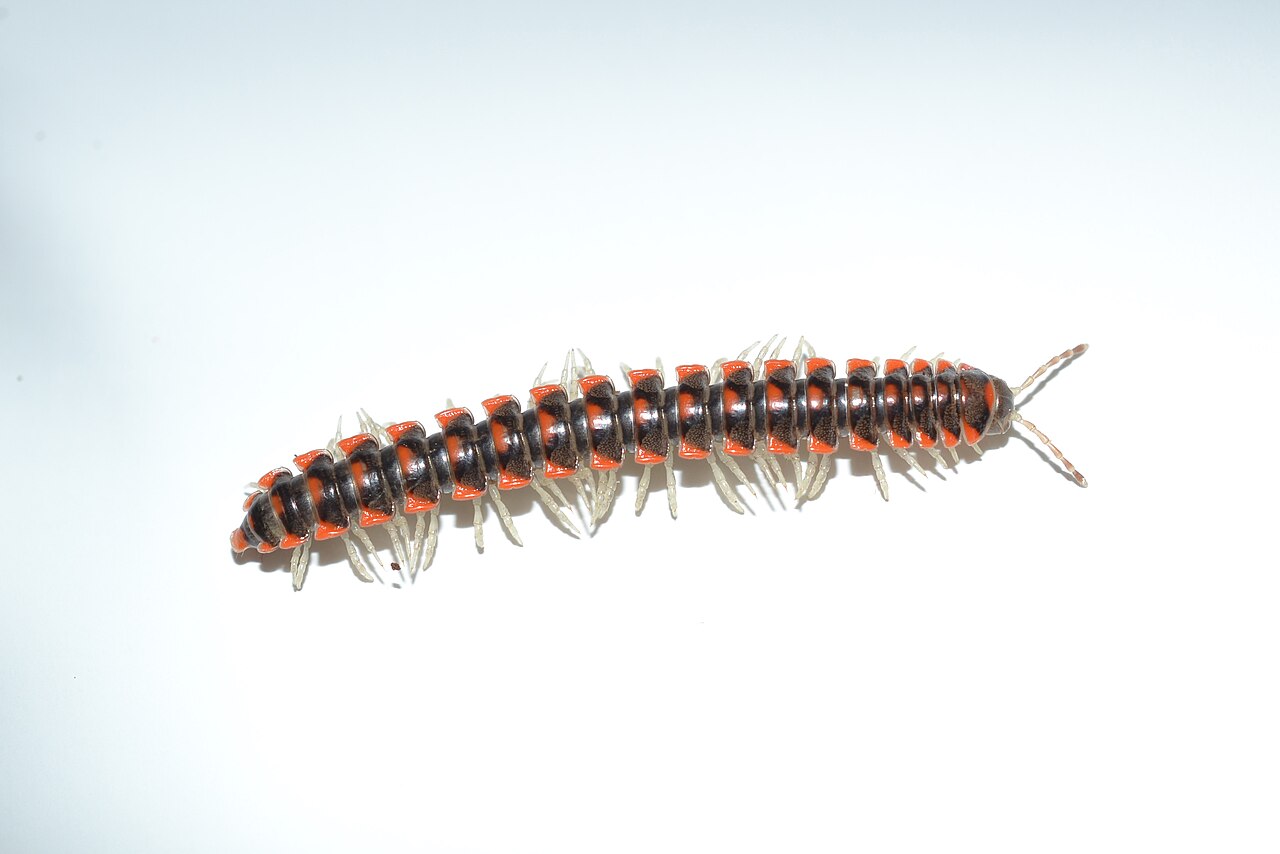
What it looks like
Forget the little black millipedes that swarm patios after rain. Leach’s train millipede is a flat-backed millipede, and flat-backed means flat: the body is wide and low, with the armor plates of each segment flaring out sideways into broad keels — the paranota — that overhang the legs like the eaves of a roof. An adult is about an inch to an inch and a quarter long, roughly 25 to 32 millimeters, and the hind end is broad and squared-off rather than tapered to a point, which is one of the field marks that separates it from other brightly colored flat-backs. The color is the rest of the identification, and it is unmistakable once you know it: the body is dark brown to nearly black, the legs are white, the antennae are long — roughly twice as long as the legs — and each segment carries orange to red markings at the edges of its keels, often forming a triangular red patch at the tip of each flange, with a matching triangle on the rear edge of each segment. The overall effect is a dark train with orange windows and white wheels, which is presumably how it got its common name — flat-backed millipedes are often called “train millipedes,” because the linked, flat segments look like the cars of a train.
The shape is the real field mark, and it is worth learning, because the eastern forests are full of flat-backed millipedes and most of them are not this species. The keels are broad and flat, the body is low and wide rather than round, and the rear end is truncate — cut off square — where many of its cousins taper to a triangle. Young ones are smaller versions of the same animal, and like all millipedes they add segments and legs with every molt. If you find a flat-backed millipede with orange-red triangles, white legs, and a squared-off tail in a rotting hardwood log in the eastern United States, you are very likely looking at Leach’s train millipede — but the look-alikes below will show you the two cousins that can fool you, and the one check that separates them.
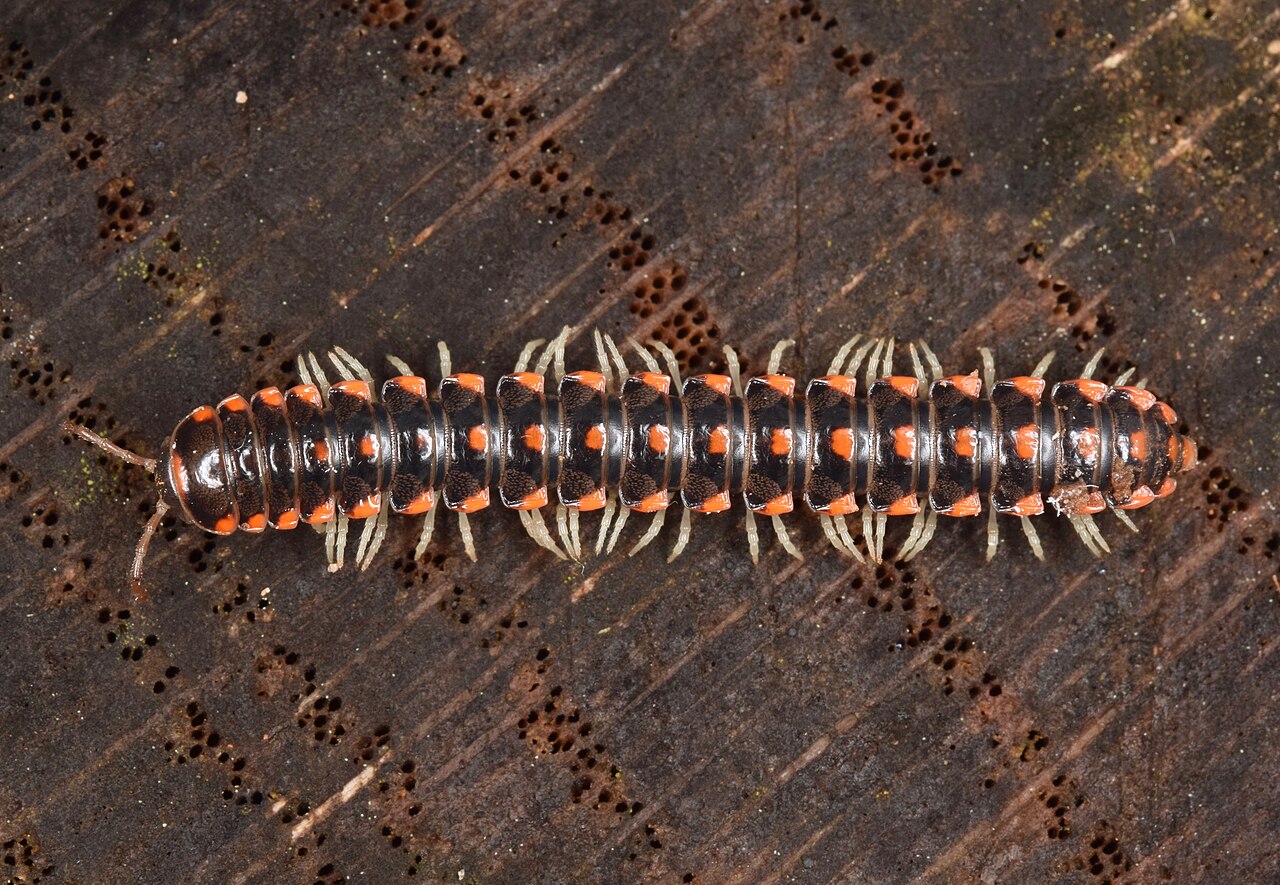
The name game
The common name is a description: “train millipede” for the flat, linked segments, and “Leach’s” for the naturalist the species honors — William Elford Leach, the English zoologist, whose name is attached to the species as leachii. The scientific name carries a small history of its own. The species was described in 1832 by John Edward Gray, and it has been shuffled between genera since — one old synonym, Euryurus erythropygus, still turns up in older Indiana records, where Bollman reported it from surface habitats in the 1880s. The current name, Euryurus leachii (Gray, 1832), is stable, and the genus Euryurus itself is a small one: the family Euryuridae, endemic to North America, contains just two genera, each with a single species — Euryurus leachii and Auturus evides. Two genera, two species, one family, found nowhere else on Earth.
The taxonomy, for the nerds in the back: kingdom Animalia, phylum Arthropoda, class Diplopoda (the millipedes), order Polydesmida — the flat-backed millipedes — family Euryuridae, genus Euryurus, species leachii (Gray, 1832). And there is a subspecies story worth knowing. Two subspecies are recognized: Euryurus leachii leachii, the northern form, and Euryurus leachii fraternus, described by Hoffman in 1978, the southern form. Where the two meet — notably in the Arkansas population on Crowley’s Ridge, which is geographically peripheral and anatomically intermediate between the two — Shelley and McAllister, writing in 2012, declined to assign the animals to either race. The subspecies are real, the boundary between them is fuzzy, and the Arkansas animals are the proof.
Where it lives: the eastern forests, log by log
Euryurus leachii lives in the eastern United States, and its range is a good map of the eastern deciduous forest: from New York and New England south through the Appalachians and the Southeast to Georgia and South Carolina, and west through the Ohio Valley — Ohio, Indiana, Illinois, Kentucky — to Crowley’s Ridge in Arkansas. That western edge is worth stating precisely, because it was only nailed down in 2012, when Shelley and McAllister recorded the genus and species from three sites on the northern part of Crowley’s Ridge, in Cross, Lee, and Poinsett counties, Arkansas, plus a published locality in Phillips County at the southern end of the ridge. Those are the only known occurrences of the genus and the species west of the Mississippi River, and they sit on that one ridge — a long, narrow upland rising out of the Mississippi floodplain — like an island. Everywhere else, this is an eastern animal.
The habitat is the key to finding one, and it is unusually specific for a millipede. Euryurus leachii lives almost exclusively in association with decaying hardwood logs and stumps near water — creeks, seepages, springs, damp hollows. The family Euryuridae is, in the words of one field account, among the very few North American millipedes you can deliberately try to find, because they occur almost exclusively in that one microhabitat. A 2022 study from Kentucky found the animals occupying coarse woody debris in the earlier stages of decay — intact heartwood, structurally sound, decay classes one to three — not the soft, crumbling punk wood of a log on its last legs. Leaf litter alone is not attractive to them; they want the log itself, and they want it near water. They are also occasional cave visitors — recorded as threshold trogloxenes in Indiana caves, wandering in from the forest outside rather than living in the dark full-time.
And a word about Florida, since this is a Florida garden site and the question will come up: Euryurus leachii has no verified record in Florida. The global biodiversity database GBIF holds 1,086 occurrence records for this species in the United States — and zero from Florida. The documented southern edge runs through Georgia and South Carolina, and the southern subspecies E. l. fraternus is a Virginia and mid-South animal, not a Floridian one. If you find a flat-backed millipede with orange spots in a Florida garden, it is far more likely to be the Greenhouse Millipede — small, dark, pale-legged, and everywhere — or the long-flange millipede Asiomorpha coarctata, the other flat-backed import that rides in potted plants. This guide states the Florida absence plainly because the project has already been bitten three times by wrong range claims, and the discipline now is to check every range against a source before stating it. The sources here agree: this is an eastern animal whose range stops north of Florida.
What it eats: the quiet recycling job
Like every millipede in this library, Leach’s train millipede is a detritivore — a creature that eats dead things so the rest of the world does not have to wade through them. Its version of the job is tailored to the log: it eats decaying hardwood, the softened wood fibers and the fungi and bacteria working through them, and the leaf litter packed into the crevices of a rotting log. The animals in the Kentucky study were living in logs in the early stages of decay, where the heartwood is still intact but the fungi have begun their work — which suggests the diet is the wood itself plus its microbial community, rather than the leaf litter on the forest floor. Put together, the picture is clear: this is an animal that eats dead wood, slowly, from the inside of a log that is already on its way to becoming soil.
What it does not like is just as important, and it is the reason you will never find one in a compost pile. It does not eat fresh leaves. It does not eat living plants, seedlings, vegetables, fruit, or roots. It does not eat your house — and this one is worth stressing, because it does live in wood: it lives in wood that is already dead and rotting in a forest, not in the sound timber of a house, and it wants that wood damp and near water, not dry and framed. It does not want leaf litter alone, without a log: field accounts are explicit that leaf litter by itself does not attract it. It does not swarm, it does not invade houses, and it does not show up in numbers anywhere a gardener would notice — because it lives inside rotting hardwood logs near creeks, and a garden without a rotting log near water is a garden without Leach’s train millipedes.
The curl and the cyanide
Disturb a Leach’s train millipede and it does what flat-backed millipedes do: it curls into a tight spiral, head tucked in the center, armored keels facing outward, and plays dead with total commitment. It cannot bite, cannot sting, and cannot run away fast — the curl is the first line of defense. The second line is the one that makes this species genuinely different from the gentle giants of the library: its defensive glands discharge hydrogen cyanide.
The chemistry is well documented, and it is worth stating precisely. Duffield and colleagues showed in 1974 that the defensive secretion of Euryurus leachii contains hydrogen cyanide, benzaldehyde, and guaiacol — the cyanide carrying the sharp, bitter-almond smell, the benzaldehyde adding a second almond note, the guaiacol a smoky phenolic edge. The cyanide comes from mandelonitrile stored in the glands, which breaks down into hydrogen cyanide and benzaldehyde when the secretion is discharged — the same biochemical trick used by the yellow-spotted millipede and by the cyanide millipedes of the library. And the animal is immune to its own poison: its mitochondria carry a cyanide-resistant terminal oxidase, so its cells keep breathing in cyanide concentrations that would shut down a cockroach’s. Hall and colleagues showed in 1969 that the cytochromes of E. leachii are far more tolerant of cyanide than those of a cockroach — the millipede is, in effect, wearing a gas mask it grew itself.
For a person, the secretion is a respect-it-don’t-fear-it situation. It can irritate skin and eyes, it can stain, and it smells strongly of almonds — which is your warning to wash your hands and keep it away from your face. It is not venom: there is no bite, no injection, nothing that gets it into your bloodstream. A single millipede’s secretion is a tiny quantity, and the danger it poses to a human is essentially nil unless you were to eat the animal or trap a large number of them in a sealed container and breathe the fumes — which is not a thing anyone does by accident. For a dog or cat that crunches one, the result is a mouthful of foul, almond-smelling fluid, drooling, and a lesson learned. Unpleasant, not an emergency — but do keep pets from eating them, and do wash your hands.
And here is the party trick: like many in its family, Euryurus leachii fluoresces under ultraviolet light. Shine a UV torch on one at night and it glows — a hidden coloration invisible in daylight, thought to be tied to the same chemistry that makes it toxic. It is a good reminder that the orange spots you see are only part of the warning: there is a whole second signal, written in ultraviolet, for the animals that can see it.
One more number, because it is the kind of thing that makes this animal feel real: in 2022, researchers at the University of Louisville measured the thermal tolerance of E. leachii collected from dead wood in Kentucky, and found a mean critical thermal maximum of about 40.5 degrees Celsius — roughly 105 degrees Fahrenheit. That is the temperature at which the animal loses coordination and cannot escape. And the logs it lives in can get hotter than that: an exposed dry log in a Kentucky July warmed past the millipede’s own heat limit. The animal survives the summer by staying inside damp, shaded logs, not by tolerating the heat — which is one more reason to leave the logs where they are, and to leave them shaded.
Life cycle: slow, secretive, and mostly inside a log
Like all millipedes, Leach’s train millipede grows by molting: it sheds its exoskeleton, adds new segments and new pairs of legs, and hardens up again, bigger than before. It hatches from an egg laid in rotting wood or damp litter with only a few segments and a handful of legs, and earns the rest over successive molts. Adults reach their full inch-plus with the full set of flat, keeled segments — and, like all millipedes, deliver far fewer than the thousand legs the name promises.
Beyond that basic pattern, the details of this species’ life cycle are thinly known, and the gaps are worth naming honestly rather than papering over. Nobody has published how long it lives, how many eggs a female lays, or how fast it grows. What is known is that it is a slow, secretive, log-dwelling animal, active in the damp shade, and that it is hard to find even where it lives — you have to roll the right log, near the right creek, at the right stage of decay, and even then you may find nothing. Hobby keepers report that colonies can build up fast in captivity at room temperature, which suggests the reproductive potential is there when food and damp are constant — but captivity is not the forest, and this guide does not turn a keeper’s anecdote into a life history. The honest statement is: this is a moderately studied species with a well-known range and chemistry and a poorly known private life, and the guide says so.
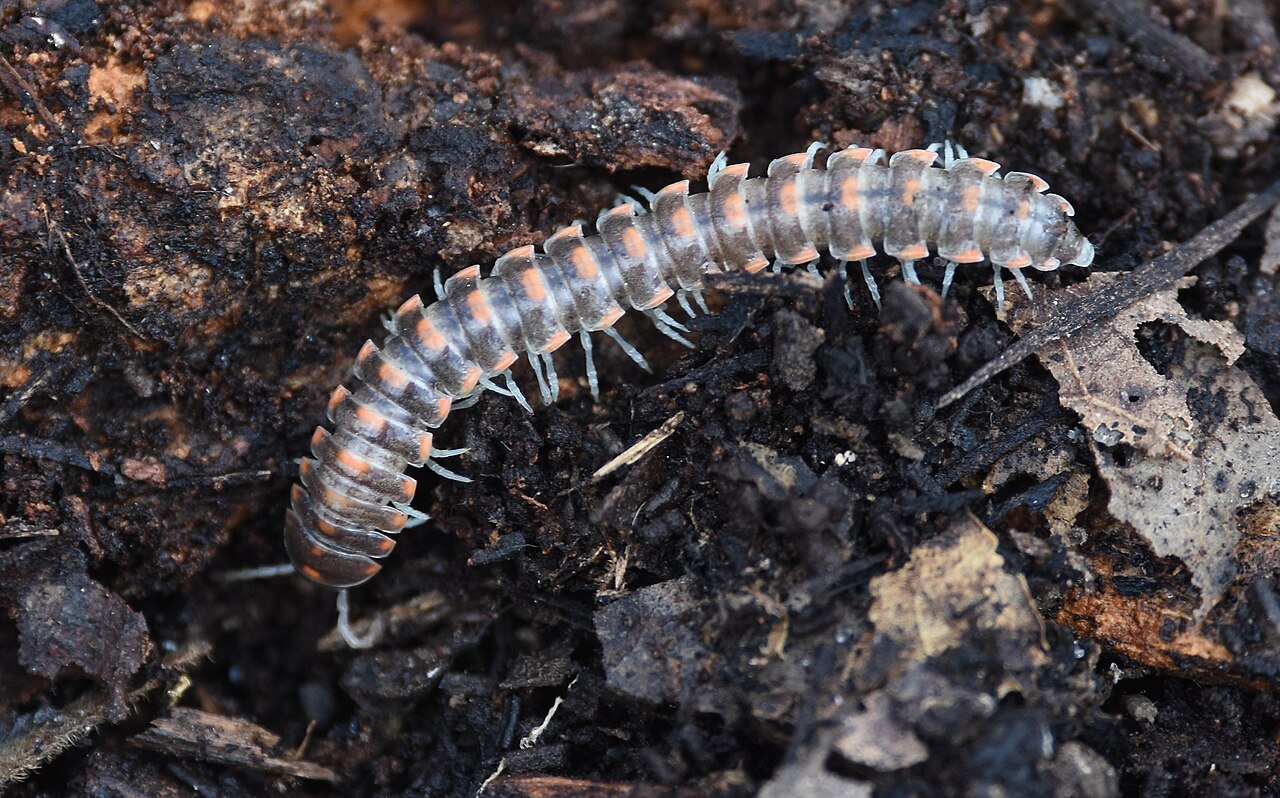
Is it a pest?
Plainly: no. It is not a pest in any sense of the word. It does not bite, sting, or spread disease. It does not eat living plants, seedlings, fruit, or crops. It does not eat your house — it eats wood that is already dead and rotting in a forest, not sound timber. It does not swarm patios after rain, it does not invade houses in numbers, and it does not show up anywhere a gardener would notice it — because it lives inside rotting hardwood logs near water, comes out at most an inch and a quarter long, and stays where the logs are. A gardener in Keystone Heights, in Jacksonville, in Miami, in Tampa, will never meet this animal, and that is not a failure of looking. It simply is not there.
The one honest caveat is the cyanide. A millipede that secretes hydrogen cyanide is not a pet, not a toy, and not something to let a small child pick up and squeeze. But a chemical defense is not the same as being a pest: the secretion is a defense against predators, not an attack on gardens, and the animal deploys it only when grabbed or crushed. Left alone in its log, it is harmless to everything except the ants that try to eat it.
How to get rid of it — or rather, how to live with it
This is mostly a “how to get rid of it” section that turns out to be very short, because there is almost nothing to get rid of. If a Leach’s train millipede wanders indoors — and they do occasionally, usually by accident, after rain — the answer is the same as for every millipede in this library:
Pick it up gently and put it back outside. Use a piece of paper or a leaf, not your bare hands if you can avoid it — not because it will bite, but because the cyanide secretion will stain your skin and smell of almonds, and you do not want it near your eyes. Put it back under a damp log, near water, in the shade. Do not put it in a jar. Do not put it in the compost. Its home is the log it came from.
Do not spray. Broad-spectrum insecticides will kill a train millipede just as dead as they kill anything else, and in dead wood, where the whole community is small, slow, and slow to recover, one sprayed log can do damage that lasts years. If you garden near woods, skip the sprays and let the predators do the work.
Leave the logs. If you garden or own land in the eastern forests and you would like train millipedes to keep living there, leave the rotting hardwood logs where they are — especially the ones near creeks and seepages, in the early stages of decay, with the heartwood still intact. A log left to rot is a whole apartment building for the dead-wood community, and this millipede is one of its tenants.
Roll logs back. If you do roll a log to look underneath, put it back exactly where it was, the same side down. The damp underside is a microclimate, and an hour in the sun can dry it out and kill everything living in it — including an animal that cannot survive much past 40 degrees Celsius.
Effects on the garden
On the plus side, everything this animal does in its habitat is helpful, in the quiet way dead-wood recyclers always are. It eats decaying hardwood, shreds it into smaller pieces, and its droppings feed the fungi and bacteria that turn dead wood into soil nutrients. In a forest, that work matters: a log that never rots is a log that never feeds the next generation of trees. And because this species favors logs in the early stages of decay, it is one of the first recyclers on the job — opening the wood up for everything that follows.
On the minus side, there is nothing to list, because this animal does not live in gardens. It does not eat garden plants, it does not nibble seedlings, it does not hide in potted plants or drainage holes, and it does not stain patios, because it never visits one. If you garden in the eastern forests and your yard backs onto woods with a creek, the honest effect on your garden is: none, unless you count the good kind. A train millipede in your log pile is a sign that a piece of the woodland community is still functioning next door. Leave the log pile where it is, and let it work.
Effects on other garden animals
Leach’s train millipede sits in the middle of the dead-wood food web. As a detritivore it eats only dead wood and the fungi and bacteria working through it — it does not hunt other animals, does not eat living insects, and does not compete with predators for prey. Its competition is with the other recyclers: the beetles, the woodlice, the springtails, and the fungi that all eat the same dead logs. It helps the soil microbes by shredding wood into bite-size pieces, and its droppings are food for fungi and bacteria, which in turn feed the whole underground web.
As prey, it is a defended meal — and a famously well-defended one. Most predators learn to leave it alone after one taste of the cyanide secretion, and the orange spots are the warning flag that teaches the lesson before the bite. Some animals eat millipedes anyway — shrews, some birds, ground beetles, and the specialist predators that have evolved to cope with cyanide — and the same is likely true here. For pets, the risk is real but small: a dog or cat that crunches one will get a mouthful of foul, almond-smelling fluid, drool, and learn not to do it again. Unpleasant, not an emergency — but do not let pets make a habit of it, and do wash your hands after handling one. The fluorescence is a final twist: under ultraviolet light, this animal glows, advertising its chemistry in a color humans cannot even see.
Look-alikes: the concrete checks
Flat-backed millipedes with orange spots all look alike until you know what to check, and with this species the first check is on the animal itself — the shape of its tail. Work through these in order and you will rarely go wrong.
Auturus evides — the closest look-alike, and the only other species in the family. Also flat-backed, also dark brown with light orange spots, also a log-dweller near water, and also in the eastern United States — the two even share the same logs in Arkansas, where the only prior family records on Crowley’s Ridge were Auturus. Check: the tail. Euryurus leachii has a broad, squared-off, truncate hind end; Auturus evides is a little over an inch long with a more tapered rear. Check the spots, too: Euryurus carries triangular orange patches at the tips of its keels. In practice, the two are hard to separate in the field without experience, and a photograph plus a location is the honest way to record one. There is no full guide for Auturus evides yet — it is on the library’s list, and this guide will link to it when it is built.
Cyanide Millipede (Apheloria virginiensis) — the bright one. Also flat-backed, also cyanide-defended, but boldly marked in black and yellow or black and orange, and larger and more boldly patterned than Euryurus. Check: the pattern. If it is black with broad yellow bands, it is a cyanide millipede; if it is dark brown with discrete orange triangles and white legs, it is Leach’s train millipede. And check the map: Apheloria virginiensis lives in Virginia and North Carolina, not Florida — a range correction this project has already had to make once. Read the full guide: Cyanide Millipede.
Black-and-Yellow Flat Millipede — the other flat-back you actually meet. Also flat-backed with wide keels, also boldly marked, but with yellow keels on a dark body and a different pattern of spots. Check: yellow keels mean the black-and-yellow flat millipede; orange triangles with white legs mean Leach’s train millipede. Read the full guide: Black-and-Yellow Flat Millipede.
Greenhouse Millipede (Oxidus gracilis) — the small, bumpy one. At under an inch long it is shorter than an adult train millipede, and its body is dark brown to black on top with pale, creamy-white legs — the pale legs are the giveaway, and it shares those with Euryurus, so look past them. The second giveaway is texture: where the train millipede is smooth and flat with broad keels, the greenhouse millipede is visibly bumpy and ridged along its back. Check: under an inch, pale legs, bumpy back — and it lives in potted plants and gardens everywhere, including Florida, where Leach’s train millipede never goes. Read the full guide: Greenhouse Millipede.
Centipedes — the one that actually matters, because this is the split with consequences. Centipedes have one pair of legs per segment, not two, and they move fast — darting, flickering, gone under the baseboard before you have finished the sentence. Millipedes move slowly, in a steady wave, and curl up when disturbed; centipedes run. Centipedes are also flattened, with long legs that stick out sideways and a pair of venomous front fangs, and they can bite. Millipedes have short legs tucked under a round body and no bite at all. Check: count the legs per segment (one pair means centipede, two pairs means millipede), then watch the speed (fast means centipede, slow means millipede), then watch what it does when poked (runs means centipede, curls means millipede). Read the full guide: Garden Centipedes.
Frequently asked questions
Is Leach’s train millipede dangerous?
Not in any way that matters to a careful gardener. It cannot bite or sting. Its defensive secretion contains hydrogen cyanide, benzaldehyde, and guaiacol, and it can irritate skin and eyes and stain — so wash your hands after handling one and keep it away from your face. A single millipede’s secretion is a tiny quantity, and the danger to a human is essentially nil.
Is it a pest?
No — plainly and completely no. It does not eat living plants, seedlings, fruit, or crops, it does not damage sound timber, it does not invade houses in numbers, and it does not swarm anywhere. It lives inside rotting hardwood logs near water in the eastern United States. It is a forest recycler, not a pest.
How big does it get?
Adults are about an inch to an inch and a quarter long, roughly 25 to 32 millimeters. Ignore any source that claims five inches — that figure comes from a low-quality pest-control page that confuses this species with several others at once.
Where does it live?
In the eastern United States, from New York and New England south through the Appalachians and the Southeast to Georgia and South Carolina, and west through the Ohio Valley to Crowley’s Ridge in Arkansas — the only place it occurs west of the Mississippi River. It lives almost exclusively in decaying hardwood logs and stumps near water.
Does it live in Florida?
No verified record exists. GBIF holds 1,086 occurrence records for this species in the United States, and zero from Florida. A flat-backed orange-spotted millipede in a Florida garden is far more likely to be a greenhouse millipede or a long-flange millipede.
Why is it called a “train” millipede?
Because flat-backed millipedes look like tiny trains: the flat, linked segments read as the cars of a train, trundling along in a line. It is a folk name, not a scientific one, and it is shared by many flat-backed species — but this is the one the name is most often attached to.
Does it really glow under UV light?
Yes. Like many in its family, Euryurus leachii fluoresces under ultraviolet light — a hidden coloration invisible in daylight, probably tied to the same chemistry that makes it toxic. Shine a UV torch on one at night and it lights up.
What does it eat?
Decaying hardwood — the softened wood fibers and the fungi and bacteria working through them — in logs in the early stages of decay, near water. It does not eat living plants, fresh leaves, or garden crops, and leaf litter alone, without a log, does not attract it.
How hot can it survive?
Not very. Kentucky researchers measured a mean critical thermal maximum of about 40.5 degrees Celsius (105 degrees Fahrenheit), and an exposed dry log in July can get hotter than that. The animal survives summer by staying inside damp, shaded logs — one more reason to leave the logs where they are, and to leave them shaded.
What should I do if I find one?
Admire it, photograph it if you like, wash your hands, and roll the log back exactly where it was, the same side down. Do not collect it, do not spray near it, and do not release it anywhere else. Its home is the log it came from.
🌱 Keep learning
Three related guides worth reading next:
- Cyanide Millipede — Flat-backed, brightly marked, and packing a real cyanide defense — the millipede that smells of almonds.
- Black-and-Yellow Flat Millipede — Bold yellow keels on a flat back — the look-alike that shares the cyanide trick.
- Soil Food Web Explorer — Meet the whole underground crew, from bacteria to beetles, and see where the millipedes fit in the chain.
🪱 Your Soil Needs This
Reading about healthy soil is great. Growing in it is better. Our small-batch, traceable worm castings are the shortcut your garden deserves.
Shop Worm Castings Subscribe & SaveEvery bag comes with a lot certificate. Know what's in your soil.