
Florida Garden Lizards & Skinks: The Scaly Pest-Control Crew
It started, as so many Florida garden discoveries do, with a log. Lift the edge of a timber, glance along a fence board, peer into the leaf litter at the base of a wall, and something impossibly shiny slides away like a coin with legs. Gunmetal-brown body. A tail the color of a new penny. Four legs so small they look like an afterthought the manufacturer glued on at the last minute. If that is the lizard you found, congratulations: you have met a mole skink, and you have also met the unofficial mascot of this entire guide.
Here is the sales pitch, and it is a good one. Florida gardens come with a standing army of small, silent, chemical-free pest controllers, and most homeowners walk right past them. Skinks patrol the leaf litter for roach nymphs and termites. Anoles work the shrubs like tiny green security guards. Racerunners hunt in the open sun. Geckos clock in at dusk and eat whatever flies into your porch light. None of them want your vegetables. None of them are venomous. All of them are free, self-maintaining, and genuinely fascinating little machines built out of scales, sunshine, and very strong opinions about temperature.
This guide covers the crew: who they are (Latin names included, because we do not dumb things down around here), how to tell the look-alikes apart honestly, the remarkable engineering under those scales, and how to keep them alive and working in your yard instead of accidentally evicting the best unpaid staff you will ever have.
Cold-Blooded Is a Misnomer: Ectothermy and the Thermal Performance Curve
First, a vocabulary upgrade, because the phrase “cold-blooded” has been slandering lizards for centuries. Lizards are ectotherms: they regulate body temperature using the environment instead of an internal furnace. A mammal burns calories around the clock to hold a steady temperature, the way you pay a power bill to keep the house at one setting in August. A lizard pays almost nothing. It shuttles — sun to shade, warm board to cool soil — and lets physics do the work. On a Florida summer morning, a basking skink is not being lazy. It is booting up.
Why does the booting-up matter? Because nearly everything a lizard does runs on a thermal performance curve. Muscle contraction, sprint speed, digestion, immune response — all of it rises as body temperature climbs toward an optimal zone, peaks, and then falls off a cliff if the animal overheats. A cold lizard is a slow lizard, and a slow lizard is lunch. So that fence lizard doing push-ups on your sun-warmed rail at ten in the morning is not showing off (well, not only showing off — more on push-ups later). It has warmed its muscles into the fast part of the curve, and it is now a functional predator. By two in the afternoon in July, the same lizard has retreated to shade, because the far side of the curve is just as dangerous. Florida lizards live their whole lives surfing that curve — the sunny log at dawn, the vanished garden at noon, the gecko shift at dusk — it is all scheduling.
Now the engineering under the hood. That famous skink shine is not just pretty. Skink scales overlap like shingles, and beneath them, embedded in the skin, sit tiny plates of actual bone called osteoderms. Read that again: your garden skink is wearing bone-reinforced armor under a polished finish, like a knight who also got the car detailed. The osteoderms stiffen and protect the body as the animal wedges through soil and root tangles, and the smooth, low-friction surface is the other half of the design — a skink does not so much run through leaf litter as pour through it. There is a reason a grabbed skink feels like a bar of soap with ambitions.
And then there is the party trick almost every lizard in this guide shares: caudal autotomy, the voluntary shedding of the tail. The tail vertebrae have built-in fracture planes — pre-scored break points, like the perforation on a sheet of stamps — and when a predator (or a curious gardener) grabs the tail, the lizard simply leaves it behind. The detached tail keeps thrashing, because the nerves in it fire on their own. The predator gets a wiggling decoy; the lizard gets a head start. The tail regrows, though the replacement is supported by a rod of cartilage instead of segmented vertebrae, and it usually comes back shorter, duller, and a slightly different color. So when you see a skink with a mismatched, stubby tail, you are not looking at a defect. You are looking at a survivor with a story. Detroit never offered a warranty that good.
Meet the Crew, Part One: The Skinks
Mole Skink (Plestiodon egregius) — The One in the Photograph
The mole skink is the skink that sparked this guide, photographed sliding along a timber in north Florida — which, up around Keystone Heights, puts it in the range of the northern mole skink, Plestiodon egregius egregius, one of several Florida subspecies of the same wonderfully secretive animal. Learn its field marks and you will never confuse it again: a smooth, shiny, gunmetal-gray to brown body, faint pale stripes running along the sides, comically tiny limbs, and a tail in shades of orange, copper, or pinkish red that it keeps its whole life. That tail is the clincher. It is essentially the only small Florida lizard walking around — well, swimming around — with a red tail as an adult.
Swimming is the right word. Mole skinks are fossorial — built for life underground, and in Florida that means sand. Rather than running on those miniature legs, a mole skink tucks them close and undulates through loose sand the way a fish moves through water, vanishing in a blink when uncovered. The tiny legs are not a design flaw; they are surface equipment. Underground, the body does the work. This is why your entire relationship with mole skinks will happen in the half-second after you move a board or a pile of leaves — and why the population in your yard is probably larger than you think. Absence of evidence, in sand, is just evidence of sand.
And here is the fact that elevates the mole skink from “neat” to “genuinely remarkable”: the females practice egg attendance. Most reptiles lay eggs and leave. A female mole skink lays a small clutch in a shallow nest cavity and then stays — coiling with the eggs, turning them, licking them clean, and guarding them until they hatch, weeks later. Research on mole skinks has shown that when a female is prevented from tending her eggs, the eggs are far more likely to fail; her turning and licking appears to protect them from fungal attack and drying out. Maternal care, in a sand-swimming lizard with legs like punctuation marks. Nature does not care about your expectations.
What is she protecting them for? A lifetime of eating roaches, crickets, spiders, termites, and other small arthropods in the dark under your mulch. If you have mole skinks, you have a sandy yard, ground cover, and a functioning underground food web. Protect the habitat — loose soil, leaf litter, logs left alone — and the skinks protect everything else.
Ground Skink (Scincella lateralis) — The Bronze Miniature
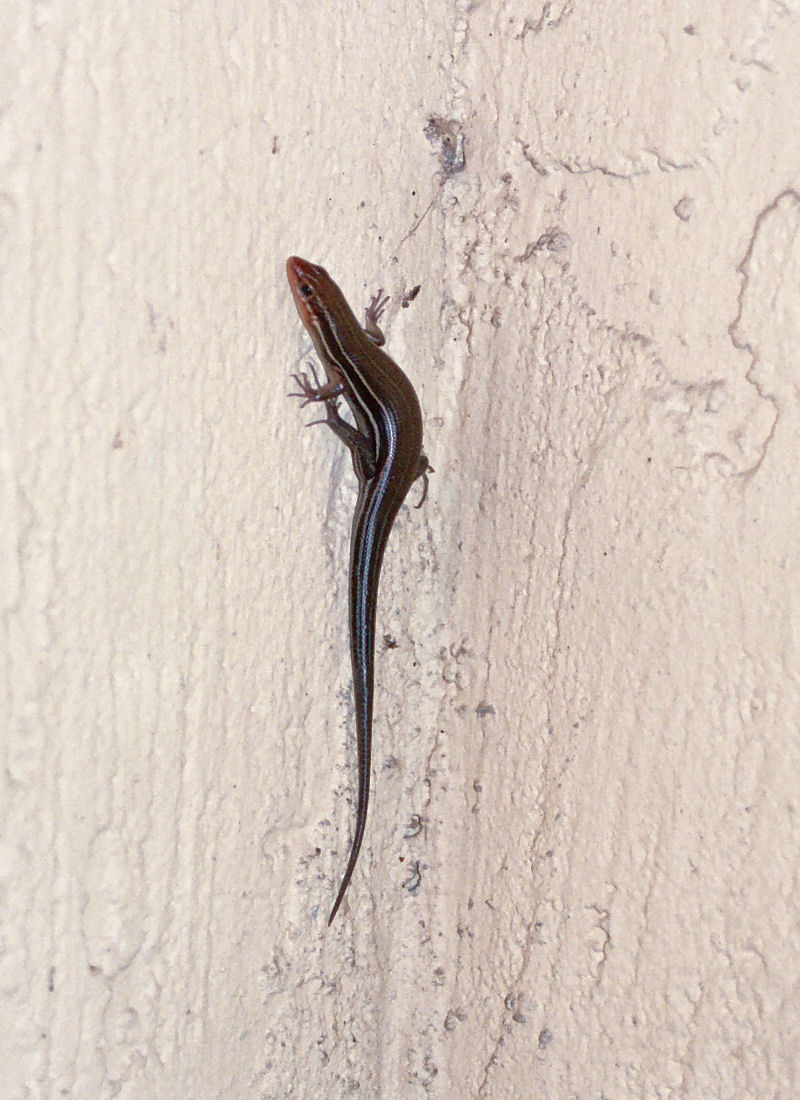
If the mole skink is a coin with legs, the ground skink is a paperclip with legs — the smallest reptile in North America, a wisp of coppery bronze that most people mistake for a baby of something else. It is not a baby. That is the adult. Ground skinks wear a crisp dark stripe down each side, running through the eye like a bandit mask that extends the length of the body, with a pale belly below it. That bold, unbroken dark lateral stripe is your best separator from the mole skink, along with the tail: a ground skink’s tail is body-colored, not red.
Ground skinks live in the leaf litter itself, rustling through dry oak leaves with a sound disproportionate to their size — gardeners often hear them before seeing them. They hunt tiny insects in the litter layer, they are utterly harmless, and they are superb indicators that your ground layer is alive. A yard scraped bare to dirt and turf has no ground skinks. A yard with leaf litter has an entire bronze civilization. Choose accordingly.
Southeastern Five-Lined Skink (Plestiodon inexpectatus) vs. Broad-Headed Skink (Plestiodon laticeps) — An Honest Confession
Now for the section where this guide earns your trust by admitting something most field guides bury in fine print: even experts often cannot separate these two species from a photograph. Juveniles of both are glossy black with five pale stripes and an almost electric blue tail. Females of both keep faded stripes into adulthood. Adult males of both fade toward plain olive-brown, and breeding males develop swollen, orange-red heads — the broad-headed male simply does everything bigger, with a genuinely massive triangular head, and it is the largest skink in our region. But a medium-sized striped adult on your fence, from a photo? Honest herpetologists reach for the lizard, not the camera.
Because the real differences are in the scales, and they are gloriously nerdy. Look at the underside of the tail: in the southeastern five-lined, those scales are all roughly the same size, while its relatives carry an enlarged central row down the tail’s underside. To separate the broad-headed, you count the labial scales along the upper lip between nostril and eye: broad-headed skinks have five; common five-lined skinks have four. That is the level we are operating at — species identity determined by counting lip scales on a lizard that would very much like to be elsewhere. Science is glorious and slightly absurd, and both things can be true.
Two practical notes. First, the blue tails on juveniles are thought to deflect predator attacks toward the expendable, breakaway tail — a neon sign that says “bite here, it is detachable.” Second, you will hear the old Florida claim that blue-tailed skinks are “scorpions” with a venomous sting. It is false. No lizard in the southeastern United States is dangerous to humans; a big broad-headed male can deliver a respectable nip if grabbed, which is best understood as a strongly worded letter, not a medical event. Leave them un-grabbed and they will spend their days eating roaches, beetles, and spiders around your logs, stumps, and fences — and broad-headeds, the climbers of the family, up your oak trees as well.
Meet the Crew, Part Two: Anoles, Sprinters, and the Night Shift
Green Anole (Anolis carolinensis) vs. Brown Anole (Anolis sagrei) — The Native and the Newcomer
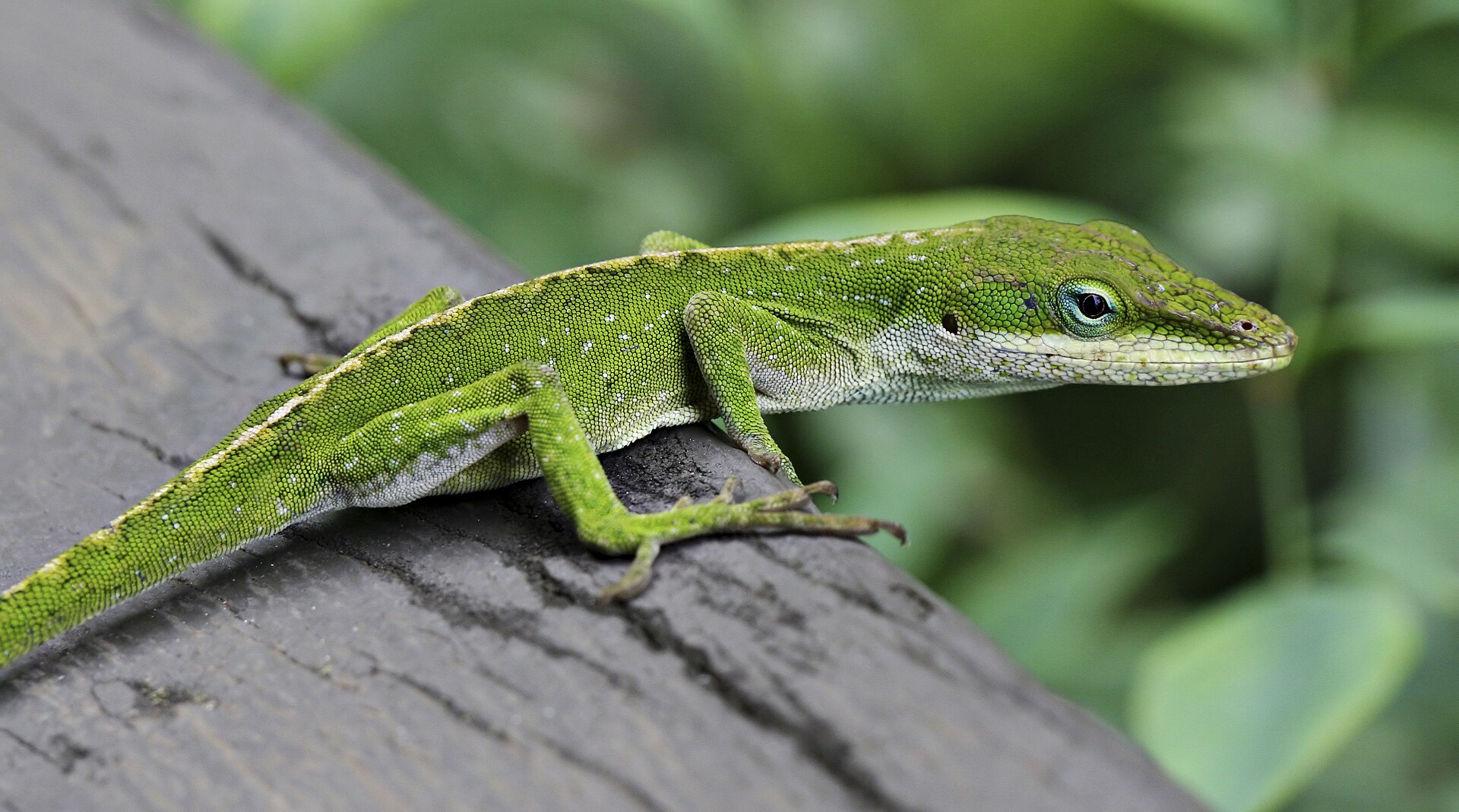
The anoles are the lizards you actually get to watch, and they reward watching. Both species are built around two pieces of technology worth understanding. The first is the dewlap: a flap of skin under the chin, supported by a slender rod of cartilage, that the male flares out like a flag — pinkish-red in the green anole, yellow-orange in the brown. The dewlap is a billboard, flashed with head-bobs and push-ups to advertise territory to rivals and fitness to females; together they work like a species signature. The second technology is under the toes: anole toe pads carry expanded scales called lamellae, carpeted with microscopic hair-like structures that grip smooth surfaces at the molecular level. That is how an anole strolls up your window glass like the wall owes it money.
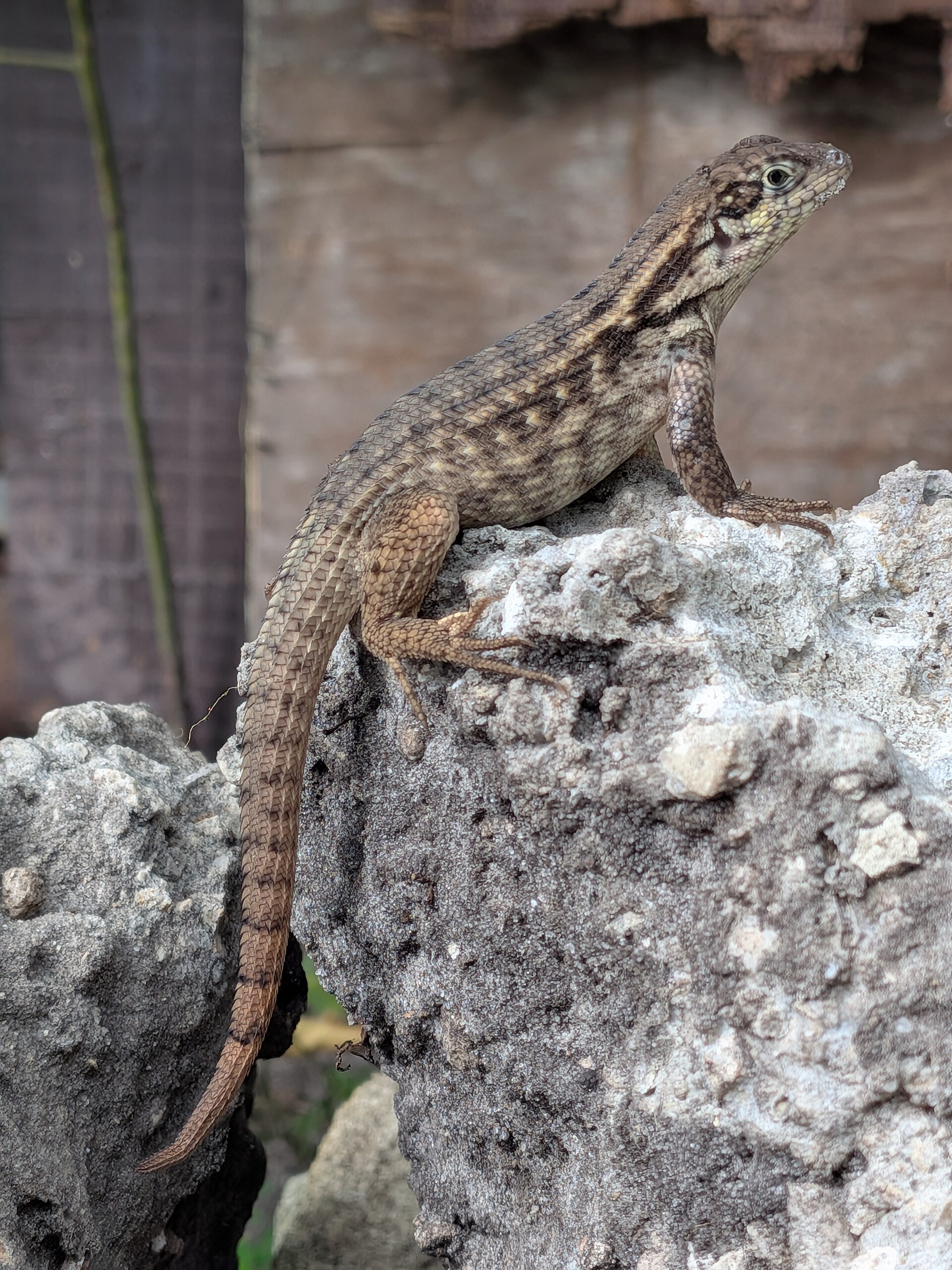
The green anole is our native — the only anole native to North America — a slender, long-snouted lizard that can shift between bright green and brown depending on temperature, stress, and background. (No, it is not a true chameleon, despite the nickname. Anole color change is impressive enough without borrowing another family’s résumé.) The brown anole arrived from Cuba and the Bahamas through the plant and cargo trade, and is now one of the most abundant lizards in the state: stockier, shorter-snouted, patterned in tans and browns. Brown anoles cannot turn green. If it is green, it is a green anole — even if it was brown an hour ago.
Here is where the story gets scientifically famous. Brown anoles are ground-and-low-trunk specialists, and where they invade, they compete with green anoles for the low perches and prey on young greens. Researchers working on Florida islands documented what happened next, and it happened fast: green anoles shifted to higher perches, moving up into thinner, smoother branches — and within about twenty generations, green anole populations in invaded areas evolved larger toe pads with more lamellae, better suited to gripping those high, thin perches. Later work found the same upward shift on the mainland. That is evolution measured within a single human career, in your shrubbery. The honest ending, though, is not a victory lap: the shift lets greens coexist with browns, but flattening a yard to lawn and concrete hurts the native far more than the invader, which thrives in disturbed urban ground. Want to help the native? Keep the shrubs, the trees, and the layered planting. Height is habitat.
Six-Lined Racerunner (Aspidoscelis sexlineatus) — The Sprinter
Every crew needs someone who does everything at full speed. The six-lined racerunner is a slim, rough-scaled whiptail with six pale stripes down a dark back and a personal philosophy that could be summarized as “why walk.” Racerunners are among the fastest lizards in North America relative to their size, built for open, sunny, sandy ground — so they simply outrun trouble, darting between patches of shade. Unlike the glossy skinks, a racerunner looks matte and granular, like fine sandpaper. If the lizard on your sandy path looks striped, dry, and deeply impatient, that is your racerunner. They hunt insects in the heat of the day when most other lizards have clocked off, which makes them the midday shift. Respect the hustle.
Eastern Fence Lizard (Sceloporus undulatus) — The Push-Up Artist of the Pine Woods
The fence lizard is the chunky, spiny-scaled lizard of fence rails, fallen pines, and sunlit wood piles in northern and central Florida — gray to brown with wavy dark crossbars, and breeding males sporting brilliant metallic blue patches on the throat and belly that they flash during, yes, push-up displays. Same billboard logic as the anole dewlap, different medium: the fence lizard’s whole underside is the sign. A taxonomic note for the truly nerdy (our favorite kind of reader): modern work has split the old fence-lizard complex into several species — you will see Sceloporus consobrinus used for the prairie fence lizards further west — but Florida’s eastern fence lizard keeps the name Sceloporus undulatus. Florida also has its own endemic relative, the Florida scrub lizard (Sceloporus woodi), a smaller specialist of open sand scrub.
House Geckos (Hemidactylus species) — The Night Shift
When the porch light comes on, the geckos clock in. Florida homes host a few introduced species of house gecko in the genus Hemidactylus — the tropical house gecko (Hemidactylus mabouia) and the Asian house gecko (Hemidactylus frenatus) among them — soft-skinned, big-eyed, translucent-looking lizards that hunt moths and roaches around lights at night. They have no eyelids, so they lick their own eyeballs clean, which is either horrifying or efficient depending on your perspective, and their toe pads let them run across ceilings. Males chirp and click after dark — if you have thought your house was haunted by a tiny, repetitive ghost, check the window frames first. These are introduced species, and honesty requires saying so; but they are now deeply established, they eat impressive numbers of insects around lights, and they ask only to be left alone on the wall. Enjoy the free extermination service.
Eastern Glass Lizard (Ophisaurus ventralis) — The Great Impostor
We end the roster with a lizard pretending, very convincingly, to be a snake — the perfect bridge to our companion guide on garden snakes, because telling them apart is a masterclass in looking closer. The eastern glass lizard is a legless lizard: long, glossy, and limbless, found in moist soils, mulch, and grassy edges, hunting insects and small rodents. How do you know it is not a snake? By the lizard equipment it kept. A glass lizard has external ear holes behind its head; snakes have none. A glass lizard has eyelids and blinks; a snake’s eyes sit under a fixed clear scale, which is why snakes appear to stare forever — they cannot help it. A glass lizard has a deep groove running along each side of its body, a fold that lets its ribcage expand; snakes lack it. And a glass lizard cannot unhinge its jaw the way a snake can, so its head stays modest and lizard-shaped. Its name comes from its other lizard inheritance: it can shed its tail like the skinks, and old tales claimed it shattered like glass. The tail breaks; the lizard does not. If you find a “snake” that blinks at you, you have found something rarer: a lizard that gave up legs and kept everything else. Let it go back to work.
Habitat That Works: Rolling Out the Welcome Mat for a Lizard
Attracting lizards requires no products, no devices, and no purchases — which may be why nobody advertises it. Lizards need four things: food (insects), cover (somewhere to not be eaten), temperature choices (sun and shade within dashing distance), and water. The single best thing you can build is a log pile: a few lengths of hardwood, stacked loosely in a quiet corner where it catches morning sun. A log pile is simultaneously a basking platform, a hunting ground, an egg-laying site for skinks, and a slow-motion buffet, as fungi and termites soften the wood and draw in the insects lizards eat. Second best: leaf litter left in place under shrubs and trees. We will say it plainly: leaves are not trash. They are the ground skink’s entire world, the mole skink’s roof, and the cafeteria both of them hunt in.
Groundcover plantings beat bare mulch, and dense native shrubs beat both, because layered vegetation is what lets green anoles live high and brown anoles live low in the same yard. A shallow water dish — a plant saucer with a stick or stone ramp so nothing drowns — covers the last requirement. One thing to skip: landscape fabric under mulch beds. For animals that live by moving between litter and loose earth — mole skinks sand-swimming below, ground skinks hunting above — that buried sheeting is a locked door in the middle of their house. Mulch alone suppresses weeds, feeds the soil as it breaks down, and leaves the underground highway open. For everything else the soil needs, the rest of our Living Root Academy guides have you covered.
The Threats Nobody Mentions at the Garden Center
Cats. We say this kindly, and factually, because many of us love cats and lizards both: free-roaming outdoor cats are among the top killers of Florida lizards. Cats hunt small reptiles relentlessly, and they do not need to be hungry to do it — hunting is hardwired play. Anoles, skinks, and racerunners evolved defenses against birds and snakes, not against a subsidized superpredator that hunts the same shrub line every day. Keeping pet cats indoors (or leashed, or in a screened catio, which Floridians are unusually well equipped to build) is the single highest-impact thing a lizard-loving household can do — and it is safer for the cat, too. That is not an anti-cat position. It is a pro-both-animals position, and the lizards will vote for it with their continued existence.
Pesticides. Broad-spectrum insecticides kill lizards two ways: directly, through exposure, and indirectly, by deleting their food supply and loading the insects they do eat with poison. A yard sprayed on a schedule is a yard where the crew starves at a poisoned cafeteria. Target genuine problems narrowly and skip broadcast treatments — you hired the lizards for this job, so let them work. Sticky glue traps deserve their own condemnation: glue boards set out for roaches or rodents routinely catch skinks, anoles, and geckos instead, and a trapped animal dies slowly unless a wildlife rehabilitator frees it with oil and patience. Do not use them outdoors, and think hard before using them indoors. A trap that cannot tell a roach from a skink is not pest control. It is just a hazard with adhesive.
There Is a Lizard in My House
Sooner or later a gecko will take a wrong turn, an anole will ride in on a plant, or a skink will dash through an open door and end up behind your couch, questioning its choices. The rescue protocol is gentle and reliable: get a large cup and a stiff piece of card, place the cup over the lizard, slide the card underneath, and carry the whole operation outside. Release it at the base of dense shrubs or leaf litter, close to cover — never in the middle of open lawn, where you have just served it to the birds. Do not grab it by the tail, for reasons this entire guide has explained: the tail is designed to come off, and it will. Wash your hands afterward, and close the door gap or screen tear that let it in. Then accept the compliment: lizards come indoors chasing insects, so an indoor lizard means your porch-light ecosystem is thriving. It was not invading. It was commuting.
The Closer: The Crew Is Already Hired
Here is the whole argument in one breath. Your garden already employs a pest-control crew: bone-armored skinks that swim through sand and guard their eggs, bronze miniatures in the leaves, lip-scale puzzles on the fence, native green anoles that rewired their own feet within living memory to hold their ground against an invader, sprinters on the midday shift, geckos on the night watch, and one magnificent legless impostor blinking from the mulch. They work for insects and sunshine. They ask for logs, leaves, water, and a yard free of poison, glue, and roaming cats. Keep your end of that bargain, and the crew will be there — shiny, quick, and quietly eating the bugs you did not want. That is the best deal in Florida gardening.
Keep learning
Met the lizards? Now meet the other scaly neighbors — the harmless snakes doing rodent patrol, and the few venomous ones to respect — in our companion Academy guide: Florida Garden Snakes: Good Neighbors and the Few to Respect.
Got kids who would rather meet the crew at eye level? The family version lives here: Lizards & Skinks for Kids.
🪱 Your Soil Needs This
Reading about healthy soil is great. Growing in it is better. Our small-batch, traceable worm castings are the shortcut your garden deserves.
Shop Worm Castings Subscribe & SaveEvery bag comes with a lot certificate. Know what's in your soil.