
IPM: The Whole Pyramid
Here’s the scene, played out in Florida gardens every single weekend. Something is eating the tomatoes. The gardener drives to the store, buys the bottle with the most insects on the label in a state of visible distress, comes home, and declares chemical war on the entire yard — the pest, the pest’s predators, three species of pollinator, a lizard who was just standing there, and, in a supporting role, the gardener’s own peace of mind. Two weeks later there are more pests than before, because the things that were eating the pests are gone, and the pests’ grandchildren have moved into a predator-free paradise with free rent.
Integrated Pest Management — IPM — is the discipline that exists to break that scene. It is not a brand of spray. It is not “organic” as a marketing category. It is a decision system, developed over decades of agricultural science, with a simple operating principle: use the least intervention that actually solves the problem, in a deliberate order, and only climb to the next level when the level below has genuinely failed. Picture a pyramid. The wide base is prevention. The tiers narrow through cultural, mechanical, and biological controls. At the very tip — the smallest, last-used part — sits chemistry. Most home pest problems should be solved in the bottom two tiers, by people who never have to touch the tip. This guide walks the whole pyramid, Florida-style.

Step Zero: Scout, Identify, and Count
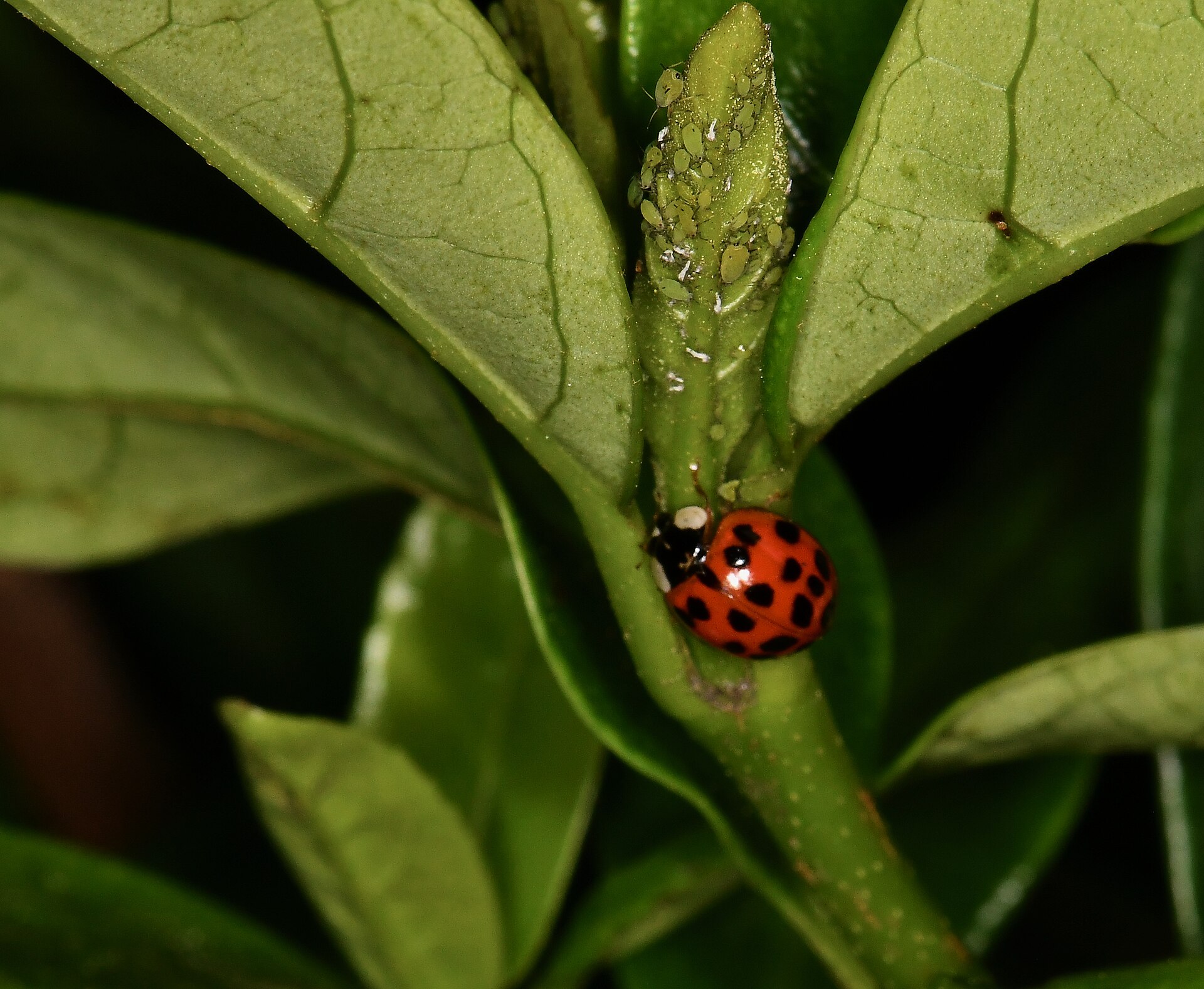
IPM begins before the pyramid, with a rule that feels like a delay and is actually the entire game: know what you’re looking at before you do anything about it. Most insects in a garden are not pests. Many are doing pest control for free. Some are pollinators in their larval wardrobe. The ladybug’s baby looks like a tiny black-and-orange alligator; the gardener who sprays alligator-looking larvae has just assassinated their own security team.
Scouting means a regular, unhurried look — undersides of leaves, new growth, the early morning shift when the night crew is still clocking out. You’re asking three questions. What is it? (Our Plant Doctor triage guide and the Florida Garden Pests guide are the identification desk.) How many are there? Three aphids are a snack bar for a ladybug; three hundred are a situation. Is the damage actually getting worse? A chewed leaf from last week that’s not spreading is a closed case, not a call to arms.
And underneath those questions sits IPM’s most liberating concept: the tolerance threshold. A food garden is not a show garden, and a plant is not a patient at zero damage. Most healthy plants shrug off a modest amount of chewing without any measurable loss of harvest. The threshold question — how much damage can this plant take before it actually costs me anything? — will talk you out of half the interventions you were about to perform. Slightly holey kale is not a crisis. Slightly holey kale is a garden.
Tier One: Prevention — the Wide Base
Prevention is everything you do before a pest ever arrives, and it is where IPM succeeds or fails. The pyramid is wide at the bottom because this tier does the most work.
Right plant, right place. A plant struggling in the wrong conditions — too wet, too dry, wrong season, wrong zone — is a stressed plant, and stressed plants are pest magnets in a way that’s almost chemical: they signal weakness, and their defenses genuinely are weaker. Half of “pest problems” in Florida are actually a plant growing where it never wanted to be, in a season it never asked for. The variety lists and seasonal timing in our Florida guides exist precisely to prevent this tier-one failure.
Soil health as pest strategy. This is the Living Root home turf, so let’s say it plainly: a plant growing in living, well-fed soil — real organic matter, functioning biology, steady moisture — tolerates pest pressure that would flatten a plant living on a synthetic drip in dead sand. Nutrition isn’t armor, but a well-nourished plant has the resources to replace chewed tissue, wall off damage, and keep producing. Building that soil is the whole subject of Know Your Amendments and our living-soil guides; consider them the pyramid’s foundation trench.
Diversity and companions. A solid block of one crop is a buffet with a sign on it. Mixed plantings confuse specialist pests and support the predators that eat generalists. This is companion planting used honestly — not as magic, but as habitat design (the full treatment is in our Companion Planting Guide).
Resistant varieties. When a disease or pest is a known repeat offender in your yard, plant breeders have often already solved it. Choosing resistant varieties is prevention you buy once, in the seed packet, instead of paying for all season.
Tier Two: Cultural Controls — How You Run the Garden
Cultural controls are your routine practices, adjusted to make life hard for pests and easy for plants:
- Spacing and airflow. Crowded plants in Florida humidity are a fungal resort. Space for the mature plant, not the transplant, and let air move.
- Watering at the base, in the morning. Wet foliage overnight is an invitation engraved for fungal disease. Water the soil; the leaves didn’t order a drink.
- Sanitation. Remove and destroy (not compost) badly diseased material; clean up fallen fruit that hosts the next pest generation; don’t let a hopelessly infested plant stand there running a breeding program. Cold compost piles don’t kill pathogens — a diseased tomato plant in the compost is a time capsule, not a treatment.
- Timing. Plant so the crop’s vulnerable stage misses the pest’s peak season. Florida’s two-season calendar makes this a real lever: some crops are simply easier in the fall window than the spring one.
- Rotation. Don’t plant the same family in the same bed season after season; soil-borne diseases and pests build up mailing addresses. Move the family, starve the specialists.
- Trap crops and sacrificial plants. Occasionally the smartest plant in the bed is the one you planted to be eaten — a magnet crop that draws pests to one inspectable, removable location. The plant takes one for the team, knowingly, which is more than most of us can say.
Tier Three: Mechanical and Physical Controls
When prevention and culture aren’t enough, IPM goes hands-on — literally. This tier is underrated because it isn’t sold in a bottle:
- Hand-picking. The tomato hornworm, the squash vine borer’s frass trail, the cluster of stink bugs — many of Florida’s worst offenders are large, slow, and pickable. Gloves, a bucket of soapy water, five minutes, done. A blacklight flashlight at night turns hornworm hunting into a glowing safari the kids will fight over.
- Water blasts. A hard jet of water dislodges aphids and mites; knocked to the ground, most don’t return. Repeat every few days and you break the breeding cycle without a single chemical.
- Barriers. Row cover over young crops excludes the moth before she lays the egg that becomes the caterpillar — prevention with fabric. Collars protect transplants from cutworms; copper and grit deter slugs in their modest way; netting keeps birds negotiating instead of dining.
- Traps. Yellow sticky cards monitor (and modestly reduce) flying pests — in IPM their day job is intelligence: they tell you what’s actually out there before you act.
- Pruning and removal. Sometimes the intervention is a pair of pruners: the one infested branch comes off (blades disinfected after — disease travels on tools), and the problem leaves with it.
Tier Four: Biological Controls — Recruiting the Locals
Biological control means letting living things do pest control: the predators, parasitoids, and diseases of the pests themselves. Your garden already has most of the workforce — lady beetles, lacewings, assassin bugs, spiders, parasitic wasps too small to notice and too effective to ignore, plus the anoles running the Florida day shift. The IPM gardener’s biological job is mostly habitat and restraint: keep flowers blooming in succession for the adults that eat nectar and pollen, keep a water source, tolerate a small standing population of prey (a garden with zero aphids has zero ladybugs by next month — predators need a reason to stay on payroll), and above all, don’t nuke the workforce with broad-spectrum sprays and then wonder why the pests threw a parade.
Purchased biologicals have a place — beneficial nematodes for soil pests are a genuinely useful Florida tool against things like mole crickets and soil-stage grubs, and Bt (a naturally occurring bacterial product) is a targeted, biological-tier answer to caterpillar outbreaks that spares nearly everything that isn’t a caterpillar. The honest notes: purchased predators often emigrate within days (you’re buying a boost, not an army), and every biological product works on a narrow target — identification, step zero, is what makes the tier possible at all.
The Tip: Chemical Controls, Last and Least
IPM is not a vow of chemical abstinence; it is a vow of chemical sequence. If a problem has survived identification, thresholds, prevention, culture, mechanical effort, and biology — and the crop is genuinely worth saving — then a chemical tool, chosen precisely, is a legitimate final tier. The discipline looks like this:
- Least-toxic and most targeted first. Insecticidal soaps and horticultural oils kill on contact, work on soft-bodied pests, and leave no lingering residue — they’re a different universe from calendar spraying. Even within “real” insecticides, choose the narrowest spectrum that fits the identified pest.
- Spot-treat the problem, not the property. The infested plant, not the yard.
- Time it for the pollinators. Never spray open bloom; if a treatment is truly needed, apply when bees aren’t foraging — and remember that systemic products can move into pollen and nectar, which is exactly the kind of detail the label exists to tell you.
- The label is the law. That’s not a slogan; legally, the label directions govern. Rates, targets, safety intervals before harvest — it’s all printed on the bottle by people who studied the chemistry longer than any of us will. Read it like it matters, because it does.
- Then audit. Did it work? Was it needed? A tier you climbed to should be rare enough that you can afford to ask.
A Florida Walk-Through
The pyramid, in one imaginary-but-typical case: your fall tomatoes develop a caterpillar problem. Step zero: it’s fruitworms, numbers modest, damage mostly cosmetic on a few fruit. Threshold: tolerable for now, scout twice a week. Tier one was already done in August — right variety, good soil, sane spacing. Tier two: you strip the lowest leaves for airflow and stay on top of fallen fruit. Tier three: evening hornworm patrols with the kids and a blacklight; two big ones go to the chickens. Tier four: the parasitic wasps are visibly working — you find a mummified caterpillar wearing its white cocoons like a tiny warning sign — so you hold. No spray is purchased. The harvest is fine. The “intervention” was mostly walking around with a flashlight, and it worked because the bottom of the pyramid had been carrying the garden all along.
That’s the whole philosophy in a single story: the pyramid isn’t a ladder you’re supposed to climb — it’s a building you’re supposed to live in the bottom of. Scout honestly, build the base wide, and the tip of the pyramid becomes what it should be in a home garden: mostly theoretical.
The Scouting Habit: Five Minutes, Twice a Week
The pyramid runs on information, and information has a collection schedule. Twice a week, take the same slow walk through the garden with no tool in your hand except maybe a phone for photos. Flip a few leaves on each crop — the undersides are where the truth lives. Look at the newest growth (aphids and caterpillars file their paperwork there), the oldest leaves (deficiency and disease start downstairs), and the soil line (cutworms and wilts announce themselves at the border). You’re not solving anything on this walk. You’re taking attendance.
Then write it down — a note on the phone, a line in the garden notebook: date, plant, what you saw, roughly how much of it. Three weeks of those notes are worth more than any product on the shelf, because they convert panic into trend lines. “Aphids on the peppers” is a scare. “Aphids on the peppers, up slightly, but two ladybug larvae present and the count held steady for ten days” is a management plan that’s already working. IPM’s deep secret is that it’s mostly this: a person who looks at their garden regularly, on purpose, and keeps receipts.
Florida’s Greatest Hits, Sorted by Tier
To make the pyramid concrete, here’s how it sorts the usual Florida suspects:
- Citrus leafminer (the squiggly silver trails in new citrus leaves): almost pure step zero. On a mature tree the damage is cosmetic and the threshold answer is do nothing — the tree outgrows it, and parasitoid wasps police the miners if you don’t spray them off the job. Protecting a very young tree’s flush is the exception that proves the threshold rule.
- Pickleworms in cucumbers and squash: a tier-three classic. The moth lays eggs at night and the larva bores straight into fruit, where no spray reaches it anyway. Row cover until flowering, prompt harvest, destroying infested fruit, and timing plantings to dodge peak pressure do more than any bottle ever bottled.
- Whiteflies: tier two and three — blast them off with water, prune out the worst leaves, yellow cards for monitoring, and ruthlessly avoid the broad-spectrum spray that kills their parasitoids and converts a nuisance into an occupation.
- Armyworms in the lawn and garden: scout at dusk, hand-pick what you can, and if a true outbreak on young plants demands backup, Bt is the tier-four citizen built exactly for caterpillars and almost nothing else.
- Root-knot nematodes in the sand: the pyramid’s long game — there is no satisfying spray for a home gardener, which is precisely the point. Resistant varieties and grafted plants (tier one), rotation and solarization and organic-matter building (tier two), and time. Florida’s most honest pest lesson is that some problems are only solvable at the base of the pyramid, and the base is wide for a reason.
The Hardest Tier: Removing the Plant
There is one more control that belongs in every tier and gets said too rarely: sometimes the correct management of a plant is to take it out. A chronically diseased specimen, a variety that fails in your yard every single season, a squash so thoroughly colonized by borers that it has become pest infrastructure — keeping it is not kindness, it’s a subsidy for everything eating your other plants. IPM is unsentimental on this point because the math is unsentimental: one hopeless plant removed early can be worth a whole shelf of interventions later. Bag it, bin it (don’t compost the diseased ones), disinfect the tools, and plant the space with something that wants to live in your garden. The pyramid’s real foundation isn’t a technique at all. It’s a gardener paying attention, keeping records, and making decisions in order. Everything else is just leverage.
🌱 Keep learning
Identify the culprit with Florida Garden Pests and Plant Doctor, design the habitat tier with The Companion Planting Guide, build the foundation with Know Your Amendments, and find the rest of the collection at the Living Root Academy.
🪱 Your Soil Needs This
Reading about healthy soil is great. Growing in it is better. Our small-batch, traceable worm castings are the shortcut your garden deserves.
Shop Worm Castings Subscribe & SaveEvery bag comes with a lot certificate. Know what's in your soil.