
Free Plants: The Propagation Guide
Every gardener has had the same moment. You’re standing in the nursery, holding a one-gallon pot that contains, generously, eleven leaves and a root system, and the tag says a number that would buy lunch. And somewhere in the back of your head a small voice says what gardeners have said for thousands of years: I bet I could make more of these. You can. That voice is correct. It has always been correct. That voice is the entire reason nurseries are nervous.
Propagation is the polite word for making new plants from old plants — cuttings, divisions, layers, grafts — instead of buying them or growing them from seed. It is the oldest gardening technology there is, older than the seed packet, older than the nursery, older than the wheel’s first career change into a wheelbarrow. And it comes with a superpower seeds can’t match: a propagated plant is a clone. It is genetically the same individual as the plant you took it from. The tomato that shrugged off your worst summer, the fig that fruits like it’s showing off, the basil that tastes like the one your grandmother grew — propagate them, and you get that exact plant again. Seeds, wonderful as they are, shuffle the deck. Propagation photocopies the winning hand.
This guide covers the whole toolkit: cuttings (softwood, semi-hardwood, hardwood), division, layering and air layering, and grafting basics — plus the medium to root them in, Florida timing, and an honest troubleshooting section for the cuttings that sit there doing nothing while judging you.
Why Propagate Instead of Sowing?
Plants grown from seed are children: they carry a mix of two parents, and they vary. That’s glorious when you’re breeding or exploring — our seed-saving guide is built on exactly that joy — but it’s a problem when the plant you love is special because of its exact genetics.
Three situations where propagation isn’t just cheaper, it’s the only correct move:
- Named fruit varieties. A mango seed from a spectacular mango will grow a mango tree. It will not grow that mango. Fruit quality, size, season, and fiber are all up for renegotiation. Every named variety of mango, avocado, citrus tree, and grape in the world exists because someone grafted or rooted a piece of the original tree — some of those clones are centuries old and still going.
- Hybrids and sterile plants. Many garden hybrids don’t come true from seed, and some barely make viable seed at all. If you want more of them, you clone them or you buy them.
- The plant that’s already proven itself in YOUR yard. Nurseries sell plants that did well at the nursery. Your garden has its own soil, its own microclimate, its own particular Florida chaos. A cutting from the plant already thriving in your conditions is pre-adapted in a way no purchase can be.
There’s also the math, which we will do vaguely on purpose: one healthy mother plant can become five, ten, twenty plants in a season. Gardeners who propagate stop shopping for plants and start shopping for one good plant, the way a library buys one good book and lends it forever.
The Toolkit, and the Hygiene Lecture
You need less than the internet wants to sell you:
- Sharp bypass pruners and a sharp knife. Sharp is not a luxury. A clean cut slices cells; a dull cut crushes them, and crushed tissue rots. Most propagation failure is a dull blade wearing a trench coat.
- Rubbing alcohol or a diluted bleach solution for wiping blades between plants.
- Small pots or cells, labels, and a pencil. Labels matter more than you think. In six weeks, every green stick in a pot looks identical, and “mystery plant roulette” is a game you will lose.
- A humidity strategy: a clear plastic dome, a clear storage tote, or even a plastic bag tented over the pot.
- Rooting hormone (optional). It can improve success on stubborn wood. Plenty of easy plants root happily without it. It’s a helper, not a spell.
Now the hygiene lecture, delivered with love: disinfect your blades between plants. Many plant diseases — bacterial spots, fungal wilts, viruses — travel plant to plant on cutting tools. You can take twenty cuttings and accidentally run a disease delivery service, inoculating every fresh wound you make. Ten seconds of wiping per plant. It is the cheapest insurance in all of gardening, and skipping it is how a propagation session becomes an epidemiology case study.
What a Cutting Is Actually Doing
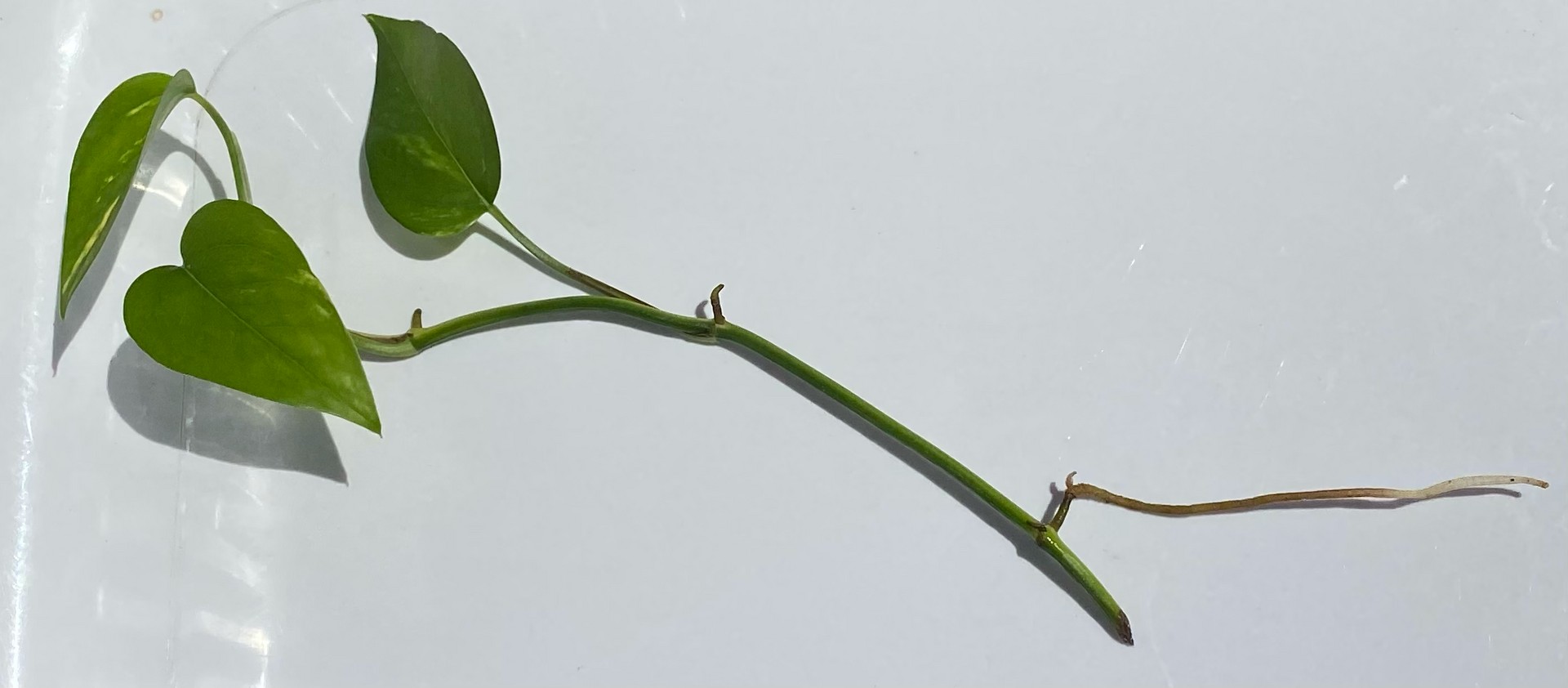
A cutting is a piece of stem with no roots, which means it has a plumbing problem: leaves keep losing water, and there’s no root system to replace it. Everything in cutting technique is about solving that problem long enough for the stem to do something remarkable — grow brand-new roots from tissue that was never root tissue. Those are called adventitious roots, and they’re triggered partly by the plant’s own hormone, auxin, which is made in growing tips and young leaves and drifts downward, pooling at the cut end. The plant, sensing catastrophe, essentially votes to rebuild its missing half. Your job is climate control for the vote: keep humidity high so leaves stop hemorrhaging water, keep the medium moist but airy, keep things warm, and wait.
This is also why cuttings are taken with a node — that knobbly joint where a leaf attaches. Nodes are where the plant keeps its most flexible, ready-to-change tissue. A cutting without a node is a stick with ambitions. A cutting with two or three nodes is a plan.
The Three Woods: Softwood, Semi-Hardwood, Hardwood
Cuttings are classified by the age and firmness of the stem, and the classification matters because each type roots differently and is taken at a different season.
Softwood cuttings come from the soft, green, bendy new growth of spring and early summer. They root the fastest — sometimes in a couple of weeks — and they also wilt the fastest, because soft tissue loses water like it’s its job. Basil, coleus, mints, and many herbs and ornamentals root this way almost insultingly easily. High humidity is non-negotiable.
Semi-hardwood cuttings come from the current season’s growth after it has firmed up — it snaps rather than bends, and the base is starting to toughen while the tip is still soft. In Florida this is a long, generous window through summer and into fall. Many shrubs, citrus trees, figs, and Mediterranean herbs like rosemary take well this way. This is the workhorse category: sturdy enough to handle, young enough to root.
Hardwood cuttings come from fully mature, dormant-season wood — taken in late fall and winter in most climates. They root slowly, over weeks to months, but they’re tough and forgiving about humidity. Grapes, figs, pomegranates, and many deciduous shrubs are classic candidates. In Florida, where “dormant” is a relative term for many plants, hardwood timing follows the plant’s own rest period rather than the calendar’s opinion.
A Cutting, Step by Step
- Pick a healthy mother. No spots, no wilting, no pest colonies. You’re photocopying — start with a clean original.
- Cut in the morning if you can, when the plant is fully hydrated. Take a piece roughly 4–6 inches long with at least two or three nodes.
- Make the bottom cut just below a node, clean and straight, with your disinfected blade. Make the top cut above a node too — some gardeners angle the top cut so they can tell up from down later. A cutting planted upside down will think about roots in entirely the wrong direction, briefly, then die confused. Mark your polarity.
- Strip the lower leaves. Any leaf buried in the medium will rot there. Keep a couple of leaves at the top for photosynthesis; if they’re huge, trim them in half — the plant keeps its solar panels, loses less water.
- Optional: dip the base in rooting hormone per the label, tapping off the excess.
- Stick it. Poke a hole in the medium first (jamming a tender stem straight in scrapes off hormone and damages tissue), insert so at least one node is buried, firm the medium gently.
- Water in, dome on, bright shade. Not direct Florida sun — a cut under a plastic dome in August sun is a slow cooker. Bright indirect light is the sweet spot.
- Wait, and test with a tug. When you feel resistance, roots are holding. Resist the urge to excavate for a look; roots are shy and easily bruised. Shyness is not failure.
The Rooting Medium: Where Castings Earn a Seat
A rooting medium has one job description with two conflicting clauses: hold moisture against the stem, and hold air so the stem doesn’t rot. Pure garden soil fails clause two — it compacts and carries disease. The classic answer is a lean, airy mix: perlite or coarse sand for structure, coir or peat for moisture, and — here’s where our herd reports for duty — worm castings blended in modestly.
Use castings the way this site uses them for seedlings generally: within the 10–20% band of the mix by volume — a supporting role, not the whole cast. What castings bring to a rooting bench isn’t brute nutrition (a cutting has no roots; it can’t eat a banquet yet). It’s biology: a living microbial community around the cut surface, in a medium that’s otherwise nearly sterile. Keep the total mix lean, moist like a wrung-out sponge, and never soggy. Soggy is where cuttings go to become soup. (Our Seedling Guide covers starting mixes in depth; the same judgment applies here.)
Division: The Instant Gratification Method
Division is propagation with the suspense removed. Many plants grow as clumps — a crown that produces multiple shoots and its own root mass — and dividing simply means splitting that clump into pieces, each with roots and shoots attached, and replanting them as independent plants. Each division is a mature plant from day one. No rooting watch, no humidity dome, no drama.
Good candidates in Florida gardens: lemongrass, gingers, daylilies, agapanthus, society garlic, many ornamental grasses, clumping bamboos (divide with conviction and a sharp saw — bamboo does not negotiate), and most herbs that mound, like chives. Plants that grow from a single trunk or a taproot are not candidates, which they will demonstrate by dying at you.
The method: water the plant well the day before. Dig the clump with as much root as you can. Then — with a sharp spade, a soil knife, or (for the truly congested) two forks back to back — pry or cut the crown into sections, each with its own roots and at least a few healthy shoots. Trim any mangled roots cleanly. Replant divisions at the same depth they were growing, water deeply, and shade them for a week or two if the weather is fierce: a division is a plant that just had surgery and a relocation on the same day. Mulch, water, and give it a minute.
Divide when the plant is actively growing but not in the worst of the summer blast — spring and early fall are kind in Florida. A clump that has gone sparse and woody in the center, with all the action at the edges, is literally asking for it: that donut shape is the plant’s own memo saying the middle has retired.
Layering: Rooting Without Letting Go
Layering is the cautious engineer’s approach: the new plant roots while still attached to the mother, drinking from her root system the whole time. No plumbing crisis, no dome, no suspense. It’s slower, and it is close to foolproof.
Simple layering: take a low, flexible branch, bend it to the ground, wound or nick the underside slightly where it touches soil, pin that spot down (a landscape staple or a brick works), and bury it under a few inches of soil with the tip sticking out. Keep it moist. Roots form at the buried, wounded node. Months later, sever the connection and dig up your new plant. Blackberries, trailing herbs, jasmine, and many shrubs layer almost on their own wherever a branch touches earth — gardeners call the deliberate version “layering” and the accidental version “the blackberry situation.”
Air layering is the same idea performed in mid-air, and it is the Florida fruit grower’s superpower. On a branch too high to bend — a mango, a lychee, a fig, a citrus tree — you select a healthy pencil-thick branch, remove a ring of bark (the girdle) or make a careful upward cut, pack the wound with moist sphagnum moss or coir, wrap it in plastic to hold the moisture, and wait. The branch, still fed by the tree, does what girdled branches do: it tries to root at the interruption, right into your moss ball. In our warmth, rooting can take a couple of months, give or take the species and season. When the ball is full of visible roots, you cut below it and pot up a young tree that is genetically the mother — and because you started with a mature branch, it’s a bigger, further-along tree than any cutting could give you.
Girdling sounds violent, so let’s be precise: you remove a ring of bark and the soft tissue under it, scraping down to clean wood so the ring can’t heal over. Miss a strip and the branch bridges the gap and roots poorly; this is the step to do slowly, once, properly. Everything downstream is patience and moisture checks.
Grafting Basics: Two Plants, One Tree
Grafting joins a piece of one plant (the scion — the variety you want to eat) onto the root system of another (the rootstock). It sounds like plant surgery because it is, but the actual mechanics rest on one beautiful fact: if you press the thin green growing layers — the cambium — of two related plants together and hold them still, they will heal into one continuous plant. Cambium alignment is the entire game. Everything else is clamps and hope.
Why bother? Because roots and fruit are different job descriptions:
- Disease and soil tolerance. The rootstock is chosen for the neighborhood — resistance to soil diseases, tolerance for wet feet or nematodes — while the scion is chosen for the table. In Florida sand, where nematodes throw festivals, the right rootstock can be the difference between a tree and a memorial.
- Size control. Dwarfing rootstocks keep a fruit tree at ladder-free height.
- Speed. A grafted tree fruits years sooner than a seedling, because the scion is mature wood — it already knows how to be a grown-up.
- Variety conversion. An established tree of a disappointing variety can be re-worked with new scions. Gardeners call this “topworking.” The tree calls it a promotion, probably.
Two grafts cover most backyard ambitions, in plain terms. The whip graft joins a dormant scion stick to a rootstock of matching thickness: long matching diagonal cuts on both, cambium lined up along at least one side, wrapped tight with grafting tape. It’s the handshake — matching surfaces, firm grip. The bud graft (T-budding) uses a single bud instead of a stick: a T-shaped flap cut in the rootstock’s bark, the bud slipped underneath, everything wrapped except the bud’s eye. It’s done when the bark is “slipping” — peeling easily because the plant is actively growing — which in Florida is a long and forgiving season.
Rules that are not negotiable: scion and rootstock must be close relatives (within the same genus is the usual backyard rule, and citrus trees, mangoes, and stone fruit each keep to their own families); scion wood must be healthy and collected at the right dormancy stage for the method; every cut is made with a clean, disinfected, very sharp knife; and the union gets wrapped and protected from drying out until it heals. A full treatment of fruit-tree grafting lives with our Florida Fruit Trees guide — consider this the orientation, not the residency.
Florida Timing
Our climate rewrites the mainland calendar in the propagator’s favor. Warmth is a rooting accelerant: stems that sulk for months in a cold-climate windowsill often root in weeks here. The long growing season means the semi-hardwood window stretches generously, and air layers set in spring have all summer to work.
The cautions are the flip side of the gifts. Summer humidity plus a sealed dome plus rich medium equals a mold convention — ventilate your domes, don’t hermetically seal, and err toward airy medium in the wet season. Mid-summer sun will cook cuttings through plastic in an hour. And tropical plants resent being asked to root into our brief winter cool snaps: for the truly tropical material, late spring through early fall is the kind season. When in doubt, propagate when the mother plant is actively growing — she’s the one funding the project, and her enthusiasm is the whole budget.
Troubleshooting: A Field Guide to Green Sticks
- The base turns black and mushy. Rot — too wet, too rich, or a dirty blade. Cut back to clean tissue if there’s length to spare, re-stick in fresh, airier medium, and review your watering. Soggy is a lifestyle choice for rice, not cuttings.
- Leaves crisp while the medium is moist. Desiccation from the top — too much sun or too little humidity. More shade, dome back on, mist. The stem can’t drink yet; stop asking it to sunbathe.
- Tiny flies dancing on the medium. Fungus gnats — their larvae snack on fungi and tender new roots. Let the surface dry slightly between waterings, use sticky traps for the adults, and don’t keep the medium swampy. They are a symptom of wet more than a cause of failure.
- White fuzz. Mold, from still, saturated air. Ventilate daily; remove anything that’s gone fully to fuzz before it evangelizes the neighbors.
- Nothing. For ages. But it’s still green. Not necessarily failure — hardwood and slow species take months. Check for callus (a pale swelling at the base): that’s the plant working on it. Green and callused means be patient. Brown and brittle means it’s a stick now, and compost takes all returns.
- Leaves grow, then everything collapses. The cutting spent its savings: it pushed leaves from stored energy before roots arrived, then went broke. This is why we trim big leaves and keep top growth modest until the tug test says roots exist.
One last reframe, because it’s true: propagation is the highest-leverage skill in the garden. Seeds ask you to wait for a generation. Purchases ask you to pay per plant. Propagation asks only for a sharp blade, a clean cut, and the patience to let a plant do the thing it evolved over millions of years to do — refuse, under any circumstances, to be just one plant.
🌱 Keep learning
Start them from seed instead with the Seedling Guide, keep the genetics going with Saving Your Own Seeds, pot your new clones up with the Container Gardening Guide, and find the rest of the collection at the Living Root Academy.
🪱 Your Soil Needs This
Reading about healthy soil is great. Growing in it is better. Our small-batch, traceable worm castings are the shortcut your garden deserves.
Shop Worm Castings Subscribe & SaveEvery bag comes with a lot certificate. Know what's in your soil.