
Your lawn has a downstream address, whether you know it or not.
Your Yard Is a Tributary
Here is the single most useful idea in all of water science, and it fits in one sentence: every piece of land drains somewhere. The patch of ground your house sits on, your vegetable beds, your driveway, the strip of grass by the road — all of it is tilted, however slightly, toward some ditch, creek, canal, or river, which is tilted toward a bigger water body, which eventually reaches the sea. That whole funnel-shaped area of land is called a watershed, or a drainage basin. The ridge lines between watersheds are called divides, which is a gloriously dramatic name for what is usually just a subtle rise in the ground that decides whether a raindrop ends up in the Atlantic or the Gulf.
You live in a watershed. You cannot opt out. You can only decide what you send downstream.
This is not a guilt trip. It is a superpower. Once you see your yard as the headwaters of something, every choice you make out there — what you spread, what you spray, what you leave bare — stops being a private matter between you and your tomatoes and becomes a letter you are mailing to the river. The good news is that the same yard can mail very nice letters.
Three Fates of a Raindrop
When rain hits your yard, each drop faces exactly three possible fates, and the balance between them decides almost everything about water quality.
Fate one: runoff. The water slides across the surface without soaking in, picking up speed and anything loose on its way — soil particles, fertilizer granules, pesticide residue, pet waste, motor oil from the driveway. Runoff is water in a hurry, and hurried water is a thief. It steals topsoil and delivers it, along with everything riding on it, to the nearest ditch.
Fate two: infiltration. The water soaks down into the soil, moving through pore spaces between particles, the way coffee moves through a filter. Good infiltration means the soil acts like a sponge and a sieve at once: it holds water for roots and strains out some of what the water carries. Roots, worms, fungi, and organic matter are what keep those pore spaces open. Compacted, bare, lifeless soil has about as much infiltration as a parking lot, which is to say, almost none.
Fate three: leaching. The water sinks past the root zone entirely, down toward the water table, carrying dissolved substances with it. Leaching is invisible and therefore easy to ignore, which is a shame, because in Florida it is doing a great deal of the mischief. A dissolved nutrient does not need a ditch to reach water. It just needs gravity and time.
Every gardening practice you adopt tilts this balance. Mulch, living roots, and organic matter push water toward infiltration. Bare soil, compaction, and hard surfaces push it toward runoff. Soluble chemicals dissolved in irrigation water are practically volunteering for leaching. Your yard is a machine for sorting raindrops, and you are the one who sets the dials.
Why Broadcast Chemicals Are the Problem
Let us be precise about the villain here, because precision is what keeps this from being a lecture. The problem is not that a gardener once fed a tomato. The problem is broadcast application: spreading weed killer or synthetic fertilizer over a whole lawn or a whole landscape, on a schedule, whether anything needs it or not.
Broadcast means most of the product never reaches a target plant. Some of it lands on leaves that do not need it. Some lands on soil where no roots are waiting. Then the rain comes, and the runoff and leaching fates take over. The weed killer that was supposed to punish one dandelion is now riding a sheet of water toward the street drain. The fertilizer that was supposed to green up the grass is now dissolved nitrate and phosphate, sinking through sand toward the aquifer or sliding toward the canal.
Synthetic fertilizers are especially leaky by design. They are mostly soluble salts — nitrogen and phosphorus in forms that dissolve instantly in water, which is why they green things up so fast and why they leave so fast. They are fast food for plants: a sugar rush with no fiber. A plant can only absorb so much at once, and the rest is looking for an exit. Contrast that with feeding soil biology — worm castings and compost release nutrients slowly, as microbes break organic matter down, which means the nutrients show up at roughly the pace roots can actually use them. Slow food stays home. Fast food runs away.
Pesticides have the same geometry problem. Spraying a whole yard for a pest that lives on three shrubs is like fumigating a house because you saw one ant. The chemical goes everywhere, including the places where it does nothing except wait for rain. Spot treatment — finding the actual pest, treating the actual plant — is not just gentler. It is more accurate. Accuracy is the whole game.
Why Florida Leaks More Than Most Places
Florida is, hydrologically speaking, a sieve wearing a raincoat. Three things conspire to make this state unusually leaky.
First: sand with a tiny memory. Soil scientists measure a soil’s ability to hold onto nutrients with something called cation exchange capacity, or CEC. Cations are positively charged nutrient ions — calcium, magnesium, potassium, ammonium — and soil particles hold them the way a magnet holds paper clips, on charged surfaces. Clay particles and humus have enormous charged surfaces. Sand has almost none. A typical Florida sand has a CEC of roughly 1 to 5 milliequivalents per 100 grams, while a good clay loam can be ten or twenty times that. Translation: Florida sand forgets. You can pour nutrients onto it and they simply do not stick around. They wash straight through, the way water runs through a colander, because at the particle level that is basically what sand is.
Second: the water table is right there. Florida’s uppermost aquifer, the surficial aquifer, sits just a few feet below the surface in many places, sometimes less. There is not a deep stack of filtering rock between your lawn and your drinking water. What leaches past the root zone does not have far to travel before it is in the groundwater, and groundwater and surface water in Florida are constantly trading places through springs, seeps, and wetlands. The boundary between “underground” and “in the river” is more of a suggestion than a wall.
Third: the rain arrives all at once. A Florida summer downpour does not politely sprinkle. It dumps inches in an hour onto soil that may already be saturated or baked hard, and the excess has to go somewhere fast. Fast water is runoff water, and runoff water is the delivery service for everything loose on the surface.
And then, the final insult: Florida’s rivers are slow. A river that drops only inches per mile cannot flush pollutants out to sea in a hurry. What enters a slow river tends to linger, recirculate with the tides, and settle in. Florida’s waters do not rinse. They steep.
What Happens Downstream: Eutrophication, Properly Explained
So the nitrate and phosphate arrive in a river or estuary. What actually happens next is not magic and not mystery. It is a chain reaction with a name: eutrophication, from the Greek for “well nourished,” which is a polite way of saying “fed to death.”
Step one: the extra nitrogen and phosphorus act as fertilizer in the water, exactly as they do on land. Algae and aquatic plants grow explosively. The water turns green and cloudy. This is called a bloom, and on its own it is just plants doing what plants do when fed.
Step two: the bloom blocks sunlight. Seagrass beds below the surface, which need light the way your tomatoes do, start to die back. Seagrass is nursery habitat for fish, shrimp, crabs, and manatees, so losing it is like bulldozing a neighborhood and calling it landscaping.
Step three: the algae die, sink, and decompose. Decomposition is carried out by bacteria, and bacteria breathe oxygen. A big bloom means a big bacterial feast, and a big feast drains the dissolved oxygen from the water. Fish and shellfish, which need that oxygen exactly as urgently as you need air, start to suffocate. Low-oxygen water is called hypoxic. Water with essentially no oxygen is called anoxic, and in anoxic water, not much with gills survives.
Step four: the murky, oxygen-poor water lingers, because the river is slow and the tides keep pushing it back upstream. The estuary gets stressed, fish kills make the news, oyster beds suffer, and everybody wonders where it came from. It came from upstream. It came from thousands of yards, each one contributing a little, which is the most important sentence in this whole guide: nobody’s lawn alone wrecked the river, and everybody’s lawn together did.
One careful distinction, because nerdy accuracy matters: not every green bloom is toxic. Many blooms are simply overgrowth. Some kinds of cyanobacteria, the organisms formerly called blue-green algae, can produce toxins under certain conditions, and those are the ones that close beaches and make headlines. The everyday damage of eutrophication — the murk, the seagrass loss, the oxygen crash — does not need toxins to be serious. It just needs too much fertilizer in the wrong place.
A Tour of Florida’s Rivers (One Line Each, No Cheating)
Florida has more than 1,700 rivers, streams, and creeks, which is far too many for one guide, so here is a tour of the headliners, each in a single honest line. Notice how many of them end in an estuary — that is where your yard’s mail gets delivered.
The Panhandle, Gulf-bound: the Escambia, sliding out of Alabama into Pensacola Bay; the Blackwater, tea-colored with tannins; the Choctawhatchee, feeding its namesake bay; the Ochlockonee, winding to Apalachee Bay; the Chipola, spring-fed and clear, a tributary of the big one below.
The Apalachicola is the largest river in Florida by flow, born where two Georgia rivers meet, running unimpeded to Apalachicola Bay, where its freshwater is the reason the oysters exist at all. Less freshwater, fewer oysters. It is that direct.
The Suwannee runs 246 miles from the Okefenokee Swamp to the Gulf, blackwater-dark, spring-fed along the way, the second-largest river in the state by flow, and the only major southeastern river that still runs essentially unspoiled.
The Santa Fe joins the Suwannee after a career of disappearing underground and reappearing through springs, which is the most Florida thing a river can do.
The Withlacoochee — and yes, Florida has two rivers with this name, because Florida enjoys watching you check a map twice. The central one flows to the Gulf; the northern one joins the Suwannee.
The Gulf coast peninsular rivers: the Peace, draining ranchland and phosphate country toward Charlotte Harbor; the Myakka, wild and scenic, alligators included; the Hillsborough, feeding Tampa Bay; the spring runs — Silver, Rainbow, Weeki Wachee, Wakulla — so clear and constant in temperature that they feel air-conditioned, because they basically are, by geology.
The Kissimmee meanders south into Lake Okeechobee, which is less a lake and more a very wide, very shallow saucer that everything in central Florida eventually drains toward.
The Atlantic side: the St. Marys, forming the Georgia border out of the Okefenokee; the Loxahatchee, federally designated wild and scenic; and the St. Lucie River, which is a real river with a canal problem, as you will see below.
The Everglades is not a river in the usual sense and is absolutely a river in the important sense: a sheet of water miles wide and inches deep, sliding south so slowly it is called the river of grass. Drain it, ditch it, and divert it, and you have rearranged the plumbing of an entire peninsula. Which, of course, is exactly what happened.
Canals Are Not Rivers (A Distinction Worth Making)
Florida has thousands of miles of canals, and it matters that you not confuse them with rivers. A river carves its own path over geologic time, meandering, flooding its plain, building its own banks. A canal is a ditch with ambition: dug by people, usually straight, usually for drainage or transport, and very good at moving water — and everything in it — somewhere else in a hurry.
The big east-coast drainage canals — the Miami, the North New River, the Hillsboro, the West Palm Beach, and the St. Lucie — were cut from Lake Okeechobee toward the Atlantic to drain land for farming and settlement. The St. Lucie Canal, now called the C-44, was built between 1916 and 1924 through uplands with no natural drainage pattern at all; it has no natural connection to the lake it drains. Its sole purpose was to move water out, fast. When lake water carrying farm and lawn nutrients gets released through it into the St. Lucie River estuary, the estuary gets a nutrient pulse it never evolved to handle, and the algal blooms follow like clockwork. The Caloosahatchee, on the Gulf side, is partly canalized too, as part of the cross-state Okeechobee Waterway.
None of this is an argument against flood control. It is an argument for knowing which kind of water you are looking at. A canal is a fast pipe. A river is a slow living system. Treating one like the other is how estuaries get hurt.
The St. Johns River: A Proper Deep Dive
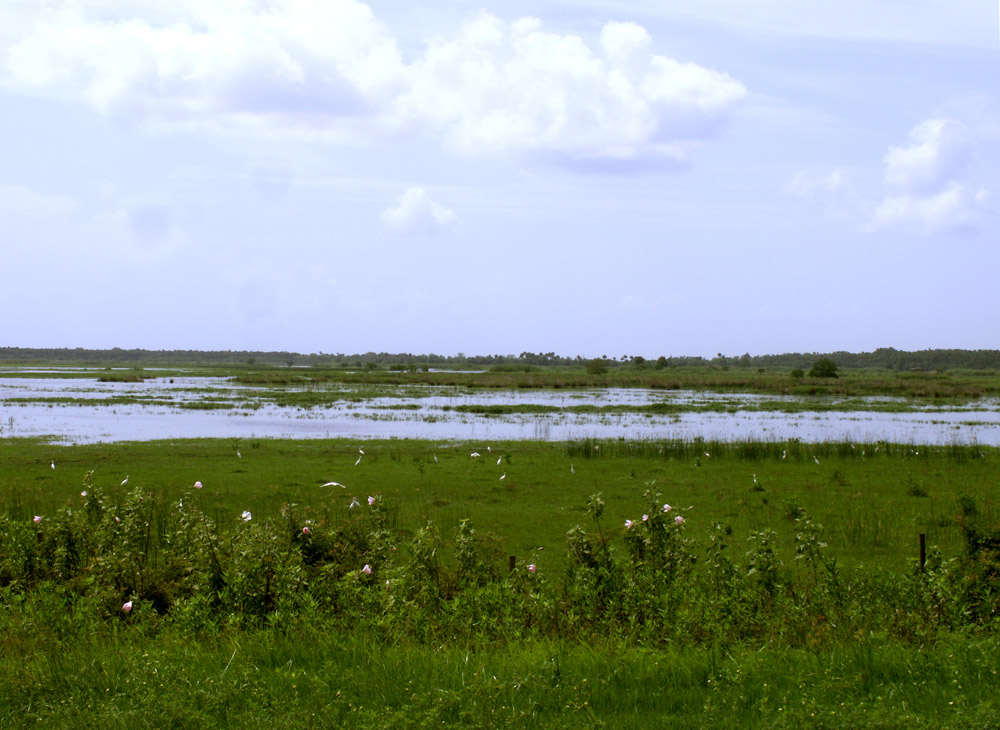
If Florida’s rivers had a valedictorian, it would be the St. Johns, and it would give a very slow speech. Here are the facts, each one slightly unreasonable in the best way.
At 310 miles, it is the longest river entirely within Florida — it starts in the state and ends in the state, which matters, because it means Florida owns the whole story, upstream and down. It begins as a marsh near Vero Beach, a place so flat and swampy that the river’s headwaters are less a source and more a suggestion, and it ends at the Atlantic Ocean near Jacksonville, where it meets the sea at Mayport.
It flows north. Rivers do not consult compasses; they follow gravity, and the St. Johns follows a landscape that tilts almost imperceptibly toward the north. If you travel upstream on the St. Johns, you are traveling south, which confuses first-time boaters and delights geography teachers.
It drops less than 30 feet over its entire 310-mile course. That averages out to about an inch of drop per mile. Picture a ruler held nearly level for the length of a very long road trip. That is the whole gradient. The result is a flow rate of roughly 0.3 miles per hour, which is slower than a walking pace. You could outwalk this river, and honestly, on a hot day, you might want to.
Because it is so flat and so slow, the ocean pushes back. Tides drive brackish water far upstream, turning much of the lower river into a long brackish estuary where fresh and salt water mix, and where the fish and plant communities change gradually along the gradient instead of all at once. The river is at its widest nearly three miles across, and its drainage basin covers about 8,840 square miles across 12 counties — an area that includes some of Florida’s major wetlands, around 3,500 shallow lakes, and two of the state’s biggest urban centers.
The river is managed as three major basins — upper, middle, and lower — plus the Lake George and Ocklawaha watersheds. The Ocklawaha is its largest tributary and itself flows north to join it, because in Florida, even the tributaries refuse to behave conventionally.
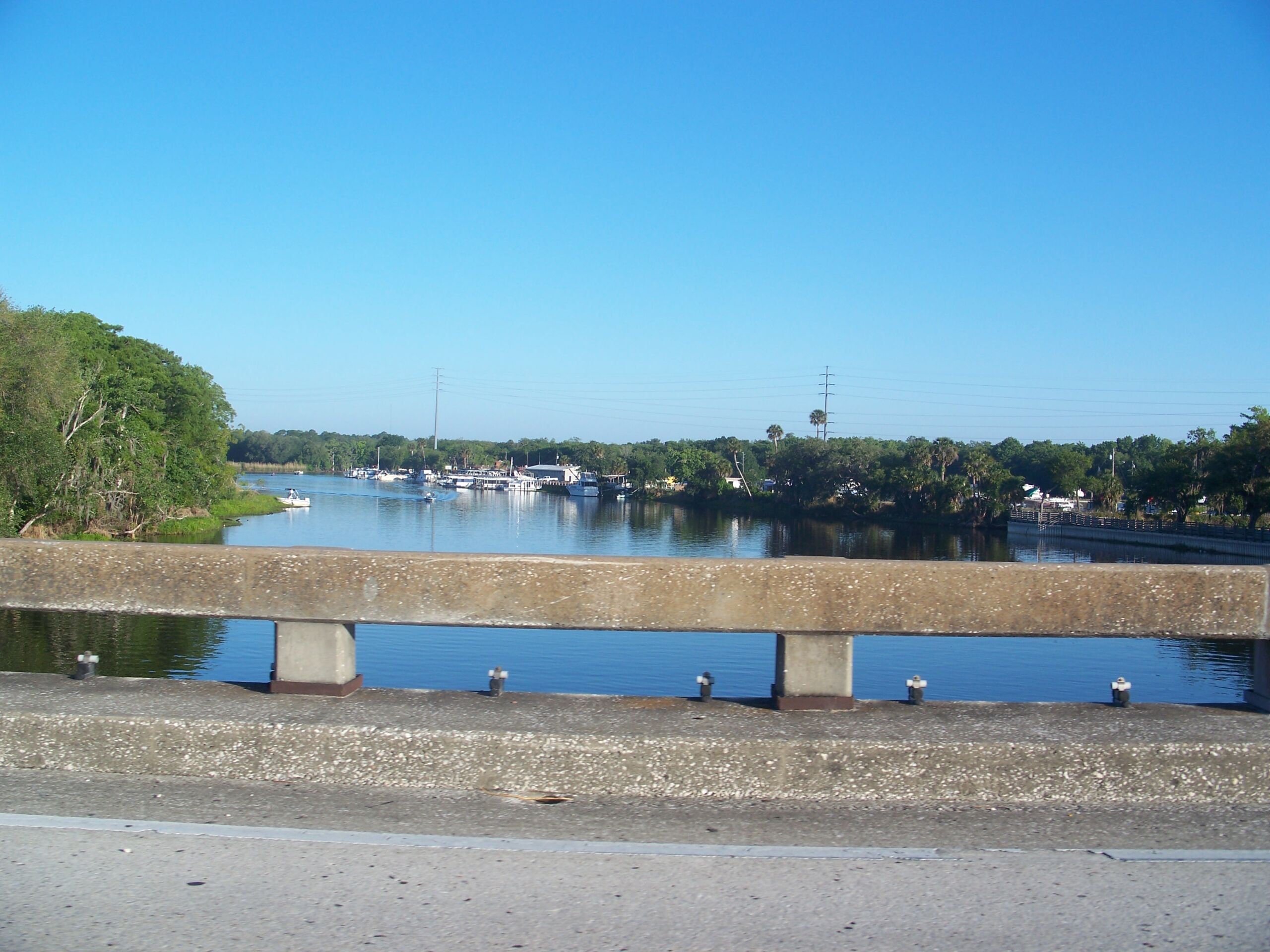
Here is why the St. Johns belongs in a gardening guide: its basin is full of yards. Millions of people live inside that 8,840-square-mile funnel, and every lawn, bed, and driveway in it is a tributary. When the river turns green or the dissolved oxygen crashes, it is not one villain. It is the sum of a thousand small decisions, made upstream, by people who mostly never see the river. Which means the fix is also the sum of a thousand small decisions, made upstream, by people who mostly never see the river. That is you. That is the whole plot.
The Living Root Alternative (The Hopeful Half)
Now the good news, because a guide that only scolds is a guide nobody finishes. Everything that makes a yard leak can be run in reverse, and the reverse is mostly just good gardening.
Feed the soil, not just the plant. Worm castings and compost release nutrients at the pace of biology, not the pace of a salt dissolving in water. Microbes break organic matter down, roots take up what they need, and the excess — the part that would have run off — mostly never exists in soluble form to begin with. If you want to understand why, the Know Your Castings page walks through what castings actually are, and the Soil Food Web explorer shows the creatures doing the work. The soil food web is not a metaphor. It is the workforce.
Keep living roots in the ground. A root is a straw, a sponge, and an anchor at once. Roots drink water that would otherwise run off, they hold soil particles that would otherwise wash away, and they feed the fungi and bacteria that glue soil into crumbs with pore spaces in between. Bare soil is the enemy. A bed with something growing in it, or mulched thickly if nothing is growing, is a bed that keeps its water and its nutrients home.
Mulch like you mean it. A thick mulch layer is a roof and a sponge: it breaks the impact of a downpour so the soil does not seal over, it slows water so it has time to infiltrate, and it keeps the soil moist between rains so the next rain does not hit baked, water-repellent dirt. The Raised Beds guide gets into the mechanics of building beds that hold water instead of shedding it.
Plant natives suited to the place. A plant that evolved in Florida’s sand, rain, and heat does not need to be propped up with constant feeding and spraying the way a plant from somewhere else might. Native plants are not magic, but they are pre-approved by several thousand years of field testing. The native plant finder is the place to start matching plants to your actual conditions instead of fighting them.
Spot-treat instead of broadcasting. See a pest on three shrubs? Treat three shrubs. See a weed in one bed? Pull it, mulch the spot, move on. Every square foot you do not spray is a square foot that cannot run off. Precision is not just kinder to the river. It is cheaper, and it leaves the beneficial insects alive to do pest control for free.
Catch water before it leaves. Rain gardens — shallow planted basins that collect roof and driveway runoff and let it infiltrate — are watersheds in miniature, and they work. So do buffer plantings along ditches and low spots: a strip of deep-rooted plants between your lawn and the nearest water is the last line of defense, the bouncer at the door of the river. Even a strip of unmowed grass and wildflowers along a ditch catches sediment that would otherwise travel.
None of this requires sainthood. It requires the same habits that make a garden thrive anyway: organic matter, mulch, roots, diversity, and paying attention. The river-friendly yard and the productive yard are the same yard. That is the entire secret, and it is not much of a secret.
Find Your Own Watershed (Then Do Three Things This Weekend)
Here is your homework, and it is the fun kind. First, find your watershed. Start at your front door and follow the water. When it rains, where does the water off your roof go? Into a gutter, onto the driveway, down the street to a storm drain? That drain empties somewhere — into a ditch, a retention pond, a canal, a creek. Follow it on a map, or better, follow it on foot or by car, downstream as far as you can. Your county’s water atlas or your water management district publishes watershed maps, and the moment you see your street inside a named basin, the whole idea stops being abstract. You will never unsee it. Congratulations and condolences.
Then, three things this weekend:
One: mulch every bare patch. Walk your beds and find every square foot of naked soil. Cover it. Wood chips, pine needles, straw, leaves — whatever you have. Bare soil is an open door for runoff. Close the door.
Two: swap one synthetic feed for biology. Pick one bed, one lawn section, one container. Skip the blue granules this round and top-dress with worm castings or compost instead. Watch what happens over the next month. The plants will not know the difference, but the ditch will.
Three: take the rain walk. Next time it rains hard, put on boots and go outside. Watch where the water actually goes on your property — not where you think it goes, where it goes. Find the spot where it leaves your yard. That spot is your personal tributary headwaters. Everything you do uphill of it is a letter to the river. Make it a nice one.
We all live in a watershed. The river does not care whether you believe that. It just keeps accepting deliveries. So send it something worth receiving: clean water, held soil, and a yard full of living roots doing what roots have always done — drinking deep, holding fast, and keeping the good stuff home.
🌱 Keep learning
Three related guides worth reading next:
- Ponds, Ducks, Fish & Chickens — The backyard ecosystem guide: stacking animals, water, and garden into one system.
- Grow Your Own Chicken Feed — Cut feed costs with duckweed, forage crops, and fermented feed.
- The Living Root Reading List — Books and resources that make better gardeners without requiring a lab coat.
🪱 Your Soil Needs This
Reading about healthy soil is great. Growing in it is better. Our small-batch, traceable worm castings are the shortcut your garden deserves.
Shop Worm Castings Subscribe & SaveEvery bag comes with a lot certificate. Know what's in your soil.