
🔥 Flame Acanthus
What it looks like
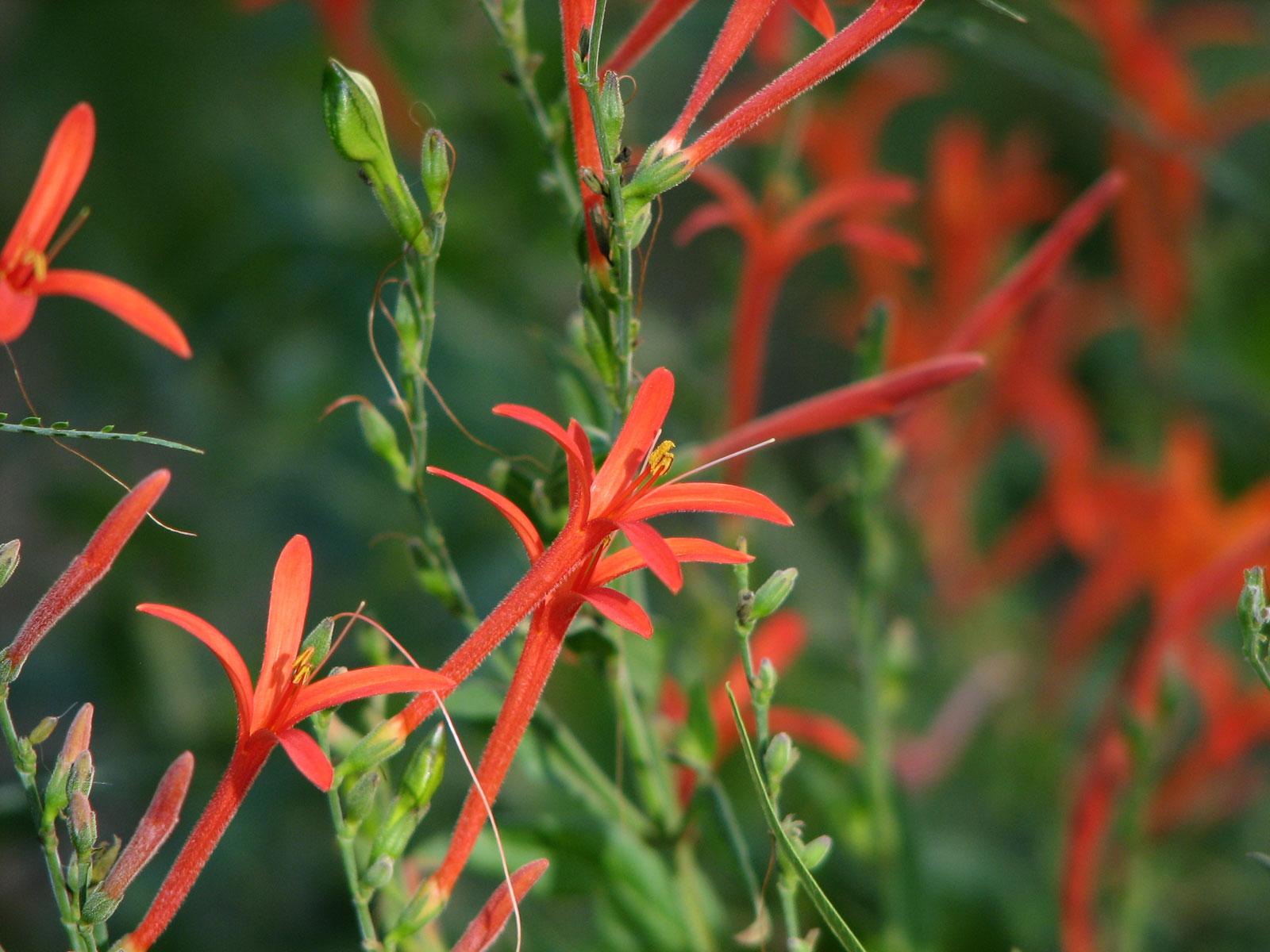
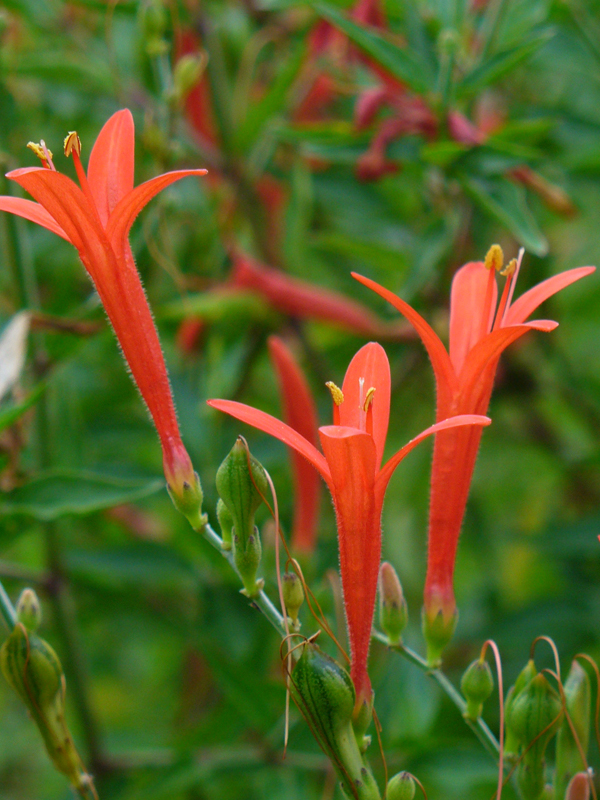
First, clear up the name, because this plant collects common names the way a desert wash collects rain. The butterfly guides call it Anisacanthus wrightii, and that is the name this guide uses, because that is the name a reader following a butterfly link will be looking for. Modern references usually place the same plant as Anisacanthus quadrifidus var. wrightii, with Anisacanthus wrightii listed as a synonym, and the Lady Bird Johnson Wildflower Center gives exactly that treatment. So if a nursery tag says flame acanthus, hummingbird bush, Wright’s desert honeysuckle, Wright acanthus, Texas firecracker, or Mexican flame, and the Latin on the tag reads Anisacanthus quadrifidus var. wrightii, you are holding the same plant. The “Wright” in the name honours Charles Wright, the nineteenth-century botanical collector who collected extensively in Texas. The “desert honeysuckle” part is a friendly lie of the harmless kind: this is not a true honeysuckle at all. True honeysuckles belong to the honeysuckle family, Caprifoliaceae. This plant belongs to the acanthus family, Acanthaceae, which makes it a cousin of the garden bear’s breeches and of the tube-tongues, not of honeysuckle — and it is a different genus from both of those, so do not fold it into either guide.
In the garden it is a spreading, deciduous shrub, usually 3 to 5 feet tall and about as wide, with several stems rising from the base and bark that peels in thin, papery strips as it ages — exfoliating bark, in the polite term, which gives winter stems a ragged, interesting texture even when the leaves are gone. The leaves are light green, lance-shaped, simple, and arranged oppositely along the stems, giving the shrub a light, airy texture that reads as delicate even though the plant itself is anything but. Then come the flowers, and the flowers are the whole point. They are slender, tubular, red-orange blossoms about an inch and a half to two inches long, carried in sprays along the stems, and they look like small flames or firecrackers — hence flame acanthus, Texas firecracker, and Mexican flame, three names for one visual joke. The bloom season is long: from late spring through fall, with the heaviest flushes after rain, which is exactly how a desert plant ought to behave. Rain falls, the shrub answers with fire. In its native range it grows on rocky banks and floodplains of streams, on rocky calcareous slopes, in shrublands and grasslands, from south-central and west Texas into northern Mexico, with the wider species continuing south to Oaxaca. It is a plant of dry places that knows how to use a floodplain, which is a useful paradox to keep in mind when you site it: it wants drainage, but it is not afraid of a drink.
For butterflies, this guide exists because of one very specific record. The Crimson Patch guide in this series lists its host plants as acanthus shrubs, “above all flame acanthus (Anisacanthus wrightii)” in Texas, and that is the butterfly connection that matters here. The Crimson Patch is a large, striking brush-footed butterfly of southern Texas, Mexico, and Central America, and in South Texas a big crimson patch on a flame acanthus is, in the guide’s own words, almost certainly this species. That is a host record, meaning caterpillars eat the leaves — a different and stronger claim than a nectar record, where adults merely sip. The flowers, meanwhile, are a nectar magnet in their own right: their long red-orange tubes are built for hummingbirds, which is why hummingbird bush is another common name, and they are visited by butterflies and native bees as well. Grow it for the flames, and know that in its home range you are also growing caterpillar food for a butterfly that wears the same colours as the flowers it eats. That is either a coincidence or a very good joke, and either way it is worth planting.
How to grow
Site flame acanthus in full sun, in the driest, sunniest spot you have that still gets occasional water, and then mostly leave it alone. It blooms best in full sun and tolerates light shade, but shade costs you flowers, and flowers are why you planted it. It is adaptable about soil in a way that surprises people who hear “desert plant” and assume it needs pure sand: the Wildflower Center notes it growing wild mostly in rocky, calcareous soils but adapting both to the heavy soils of Houston and to the drying, confined conditions of pots, and to a wide variety of soils from rocky slopes to open areas, provided drainage is good. The one thing it will not forgive is soil that stays wet. Give it well-drained sand, loam, clay, caliche, or limestone — the list is long — but never a soggy hollow. In a garden, a slope, a raised bed, or a spot near a wall that sheds water will all do. Plant in spring after the last frost, or in fall where winters are mild, setting the plant at the same depth it grew in its pot, and water it in well. Space plants 3 to 5 feet apart if you are planting more than one; they will fill in to a loose, spreading shrub, and they make a dense, low hedge if sheared, though shearing costs some of the informal, festive character that makes the plant charming in the first place.
Once established, flame acanthus is a tough, long-lived shrub that asks for very little and gives back for months. It is late to come out in spring, so do not panic if neighbouring shrubs leaf out first and yours still looks like dead sticks — that lateness is normal, and it is one reason to site it where a late start will not leave an obvious gap in spring. In early spring, before new growth starts, cut it back hard: periodic shearing, or even severe cutting back, rejuvenates the plant and produces a flush of vigorous new flowering stems. Gardeners in colder parts of its range treat it as a root-hardy perennial, cutting dead top growth to the ground in spring and letting it re-emerge from the roots like a herbaceous perennial, and it will survive as far north as Dallas in that form, though only the roots survive the winters there. In mild winters it keeps more of its woody framework and leafs out from existing branches. Either way, the plant’s strategy is the same: die back if you must, come back fast, and flower on the new growth. That is a good strategy for a desert plant, and a forgiving one for a gardener.
Propagation is straightforward. Softwood cuttings taken in late spring or summer root readily in a gritty mix, and seed can be sown, though seedlings vary and named selections will not come true from seed. If you want more plants quickly, cuttings are the honest route. The fruit is an inconspicuous brown capsule with black seeds, nothing to write home about, and the plant does not self-sow aggressively enough to be a nuisance in most gardens — its enthusiasm is reserved for flowering, not for taking over. Give it room to be itself: an upright, informal, spreading shrub that looks best at the back of a perennial bed, in a xeric border, in a rock garden, or in a large patio pot, where the red-orange sprays can be seen against a wall or a pale fence. It is not a formal hedge plant by temperament, however well it tolerates shearing, and it looks happiest when it is allowed to be a little wild.
Florida note: Say this plainly: flame acanthus is a poor bet in most of Florida, and the problem is not cold. Florida is warm enough for it in much of the state, but the plant evolved for dry air, sharp drainage, and rain followed by drying out, and Florida offers humidity, wet summers, and soils that stay damp — the combination that rots the roots of desert plants and invites fungal trouble. A North or Central Florida gardener with a genuinely dry, raised, gritty bed in full sun could try it as an experiment, in a pot with excellent drainage if the ground is at all heavy, but it should be tried as an experiment, not planted as a sure thing. For most Florida gardeners, the honest advice is to admire it in Texas gardens and spend the same sunny space on a plant that wants Florida’s summers. A guide that pretended a desert shrub would love a humid Florida summer would be selling you a plant for a climate it does not enjoy.
Water & feeding
Water needs are low once the plant is established, and this is where most gardeners go wrong by being too kind. Water deeply to establish it in its first growing season, then back off. In the growing season, water every one to two weeks is plenty in most soils, and in winter every three to four weeks — or less, if rain does the job. The plant’s own signal is the best guide: rain triggers a flush of blooms, so a deep soak followed by drying out mimics its native rhythm better than a daily sprinkle. Daily sprinkling keeps the surface wet, encourages shallow roots, and invites rot; a deep, infrequent soak encourages the deep, fibrous root system that makes the plant drought-tolerant in the first place. In a pot, water only when the mix has dried out well down, and never let the pot sit in a saucer of water.
Feeding: light to none. This is a plant that blooms reliably in poor soils, and rich feeding produces soft, floppy growth that flops and flowers less well. A spring dressing of compost, or nothing at all, is enough for most plantings. If the leaves look pale and growth is weak, a light balanced feed in spring will help, but do not chase lushness — lushness is not what this plant is for. The lean-soil rule holds across the desert shrubs in this series: feed the soil’s structure with grit and drainage, not with nitrogen, and let the plant do the rest. Mulch lightly with gravel or stone rather than with moisture-holding bark, which keeps the crown damp; a gravel mulch looks right with the plant, keeps the roots cool, and lets water through without holding it against the stems.
Common problems
- Wet soil and root rot. The main killer, and the reason Florida is a poor bet. Sharp drainage, raised beds, gravel mulch, and infrequent deep watering are the prevention. Once the roots rot in warm, wet soil, the plant rarely recovers.
- Late spring emergence. The plant leafs out late, which looks like death to a new gardener. Wait until late spring before declaring it dead, and scratch a stem: green under the bark means it is alive and merely fashionably late.
- Winter dieback in cold zones. Top growth dies back where winters are cold, which is normal at the northern edge of its range. Cut dead stems to the ground in early spring and let it regrow from the roots.
- Leggy growth in shade. Too little sun produces stretched stems and few flowers. Move it to full sun, or cut it back hard in spring to force bushy new growth.
- Overwatering by kindness. Daily sprinkling and rich, moisture-holding soil produce soft growth and rot. Water deeply and infrequently, and keep the soil lean.
- Brittle stems. The stems are slender and brittle, and they snap if roughly handled. Site the plant where it will not be brushed by foot traffic, and handle it gently when pruning.
- Few flowers in a dry year. Bloom follows rain and watering, so a long dry spell means a quiet shrub. A deep soak will usually trigger a flush — the plant’s way of answering water with fire.
Harvest
The harvest is flowers, cuttings, and hummingbird visits, not food. Cut flowering stems for arrangements — the red-orange tubes are long-lasting in water, and a handful of stems in a vase looks like a small firework display that does not go out. Cut stems for cuttings in late spring or summer if you want more plants, and take them from vigorous new growth, not from the oldest wood. The other harvest is the one you cannot put in a vase: the daily visits of hummingbirds, which treat a flame acanthus in bloom as a reliable bar, and the butterflies that work the flowers for nectar. Leave some flowers standing through the season rather than cutting every stem, because the plant’s ecological work — feeding pollinators in a dry landscape, and feeding Crimson Patch caterpillars in Texas — depends on flowers and leaves left in place. A shrub cut bare is a decoration; a shrub left to bloom is a habitat, and this one is good at being both.
Browse all plant & pest guides
Saving seeds
Flame acanthus (Anisacanthus quadrifidus var. wrightii, still sold and listed under its older name Anisacanthus wrightii) is a generous seed parent, but it is also a sneaky one. After the red-orange tubes fade, the plant forms small brown capsules — and when those capsules are fully ripe, they split and fling their seed away from the parent. That is a brilliant dispersal strategy for a desert shrub and a terrible one for a seed saver standing three feet away. The trick is to get there first: watch the capsules as they turn brown and dry, and either slip a small paper bag or a bit of mesh over the stem before they pop, or check the plant every day or two in fall and snip stems the moment the capsules look dry but have not yet split wide open.
Drop the stems into a paper bag and let them finish drying indoors for a week or so, then shake and crush the capsules gently to release the dark seeds. Pick out the worst of the chaff — perfection is not required — and store the clean seed in a labeled envelope or jar in a cool, dry, dark place. In Florida humidity, that means airtight with a desiccant packet; seed that feels dry in a desert climate can quietly reabsorb moisture in a Florida summer and lose vigor. Fresh seed sown the following spring gives the best results, so do not sit on it for years hoping it improves with age. It will not.
To sow, use a well-drained seed-starting mix and barely cover the seed — about its own thickness deep — then keep the mix moist but never waterlogged, and warm, roughly 70 to 75°F. Germination is famously uneven in this species: some seeds pop in a couple of weeks, others take their time, and a few seem to be considering the matter at length. Do not throw the pot out after three weeks. Some growers give the seed a head start with an overnight soak or a light nicking of the coat, and that can even things out, but results vary, so treat it as an experiment rather than a guarantee. Prick seedlings out once they are big enough to handle, and grow them on in good light before planting out.
One honesty note before you label your jars: flame acanthus is a species, not a hybrid, so seedlings will broadly resemble the parent — same tubular red-orange flowers, same hummingbird habit — but they will not be identical clones. Flower shade and vigor will vary a little from seedling to seedling, which is the normal price of sexual reproduction and, frankly, part of the fun. If you have one particular shrub whose exact color and form you want to keep, take softwood cuttings instead: four- to six-inch tips of new growth in late spring or summer, cut just below a node, lower leaves stripped, stuck in a moist, gritty mix until rooted. And if you would rather not manage seed at all, just leave a few capsules alone — this plant self-sows cheerfully, and the volunteers that appear around the parent can be moved while small or pulled if you have enough already. Deadhead before the capsules ripen if you want no volunteers at all.
Species and varieties in this group
Flame acanthus (Anisacanthus quadrifidus var. wrightii, also sold and listed as Anisacanthus wrightii) — the plant of this guide: red-orange tubular flowers, 3 to 5 feet, Texas and northern Mexico, host for Crimson Patch caterpillars in Texas.
Thurber’s desert honeysuckle (Anisacanthus thurberi) — a related desert honeysuckle of Arizona, New Mexico, and northern Mexico, with similar tubular flowers and a similar dry-country habit; a different species, not a synonym of the plant in this guide.
Dwarf desert honeysuckle (Anisacanthus puberulus) — a smaller relative restricted in Texas to Brewster and Presidio counties in the Big Bend country, growing along sandy washes and rocky arroyo banks.
Narrowleaf desert honeysuckle (Anisacanthus linearis) — another Big Bend relative, with narrow leaves, growing along arroyos and brushy canyons; like the dwarf species, a reminder that “desert honeysuckle” names a small group, not a single plant.
Nursery selections of flame acanthus circulate under names such as San Antonio Red — selections of the same var. wrightii plant, chosen for flower colour and habit, rather than separate species.