
🌳 Madrone and Strawberry Tree
What it looks like
Arbutus is a small genus of evergreen trees and shrubs in the heath family, Ericaceae, which makes it a cousin of blueberries, rhododendrons, manzanitas, and bearberry — a family that likes acidic soil, hates wet feet, and rewards a gardener who leaves it mostly alone. The genus holds roughly a dozen species, scattered around the Mediterranean, western North America, and Mexico, with a couple of outliers in the Canary Islands and Ireland. They are not a big genus, but they are a memorable one, because almost every species shares the same three calling cards: glossy evergreen leaves, clusters of small urn-shaped or bell-shaped flowers, and red, bumpy fruit that looks like a strawberry and tastes like a polite disappointment.
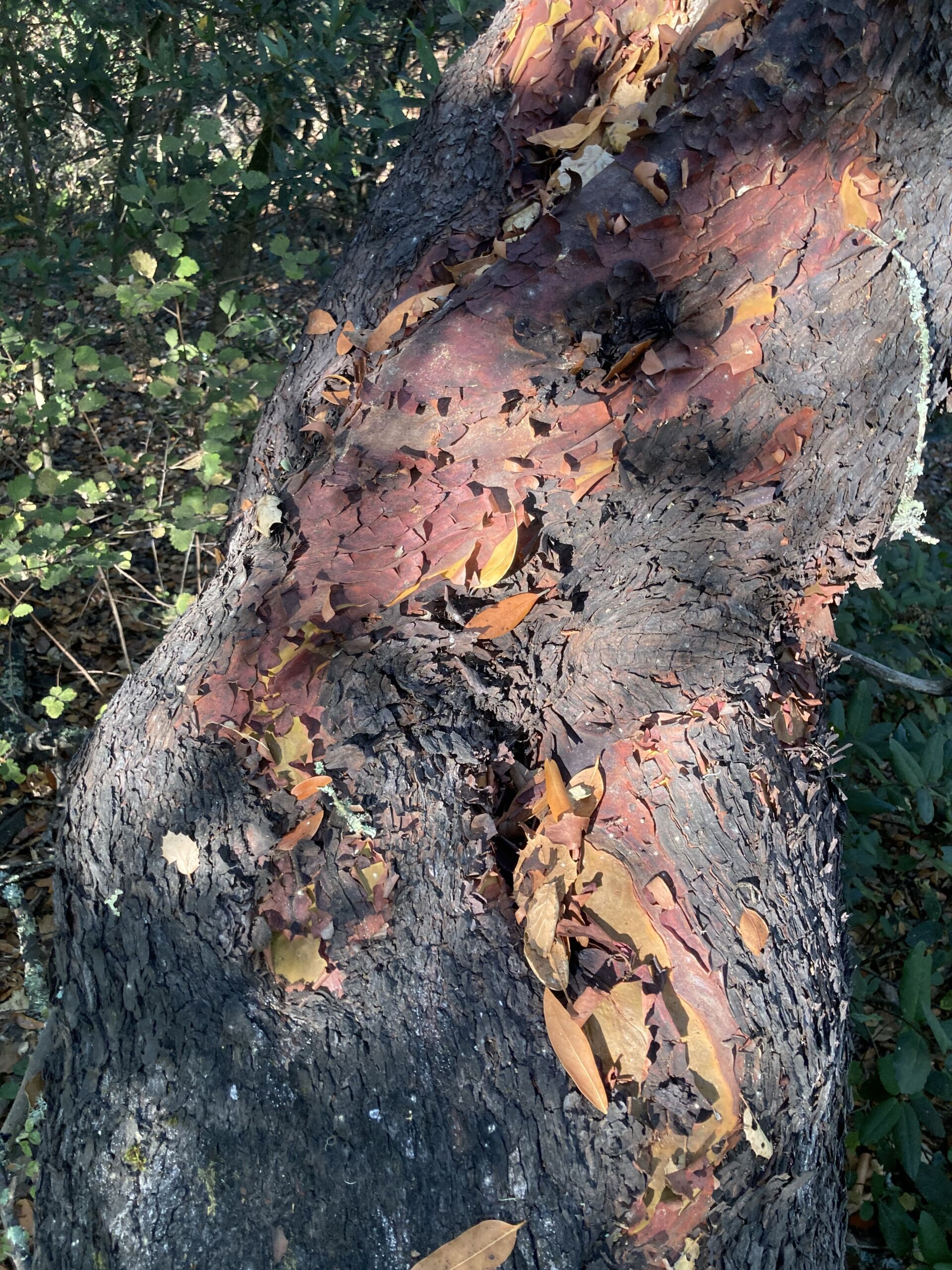
The bark is the giveaway, and it is the reason people stop on a trail and stare. On Pacific madrone, the bark on young wood is smooth and reddish-brown, and as the tree grows it peels away in thin, papery curls to reveal smooth, satiny wood underneath in shades of green, cream, and cinnamon. It looks like the tree is changing its clothes in public, which, in a sense, it is. Strawberry tree bark peels too, in cinnamon-brown flakes, though less dramatically than its Pacific cousin. If you see a broadleaf evergreen shedding its bark in curls and standing there looking smug about it, you are probably looking at an Arbutus, and the main lookalike to rule out is manzanita, another Ericaceae member with similar bark, similar urn-shaped flowers, and a similar attitude toward summer water.
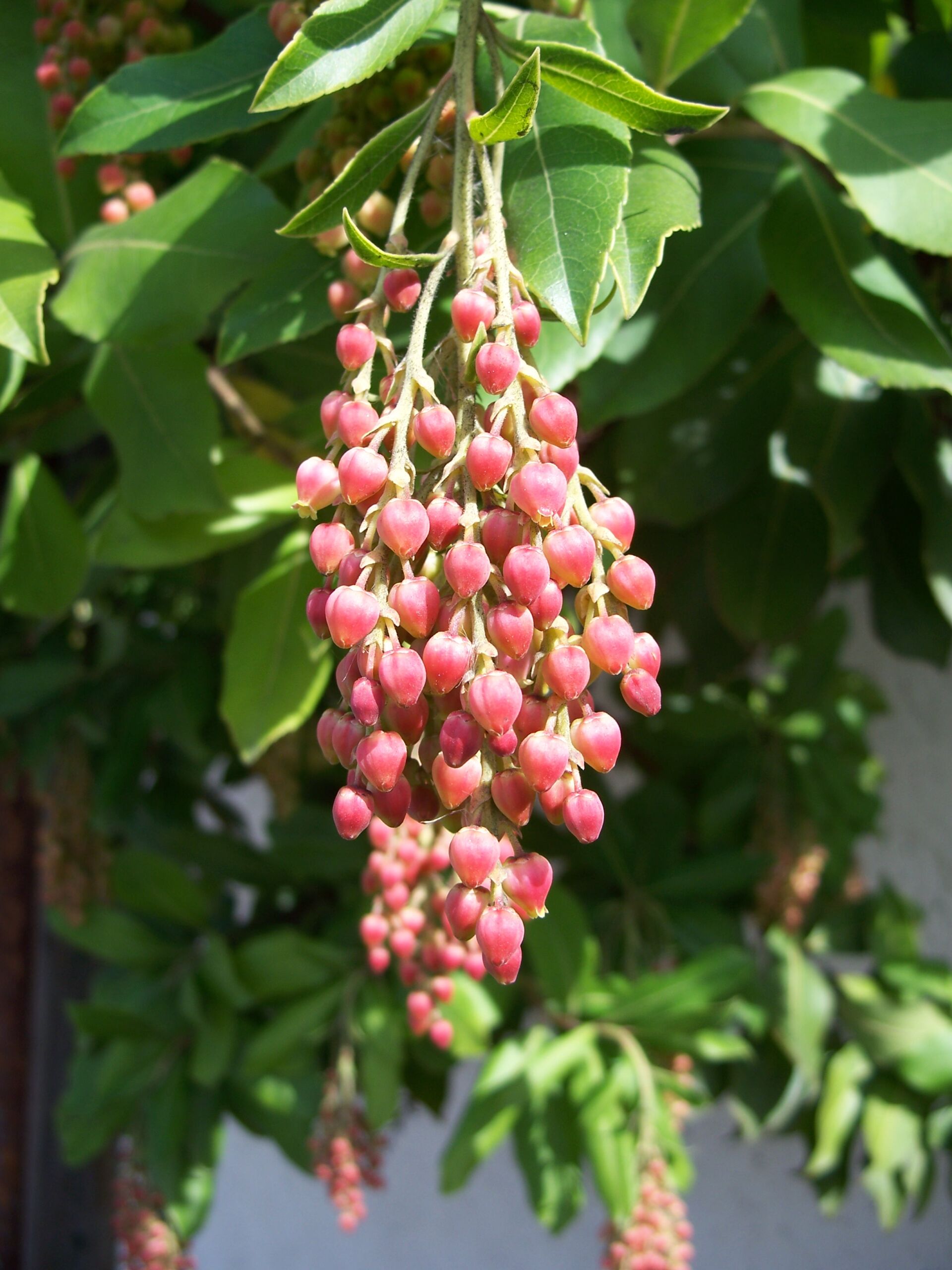
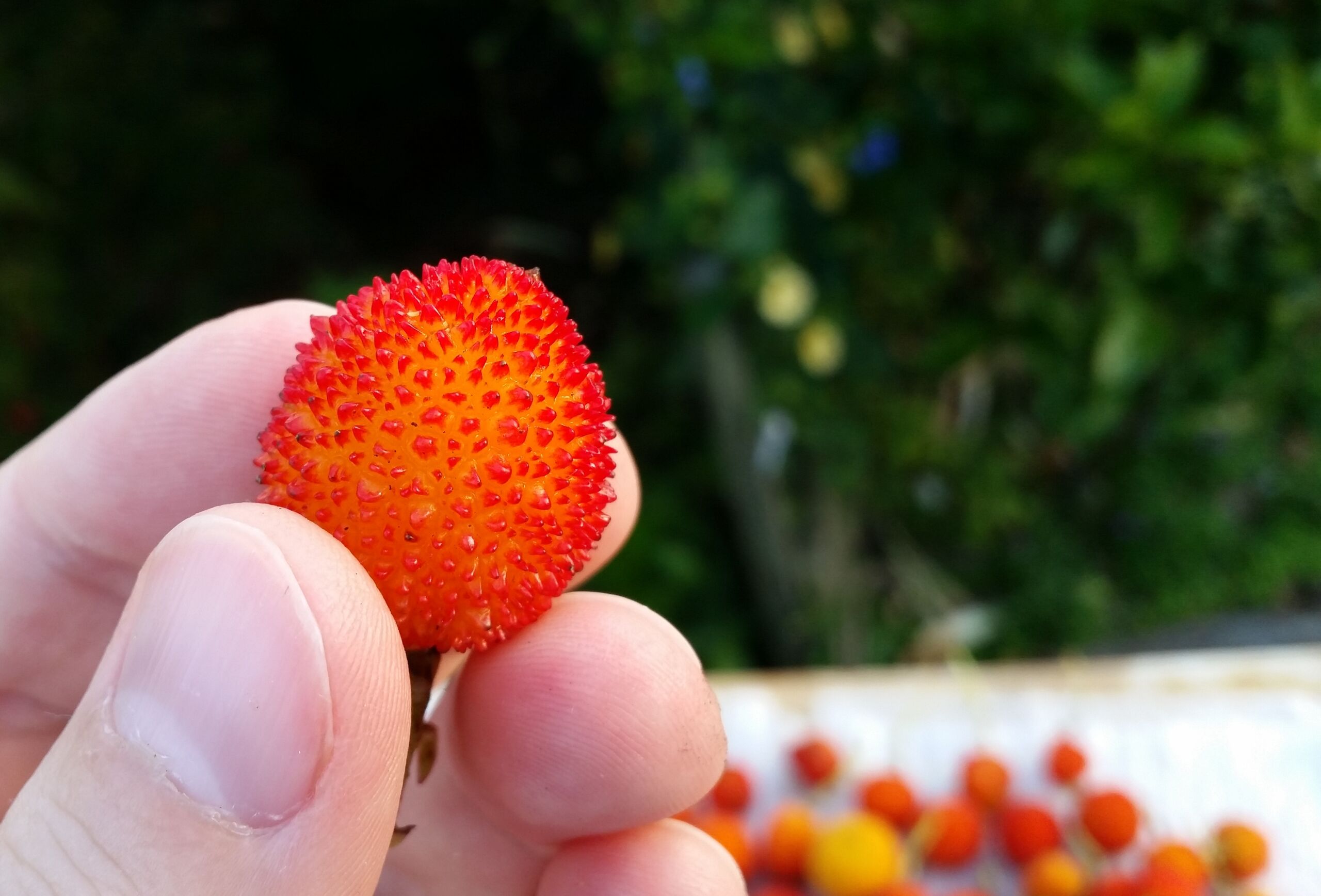
The leaves are alternate, simple, leathery, and glossy dark green above, often paler or grayish-green underneath. Pacific madrone leaves run about two to six inches long, and they stay on the tree for about two years before turning orange and red and dropping in early summer, which means a madrone in June can look autumnal while every other tree is just getting going. Strawberry tree leaves are smaller, darker, and toothed along the edge, with a reddish leaf stalk. The flowers hang in drooping clusters, white to pink, shaped like little bells or urns, and they are a genuine pollinator magnet in spring. The fruit that follows is a round, warty berry, orange to scarlet red, with a mealy pulp and many hard seeds. On strawberry tree, flowers and fruit appear at the same time, because the fruit takes about a year to ripen, so a single branch can carry last year’s red berries and this year’s white bells side by side, which is the kind of two-for-one display most trees only dream about.
Size is where the genus refuses to be summarized, and this guide will not pretend otherwise. Pacific madrone is a real tree: commonly 30 to 65 feet tall in gardens and forest edges, and much taller in old forest, where specimens over 100 feet have been measured. Strawberry tree is a small tree or large shrub, usually 10 to 15 feet tall in gardens, sometimes reaching 15 to 30 feet where it is happy. Texas madrone is a small tree. Mexican madrone can be a low shrub of one to four feet that spreads into colonies. So when someone asks how big an Arbutus gets, the honest answer is another question: which one? Read the species notes at the end before you buy, because a Pacific madrone in a shrub border is a landscaping mistake with a trunk, and a Mexican madrone where you wanted shade is a groundcover with ambitions.
Florida note: Say this plainly. Pacific madrone is a West Coast tree of cool, foggy, summer-dry slopes from British Columbia to California. It is a poor Florida bet: Florida’s humidity, summer rain, and warm nights are the opposite of what it wants, and its fungal problems only get worse in wet heat. Strawberry tree is the more garden-tolerant member of the genus, but it is a Mediterranean plant, not a Florida native, and it still wants excellent drainage and a break from soaking summer soil. No Arbutus species is a Florida native, and none of them belongs on a Florida native-plant list. If you garden in Florida, this guide is for reading butterfly guides correctly and for admiring a western tree from a respectful distance, not for planting one and hoping the humidity will be kind. It will not be kind.
How to grow
Start with the species, because genus-level planting advice for Arbutus is a trap. Pacific madrone is famously difficult in cultivation, and the difficulty is not mysterious: it wants what its native slopes give it, which is excellent drainage, lean soil, cool roots, and a dry summer, and it resents almost everything a normal garden offers, especially summer irrigation, rich soil, and being moved. The standard advice from western growers is to plant a small seedling in its permanent spot, about a foot tall, and then leave it alone, because established trees do not transplant well and older nursery stock often sulks or dies after planting. If you are not on the West Coast, or in a Mediterranean climate with sharp drainage, do not start with Pacific madrone. Start with strawberry tree, which tolerates garden conditions, accepts some summer irrigation as long as drainage is adequate, and is widely available in the nursery trade, including compact forms for small gardens.
Give any Arbutus full sun to part shade. Pacific madrone thrives in full sun along the coast and at higher elevations inland, and young trees appreciate the filtered shade of evergreen trees while they establish, but they do not establish in full shade. Strawberry tree grows in sun or shade and most soils, again provided drainage is adequate. That drainage clause is doing a lot of work, and it deserves emphasis: these are plants of rocky slopes, bluffs, and thin soils, not of heavy clay that holds water after rain. Plant on a slope, in a raised bed, or in a spot where water moves away from the roots, and do not plant in a lawn that gets watered all summer. Pacific madrone in particular should sit well away from lawns and from any plants that demand summer watering, because wet soil in summer invites the fungi that kill it.
Soil should be well-drained and lean rather than rich. Strawberry tree performs best in slightly acidic soils but tolerates a range of soils, and it tolerates wind, light frosts, and salt better than many evergreens. Pacific madrone wants dry, infertile soil and resents fertiliser; western growers advise not to fertilise it at all, and to water only to establish. That is not neglect as a philosophy, it is matching the plant to its native bargain: thin soil, sharp drainage, and a long dry season, traded for evergreen beauty and bark that peels like a party trick. A soil rich in organic matter that stays moist through summer is the opposite of that bargain, and the tree will let you know by declining, usually through disease rather than through a polite letter.
Hardiness is, again, species by species, and the sources disagree enough that this guide reports the disagreement instead of smoothing it over. Pacific madrone is variously listed at zones 7 to 9 and at zones 5a to 8b, depending on the source, which tells you two things: it is not a tender tropical, and it is not reliably hardy everywhere either, so check a source for your region and buy from a nursery that knows your climate. Strawberry tree is generally listed at zones 7 to 10 or 7 to 11, and is damaged by frost in colder zones. Arizona madrone is the cold-hardy surprise of the group, handling temperatures down to about minus 15 degrees Fahrenheit and listed around zones 6a to 10b. Greek strawberry tree sits around zones 8 to 10, and Texas madrone around zones 7 and 8. The genus as a whole is a mild-climate, summer-dry group, and no member of it is a good choice for a hot, humid, summer-wet garden, which is the polite botanical way of saying Florida again.
Plant in fall or spring from a small container, disturb the roots as little as possible, and water deeply but infrequently through the first year or two until the plant is established. After that, strawberry tree is fairly drought tolerant, and Pacific madrone should be watered rarely, deeply, and never splashed on the trunk or leaves, because wet bark and foliage invite fungus. Mulch lightly with gravel or coarse bark rather than a thick, moisture-holding blanket against the trunk, and keep the crown open with minimal pruning. These trees shed bark, fruit, and large leaves more or less continuously, so plant them where that litter is a feature, on a slope or a woodland edge, rather than over a patio you sweep daily. A madrone over a patio is a tree that will redecorate it, daily, in bark curls.
Water & feeding
Water to establish, then back off, and the exact amount of backing off depends on the species. Strawberry tree needs moderate water for the first year or two and is fairly drought tolerant once established. Pacific madrone should be deeply irrigated about once a month in summer while young, and then left to the climate it lives in, which on the West Coast means a dry summer it is built for. In both cases, the rule is deep and occasional, never shallow and daily, and never with a sprinkler wetting the trunk and leaves. Wet foliage and wet bark are an invitation to the leaf spots, cankers, and root rots that are the genus’s main enemies, and a madrone that is watered like a lawn tree will behave like a lawn tree that has been asked to live on a mountainside. It will not thrive.
Feeding is minimal, and for Pacific madrone it is close to none. Do not fertilise Pacific madrone; it evolved in lean soil and extra nitrogen produces soft growth that disease loves. Strawberry tree does not need heavy feeding either: a light spring application of a balanced fertiliser for acid-loving plants, or simply a mulch of compost kept away from the trunk, is plenty, and in many gardens no feeding at all is fine. If the leaves are a healthy dark green and the tree is growing, it is telling you it has enough. Yellow, stunted growth on a madrone usually means drainage or disease, not hunger, and feeding a sick madrone is like offering cake to someone with a stomach bug: kind, and entirely beside the point.
Pruning is minimal. Strawberry tree needs little pruning beyond removing dead or crossing wood and shaping a young tree to a single trunk if you want a tree form rather than a multi-stemmed shrub. Pacific madrone should be pruned as little as possible, in dry weather, because pruning wounds are entry points for canker fungi, and the tree’s natural branching is part of its beauty anyway. Never top an Arbutus. Topping destroys the crown, invites decay, and produces a flush of weak shoots that will never look like the tree you bought. If a mature madrone needs major work, hire a certified arborist who knows the species, and schedule the work for a dry period, not for the wet season when fungi are most active.
Common problems
- Fungal leaf spots, cankers, and root rot. The defining problems, especially for Pacific madrone in cultivation and in wet climates. Wet foliage, wet bark, summer irrigation, and poor drainage all invite them. Prevention is the treatment: sharp drainage, dry summers, no overhead watering, and minimal pruning wounds.
- Sudden oak death. Pacific madrone is a host for the pathogen behind sudden oak death, which is one more reason to buy from reputable sources and to report unusual dieback to your local extension service rather than composting it quietly.
- Scale, thrips, and other insects. Strawberry tree is susceptible to scale and thrips, and to anthracnose, Phytophthora root rot, and rust. Healthy, well-drained trees resist them best; stressed, wet trees invite them in.
- Transplant failure. Pacific madrone in particular does not transplant well once established. Plant small, plant once, and plant in the permanent spot. Moving a madrone is a gamble with poor odds.
- Fruit and bark litter. Not a disease, but a real garden fact. Arbutus trees drop bark, fruit, and large leaves continuously. Plant where that is acceptable, not over a pool, a patio, or a path you keep spotless.
- It is not trailing arbutus. A naming trap that matters for butterfly guides: trailing arbutus is Epigaea repens, a low, creeping heath-family plant, not an Arbutus at all. If a guide lists trailing arbutus as a host, it means Epigaea repens, and this guide does not cover it.
- It is not bearberry, either. Bearberry is Arctostaphylos uva-ursi, another Ericaceae cousin with similar flowers and a similar name history, but a different genus. The Brown Elfin lists bearberry and madrone as separate hosts for a reason: they are separate plants.
Harvest
There is a fruit harvest, and it is honest to describe it as modest. Strawberry tree fruit is edible, red, and strawberry-like in appearance only; the flesh is mealy and bland, and the old story behind the species name unedo is that it means eat one, as in one is enough. That is harsh, but it is also fair warning against planting a strawberry tree as a fruit crop. The fruit is traditionally used for jams, preserves, and fermented drinks in its native range, where a quantity of mealy fruit can be sweetened and cooked into something worthwhile, and birds eat it happily all winter. If you want a fruit tree, plant a fruit tree. If you want an evergreen that happens to fruit, and you enjoy the joke of a strawberry that is not a strawberry, Arbutus is your tree.
The real harvest is ornamental and ecological, and it lasts all year. Evergreen foliage in winter, bell flowers in spring, red fruit in fall and winter, and peeling bark in every season: that is four seasons of interest from one plant, which is more than most trees offer. Birds eat the fruit and use the tree for cover, pollinators work the flowers, and the flowers of Pacific madrone are a genuine spring event on western hillsides. The wood of Pacific madrone is hard and handsome and has been used for furniture and turnery, but harvesting wood from a slow-growing, disease-prone tree you planted for beauty is a strange way to treat it. Leave the wood on the tree, let the birds have the fruit, and take the bark curls as a souvenir. The tree is shedding them anyway.
Saving seeds
Arbutus seed hides inside one of the prettiest disappointments in the garden: the strawberry tree’s red, warty berries, which look like strawberries and taste, by the old joke behind the species name unedo, as if one is enough. Birds disagree with that review and eat them happily all winter, which is the first clue about how this seed likes to travel. Collect berries when they are fully red and soft, in fall or early winter, and beat the birds to them, because they will not wait for you. Mash the berries in water, rinse away the pulp, and keep the small, hard, dark seeds. Pulp left on the seed invites mold, and mold is the quiet killer of this whole project.
Fresh seed sown right away is the simplest route, surface-sown in a gritty, well-drained mix and kept moist but never soggy. Stored seed needs more persuasion: a soak in warm water for several days, then a cold, moist stratification period in the refrigerator. Sources disagree on the length, with recommendations running from about six weeks to roughly three months, so plan on the long end and check the bag for mold. After chilling, sow on the surface or barely covered, because these seeds germinate best with light nearby, and keep the tray in bright, indirect light at warm room temperature. Germination is slow and staggered, typically over weeks to a few months, and the seedlings are famously touchy: they damp off easily in still, wet air, they resent having their roots disturbed, and they lean on mycorrhizal fungi in the soil in ways that nursery soil does not always replace. Give them air movement, sharp drainage, and pots they can stay in until they are sturdy, then plant them out with as little root disturbance as you can manage, because a madrone that has its roots manhandled often sulks for a season or gives up entirely.
Two honesty notes belong here. First, seed does not copy a named selection: a hybrid like ‘Marina’ will not come true from seed, and cuttings or layering, both slow and uncertain in this genus, are the only way to copy one. Second, seed is a long game in Arbutus. These are slow trees even by tree standards, and a seedling may take a year or more just to become a plant you would show a visitor. That slowness is part of the charm if you are the patient type, and a reason to buy a nursery tree if you are not.
Florida note: most Arbutus species are Mediterranean or Pacific-coast plants, and Florida’s heat and humidity are not their native weather, so seed saved here must be dried thoroughly and stored airtight with a desiccant packet, cool and dark, or it will not survive storage. And if you are growing a strawberry tree in Florida at all, consider its seed project a bonus experiment on a tree you already love for its bark and evergreen foliage, not the reason you planted it.
Species in this group
Pacific madrone — Arbutus menziesii — The western North American tree, from British Columbia to California, with smooth reddish-brown peeling bark, glossy leaves, white to pink bell flowers in spring, and orange to red fruit in fall. Commonly 30 to 65 feet tall, taller in old forest; hardiness reported as zones 7 to 9 in some sources and 5a to 8b in others. The Brown Elfin host listed as madrone (Arbutus species) is this western group.
Strawberry tree — Arbutus unedo — The Mediterranean and Irish small tree or large shrub, 10 to 15 feet tall in gardens and up to 15 to 30 feet where happy, with peeling cinnamon bark, toothed dark leaves, white to pink bells, and red strawberry-like fruit that takes about a year to ripen. Zones 7 to 10 or 7 to 11 depending on source; the most garden-tolerant member of the genus.
Texas madrone — Arbutus xalapensis — A small native tree of Texas, New Mexico, and Mexico, with leathery leaves and an urn-shaped habit, in well-drained soil around zones 7 and 8.
Arizona madrone — Arbutus arizonica — A tree of Arizona, New Mexico, and northwestern Mexico, 35 to 45 feet tall, with twisting pink-brown bark and orange-red fruit, around zones 6a to 10b and hardy to about minus 15 degrees Fahrenheit.
Greek strawberry tree — Arbutus andrachne — An eastern Mediterranean and Middle Eastern evergreen shrub or small tree, 20 to 40 feet tall, with peeling red-brown bark and yellow-green to white spring flowers, around zones 8 to 10.
Hybrid strawberry tree — Arbutus x andrachnoides — The natural hybrid of Greek strawberry tree and strawberry tree, with dark brown-red bark lightening to orange-brown, around zones 7 to 10 and up to about 32 feet tall.
Mexican madrone — Arbutus occidentalis — A low shrub or small tree endemic to Mexico, only one to four feet tall, spreading into colonies more than six feet wide, with red berries and pink to white flowers, around zones 8b to 10. Not to be confused with any dwarf mistletoe of a similar-sounding Latin name.
Canary madrone — Arbutus canariensis — Unique to the Canary Islands, a tree that can reach about 50 feet tall, rarely seen in gardens outside its native range.
Note: trailing arbutus is not an Arbutus at all — it is Epigaea repens — and it is deliberately not listed here. Bearberry is Arctostaphylos uva-ursi, also a different genus. If you arrived looking for either one, you want a different guide.