
🌲 Western Dwarf Mistletoe
What it looks like
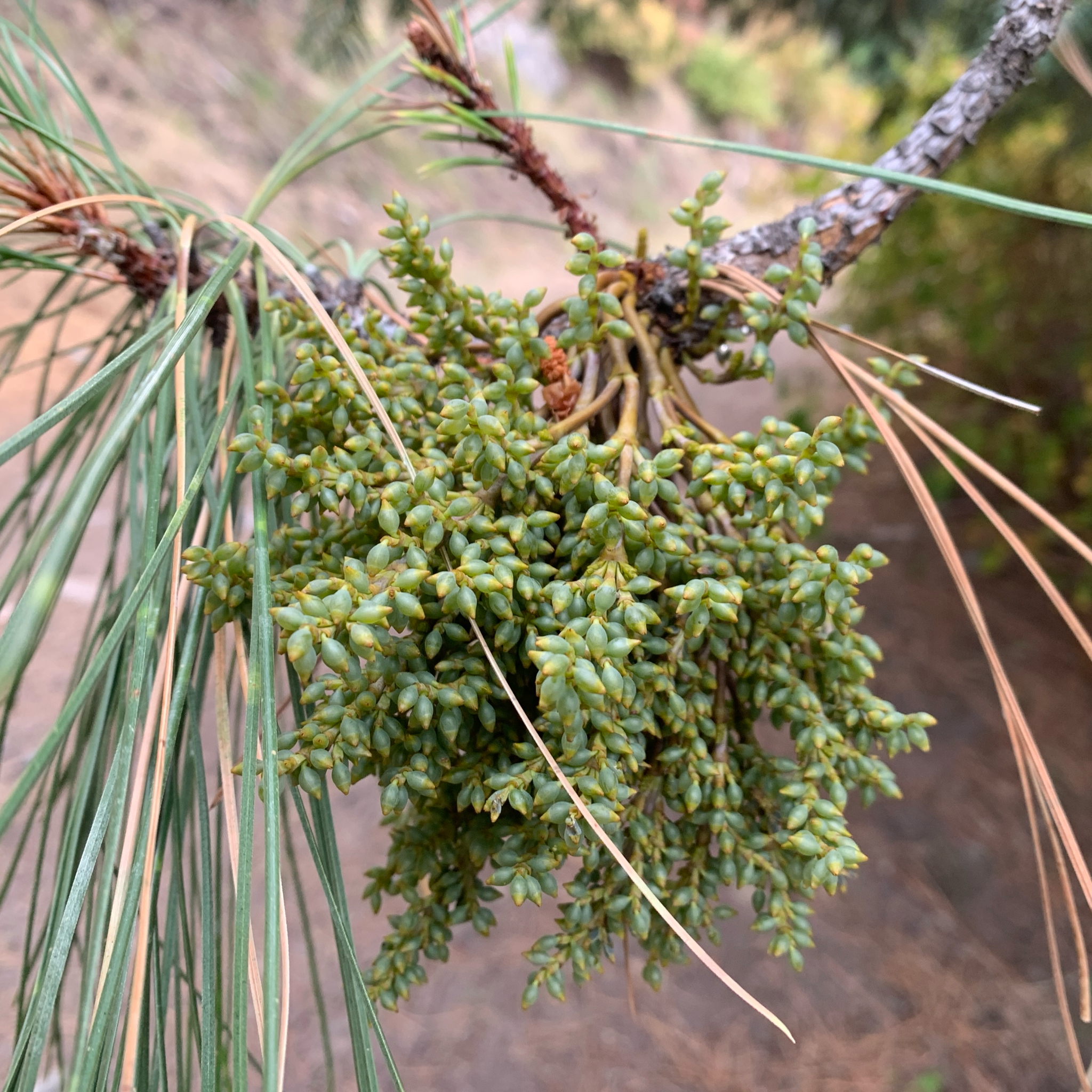
Western dwarf mistletoe looks like a small, much-branched tuft sprouting from a pine branch, green, brownish, or yellow, with fan-like branching that spreads in one plane, like a tiny hand fan glued to the bark. The stems run about 10 centimeters long, are often thicker and more robust than those of its close cousins, and carry leaves reduced to scales that clasp the stem. Like all dwarf mistletoes, it photosynthesizes weakly through its green stems and scales, and relies on its host for most of its carbohydrates. Most of the plant is hidden: for the first few years of its life it builds a haustorial system inside the host branch, tapping xylem for water and phloem for sugars, and only then sends its shoots out through the bark. What you see is the tip of an iceberg that is eating a tree.
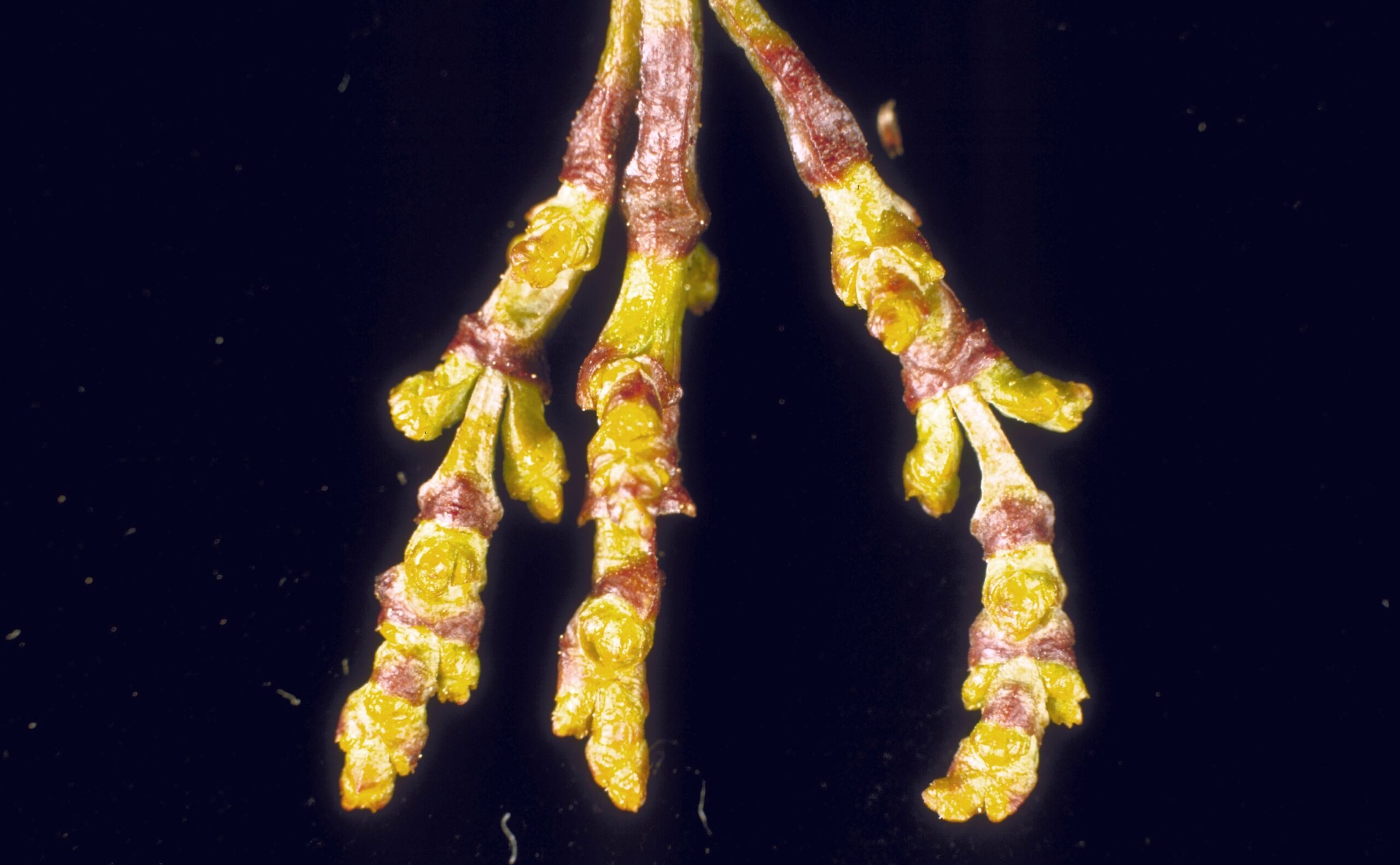
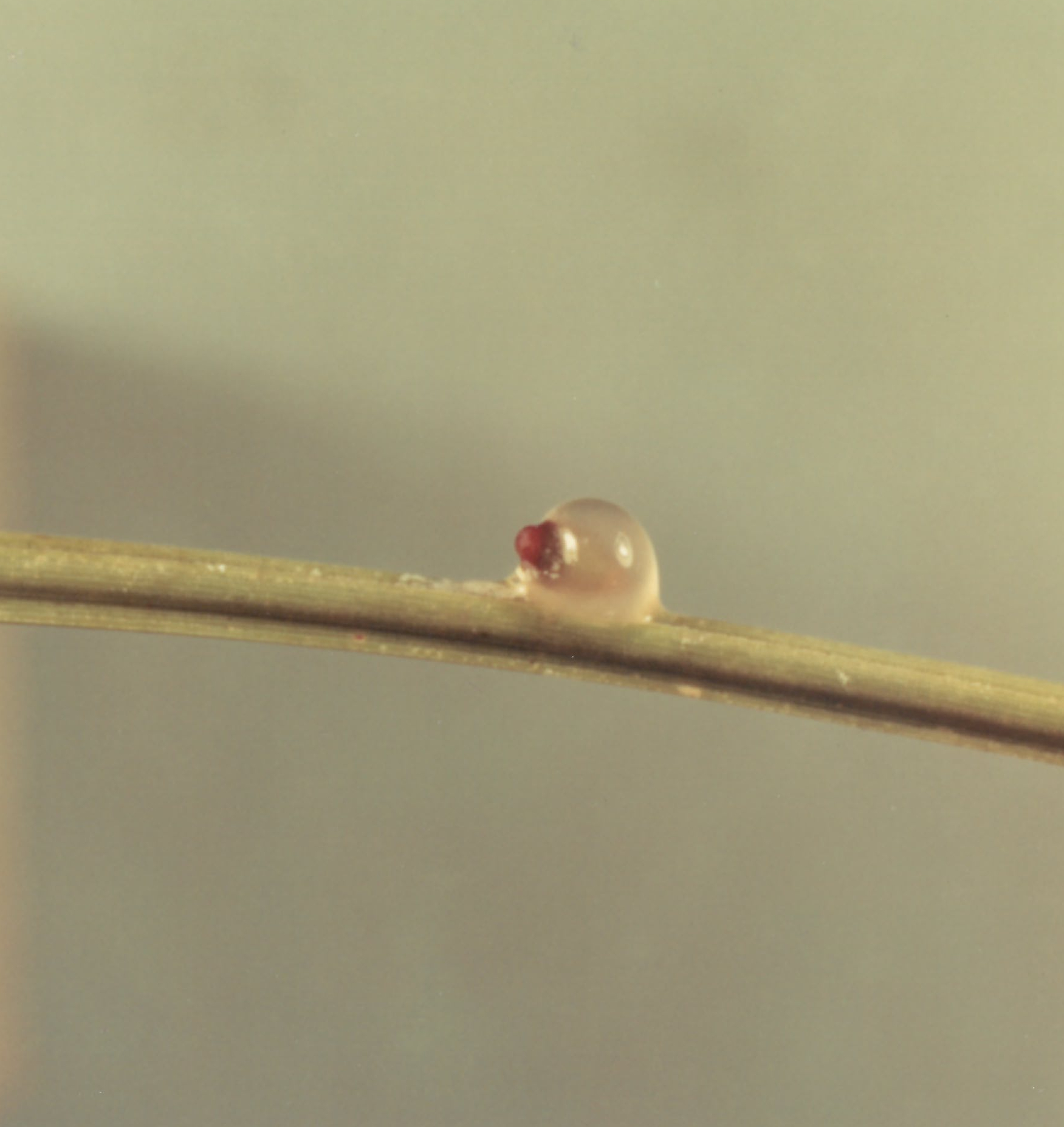
It is dioecious, with male and female plants separate. Male flowers have three or four petals, 3.1 to 4.2 millimeters across, and bloom from mid-August to late September, peaking from late August to mid-September, which is later than one close cousin and earlier than another, and botanists actually use that timing to tell them apart, because the plants themselves are so similar. The fruit is an oblong berry averaging 5 to 6 millimeters long and 3 millimeters wide, typically light green but sometimes bluish gray with a waxy coating. Seed dispersal peaks from mid-September to mid-October, when hydrostatic pressure fires each seed at about 27 meters per second, roughly 89 feet per second, to an average distance of 10.7 meters. About a third of the fruit’s mass is viscin, the sticky coating that glues the seed to whatever it strikes, and the mistletoes on a single host tree can together produce anywhere from 800 to 2.2 million seeds in a year. That range is not a typo. A heavily infected tree is a seed factory with no off switch.
Its principal hosts are the hard pines: ponderosa pine, Jeffrey pine, and Coulter pine, where over half the trees of those species are typically infected wherever the mistletoe occurs. Knobcone pine is a secondary host, and it shows up occasionally on lodgepole pine and gray pine. Its range follows ponderosa pine through the western United States, Washington, Oregon, Idaho, California, and Nevada, and into Baja California, from near sea level to 2,500 meters elevation, running down the east side of the Cascades, through the Klamath-Siskiyou region, along the Sierra Nevada and Coast Ranges, and into the Transverse and Peninsular Ranges and the Spring Mountains of Nevada. And it matters to butterflies twice over: the Thicket Hairstreak lists it among its documented hosts in Latin form, and Johnson’s Hairstreak lists it by its common name, western dwarf mistletoe, as a host in old-growth conifer forest. One parasite, two hairstreaks, and the caterpillars of both eat the shoots and take on their color.
Florida note: Say this plainly: western dwarf mistletoe is not a Florida plant, does not occur in Florida, and its ponderosa, Jeffrey, and Coulter pine hosts do not grow in a Florida yard. Its world is the western pine forest from Washington to Baja California. If you garden in Florida, this guide is for reading butterfly guides correctly, not for planting. Do not plant it anywhere, on purpose, ever.
How to grow
You do not grow western dwarf mistletoe. There is no nursery stock, no seed packet, and no planting guide that ends well. It grows itself, on pines, in western forests, by the method described above: a viscin-glued seed lands on a young branch, germinates, spends years building its hidden system, and then produces shoots that fruit by the thousands or millions. What foresters do with it is the opposite of growing: they prune infected branches before fruiting, remove heavily infected trees, and manage stand density so seeds have farther to travel and fewer young trees to land on. Juvenile trees are the most susceptible, and stands logged in the past fifty years are particularly vulnerable, because the density of young trees turns a fired seed into a guaranteed hit. In campgrounds and timber stands alike, it is a serious parasite of pines, and heavily infected trees show dieback, reduced foliage, and brooms that only get worse.
The taxonomy deserves its own paragraph, because it affects every guide that names this plant. Since its description by George Engelmann in 1850, western dwarf mistletoe has been a source of contention. The narrow treatment used here recognizes it as one species, sensu stricto, without subspecies, as do Plants of the World Online and several regional floras. The Flora of North America treats it broadly, as a subspecies with twelve other closely related species folded in as subspecies of one big campylopodum. The Jepson Manual goes further still, lumping in even the pinyon dwarf mistletoe. This guide follows the narrow treatment and the butterfly guides’ own usage, which list the fir, pinyon, and other mistletoes as separate species alongside it, but the coordinator should know that a reader following a broad-treatment flora will find this plant’s name covering a much bigger group. The disagreement is honest, it is documented, and it is not resolved.
For the field observer, the useful skills are host identification and broom recognition. Swelling of the host branch near the infection point is common, and large witches’ brooms are frequent, tangled masses that increase the flow of water and nutrients to the mistletoe while draining the tree. Those brooms are also wildlife condominiums: birds and small rodents nest in them and shelter in them, squirrels carry the mistletoe’s seeds in their fur, with up to half the squirrels in heavily infected Oregon ponderosa forests carrying seeds, and chipmunks and blue grouse eat the plant. A parasite that feeds hairstreaks, grouse, chipmunks, and squirrels while killing pines is not a villain with a simple moral. It is a forest process with feathers and fur attached.
Water & feeding
Western dwarf mistletoe takes water and food from its host and gives nothing back but brooms. Its haustoria tap the pine’s xylem and phloem, and though its green stems photosynthesize a little, the plant depends on its host for most of its carbohydrates. The effect on the tree is cumulative: reduced vigor, reduced seed yield, shorter life, and greater susceptibility to fungal pathogens that enter where the mistletoe attaches, and to bark beetles, since ponderosa pines infected by this mistletoe are more susceptible to the western pine beetle, even though the mistletoe may also make trees less suitable for beetle brood production by slowing their growth. It is a complicated relationship, and the tree loses it either way.
Its own feeding web runs in both directions. Honey bees and thrips have been documented as pollinators, which is a strange sentence about a plant most people think of as a disease. Two fungi parasitize it in turn, one causing black lesions at the shoot nodes that lead to dieback, the other producing yellowish-white lesions that erupt into masses of white spores and usually kill the shoots. The plant bug Neoborella tumida feeds on it, the snout moth Dasypyga alternosquamella’s larvae feed on it, and the hairstreak caterpillars feed on it. If you drew the food web around one infected ponderosa branch, it would look like a small city, and the mistletoe would be downtown.
Common problems
- It is the problem: For ponderosa, Jeffrey, and Coulter pines, western dwarf mistletoe is a major forest pathogen. Reduced vigor, deformed growth, and increased susceptibility to other pathogens are the standard outcomes of heavy infection, not worst cases.
- Witches’ brooms: Large brooms are frequent and conspicuous. They drain the tree and weaken branches, but they also shelter wildlife, so removal is a judgment call in wild stands and a clear call for valued trees.
- Confusion with close cousins: Jeffrey, Coulter, and knobcone pines also host other dwarf mistletoes that must be separated by flowering time and subtle morphology. Host alone does not identify this species where its cousins overlap, which is exactly why the taxonomy is contested.
- Seed rain: One tree can produce up to 2.2 million seeds a year, fired in autumn. Pruning after fruiting is too late. Management happens before mid-September, or it does not happen.
- Young-stand vulnerability: Dense young stands are the most susceptible, and recently logged stands are at particular risk. Regeneration planning that ignores mistletoe plants the next infection.
- Bark beetle interaction: Infected ponderosa pines are more susceptible to western pine beetle attack. Mistletoe management and beetle management are the same conversation in these forests.
- Florida gardeners importing it: Do not. It will not establish without its western pine hosts, and moving a forest pathogen across the country is not a gardening project.
Harvest
There is no harvest. Western dwarf mistletoe produces no crop for people, and its berries are not food or medicine. What people take from infected forests is timber from trees protected by removing infected ones, and knowledge: a correct identification, a photograph of a hairstreak caterpillar on its shoots, and a broom left standing where it shelters birds. Prune infected branches before the autumn seed firing, remove heavily infected trees where they threaten a stand, and leave brooms in wild areas where wildlife uses them. The best western dwarf mistletoe harvest is a pine forest that still has pines in it a century from now, with a few brooms left over for the birds.
Propagation
Western dwarf mistletoe does not get a seed-saving section in this guide, because the correct advice is the opposite of saving seed: do not spread it. Arceuthobium campylopodum is a parasite of hard pines — ponderosa, Jeffrey, and Coulter pines chief among them — and where established, many of those trees carry it. Infection swells branches, forces out witch’s brooms, drains vigor and seed yield, and leaves the host open to fungi entering at the attachment point. Young trees suffer worst, and heavily infected stands thin out over time as trees weaken and die.
Yes, there is a genuine ecological paradox here, and it is worth saying out loud rather than smoothing over. Those brooms, for all the harm they do the tree, are real wildlife habitat — dense, sheltered structure in an otherwise open pine canopy. That is an argument for letting forest ecologists and land managers weigh the trade-offs stand by stand. It is not an argument for a gardener to start a new infection, because a new infection does not stay politely where you put it: explosive seed discharge throws sticky seeds across the canopy, and each one that sticks starts a multi-year, mostly invisible incubation inside a branch.
So leave propagation to the plant, which is alarmingly good at it already, and leave control to people with a management plan. Do not collect the dark purple-brown fruits, do not press seeds onto pine branches, and do not move infected limbs around your property. If pines on your land are infected, an extension forester can advise on pruning, removal, or replanting with non-hosts. In Florida, the whole question is moot in the nicest possible way: ponderosa and Jeffrey pines are western trees, so this mistletoe has no Florida host waiting and no Florida garden role.
Varieties
- The species, narrowly treated — Arceuthobium campylopodum: Western dwarf mistletoe sensu stricto, on ponderosa, Jeffrey, and Coulter pines principally, knobcone pine secondarily, and lodgepole and gray pines occasionally. Fan-branched green, brownish, or yellow stems about 10 centimeters long, light green berries 5 to 6 millimeters long, and no subspecies in the narrow treatment.
- On ponderosa pine — Pinus ponderosa: The principal host across most of the range, in both the Pacific ponderosa and Rocky Mountain forms, and the tree whose map the mistletoe’s map most closely follows.
- On Jeffrey pine — Pinus jeffreyi: A principal host in California and adjacent Oregon and Nevada, where infection rates are typically high wherever the mistletoe occurs.
- On Coulter pine — Pinus coulteri: A principal host in California’s Coast Ranges and Transverse Ranges, another hard pine that carries heavy infections.
- The broad treatment, for reference: The Flora of North America treats this name broadly, folding twelve related species in as subspecies, and the Jepson Manual folds in the pinyon dwarf mistletoe as well. Those broader names describe the same plants with different boundaries, not different plants, and this guide series keeps the narrow boundaries the butterfly guides themselves use.