
🌲 Pinyon Dwarf Mistletoe
What it looks like
Pinyon dwarf mistletoe is a small, unassuming parasite that is easy to walk past and hard to forget once you learn to see it. The visible plant is a network of scaly stems, brown or greenish, no more than about 12 centimeters long, extending above the bark of its host tree, with shoots typically 7 to 12 centimeters high and 2 to 4 millimeters wide at the base, olive-green to brown. The leaves are reduced to thin scales on the stem surface, there is no leafy crown to admire, and most of the organism is hidden inside the tree, attached by haustoria that tap the host for water and nutrients. It looks, frankly, like a small dead-looking twig cluster on a pinyon branch, until you notice that the twig cluster is the plant, and that it is alive, flowering, and fruiting on a tree that is doing all the work.
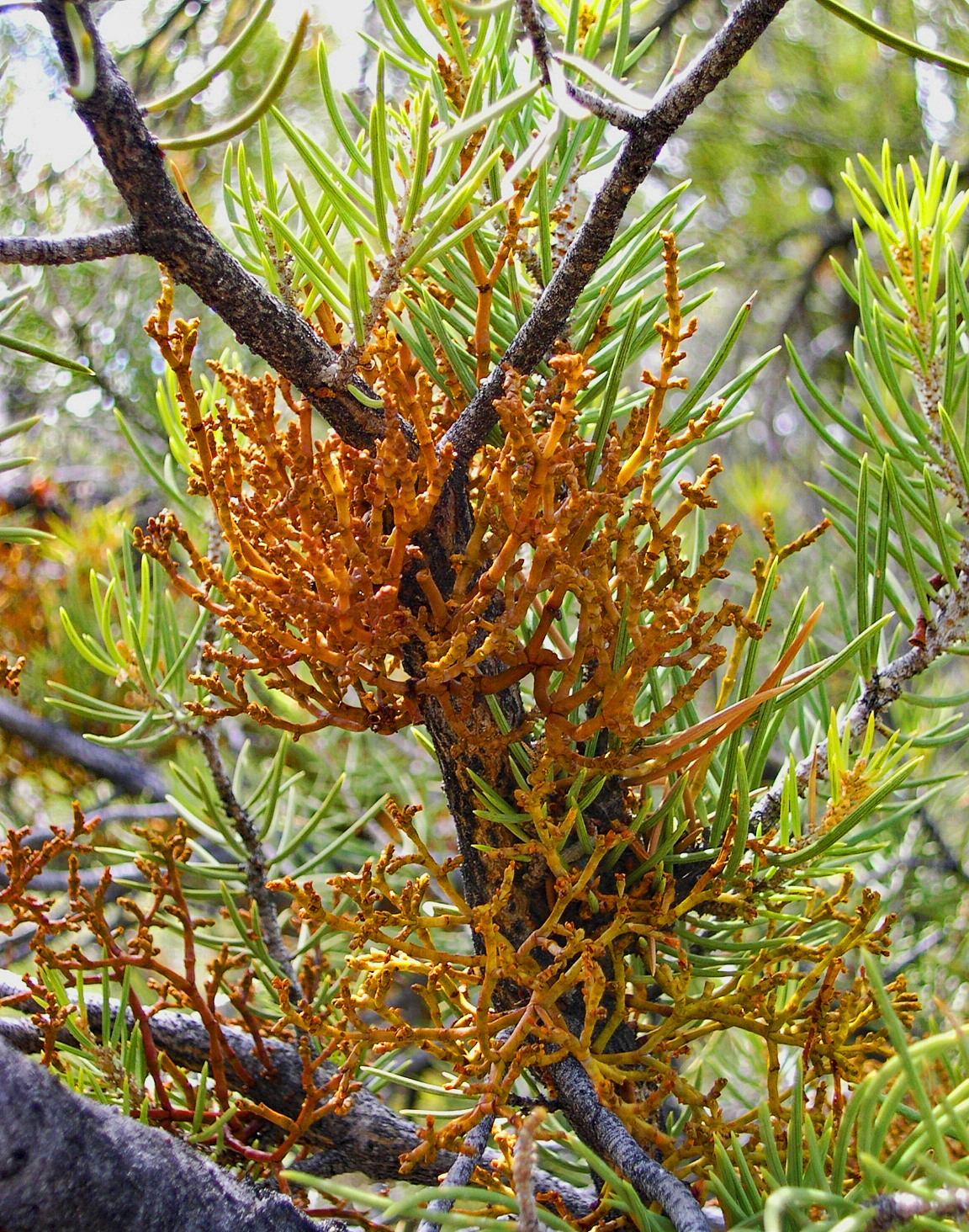
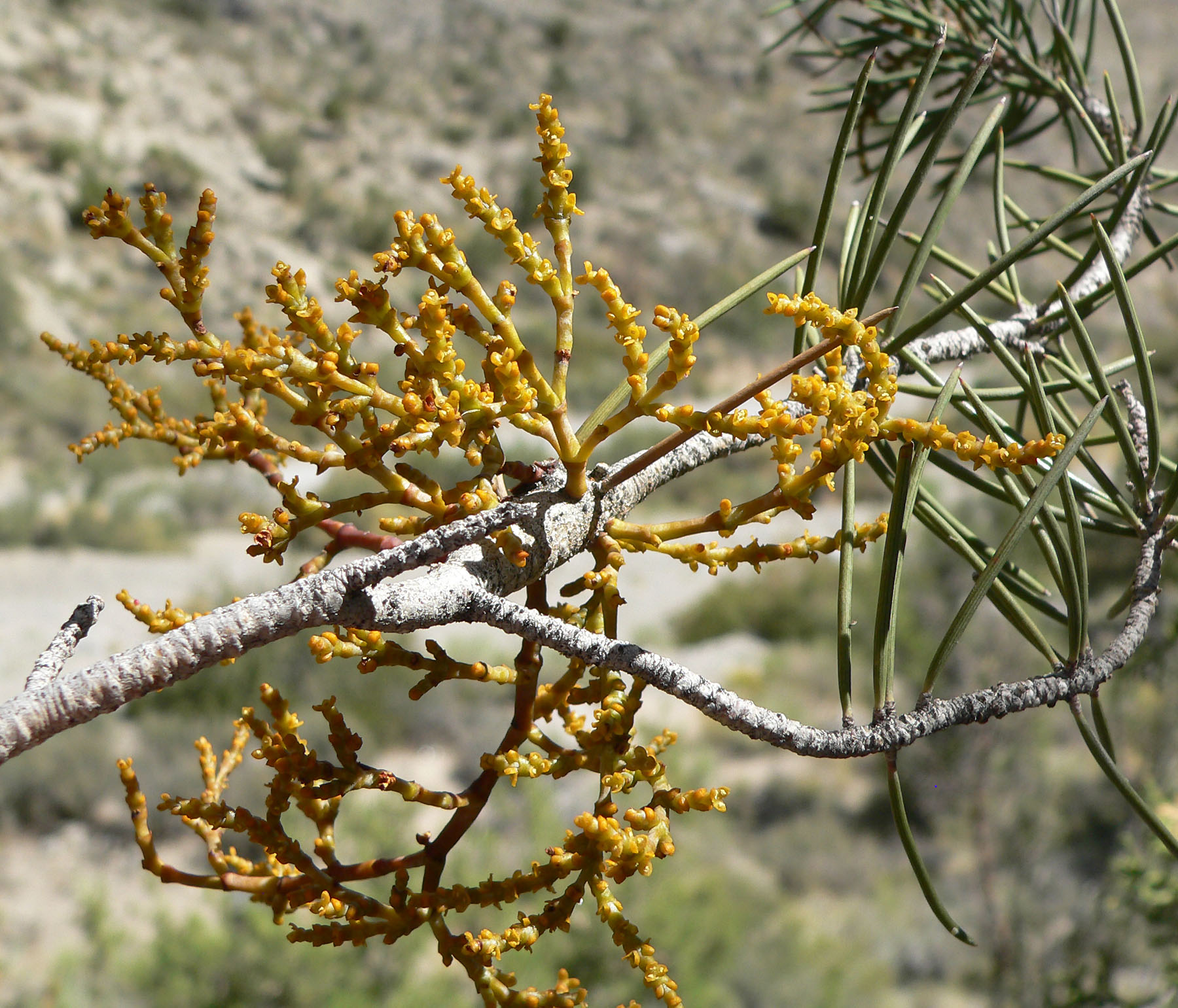
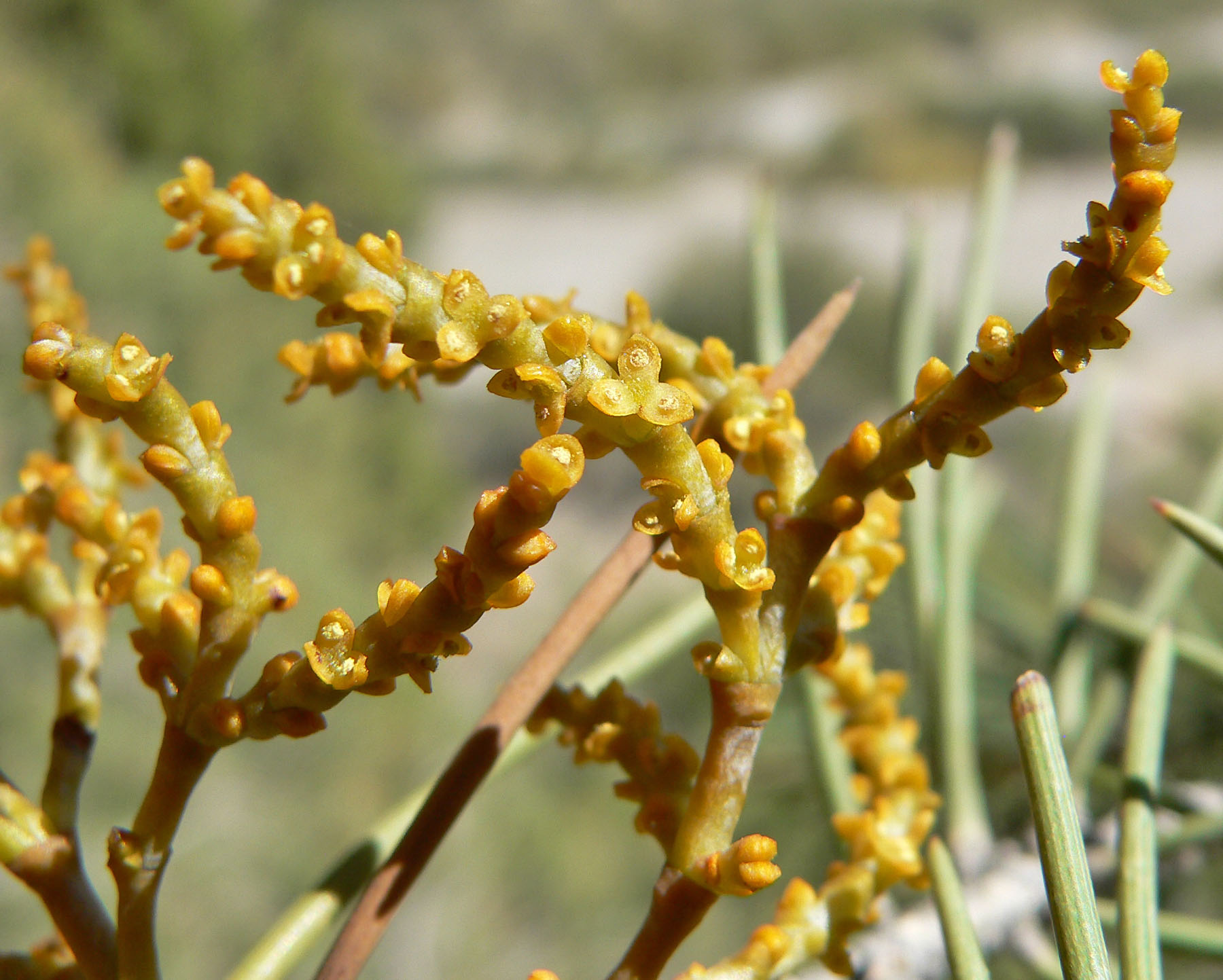
It is dioecious, with male and female plants separate, producing spikes of staminate and pistillate flowers respectively, flowering in August and September in the pinyon-juniper woodlands it calls home. The fruit is a sticky berry a few millimeters long, described in floras as about 4 millimeters long and 2.5 millimeters wide and bicolored, which explodes to disperse its seeds several meters from the parent plant, with some accounts giving dispersal up to 15 meters. The seeds are glue-coated, like all dwarf mistletoes, and they stick to neighboring pinyon branches, where they germinate and begin the hidden phase of the life cycle all over again. A pinyon pine carrying this mistletoe often responds with dense, compact witches’ brooms, tangled twig masses that are both symptom and habitat, sheltering birds and small animals while they drain the tree.
Its hosts are the pinyon pines, principally Colorado pinyon, Pinus edulis, but also other pinyons including single-leaf pinyon, Pinus monophylla, as the photographs show, and related species such as Pinus discolor and Pinus californiarum subsp. fallax. Its home is the pinyon-juniper woodland of the southwestern United States and Baja California in Mexico, at elevations roughly 1,400 to 2,400 meters, which is 4,600 to 7,800 feet, in states including Arizona, California, Colorado, New Mexico, Nevada, Texas, and Utah. That is a high, dry, open woodland of short pines and junipers, and the mistletoe tracks its pinyons through it the way all dwarf mistletoes track their hosts. It matters to butterflies: the Thicket Hairstreak lists it among its documented hosts, and its caterpillars feed on the shoots, camouflaged against them by color and texture. In the same woodlands you will also find juniper mistletoes, a different genus that parasitizes junipers rather than pines, and surveys find pinyon dwarf mistletoe frequently co-distributed with juniper mistletoe, though juniper mistletoe often occurs where pinyon dwarf mistletoe does not. Two parasites, two host genera, one woodland, and the field mark is the tree.
Florida note: Say this plainly: pinyon dwarf mistletoe is not a Florida plant, does not occur in Florida, and its pinyon hosts do not grow in a Florida yard. Its world is high desert woodland at 4,600 feet and up in the Southwest. If you garden in Florida, this guide is for understanding butterfly guides, not for planting. Do not plant it anywhere, on purpose, ever.
How to grow
You do not grow pinyon dwarf mistletoe. There is no nursery stock, no seed packet, and no planting depth, and the plant’s strategy is to arrive on its own: a sticky seed lands on a young pinyon branch, germinates, spends years building its hidden haustorial system inside the branch, and then produces shoots that flower in late summer and fire seeds in autumn. What land managers do with it is the opposite of growing: they prune infected branches before fruiting, remove heavily infected trees, and accept that in wild pinyon-juniper woodland, a certain level of infection is simply part of the ecosystem. Roadside surveys in Arizona’s Coconino National Forest found only about 12 percent of surveyed pinyon-juniper woodland infested with pinyon dwarf mistletoe, compared with about half infested with juniper mistletoes, and most of the pinyon mistletoe infestations were light. That is a parasite living at low density across a huge landscape, not a plague, and management in wild stands often means leaving it alone.
The taxonomy deserves a note, because it affects the name you will find in different books. This species was described by George Engelmann in 1878 and has no accepted varieties, but it was later described as a variety and then a form of western dwarf mistletoe, and the Jepson Manual still lumps it into that broader species. Plants of the World Online and the narrow treatment used by this guide series keep it as its own species, which matches how the butterfly guides list it, as a separate name alongside western dwarf mistletoe. A reader with a broad-treatment flora will find it under the western dwarf mistletoe umbrella instead. Same plant, different boundary, and the honest thing is to say so rather than pretend botany has settled it.
For the field observer, the useful skills are host identification and woodland reading. A dwarf mistletoe on a pinyon pine in the Southwest is almost certainly this species, while a mistletoe on a juniper in the same woodland is a different plant entirely. Look for the small scaly shoots, the branch swelling at the infection point, and the dense compact brooms that pinyons form in response. Those brooms shelter wildlife even as they drain the tree, which is the recurring moral of this genus: damage and habitat are the same structure, viewed from different branches.
Water & feeding
Pinyon dwarf mistletoe takes water and food from its host and gives nothing back but brooms. Its haustoria tap the pinyon’s xylem for water and phloem for sugars, and though its greenish stems carry some chlorophyll, the plant depends on its host for most of its carbohydrates. In the dry pinyon-juniper woodland, that theft matters: water is the limiting resource, and a parasite that drinks from a tree in a drought is a heavier burden than the same parasite in a wet forest. Heavily infected pinyons grow more slowly, produce fewer seeds, and die younger, and their decline opens space for junipers and shrubs, which slowly reshapes the woodland itself. A parasite that kills its host’s seedlings’ future is an ecosystem engineer with no building permit.
What it does not need is soil, fertilizer, or watering from a gardener, because it has outsourced all of that to the pinyon. The tree’s roots do the gathering, the tree’s canopy does the photosynthesizing, and the mistletoe takes its cut from the middle. That is why the standard advice in this section inverts: the way to help a pinyon carrying mistletoe is to help the pinyon, with water in drought where that is possible, with space around it so seeds have farther to travel, and with patience, because a lightly infected pinyon can live with its parasite for decades. The way to hurt the mistletoe is to remove the infected branch before it fruits, which is the only feeding intervention that works.
Common problems
- It is the problem: For pinyon pines, pinyon dwarf mistletoe is a parasite that reduces growth, seed production, and longevity. Heavy infection is a management concern in woodlands managed for pinyon nuts or timber, and a fact of life in wild stands.
- Compact witches’ brooms: Dense brooms on pinyon branches are the signature symptom. They shelter wildlife but drain the tree, and broomy branches are weaker and more likely to die back.
- Confusion with juniper mistletoe: The same woodlands hold juniper mistletoes on junipers. A mistletoe on juniper is not this species, and a mistletoe on pinyon is not juniper mistletoe. Host genus first, shoots second.
- Confusion with western dwarf mistletoe: Broad-treatment floras fold this species into western dwarf mistletoe. If your book has no pinyon dwarf mistletoe entry, check under that name before concluding the plant does not exist.
- Seed dispersal across the woodland: Explosive seeds travel several meters and stick to neighbors. A single infected pinyon seeds the pinyons around it every autumn, which is why isolated removal rarely holds.
- Drought interaction: In dry years the mistletoe keeps drawing water while the pinyon has less to give. Drought plus infection is the combination that kills pinyons, not either factor alone.
- Florida gardeners importing it: Do not. It will not establish without pinyon pines, and moving a forest parasite across the country is not a gardening project.
Harvest
There is no harvest. Pinyon dwarf mistletoe produces no food, no medicine, and no material worth the pinyon growth it costs, and its berries are not for eating. What people harvest from pinyon woodlands is pinyon nuts, from uninfected trees protected by removing infected ones, and knowledge: a correct identification, a photograph of a hairstreak caterpillar on its shoots, and a broom left standing where birds nest. Prune infected branches before autumn fruiting, remove heavily infected trees where they threaten a valued grove, and leave light infections in wild stands where they are part of the woodland. The best pinyon dwarf mistletoe harvest is a pinyon-juniper woodland that still has pinyons in it, with a few brooms left over for the birds.
Propagation
Pinyon dwarf mistletoe is another entry in the “please do not grow this on purpose” file. Arceuthobium divaricatum parasitizes pinyon pines — Colorado pinyon and single-leaf pinyon above all — across the southwestern United States and into Baja California. What you see of it is almost comically modest: a network of scaly brown or greenish stems, no longer than a finger, poking out of the bark. What you do not see is the bulk of the plant, threaded through the host’s tissues and drawing off water and nutrients in woodlands where water is already the limiting currency. A pinyon living lean does not need a tenant taking a cut.
Reproduction follows the dwarf mistletoe playbook: separate male and female plants, a small sticky berry, and an explosive discharge that flings the seed several meters to a nearby branch, where it glues itself down and works its way in. There is no soil stage, no pot stage, and no packet stage that makes sense for a home gardener — “growing” this plant means deliberately infecting a pinyon, and pinyons are slow-growing, ecologically load-bearing trees in their woodlands, valued for their nuts, their wildlife, and their patience. Deliberately adding a parasite to one is not propagation; it is vandalism with a Latin name.
The responsible behavior is to let wild populations be wild and to keep your hands, and your pruners, out of the seed’s travel plans. Do not collect berries, do not carry infected wood to a healthy tree, and if pinyons you steward are infected, get advice from a local forester or extension office rather than experimenting. Florida readers: pinyon woodlands are about as far from a Florida yard, ecologically speaking, as a plant can get, so this one stays a read-about-it species, not a grow-it species.
Varieties
- The species — Arceuthobium divaricatum: Pinyon dwarf mistletoe, southwestern United States and Baja California, in pinyon-juniper woodlands at roughly 1,400 to 2,400 meters. Scaly brown or greenish stems no more than about 12 centimeters long, shoots 7 to 12 centimeters high, bicolored explosive berries about 4 millimeters long, and no accepted varieties.
- On Colorado pinyon — Pinus edulis: The principal host, the two-needle pinyon of the Colorado Plateau and southern Rockies, and the tree most often carrying this mistletoe across its range.
- On single-leaf pinyon — Pinus monophylla: A principal host in the Great Basin ranges, the one-needle pinyon shown in the photographs, carrying the same mistletoe species on a different pine.
- On other pinyons: Pinus discolor and Pinus californiarum subsp. fallax are also recorded hosts, along with other pinyon species in the Southwest and Baja California. These are host records, not varieties, and they show the mistletoe’s loyalty is to pinyons as a group, not to one pine alone.
- The broad-treatment name, for reference: Arceuthobium campylopodum var. divaricatum and forma divaricatum are older names for this plant under the broad western dwarf mistletoe umbrella. If your flora uses those names, it is describing this plant, not a different one.