
🌿 Larch Dwarf Mistletoe
What it looks like
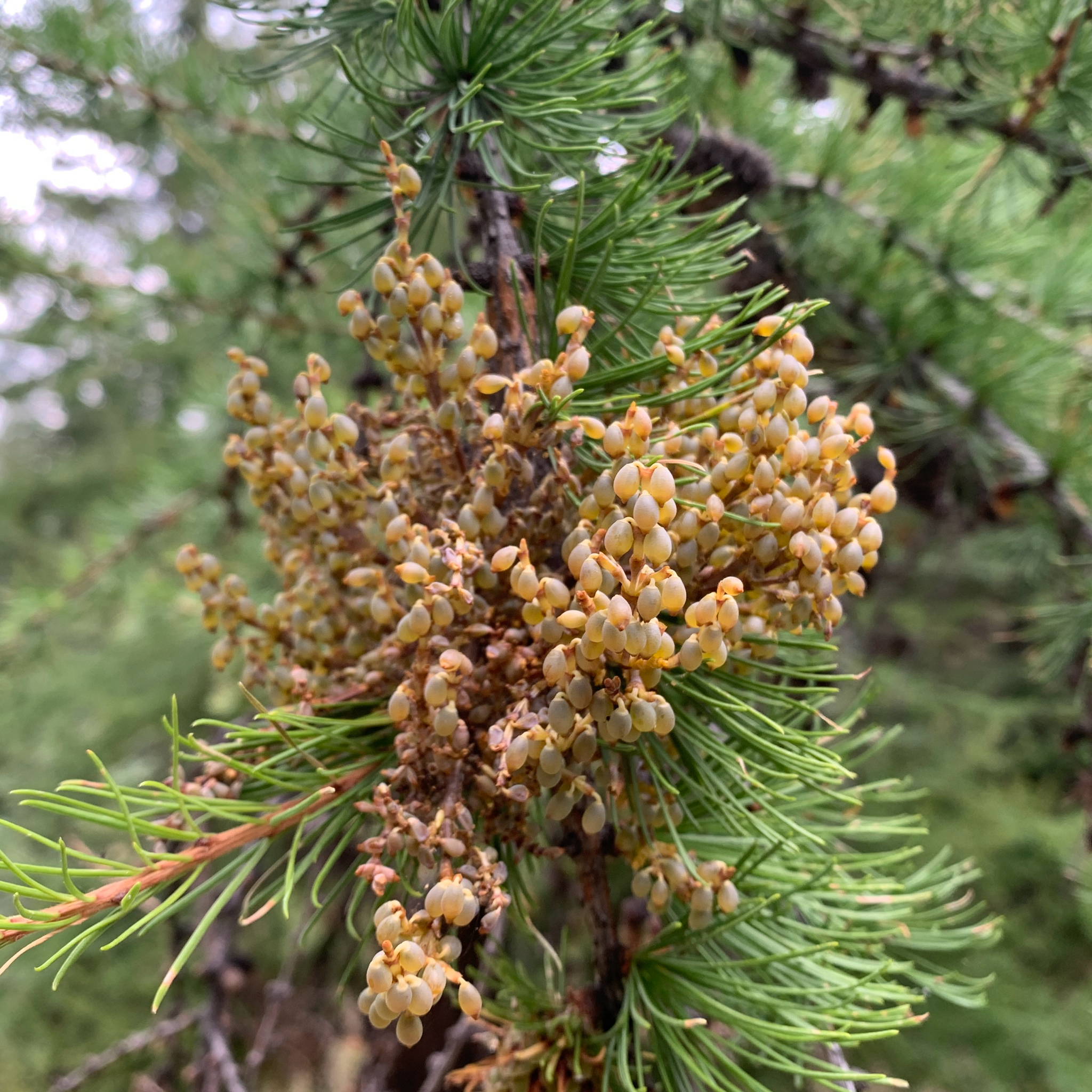
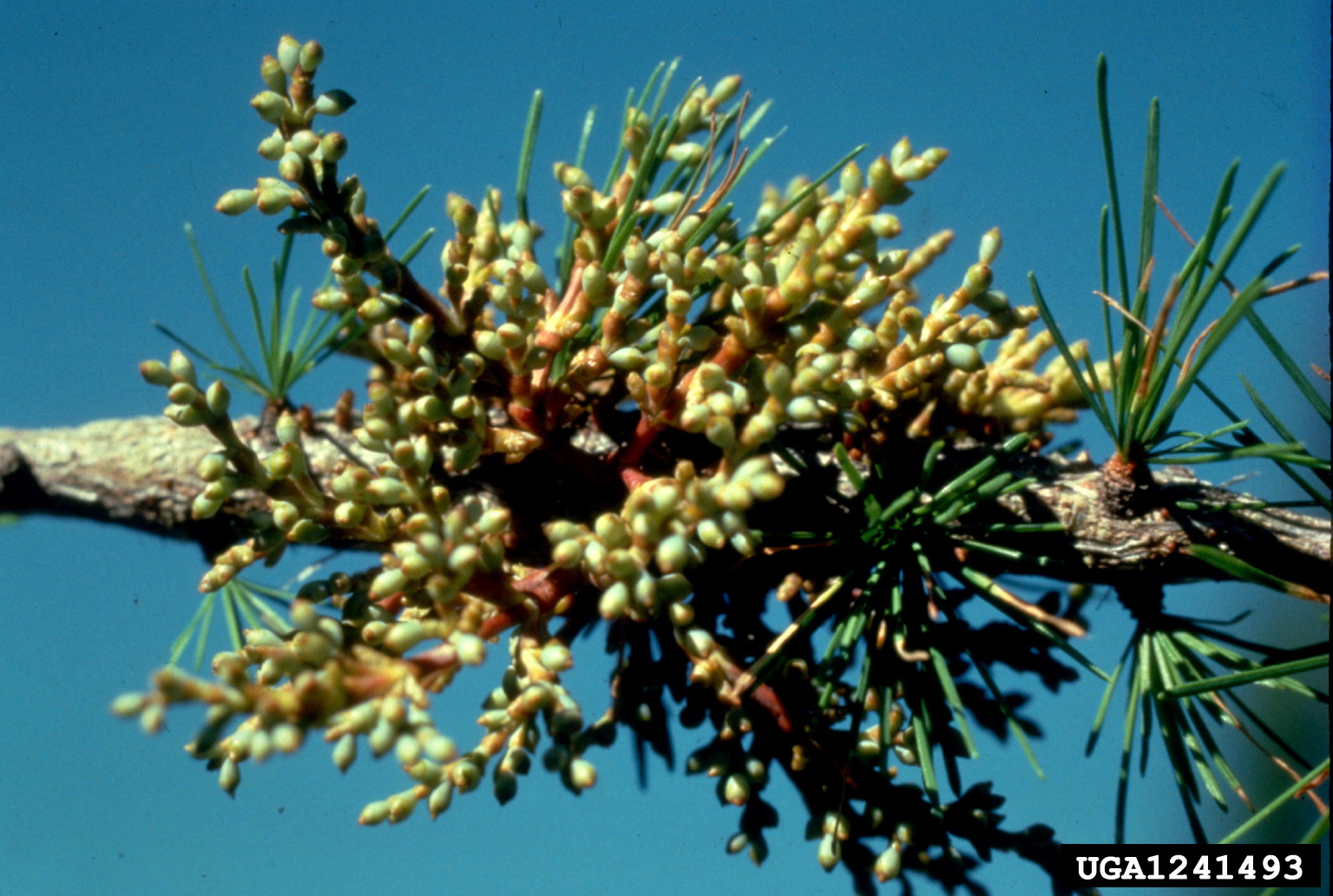
First, the most important thing about this guide: you do not plant larch dwarf mistletoe. Nobody sells it, nobody should plant it, and if you find it in your garden you almost certainly do not have it, because its hosts are western conifers and its range is the Pacific Northwest. This is a host-plant guide, written because a butterfly — the thicket hairstreak — depends on this plant, and because understanding a parasite this specialized is genuinely wonderful. Think of it as a field guide to a tiny, exploding, tree-dwelling freeloader, not as a shopping list.
What you would actually see, if you were standing under an infected western larch, is almost nothing — and then, once you learn to look, you cannot unsee it. The plant itself is a small, much-branched shrub growing out of a conifer branch, with stems that are yellow-green, brown-green, purplish, or red, sometimes banded with different colors on the same plant. The stems range from about 2 to 10 centimeters tall (roughly an inch to four inches), averaging around 5 centimeters — thumb-sized, in other words. The leaves are not leaves in any sense you would recognize: they are tiny, scale-like, and pressed against the stem, because this plant long ago gave up on making its own living by photosynthesis in any serious way. It does contain chlorophyll, and its stems are greenish, but its photosynthetic rate is low, and it takes the vast majority of its carbohydrates from its host tree. That is the whole business model: live inside a tree, drink from its plumbing, and put your modest energy into flowers, fruit, and ballistic seed dispersal.
The giveaway is rarely the mistletoe itself. It is the tree’s reaction. Infected branches swell into spindle-shaped lumps, and the tree responds to the parasite’s chemical meddling by growing dense, tangled masses of twigs called witches’ brooms. A big broom on a western larch is a billboard that says dwarf mistletoe lives here, and foresters, birds, and hairstreak hunters all read it the same way. The brooms matter beyond the joke of their name: they are nesting habitat for birds and small mammals, they break off under snow and add fuel to wildfires, and they are a resource sink, funneling water and nutrients toward the infection point and away from the rest of the tree. A heavily infected larch grows more slowly, makes fewer seeds, and dies younger. This is a parasite with consequences, not a decoration.
For butterflies, this plant is dinner, nursery, and camouflage studio all at once. The thicket hairstreak’s caterpillars feed only on dwarf mistletoes, including this species, and the caterpillars resemble their host plants so closely in segmented body shape and color — taking on the color of the mistletoe they eat — that they are effectively invisible on the shoots. If you ever find a thicket hairstreak caterpillar, you have found it by finding the mistletoe first, which is exactly how the butterfly wants it.
How to grow
You don’t. Let us be blunt, because a growing guide that pretends otherwise would be dishonest: larch dwarf mistletoe is an obligate parasite of conifers, and there is no garden cultivation method for it. It does not grow in pots, it does not grow from a seed packet, and deliberately infecting a healthy larch with it would be an act of tree vandalism, not gardening. The honest version of “how to grow” for this species is “how it grows in the wild,” and that story is worth telling properly, because it is stranger than any garden plant’s story.
It starts with a seed fired like a bullet. The fruit is a small oblong berry, averaging about 4.3 millimeters long and 3 millimeters wide, and when hydrostatic pressure inside it builds high enough, the seed is ejected at an initial velocity of approximately 27 meters per second — about 60 miles per hour — traveling an average of about 6 meters and up to about 15 meters. A sticky coating called viscin helps the seed glue itself to whatever branch or needle it strikes. Most seeds fail: in experimental inoculations of western larch, only about 2 percent of seeds that germinated went on to produce shoots. The ones that succeed germinate on a young branch, penetrate the bark, and spend a few years building an endophytic system — a hidden network of tissues called haustoria that tap into the host’s xylem for water and phloem for nutrients — before any aerial shoot emerges from the bark. The plant is invisible for years, then suddenly there are shoots, then flowers, then more cannon-fire seeds.
The plant is dioecious, meaning male and female flowers grow on separate plants. Male flowers have three or four lobes and average roughly 2.7 to 3.7 millimeters across; flowering runs for about six weeks, from mid-July to mid-September depending on the year, and fruit matures from late August to early October. If you are a forester, the management version of this story is pruning infected branches, removing heavily infected trees, and favoring non-host or less susceptible species in regeneration — the standard dwarf mistletoe playbook, applied at forest scale, not garden scale. If you are a butterfly watcher, the management version is simpler: leave infected larches alone where they are not a hazard, because the brooms and the mistletoe are the hairstreak’s whole world.
Florida note: Florida gardeners, this one is not for you in any sense, and that is fine — not every plant in a butterfly guide is a plant for every garden. Western larch does not grow in Florida, mountain hemlock does not grow in Florida, and therefore larch dwarf mistletoe does not grow in Florida. Its value here is ecological literacy: when you read a thicket hairstreak guide and see a list of Latin names, this is the plant behind one of them, and now you know what it does, why it matters, and why no Florida nursery will ever stock it.
Water & feeding
Watering a dwarf mistletoe means watering its host tree, and feeding it means feeding its host tree, because the mistletoe has no roots in soil at all. Its haustoria drink from the host’s xylem and phloem, and infected trees measurably use water differently — large, heavily infected larches show higher water use than uninfected trees, while also carrying less sapwood, which is one more way the parasite taxes its host. There is no fertilizer program for a parasite, no mulch ring, no drip line. The soil science here is secondhand: whatever the western larch wants — cool, moist, well-drained mountain forest soil in the Pacific Northwest — the mistletoe gets, filtered through bark and wood.
The one practical watering note belongs to the host, not the parasite. Drought-stressed conifers suffer more from mistletoe infections than vigorous ones, which is why foresters treat mistletoe as one stress among several rather than a single villain. A healthy, well-watered larch tolerates a light infection for years; a drought-stressed one declines faster. That is the closest thing to care advice this plant gets, and it is really tree advice wearing a mistletoe costume.
Common problems
- It kills trees, slowly. Heavy infections reduce host vigor, seed production, and wood quality, and can lead to early mortality. This is not a benign garden guest; it is a forest pathogen, and foresters manage it as one.
- Witches’ brooms break and burn. Large brooms on western larch snap off under snow and add fuel to wildfires. Some ecologists note that fire-adapted western larch may benefit indirectly when broom-fueled fires clear fire-sensitive competitors — a parasite that accidentally helps its host’s species while harming individual trees, which is the kind of paradox ecology loves.
- It is nearly invisible for years. The endophytic system develops inside the branch for a few years before shoots emerge, so a tree can be infected long before anyone sees mistletoe. Surveys have to allow for these latent infections.
- It has parasites of its own. Two fungi parasitize this mistletoe — one causing black lesions and shoot dieback, another producing masses of white spores that typically kill the shoots. Parasites all the way down, and the fungi are, in a small way, the larch’s unlikely allies.
- Identification is a host-and-microscope job. Dwarf mistletoes are separated partly by host affinity: this is the only mistletoe that primarily parasitizes western larch, and one of only two with mountain hemlock as a primary host. Telling it from its relatives on an unfamiliar host takes a specialist, not a phone photo.
- Do not try to grow it. Deliberate infection of a conifer is not a garden project, and in many places moving a forest pathogen around is exactly the kind of idea that ends with a very awkward conversation with a forester.
Harvest
There is no harvest, unless you count the harvest of understanding. Nobody eats larch dwarf mistletoe, nobody brews it, and nobody decorates with it — it is too small, too sparse, and too busy being a forest pathogen. What it yields, if you pay attention, is wildlife: brooms that shelter nesting birds and small mammals, shoots eaten by blue grouse feeding on host trees, and caterpillars of the thicket hairstreak, which eat nothing else. The crop of a dwarf mistletoe is a food web, and the harvest is watching a butterfly that looks like mistletoe lay eggs on mistletoe, in a forest that would look emptier without both.
Browse all plant & pest guides
Propagation
Larch dwarf mistletoe is not a plant to propagate deliberately, and it is worth being precise about why, because this one has a couple of wrinkles that could tempt a well-meaning reader into an exception. First, it is ranked Apparently Secure, so there is no rarity rescue argument. Second, its taxonomy is genuinely debated — some treatments fold it into western dwarf mistletoe as a subspecies, others keep it as its own species — but that debate changes the name on the label, not the behavior of the plant. Under any name, Arceuthobium laricis is an obligate parasite of western larch and mountain hemlock through the Pacific Northwest, sapping growth and seed production, forcing witch’s brooms, and, in heavy infections, helping push host trees toward death.
Its seed biology is the usual dwarf mistletoe drama in miniature: green berries at the shoot tips, forcibly ejected sticky seeds that can travel well beyond the parent branch, rain washing them down to twigs, germination and penetration, then a quiet incubation of a few years before shoots even appear. That long invisible phase is the trap for anyone tempted to “just try one”: the infection is established long before it is visible.
The one legitimate context for intentional infection is not a garden: controlled research, such as inoculation experiments testing which larches it can infect, done with a protocol and permission. That is not a home project, and it is not a seed-saving project. For everyone else, the move is to leave wild infections alone, not to move infected material, and to talk to a forester if larches you manage are infected. Florida note, as with all its cousins: western larch is not a Florida tree, so this mistletoe has no business in a Florida landscape.
Related dwarf mistletoes
The thicket hairstreak guide lists seven dwarf mistletoe hosts, all in the genus Arceuthobium: Arceuthobium campylopodum, Arceuthobium occidentale, Arceuthobium abietinum, Arceuthobium americanum, Arceuthobium laricis (this guide), Arceuthobium divaricatum, and Arceuthobium globosum. They are separated largely by host tree and by small morphological and flowering-time differences, and their taxonomy is actively debated — see the note below.
Arceuthobium campylopodum — the western dwarf mistletoe in the broad sense, on pines across western North America; some authorities fold several of the other listed taxa into this one variable species.
Arceuthobium occidentale — the gray pine dwarf mistletoe of California foothill pines, treated as its own guide in this project.
Arceuthobium abietinum — the fir dwarf mistletoe, principally on firs (Abies species).
Arceuthobium americanum — the lodgepole pine dwarf mistletoe, principally on lodgepole pine.
Arceuthobium divaricatum — the pinyon dwarf mistletoe, on pinyon pines of the Southwest.
Arceuthobium globosum — a Mexican and Central American dwarf mistletoe, at the southern end of the thicket hairstreak’s host range.