
🌳 Arizona White Oak
What it looks like
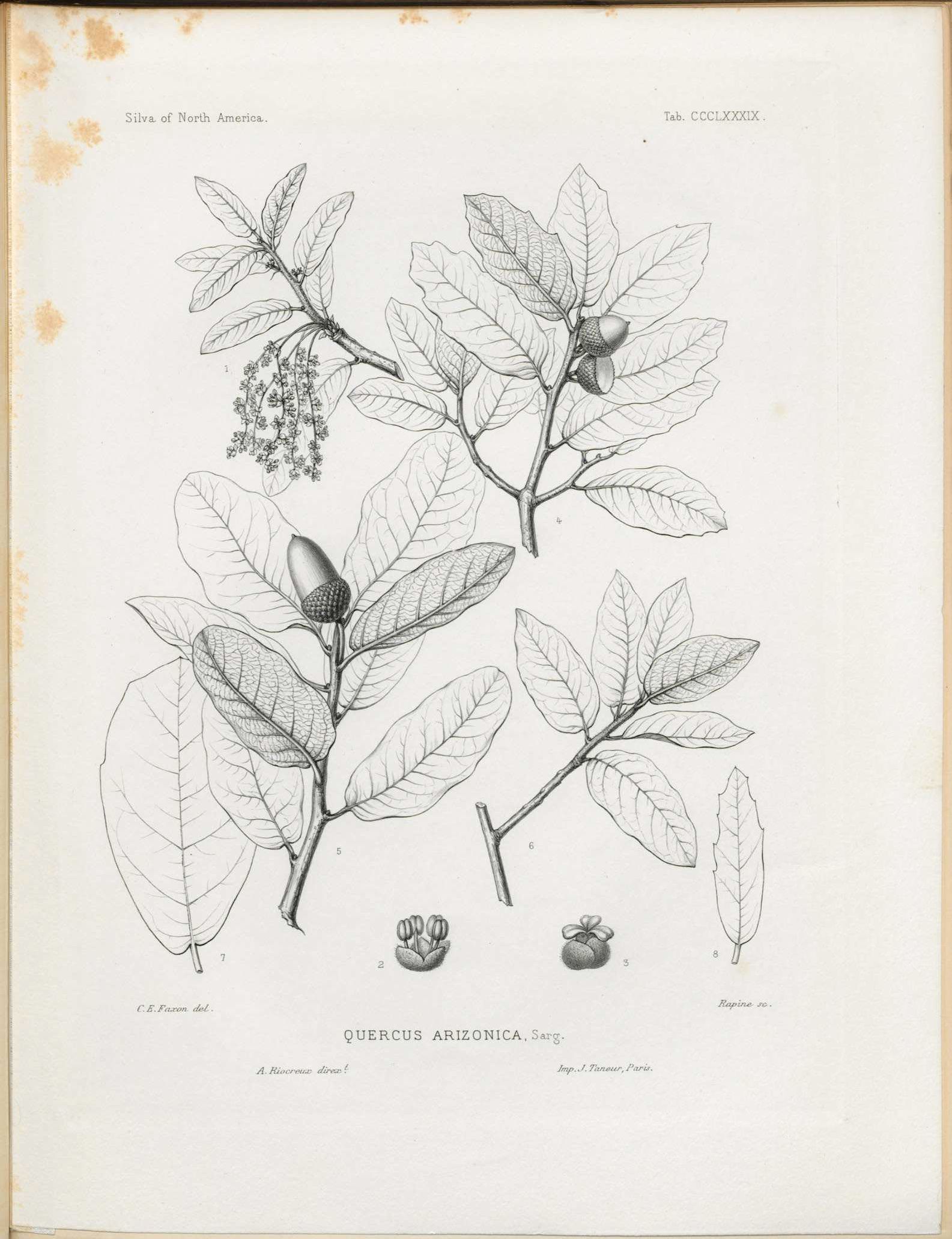
Arizona white oak is a medium to large tree of the white oak group, and the first thing to know about it is that it breaks every rule the eastern white oak taught you. It is evergreen, not deciduous. It grows in desert mountains, not eastern forests. Its leaves are small, thick, and leathery, not big and lobed. And it belongs to the white oak group anyway, because botany groups oaks by their flowers and acorns, not by whether they drop their leaves — and Arizona white oak’s acorns, with their bowl-shaped caps and single-season maturation, are white-oak acorns through and through. It is one of the largest southwestern oaks, and in its home ranges it is a dominant tree of the woodlands that rise out of the desert like islands in a dry sea.
In gardens and in the wild it typically grows 20 to 60 feet tall, with a broad, rounded crown and stout, spreading branches; the standard botanical description gives 5 to 10 metres, occasionally to 18 metres, which lands in the same range, and the trunk of a large specimen can reach about a metre in diameter. It grows very slowly once mature — this is a tree that measures its life in centuries and its growth in fractions of an inch — and it is often shrubby at high elevations, where wind and cold prune it into a smaller form. The crown is irregular and spreading, not the neat dome of a park tree, and the tree reads as rugged: a tree shaped by wind, drought, and elevation, not by a nursery catalog.
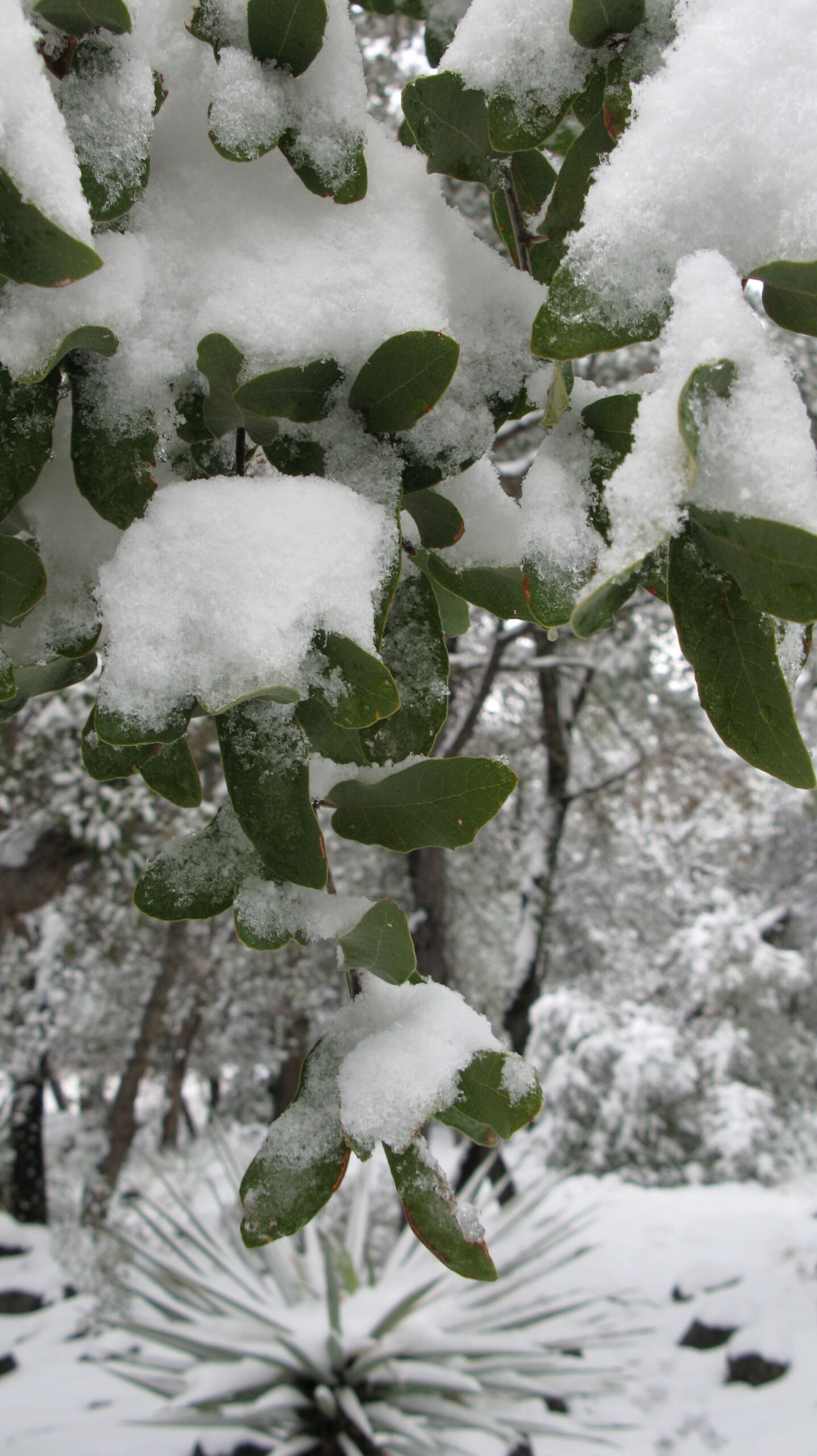
Identification starts with the leaves and the bark, and both are desert adaptations you can feel. The leaves are evergreen or sub-evergreen — they may shed in late winter or as new leaves emerge in spring, rather than in a single autumn drop — alternate, simple, and oblong, 1.5 to 3.5 inches long, thick and leathery and stiff, yellowish-green to blue-green, with margins entire or toothed near the tip and edges that roll slightly under. The veins are parallel, sunken on the upper side and raised underneath, and the whole leaf feels like it was built to hold water through a dry season, because it was. The bark is light grayish, thin and lenticelled when young, becoming quite thick with shallow fissures and scaly ridges on older trees — pale, scaly bark that recalls its eastern relative, the white oak, and that is part of why it carries the white oak name. The twigs are medium-sized and fuzzy, light brown to reddish-brown, with pointed clusters of fat terminal buds.
The acorns tell the rest of the story, and they are a feast-or-famine crop. They are oblong, half an inch to an inch long, with bowl-shaped caps covering about a third of the nut, maturing in autumn, and the quantity varies wildly from year to year: a mast year can rain acorns, and the next year can bring almost none, with germination tracking the rainy season’s moisture. The flowers are monoecious, male and female on the same tree: the male flowers are long, drooping, yellowish-green catkins, and the female flowers are small spikes in the leaf axils. For butterflies, Arizona white oak is a host tree, not a nectar plant. In the butterfly guides it appears as a host plant for the meridian duskywing, listed under the forms “Arizona white oak” and Quercus arizonica. The duskywing’s caterpillars feed on oak leaves, and this oak — a white oak of the mountains, not the eastern forest — is the one the meridian duskywing’s guide names.
Do not confuse this tree with its oak cousins, and the site’s own oak guides are the map. The eastern white oak (Quercus alba) is a different, deciduous species of the eastern forest, covered by its own species guide, and it does not grow in the desert mountains. The live oak (Quercus virginiana) of the site’s oak guide is a different, evergreen species of the South. The other oak species guides — canyon live oak, coast live oak, scrub oak, black oak, and Gambel oak — each cover their own species, and none of them covers Quercus arizonica. Arizona white oak is its own tree, with its own small leathery leaves, pale scaly bark, and sky-island range, and this guide claims Quercus arizonica only. It hybridizes readily with other southwestern oaks where they meet — gray oak, Gambel oak, and Mohr shin oak among them — so a tree at a range boundary may be a hybrid, and that is normal oak behavior, not a failure of identification.
How to grow
Arizona white oak is a tree for a large, dry, sunny site with rocky, well-drained soil, and it rewards patience on a scale few garden trees can match. Plant a nursery-grown tree in full sun to part shade, in rocky or sandy, well-drained soil, with room for a 25- to 50-foot spread at maturity. Do not plant it under a power line, against a house, or in a spot where a 60-foot tree will become a problem, because an Arizona white oak planted well will outlive the planter. Dig a wide, shallow planting hole, set the tree at the same depth it grew in the nursery, mulch with gravel or rock rather than wood chips, and water deeply to establish in its first seasons.
Once established, Arizona white oak is a low-water tree, and the most common way to kill it is to water it like a lawn tree. It wants the mountain woodland’s rhythm: seasonal rain, long dry spells, and soil that drains fast. It is both heat- and cold-tolerant within its range, it tolerates poor, shallow, rocky soils, and it grows in a remarkable range of communities — savannas, semidesert grasslands, chaparral, Madrean evergreen woodland, and pine-oak communities — but every one of those communities has drainage in common. Prune only to remove dead, crossing, or damaged wood, in the dormant season, and let the crown develop its natural, irregular, spreading form. An Arizona white oak pruned into a lollipop is an Arizona white oak insulted, and it will take decades to forgive you.
Fire is part of this tree’s story, and a gardener in its range should know it. Small Arizona white oaks are usually killed by fire, and acorns are often killed by fire as well, but larger trees usually survive fires that are not severe, and if a stump survives a fire it will sprout rapidly afterward. The foliage is extremely flammable, which is a real consideration for siting near structures in fire country: give it defensible space, keep dead wood pruned out, and do not plant it as a foundation shrub against a house in a fire-prone canyon. A tree that survives fire by sprouting is a tree that expects fire, and the garden plan should expect it too.
Florida note: Arizona white oak is not a Florida tree, and this guide says so plainly. It is a tree of high, dry, rocky mountain woodlands at roughly 4,500 to 8,500 feet elevation, with dry air, sharp drainage, and a two-season rainfall pattern, and Florida’s humidity, wet summers, sea-level elevation, and heavy soils are the opposite of what it wants. A white oak of the desert mountains in a Florida yard would sit in wet soil, breathe wet air, and decline, and no amount of drainage engineering makes a sky-island oak into a Florida garden tree. This guide exists because a butterfly guide mentions it, not because it belongs in a Florida bed. In Florida, the oaks that belong are the live oak and the other native oaks of Florida’s own woodlands, and this tree should stay where it grows: in the mountains above the desert.
Water & feeding
Water needs are low once established, with a mountain-woodland twist. Arizona white oak prefers dry, rocky or sandy soil and establishes best with deep, regular watering in its first seasons, but once established it is drought-tolerant — its deep roots and leathery leaves are built for dry seasons. In a garden setting, water deeply and infrequently, soaking the root zone rather than sprinkling the surface, and let the soil dry between waterings. Good drainage is the rule: it tolerates a range of soil types, from clay loam to rocky soil, and a pH from mildly acid through neutral to mildly alkaline, but it does not tolerate standing water or heavy, waterlogged soil, and it is sensitive to soil compaction and grade changes around its roots. Do not pave over an Arizona white oak’s root zone, do not pile soil against its trunk, and do not trench through its roots for a pipe and expect it to forgive you.
Feeding: light, if at all. An Arizona white oak in good, rocky, woodland soil needs no fertilizer, and its own leaf litter — left in place under the crown, not raked away and bagged — is the best feeding program there is. The soil science note is the tree’s whole story: oak leaves, fallen and decayed, build the humus-rich, fungal-dominated soil that oaks and their mycorrhizal partners thrive in, and the tree’s deep roots bring up minerals that shallow plants cannot reach. If a garden tree looks pale or chlorotic, check drainage first, because an Arizona white oak in waterlogged or compacted soil will look hungry no matter how much you feed it.
Common problems
- It is big, slow, and permanent. An Arizona white oak needs a large site, decades to mature, and a planting spot that will still make sense in a century. Do not plant it in a small lot, under a power line, or against a house and then complain that it grew.
- Overwatering and wet soil. This is a dry-mountain tree, and daily lawn irrigation, soggy clay, and low spots will rot it. Plant it in sharp drainage, water deeply and rarely, and keep it out of the lawn’s sprinkler zone.
- Fire risk in fire country. The foliage is extremely flammable, small trees are killed by fire, and siting near structures in a fire-prone canyon needs defensible space and dead-wood pruning. A tree that expects fire should be planned for, not planted against a deck.
- Hybrid confusion. Arizona white oak hybridizes readily with gray oak, Gambel oak, and Mohr shin oak where their ranges meet, so a tree at a boundary may not be pure. Check leaves, bark, and acorns together, and accept that some oaks are hybrids — that is oak biology, not a mistake.
- Mast-year mess, gloriously. A mature Arizona white oak in a mast year drops thousands of acorns, and they will dent cars, clog gutters, and sprout in every bed. Site it over open ground, not over a driveway you keep pristine, and accept the mast as the price of the tree.
- Confusion with other oaks. Small, thick, leathery, evergreen leaves and pale scaly bark separate Arizona white oak from the eastern white oak’s big lobed deciduous leaves and from the live oak’s different range and habit. Check leaves, bark, acorns, and range together, and do not assume every white oak is this species.
Harvest
Harvest, for Arizona white oak, is about acorns, wood, and wildlife — in that order of garden relevance. The acorns are mildly flavored and low in tannins for an oak, edible after thorough leaching, and they have been used as food by people and wildlife for as long as there have been sky-island oaks — but this guide does not present them as a casual food crop, because acorn processing is real work and the tannins still require leaching. The wood is hard, heavy, and strong, usually used for fuel, and rarely used for furniture or commercial work because straight timber is hard to find in a slow, irregular mountain tree. The harvest this guide recommends without reservation is the ecological one: let the tree drop its acorns for deer, turkeys, javelinas, songbirds, and quail, let it give cover to the same animals that forage beneath it, let it host the meridian duskywing and the other caterpillars that feed on its leaves, and let its leaf litter build the soil beneath it. An Arizona white oak managed that way gives you shade, wildlife, and a mountain woodland in miniature, which is a better yield than a barrel — and it does so for centuries.
Browse all plant & pest guides
Saving seeds
An oak’s seed is an acorn, which means saving seed from Arizona white oak (Quercus arizonica) is gloriously low-tech: you pick up nuts off the ground in autumn and plant them. The catch is that white-oak acorns break nearly every seed-saving rule you know, so forget everything you learned about drying beans on a windowsill. White oaks — the group Quercus arizonica belongs to — have little or no dormancy. Their acorns want to germinate soon after falling, and they must never dry out. A desiccated acorn is a dead acorn. This is the one seed in your collection that should never see a paper envelope on a shelf.
Collect in autumn, when ripe acorns drop on their own and the cap slips off easily. Choose plump, uncracked nuts with no tiny exit holes (those are weevil calling cards). The classic float test still earns its keep: drop them in a bucket of water, keep the sinkers, compost the floaters, which are usually empty or damaged. Gather more than you think you need — germination is variable, and squirrels consider your nursery a buffet, so plant extras and protect pots with wire mesh.
Then you have two honest paths. The simplest is to sow right away, about an inch deep in deep pots of well-draining mix — deep, because an oak’s first act in life is to send down a taproot like it has somewhere important to be. Keep the mix moist, not soggy, and wait. The second path is moist, cool storage over winter: tuck the acorns in a bag of damp (not wet) peat or sand in the refrigerator and sow in spring. Sources disagree on how much chilling white-oak acorns actually need — some give a month or two of cold stratification, others point out that white oaks germinate with little or no dormancy at all — so treat the fridge as storage that keeps them alive and ungerminated, not as a magic dormancy-breaking ritual. Check the bag now and then and discard any that go soft or moldy. Florida growers, take note: our humidity makes mold the enemy of stored acorns, so wring that peat out well and give the bag a little air rather than sealing it sopping wet.
One more piece of oak honesty: oaks cross-pollinate freely, including across species in the white oak group, so a seedling is a genetic remix, not a photocopy of its parent. If you want an exact copy of a particular tree, you need grafting, not acorns. But if you want a tough, deep-rooted native oak with your own hands in its story from the very first taproot, an acorn is the cheapest miracle in the garden — just don’t let it dry out, don’t rush it, and remember you are planting a tree your grandchildren will sit under. That is a feature, not a bug.
Species in this group
Arizona white oak (Quercus arizonica) — the species described in this guide, the evergreen white oak of Arizona, New Mexico, western Texas, and northern Mexico, host for the meridian duskywing.
White oak (Quercus alba) — the eastern, deciduous white oak, covered by its own species guide; a different species, not Arizona white oak, and the correct pairing for the name “white oak” in eastern butterfly guides.
Live oak (Quercus virginiana) — the evergreen oak of the South, covered by the site’s oak guide; a different species, not Arizona white oak, and the Florida oak for central and southern gardens.
Gray oak (Quercus grisea) — a southwestern oak closely related to Arizona white oak, which hybridizes with it where their ranges meet; a different species, not covered by this guide.
Gambel oak (Quercus gambelii) — a southwestern oak covered by its own species guide, which hybridizes with Arizona white oak; a different species, not covered by this guide.
Black oak (Quercus velutina), scrub oak (Quercus ilicifolia), canyon live oak (Quercus chrysolepis), and coast live oak (Quercus agrifolia) — oak species covered by their own guides; each is a different species from Quercus arizonica.