
🌵 Bailey’s Yucca
What it looks like
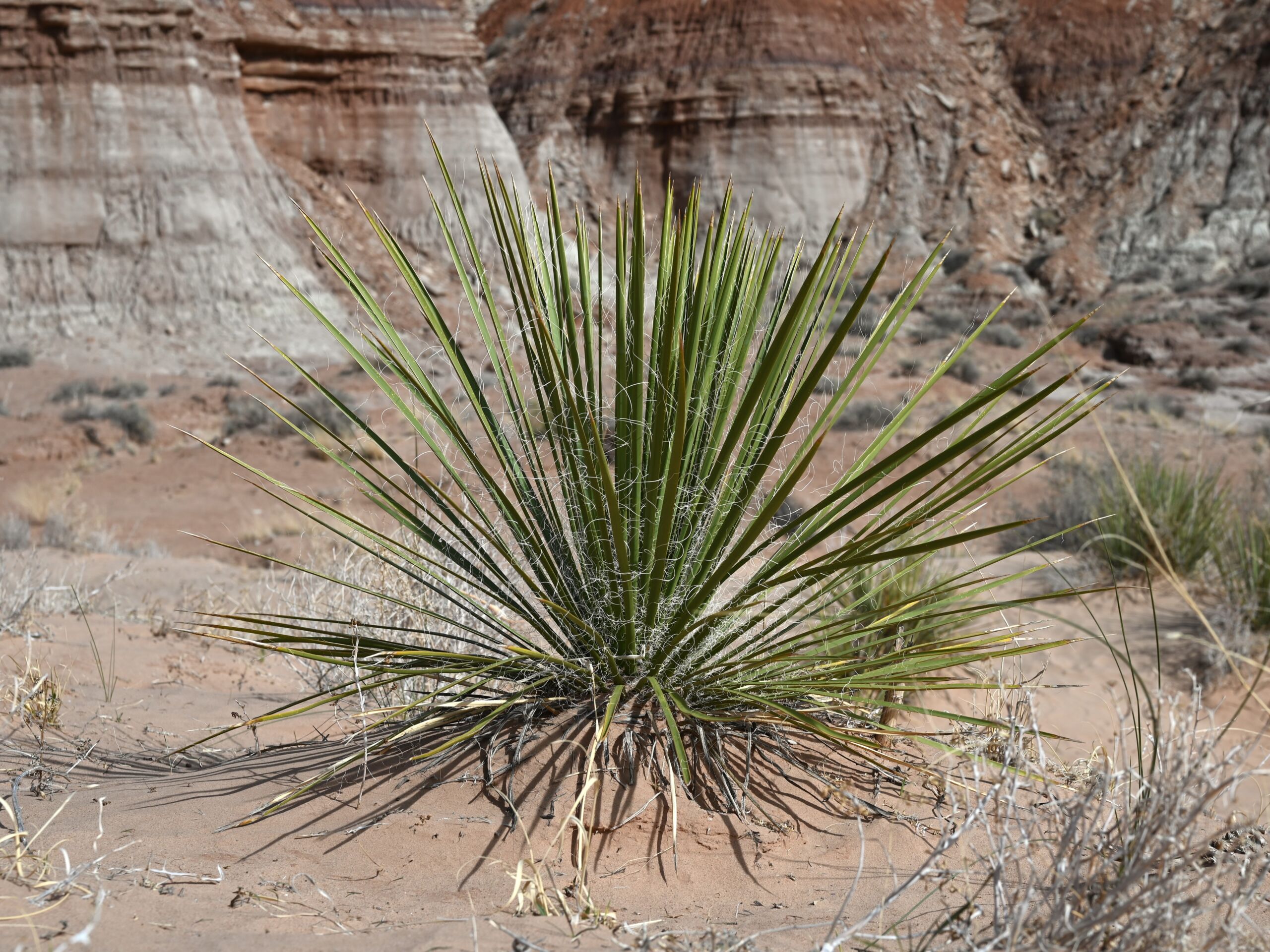
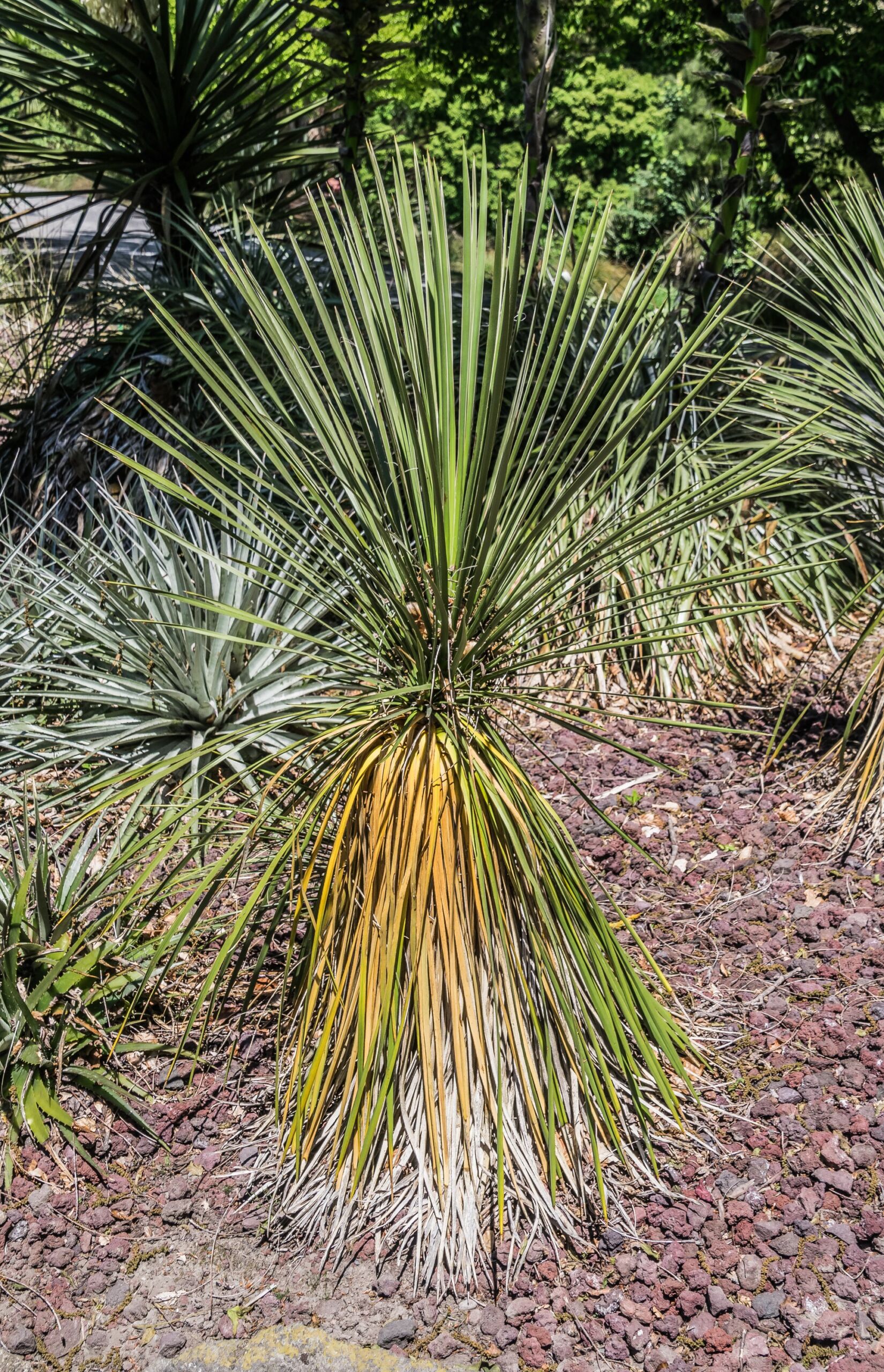
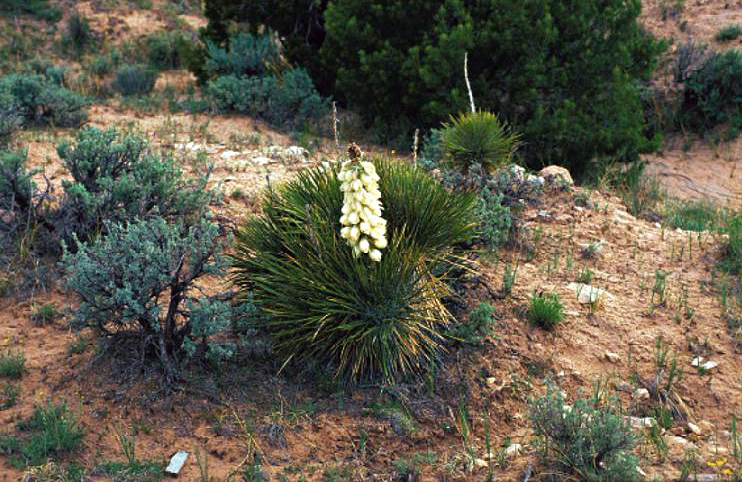
Bailey’s yucca is a small, stemless evergreen yucca of the asparagus family, Asparagaceae, native to the Four Corners country — Utah, Arizona, New Mexico, and Colorado — where much of its range lies within the Navajo Nation, which is why it is also called Navajo yucca, and in higher country, alpine yucca. It grows as a solitary rosette or, more characteristically, as a cespitose colony: a cluster of rosettes that can spread 1.3 to 2 meters across, each rosette usually small and symmetrical, stemless or with only a short leafy stem, rising no more than about 20 centimeters above the ground before the leaves take over.
The leaves are the identification. They are narrow — less than half an inch across, 25 to 45 centimeters long and only 0.6 to 0.9 centimeters wide — rigid, yellowish green, flat on top and convex or keeled beneath, sometimes slightly sickle-shaped, widest near the middle. The margins are entire and recurved, whitish, and filiferous: they peel into curling white fibers along the edge, the classic yucca fringe. Each leaf ends in a spine, a sharp needle up to about 3 millimeters long on the Flora of North America description, though field guides describe a spine nearer an inch; either way, it is a plant to handle with gloves and respect. A colony of these rosettes reads from a distance as a low, spiky, yellow-green pincushion on a sandy slope, quite unlike the tall trunked yuccas or the broad-leaved banana yucca.
The flowers are the second identification, and they are shy for a yucca. The inflorescence is racemose — an unbranched spike rather than a branched panicle — arising within or just beyond the rosettes, only 2.5 to 4.5 decimeters long, on a scape-like stalk 10 to 20 centimeters tall. In other words, the flower stalk barely clears the leaves, and in some forms it starts below the leaf tips, so the bells hang among the swords rather than towering over them. The flowers are pendent, bell-shaped, with tepals 5 to 6.5 centimeters long, ovate to obovate, white to pale creamy yellow, sometimes with a purplish tinge, subtended by erect purplish bracts. The style is white, the stigma green and lobed. Flowering is in spring. The fruit is an erect, dry, oblong-cylindric capsule about 5 by 2.5 centimeters, opening by splits between the chambers, holding dull black, thin seeds 6 to 10 millimeters long.
The taxonomy note, stated openly because it changes what a nursery tag means: Yucca baileyi was described by Wooton and Standley in 1913, and its synonyms include Yucca navajoa and Yucca standleyi, while one of its varieties, var. navajoa, covers the compact colonies of semi-erect, branched plants. Flora of North America notes that var. navajoa possibly hybridizes with Yucca glauca and with Yucca angustissima, the narrowleaf yucca — and that is the question this guide flags honestly. Bailey’s yucca and narrowleaf yucca grow in overlapping country, look alike to a casual eye, and intergrade where they meet; some New Mexico keys warn outright that taxonomists have not settled a firm division of these yuccas into species, and advise identifying populations by their general character rather than by a single plant. One form, var. intermedia, is treated by some sources as its own species, Yucca intermedia, with a flowering portion 1.5 to 2.5 times longer than the leaves. This guide follows the butterfly guides, which list Bailey’s yucca as Yucca baileyi, and it keeps that name while warning you that a plant sold or keyed as narrowleaf yucca, Navajo yucca, or intermediate yucca may be the same population wearing a different Latin name. The field marks that lean toward baileyi are the diminutive rosette, the very narrow leaves, the flower stalk that stays within or just beyond the leaves, and the purplish bracts.
How to grow
Give Bailey’s yucca what its home country gives it: sun, air, and drainage, and very little else. Plant it in full sun — it tolerates part sun, but shade makes it weak and leggy and robs it of its symmetrical form — in sandy, gravelly, sharply drained soil. In the wild it grows on sandstone ridges, sandy soils, and cinder flats, in mixed warm desert shrub, grassland, and pinyon-juniper and ponderosa pine woodland, at elevations of 1,300 to 2,500 meters. Translate that to a garden as a raised bed, a rock garden, a sunny slope, or a container of gritty mix: any place where water runs through and never stands. The crown must sit level with the soil, never buried, and the plant must never sit in a saucer of water.
Space plants 24 to 36 inches apart, and site them where nobody has to brush past them. Those leaf spines are not ornamental; they puncture skin and snag clothing, and a colony at ankle height is a hazard disguised as a groundcover. Keep rosettes back from paths, play areas, and anywhere people walk in shorts or bare feet. Once established, Bailey’s yucca is notably drought tolerant and asks for very little: no staking, no spraying program, no annual ritual beyond removing dead leaves and, after flowering, the spent stalk. One desert nursery puts its summer watering at once or twice a month, and that is a generous reading; in a rainy-summer climate, the rain alone is usually too much, and drainage matters more than any watering schedule.
The hardiness question deserves honesty, because sources disagree at the cold end. One care summary lists zones 5 to 9 for Navajo yucca; a desert nursery says hardy to about 10 degrees Fahrenheit; other listings report minimum temperatures around 0 degrees Fahrenheit in dry conditions for short periods. The plant’s native elevations run to 2,500 meters in the Colorado Plateau, which argues for real cold tolerance — provided the soil is dry. Cold plus wet is the killer, not cold alone, and a plant that survives a dry mountain winter will rot in a wet lowland one. The hero range here is 5 to 9, and the honest version is: cold-hardy for a yucca, but only where winter drainage is sharp. In Florida, that combination almost never exists. Bailey’s yucca is a desert plant of dry air and sandy, high-country soil; in humid Florida, with summer rain and heavy air, it is a poor bet outside a covered rock garden or a pot that can be kept dry. This guide does not recommend it as a Florida landscape plant. It belongs in this library because a butterfly — the Strecker’s giant-skipper — uses it as a host, not because it belongs in a Keystone Heights bed.
Propagation is by seed, offsets, or division. Colonies produce offsets that can be separated with roots attached and replanted. Seed is the slower route, and it comes with the yucca catch: in its native range, yucca flowers are pollinated by particular yucca moths, and where the right moth cannot live, seed will not set unless flowers are pollinated by hand. If your yucca blooms and never makes a capsule, the moth, not your gardening, is the missing piece.
Water & feeding
Water deeply but rarely while the plant is establishing, then back off hard. An established Bailey’s yucca is drought tolerant and prefers dry to moist soil; overwatering, especially in anything heavier than sand, is the fastest way to kill it. A light spring mulch of compost or worm castings is plenty of feeding, and rich soil is actively counterproductive: it pushes soft growth on a plant whose whole design is lean and tough. Do not plant it in a bed that gets daily irrigation for thirstier neighbors, and do not site it under a downspout or at the foot of a slope where water collects. If the center of the rosette turns soft and mushy, that is rot from wet soil, and the honest remedy is to lift the plant, cut away the rot, and replant it higher and drier — or accept the lesson and plant the replacement on a mound of grit.
The soil pH guidance is forgiving: roughly neutral, about 6.0 to 7.5, in sandy or gravelly soil with good aeration. That is not the hard part. The hard part is drainage and air. A Bailey’s yucca in a pot wants a cactus mix with extra grit, a drainage hole that actually drains, and a saucer that is emptied, not left full. In the ground it wants the highest, driest, sunniest spot you have, and it will punish generosity with rot.
Common problems
Root rot from wet soil is the problem that matters; everything else is footnotes. Leaf-spotting fungi can appear during wet periods — improve air circulation, avoid overhead watering, and remove spotted leaves rather than reaching for a spray. The sharp leaf tips are a hazard to people and pets, not a disease, but they belong in this section because they are the complaint most gardeners actually have: site the plant where nobody has to brush past it. Cold is rarely the killer in dry soil, and heat is not either; a Bailey’s yucca that fails has almost always drowned, or been kept wet through a humid summer, not frozen or baked.
The other common problem is identity. Nurseries and field guides use Navajo yucca, alpine yucca, Bailey’s narrow-leaf yucca, narrowleaf yucca, and intermediate yucca for a cluster of overlapping populations, and the common names slide across species boundaries. If the plant you need is the butterfly host — the one the Strecker’s giant-skipper uses — confirm the Latin with the seller, and prefer a southwestern native-plant nursery that knows the difference between baileyi, angustissima, and glauca over a generic tag that just says yucca. And remember the humidity warning: a plant that thrives on a dry mesa at 6,000 feet is not failing you when it sulks in a humid Florida summer. It is telling you it lives somewhere else.
Harvest
Bailey’s yucca is not a crop, but it is traditionally a useful plant, and the old uses are worth recording with care. The Navajo people make extensive use of yucca fibers for a wide assortment of useful and ceremonial items, and use the roots as soap — the saponin-rich roots lather, which is why so many yuccas carry soap in their folk names. That is the recorded use for this species group, and it comes with the usual cautions: be certain of the species, use only the parts the references name, and remember that a plant grown as a butterfly host has a job already. The Strecker’s giant-skipper caterpillars feed on this yucca, and a garden that harvests every rosette is a garden that has evicted its skippers. The better harvest, for most growers, is the plant itself: a tight colony of narrow swords, a short stalk of cream bells tucked among the leaves in spring, and a clump that comes back from its own offsets year after year, asking for sun, sand, and to be left alone.
Propagation
Bailey’s yucca (Yucca baileyi) can be grown from seed, but almost nobody with an established plant bothers, because the plant hands you a much faster method for free: offsets, also called pups, that sprout around the base of the mother plant. A pup is already a yucca, just a small one, and it will flower years sooner than a seedling — seed-grown yuccas can take several years to reach flowering size. Offsets are the practical route; seed is the patient person’s hobby.
To divide a pup, wait until it is a decent size with roots of its own, in spring or early summer. Cut down between the pup and the parent with a sharp, clean knife or spade, taking a good section of root with the pup. Wear gloves and eye protection: those narrow leaf tips are genuinely sharp. Let the cut surface dry and callus for a few days to help prevent rot, then set the pup in a very gritty, well-draining mix at the same depth it grew before. Water it in, then water sparingly until rooted. In Florida’s rainy summers, drainage is everything: a pup sitting in wet soil rots before it roots.
For seed, let the pods dry on the plant until brown, then split them and collect the flat, dark seeds. Pods can be scarce: in its Four Corners home, Bailey’s yucca is pollinated by yucca moths, and outside that moth’s range, seed set is often poor. Sow shallowly in gritty mix, keep it warm, roughly 70 to 80 degrees, and lightly moist, and expect erratic germination over weeks to months. Store saved seed dry, airtight with a desiccant, cool and dark, and remember that seed-grown plants vary, while a pup is an exact clone of its parent.
Species in this group
- Bailey’s yucca — Yucca baileyi: This guide’s plant. A small, stemless Four Corners yucca, also called Navajo yucca and alpine yucca, with very narrow leaves under half an inch wide, curling white leaf fibers, and a short flower stalk that stays within or just beyond the leaves; host of the Strecker’s giant-skipper.
- Narrowleaf yucca — Yucca angustissima: The closest look-alike and the taxonomy question in this guide. Longer, narrow leaves and a taller flower stalk, 3 to 6 feet, with flowers well above the leaves; grows on the Colorado Plateau and possibly hybridizes with baileyi where they meet.
- Intermediate yucca — Yucca intermedia: Treated by some sources as Yucca baileyi var. intermedia and by others as its own species. Its flowering portion is 1.5 to 2.5 times longer than the leaves, longer than the typical baileyi stalk.
- Soapweed yucca — Yucca glauca: A Great Plains yucca with narrow, blue-green leaves and curly leaf fibers, and a possible hybridization partner of baileyi. Green stigmas and a loosely flowered cluster help separate it in the field.
- Banana yucca — Yucca baccata: A much broader-leaved southwestern yucca with fleshy, banana-shaped fruit. Not Bailey’s yucca, despite sharing its desert country and its giant-skipper visitors.
- Small’s yucca — Yucca smalliana: A southeastern yucca with narrow leaves and peeling fibrous margins, and its own taxonomy tangle. Not Bailey’s yucca, and a reminder that narrow leaves alone do not identify a yucca.