
🍀 Bird’s-foot Trefoil
What it looks like
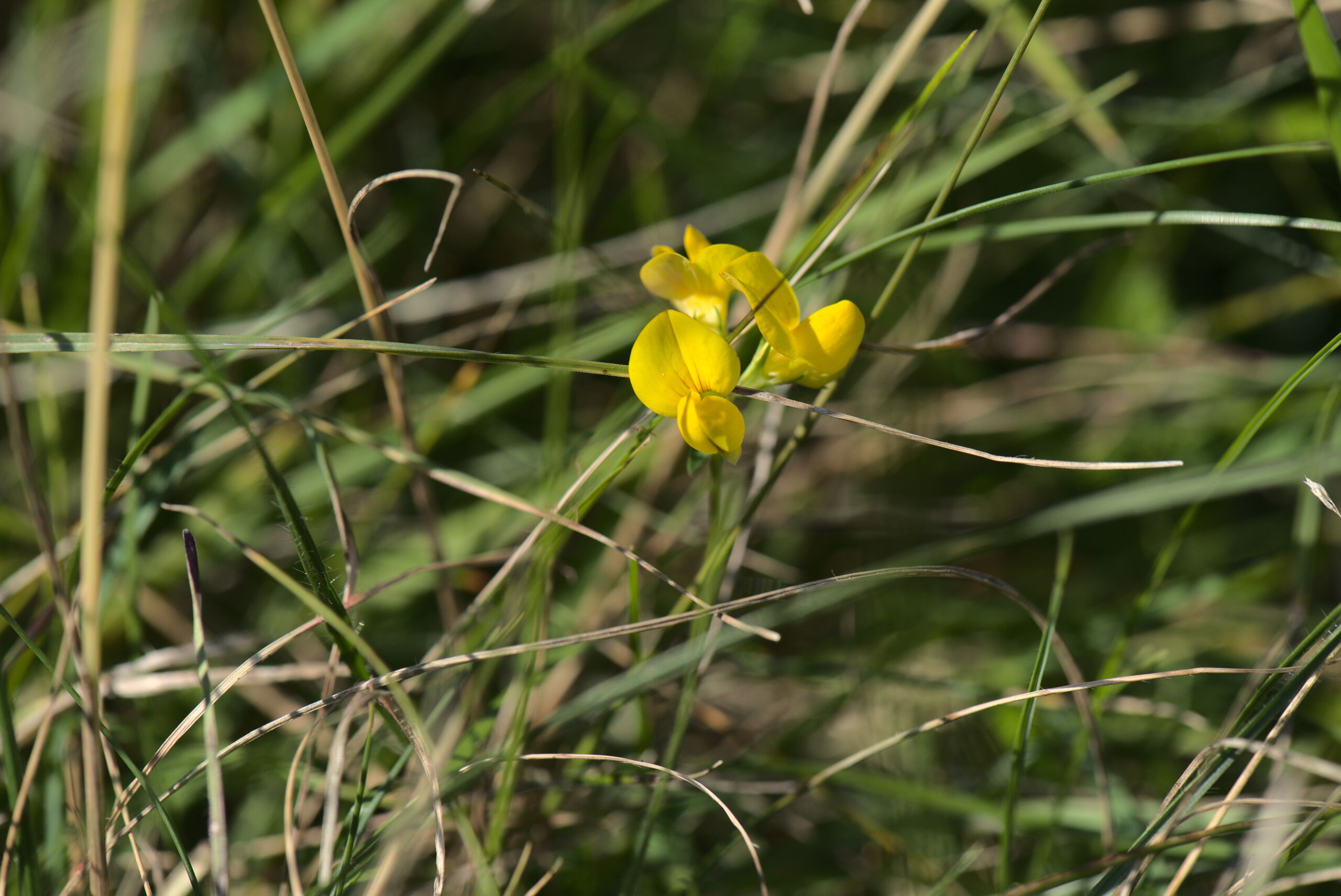
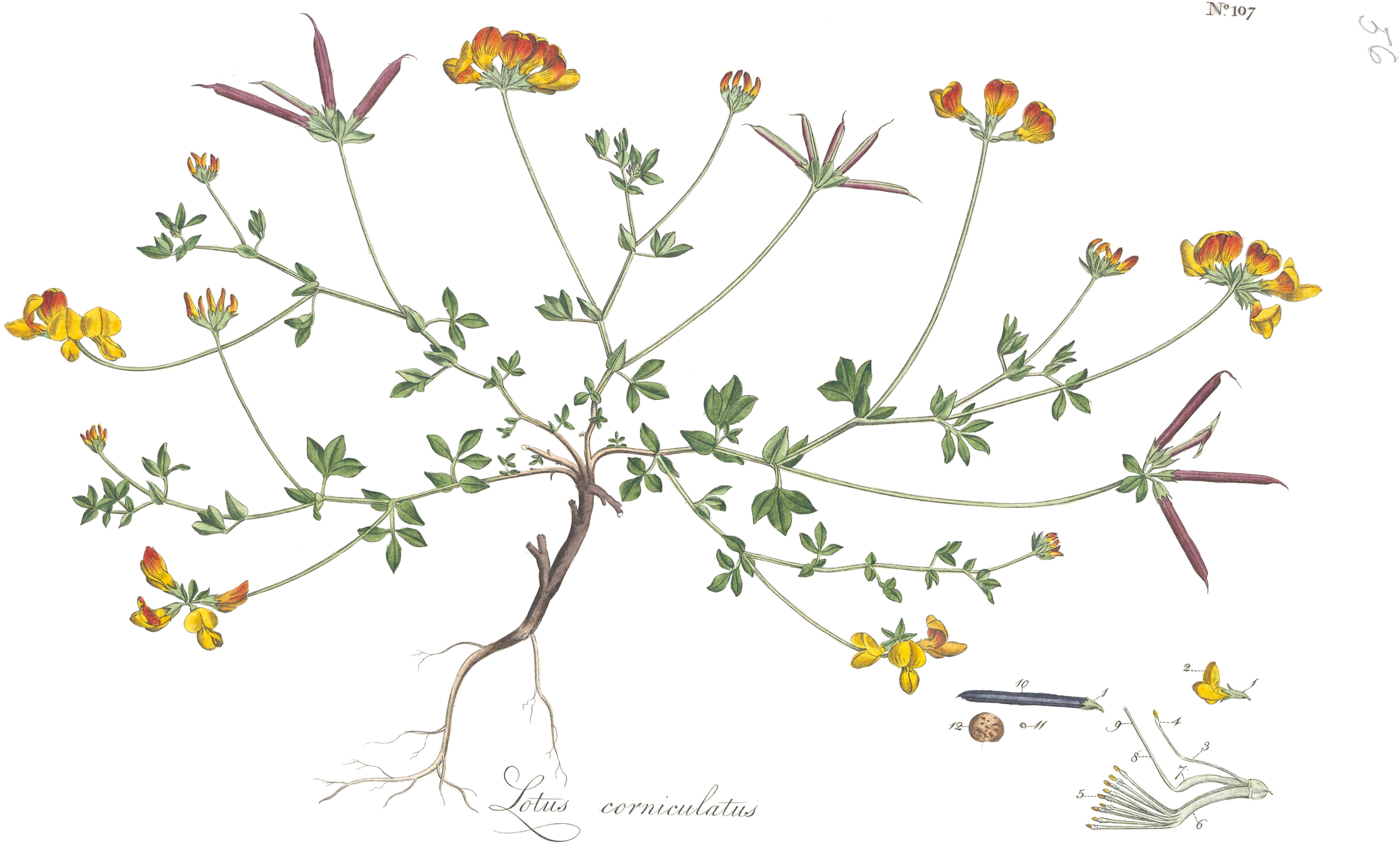
Bird’s-foot trefoil is a low, mat-forming perennial legume that looks like it cannot decide whether it wants to be a lawn, a wildflower, or a farm crop — and the honest answer is all three. It grows 6 to 24 inches tall, with slender stems that sprawl, trail, and sometimes root at the nodes, spreading into a dense mat by seed, stolons, and rhizomes. From a distance it is a wash of yellow in a meadow; up close it is a small masterpiece of pea-family engineering.
The leaves are the first riddle. They look trifoliate — three leaflets, like a clover, which is where “trefoil” comes from — but count again: there are five leaflets, three terminal ones and two more at the base of the stalk where it joins the stem, the basal pair so stipule-like that generations of botanists have argued about what to call them. The flowers are the second delight: clusters of 2 to 12 bright yellow, pea-shaped blossoms, each about half an inch long, carried in a flat-topped whorl (an umbel) at the end of a long stalk, often streaked or tinged with red or orange, especially as they age. Folk names for it include “eggs and bacon,” for the yellow-and-orange buds, and “granny’s toenails,” for reasons best left to the imagination.
The seed pods are where the bird comes in. After flowering, the plant produces slender, cylindrical brown pods, 1 to 2 inches long, that spread outward from a single point like the toes of a bird’s foot — hence bird’s-foot trefoil, and hence the species name corniculatus, “little-horned,” for the horn-like curve of the pods. Each pod holds numerous small, roundish, olive-to-black seeds. It is a plant that wears its identification on its fruit, which is more than most plants can say.
Florida note: Be honest about geography here: bird’s-foot trefoil is a Eurasian plant, widely naturalized across North America, but one garden reference describes it as found throughout North America except the Deep South — and Florida is the Deep South. This is a cool-temperate forage and meadow plant for zones 3–9, not a Florida lawn plant, and in the peninsula’s heat it is outside its comfort zone. Grow it where its zones say it belongs; in Florida, admire it in pictures and plant something that actually wants to live there.
Do not confuse it: Bird’s-foot trefoil (Lotus corniculatus) is not ticktrefoil (Desmodium), despite the shared word “trefoil” — ticktrefoil is a different genus with sticky, segmented seed pods that cling to clothing, and it has its own growing guide. Greater bird’s-foot trefoil (Lotus pedunculatus) is a close cousin with a wetter habitat and a taller habit. Check the Latin, not just the trefoil.
How to grow
Give bird’s-foot trefoil full sun and well-drained soil, and it will take care of the rest. It prefers full sun and moist soil but tolerates dry, droughty ground, and it grows in light sandy, medium loamy, and heavy clay soils alike, in nutritionally poor soil where fussier legumes sulk. It is famously tolerant of low-pH soils — agronomy references note it growing in soils at pH 5.5 and tolerating short wet spells — which is why it became a forage crop for marginal land in the first place: where alfalfa demands lime and drainage, trefoil just gets on with it.
Sow seed in spring or fall at a shallow depth of about a quarter inch, spacing plants about 6 inches apart, and keep the seedbed moist until establishment. Trefoil seed is small and the seedlings are unhurried; it reaches full size in one to two years and persists as a moderately long-lived perennial, spreading steadily once established. Like other legumes, it fixes atmospheric nitrogen through rhizobium bacteria in nodules on its roots, which means it feeds itself and, in time, the soil around it — one reason it is used as a groundcover, a living mulch, and a pasture plant rather than just a pretty face.
Mowing is your main management tool. Trefoil tolerates mowing and shearing, and regular cutting keeps it dense and low, controls its spread, and prevents it from getting woody. For a lawn or groundcover, mow it like clover; for a meadow, mow once or twice a season after flowering; for a forage stand, cut for hay before it gets stemmy. Left entirely alone it will still grow, but it will sprawl, seed, and wander, which is fine in a meadow and less fine in a formal bed. Edge it if you want boundaries — stolons and rhizomes do not respect garden plans.
Water & feeding
Water to establish, then water moderately. Trefoil prefers moist soil but tolerates drought once established, and it handles both dry and moist conditions better than most forage legumes — one agronomy comparison rates its tolerance of drought, wet soil, and low pH all as high. In a garden setting, that translates to a plant you can mostly ignore after the first season: water in dry spells if you want lush growth and heavy bloom, and let it fend for itself the rest of the time.
On feeding, the legume rule applies: do not pile on nitrogen fertilizer. Trefoil fixes its own nitrogen, and added nitrogen makes it lazy — it fixes less when nitrogen is handed to it, and the extra nitrogen mostly feeds competing grasses and weeds. A soil test is worth more than a bag of fertilizer here; if your soil is genuinely poor, trefoil is one of the few plants that treats that as a compliment. Phosphorus and potassium matter more than nitrogen for legumes, but only if a soil test says they are short — otherwise, let the plant do its own chemistry.
Common problems
- It spreads: Trefoil spreads by seed, stolons, and rhizomes, and in parts of the United States it is considered invasive or naturalized beyond its welcome — one seed supplier warns to check with your local agricultural office, and several states list it as a weed of fields and roadsides. Plant it where its wandering is acceptable, mow before seed sets if you want to limit it, and never plant it next to a natural area you are trying to keep native.
- Slow establishment: Trefoil is not instant groundcover. Seedlings are small, growth is moderate, and full cover takes a season or two. Sow at the recommended rate, keep weeds down while it establishes, and do not judge it at six weeks.
- Heat intolerance: This is a cool-temperate plant. In hot southern summers it sulks, thins, and may disappear, which is why its range stops short of the Deep South. If your summers are long and brutal, trefoil is not your groundcover — plant a warm-season legume instead.
- Confusion with lookalikes: Trefoil’s yellow pea flowers resemble several other legumes, and its five-leaflet leaves confuse everyone at first glance. The bird’s-foot pod cluster is the clincher: if the pods do not spread like a bird’s toes, it is not bird’s-foot trefoil.
- Overgrazing and close cutting: As a forage plant, trefoil tolerates grazing but not abuse — repeated close defoliation weakens the stand and thins the mat. Rotate grazing, leave enough leaf to regrow, and it will persist for years.
Harvest
Trefoil’s harvest is a forage harvest, not a kitchen one. Cut for hay when the plants are in early to full flower, before stems get woody — agronomy references note trefoil hay yields run roughly 50 to 80 percent of alfalfa on good soils, which sounds like a loss until you remember trefoil grows on soils where alfalfa will not grow at all. Dry it promptly and store it dry; as a pasture plant, graze it rotationally and let it recover between grazings.
For the gardener rather than the farmer, the harvest is simpler: flowers for bees from late spring through early fall, nitrogen for the soil all year, and a low mat of yellow that asks for almost nothing. Leave some plants to set seed if you want volunteers, and leave some flower heads standing for pollinators — the caterpillars of the common blue and other blues feed on trefoil, which is why it shows up in butterfly guides in the first place. A plant that feeds butterflies, fixes nitrogen, and covers bare ground is doing three jobs at once, and it is doing them for free.
Saving seeds
Bird’s-foot trefoil (Lotus corniculatus) saves seed the way it does everything else: enthusiastically, all at once, and then all over the ground. The pods are the giveaway — slender, about an inch long, radiating from the flower stalk like a bird’s foot — and they turn from green to tan to dark brown as they ripen. The catch is that they do not wait for you. Ripe pods split and twist open and fling their seed, and because trefoil flowers indeterminately, over weeks rather than in one flush, a single plant carries green pods, ripe pods and already-emptied pods at the same time. There is no perfect day. There is only the best compromise day.
That day is when most of the pods on your chosen plants are golden-brown and a few have just begun to split. Cut in the morning, while the plants are still damp with dew, because dry pods shatter at a touch and dew keeps them quiet while you work. Cut whole stems into a paper bag or onto a sheet, dry them indoors for a week or so until the pods are crisp, then thresh by rubbing and crushing them over a tray and winnowing away the chaff. Pick through the seed and discard any with tiny holes — the trefoil seed chalcid, a small wasp-like insect, lays inside developing seeds, and holed seed is seed already eaten. Dry the good seed thoroughly before storage, and in Florida humidity that means indoors with airflow until it is properly crisp, then into a labelled, airtight jar with a desiccant packet, cool and dark.
To sow, remember trefoil is a legume, and legumes have a bacterial partner. Soak the hard little seeds in warm water for a day to soften their coats, then sow shallowly, no deeper than about a quarter inch, into a firm seedbed. If your soil has never grown trefoil, inoculate the seed with the correct Rhizobium strain for Lotus — the inoculant sold for alfalfa or clover is not the same bacterium and will not do the job — so the roots can form the nodules that fix nitrogen. Germination usually takes two to four weeks in moist soil. Let some plants go to seed in place, too: trefoil thickens its own stand by reseeding, and a patch allowed to shatter a little each year is a patch that repairs itself.
A note on truth in labelling. Open-pollinated trefoil seed will grow true to the species, but bees carry pollen between plants, so seed from a patch where several named forage types flower together may be a mix of them. For a meadow or pollinator planting, that variation is harmless and arguably welcome. If you are saving seed to keep a particular forage type pure, grow only that type for seed, or accept the mix and say so on the packet. And save seed for sowing, not for snacking: trefoil is a forage and pollinator plant, not a kitchen seed crop, and its pods belong in the soil, not the salad bowl.
Varieties
- Empire type: The prostrate, fine-stemmed, indeterminate-growth type, better adapted for grazing, with a low, spreading habit that tolerates frequent defoliation. The classic Empire variety belongs to this type and performs well in northern United States and southern Canada trials.
- European type: The more erect, faster-establishing type, better adapted for hay production, with taller stems that cut cleanly. The Viking variety is a European-type trefoil noted in Pennsylvania and New York forage references.
- Fergus: The semi-erect Kentucky trefoil that matures earlier than Empire and keeps grazing through humid southern pastures.
- Norcen: The winter-hardy northern hay trefoil with high protein and yields that hold up where winters bite.
- Tretana: The newer Viking-like trefoil bred to persist better under grazing — a short entry in the references, with a long job ahead of it.
- Pleniflorus: The double-flowered dwarf trefoil that turns a sunny gap into a 3-inch carpet of ruffled gold.
- Straight species (Lotus corniculatus, no variety name): The wild form, variable in height from 6 to 24 inches, and the right choice for meadow and pollinator plantings where forage-type uniformity matters less than wildlife value.