
🌼 Black Medick
What it looks like
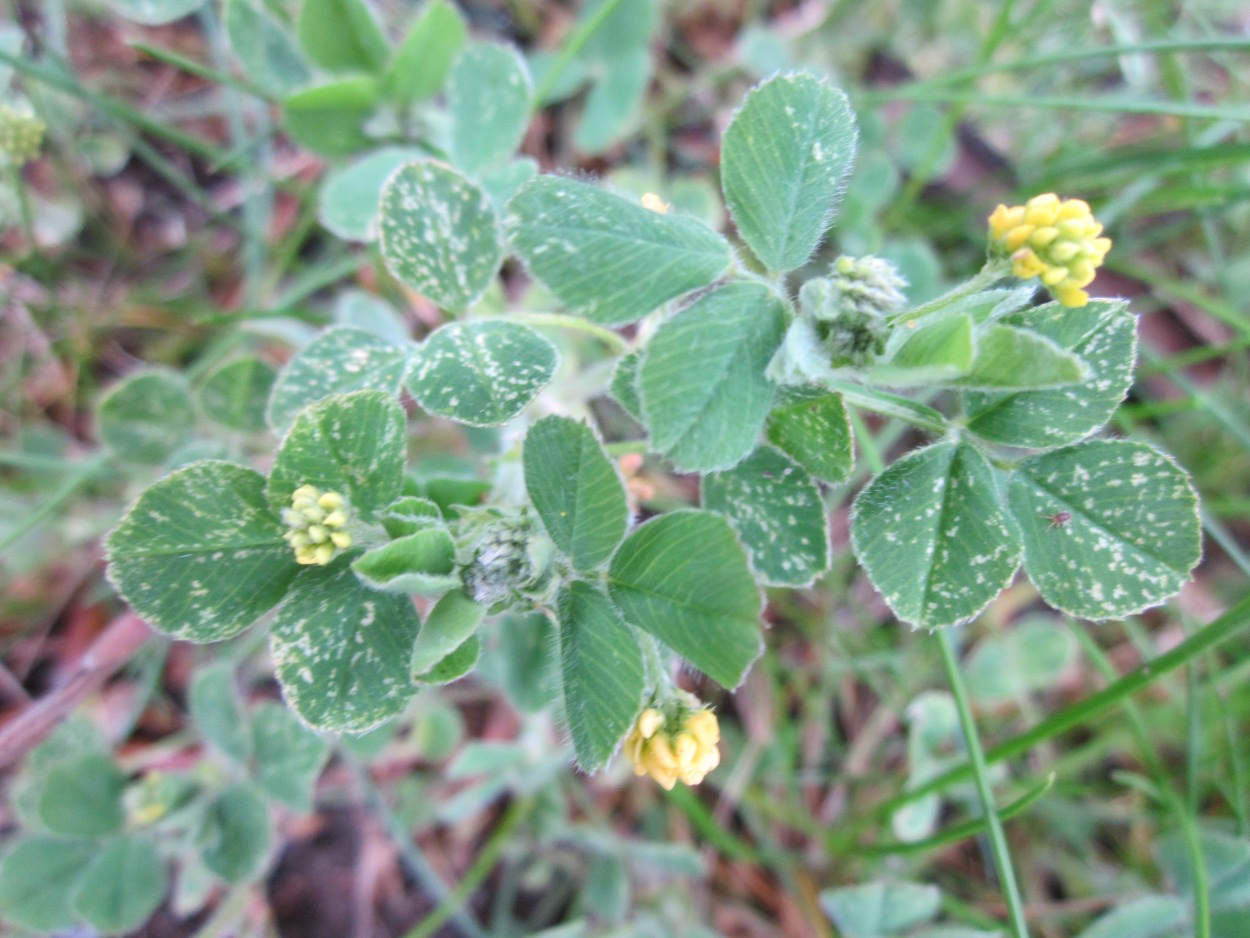

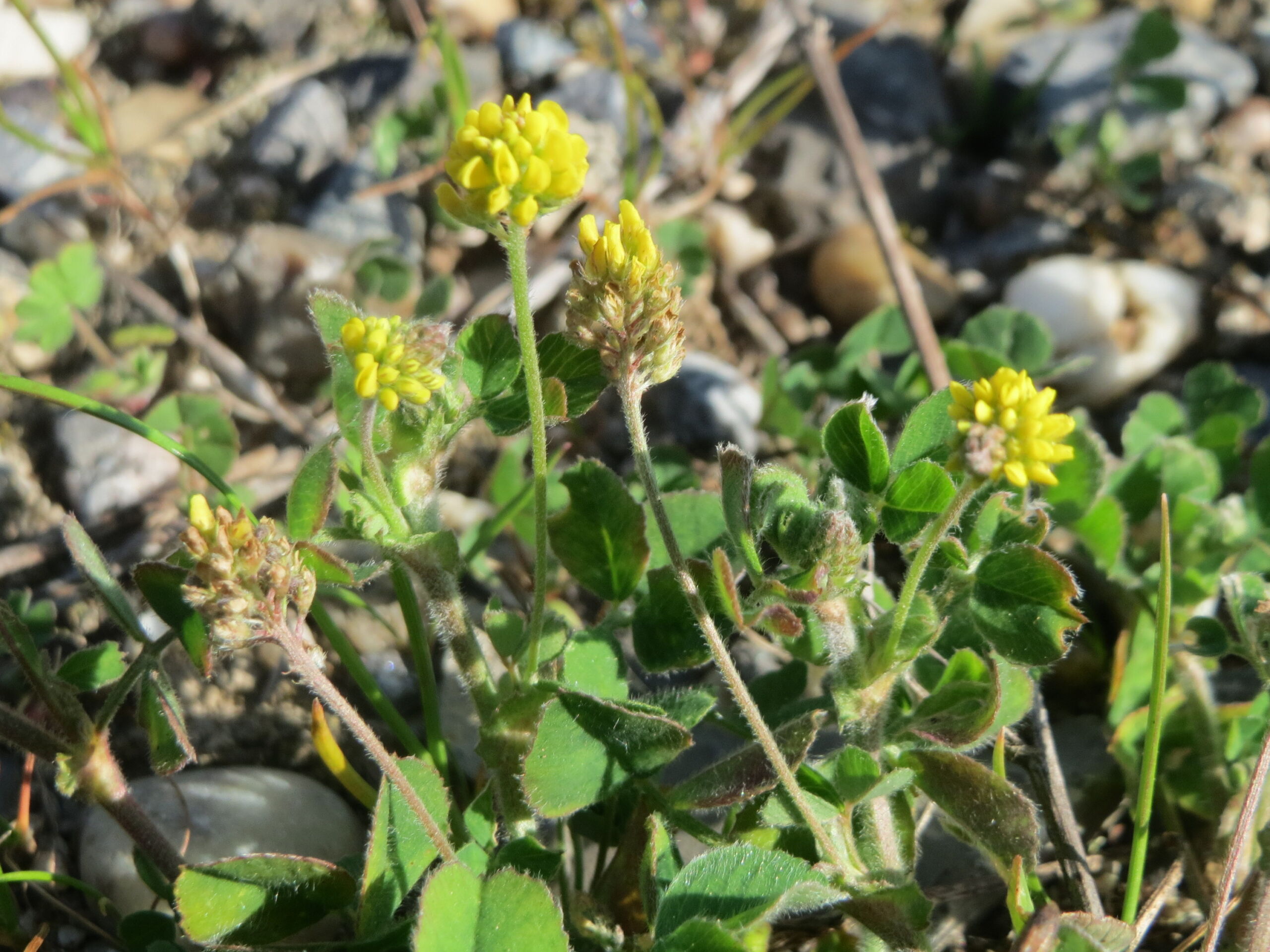
Picture a low, sprawling legume in a lawn, a meadow edge, or a crack in a dry path: fine stems that lie flat at first and then rise, branching from the base, carrying leaves of three oval leaflets each. The leaflets are hairy, toothed toward the tip, and each ends in a tiny point — and here is the field mark that separates black medick from every yellow-flowered clover it gets confused with: the center leaflet sits on a noticeably longer little stalk than the two side leaflets. That longer central petiole is the tell. Check it with your thumb and forefinger and you will never mistake this plant for a clover again.
The flowers are the second clue, and they are small enough to miss if you are walking fast: tiny yellow pea flowers, just 2–3 millimetres each, packed into tight, compact bunches on stalks as long as or longer than the leaves, each bunch holding 10 to 40 flowers and reaching about a centimetre long on a big plant. The bunches look like miniature hop cones, which is where the old names hop clover and yellow trefoil come from — and the Latin name says the same thing, since lupulina means hop-like. After flowering, each flower makes a single-seeded pod, 1.5 to 3 millimetres across, kidney-shaped, veiny, and hard: green at first, then dark brown to black as it ripens, and it does not split open. One pod, one amber seed, black as a peppercorn. That black pod is the whole reason for the common name, and it is the reason the plant looks, late in the season, as if someone scattered tiny black beads through the lawn.
Black medick is an annual or short-lived perennial in the pea family (Fabaceae), native to Europe, northern Africa, and western Asia, and now naturalized across the temperate world, including throughout the United States, Canada, and much of South America. It is a plant of dry grassland, lawns, pastures, roadsides, and disturbed ground, and it thrives where the soil is poor and the competition is thin — which is why it shows up in lawns that are hungry for nitrogen. Like other legumes, its roots carry nodules hosting nitrogen-fixing bacteria, and a plant that survives more than one year can develop a deep taproot. A lawn full of black medick is not a lawn failing at random; it is a lawn telling you its nitrogen is low, and the medick, obligingly, is already fixing some of it.
The butterfly context is specific and small, and this guide claims exactly it. The Common Blue guide lists black medick (Medicago lupulina) in its Host plants section, among the low legumes its caterpillars eat. That is the one butterfly-guide mention this species unit covers: the common form “black medick” and the Latin form “Medicago lupulina“, in the Host plants section of the Common Blue guide. Nothing more is claimed for it, and no other butterfly guide is wired to it on that basis.
One plain-text disambiguation, because this is the most misidentified small yellow legume in the lawn, and because the confusion has consequences for a gardener trying to plant the right thing. Black medick is not a clover. True clovers are Trifolium species: lesser trefoil (Trifolium dubium) has pale yellow flowers and leaflets without the pointed tip, hop trefoil (Trifolium campestre) and large hop trefoil (Trifolium aureum) are its other hop-clover lookalikes, and in all of them the withered flowers stay on the head and hide the pods, while in black medick the flowers fall away and the black pods show. Yellow woodsorrel (Oxalis stricta) is another yellow-flowered lawn weed with three leaflets, but it is not a legume at all, and its leaves fold like a shamrock’s. Within its own genus, black medick differs from alfalfa (Medicago sativa), the tall perennial with violet, pink, or white flowers grown for forage, and from bur clover (Medicago polymorpha), whose coiled pods carry hooked spines. Buy and identify by Latin name and by the long-stalked center leaflet, and the lawn weeds sort themselves out.
How to grow
Here is the honest framing for this guide: almost nobody plants black medick on purpose as a garden crop, and this guide does not pretend otherwise. It is a wild legume, a lawn weed, a pasture plant, and a cover-crop curiosity, and the growing advice below is for the gardener who wants to understand it, tolerate it, or use it deliberately as a soil-building groundcover — not for anyone expecting a vegetable bed star. If you want it, the recipe is simple, because the plant is not fussy. Give it full sun — it does not grow in shady areas — and dry to moist, well-drained soil of sand, loam, or clay. It grows in alkaline, neutral, and mildly acidic conditions, does well in limestone soils and on coastal sand dunes, and is resistant to cold, found on mountains up to 1,800 metres. In other words, if your garden has a sunny, poor, dryish patch where grass struggles, black medick will already be considering moving in, and your job is less “how to grow it” than “whether to let it.”
For deliberate use, sow seed in spring into a sunny, thin, weedy-tolerant area — a meadow strip, a path edge, an orchard floor, or a lawn you are converting toward a lower-input sward — and let it sprawl. Plants reach 15 to 80 centimetres, stems prostrate to ascending, and a patch fills in as a low, yellow-flecked carpet through the warm months. It regenerates only by seed, so a patch that you mow before it sets pods will thin out, and a patch you let go to black pods will come back next year, which is either a feature or a complaint depending on your lawn standards. As a lawn component it has real virtues: it stays low, it flowers for pollinators (it is a good nectar source for bees), it fixes nitrogen, and it tolerates trampling and mowing better than many prettier plants. As a lawn weed it has one obvious vice: the black pods and the yellow flowers read as “weed” to anyone who wants a uniform green carpet, and no amount of nitrogen-fixation talk will change their mind. Both readings are correct. Choose yours and manage accordingly.
Florida note, stated plainly. Black medick is recorded throughout the United States, including the warm South, but it is a temperate dry-grassland plant, not a Florida native and not a plant this guide recommends Florida gardeners go out of their way to establish. In a Florida lawn it will behave as a cool-season, opportunistic legume of thin, sunny spots rather than as a reliable warm-season groundcover, and Florida gardeners who want the same nitrogen-fixing, pollinator-friendly groundcover job done by a native should look at the native legumes in this library — sunshine mimosa and the native clovers and vetches — rather than importing a Eurasian lawn weed on purpose. If black medick shows up in your lawn on its own, the useful response is not panic but a soil note: it is often a sign the soil is low in nitrogen, and feeding the lawn (or letting the medick do its quiet fixing work) addresses the cause rather than just the symptom.
Water & feeding
Water: little, once established. Black medick is a plant of dry to moist, well-drained soils that pioneers disturbed ground, and it sulks in shade and in soggy soil far more than it sulks in drought. In a lawn or meadow it takes whatever rain arrives and asks for nothing extra; in a deliberately sown patch, water to establish and then leave it alone. Overwatering a thin-soil legume mostly invites the grasses and weeds that outcompete it, which defeats the purpose of sowing it. If your medick patch is yellowing and thinning in summer, the usual cause is not thirst but shade, mowing before seed set, or soil so rich that taller plants have shaded it out — this is a poor-soil plant, and generosity is not its love language.
Feeding: none needed, and that is the point. Black medick fixes its own nitrogen through root nodules, trading plant sugars for bacterial nitrogen day after day, and it improves poor soil simply by growing in it. A compost topdressing will not hurt it, but heavy fertilizer mostly feeds its competitors and hides the very signal — low nitrogen — that the plant is indicating. The soil science here is the lawn story in miniature: a thin, hungry lawn invites legumes, legumes fix nitrogen, nitrogen levels rise, grasses thicken, and the legumes fade back. That cycle is not a failure; it is succession doing its job, and a gardener who understands it stops fighting the medick and starts reading it.
Common problems
- Mistaken identity. The classic problem. Lesser trefoil, hop trefoil, and yellow woodsorrel all share the lawn with black medick. Check the center leaflet’s longer stalk, the pointed leaflet tips, and the black, single-seeded pods that show after the flowers fall.
- Lawn-weed status. If you want a uniform lawn, black medick reads as a weed, full stop. Mow before pods set to reduce reseeding, feed the lawn to raise nitrogen, and overseed thin spots with grass rather than spraying a legume that is fixing nitrogen for free.
- Shade. Black medick does not grow in shady areas. A patch that vanishes under a tree is not diseased; it is sun-starved. Plant or tolerate it only in open sun.
- Over-enthusiasm as forage. It is sometimes used as a fodder plant and grazed by sheep, but its fodder value is limited and it is not very palatable to cattle. Do not plan a pasture around it.
- Edibility caveats. Leaves and flowers are sometimes eaten in small quantities, but this guide makes no recommendation to eat it: sources note variable bitterness and concerns about compounds found in Medicago species when seeds are eaten regularly. Admire it, let the bees work it, and leave the eating to the caterpillars.
Harvest
Black medick’s harvest is seed, soil, and butterflies — in that order, and none of them requires a basket. If you want seed, wait for the pods to turn black and hard, then strip the little kidney-shaped pods from the stems; each holds a single amber seed, and a handful of pods is a whole next year of plants. If you want the soil harvest, do nothing at all except let the plants grow, flower, and die back: the nitrogen fixed in their root nodules stays in the soil food web, and the organic matter of their stems feeds it further. And if you want the butterfly harvest, leave a sunny patch unsprayed and unmown through the caterpillar season, because the Common Blue caterpillars that eat this plant are the reason this guide exists in a butterfly library at all. A low yellow legume that feeds bees, fixes nitrogen, and raises blue butterflies is doing three jobs at once for a plant most people step on without noticing — which is, on reflection, a pretty good return on a weed.
Browse all plant & pest guides
Saving seeds
Black medick (Medicago lupulina) saves its own seed with embarrassing enthusiasm, so saving it yourself is mostly a matter of getting there before it does the job for you. The tiny yellow flower clusters give way to kidney-shaped pods, each holding a single seed, and they ripen unevenly through the season: one plant can carry green pods, half-ripe pods, and hard black ones all at once. Wait until the pods you want are black and hard, then pick them into a paper bag before they drop, because once they hit the soil they join a seed bank that will volunteer medick in that spot for years whether you invite it or not.
Rub the dried pods between your hands to free the small amber seeds, and winnow away the papery chaff with a gentle puff or a kitchen sieve. Then comes the medick trick: many of those seeds wear a hard coat that shrugs off water, which is how they survive so long in the soil. Nick each seed lightly with a nail file, or soak the batch overnight in warm water, and you will wake up a far higher share of them. Sow in place in spring or autumn, barely covered, and do not bury them deep — these are small seeds with small lunchboxes.
There are no F1 hybrid medicks lurking in the seed catalogues to catch you out, so seed saved from your own patch grows up recognizably black medick, even if individual plants vary a little. Stored seed is where sources disagree, and honestly: one study found roughly half the seed still germinating after five years in dry storage, while another found only a trace of viability after four years in granary conditions. The safe reading is to sow your saved seed within a season or two rather than banking on a decade in a jar. In Florida, dry the seed thoroughly first — our humidity will happily rehydrate it into mold — then store it airtight with a desiccant packet, cool and dark, labeled with the plant and the date.
Two cautions, both friendly. First, only let seed ripen where you actually want a medick colony, because a single plant can produce thousands of seeds and it will colonize thin lawns and bare beds with glee. Second, the seeds are edible but carry trypsin inhibitors that interfere with protein digestion, so sprout or parch them before eating, the way foragers traditionally did — raw is not the move. Bonus nerdy fact for the jar label: like its legume cousins, black medick teams up with nitrogen-fixing bacteria in root nodules, so the patch you save seed from has been quietly fertilizing its own neighborhood all season.
Species
Black medick is a single species, Medicago lupulina, and this guide covers that species only, in plain text. It is not a clover (Trifolium species), not alfalfa (Medicago sativa), and not bur clover (Medicago polymorpha); those relatives are named here so a reader can tell them apart, not claimed by this guide. No named garden varieties of black medick were verified for this guide; it is grown, where it is grown deliberately at all, as the straight species, and most plants a gardener meets will be wild or naturalized volunteers rather than catalog selections. Grow or tolerate the species, identify it by the long-stalked center leaflet and the black pods, and let the genus guide for clover and the species guide for alfalfa cover their own plants.