
🌼 Brachystigma
What it looks like
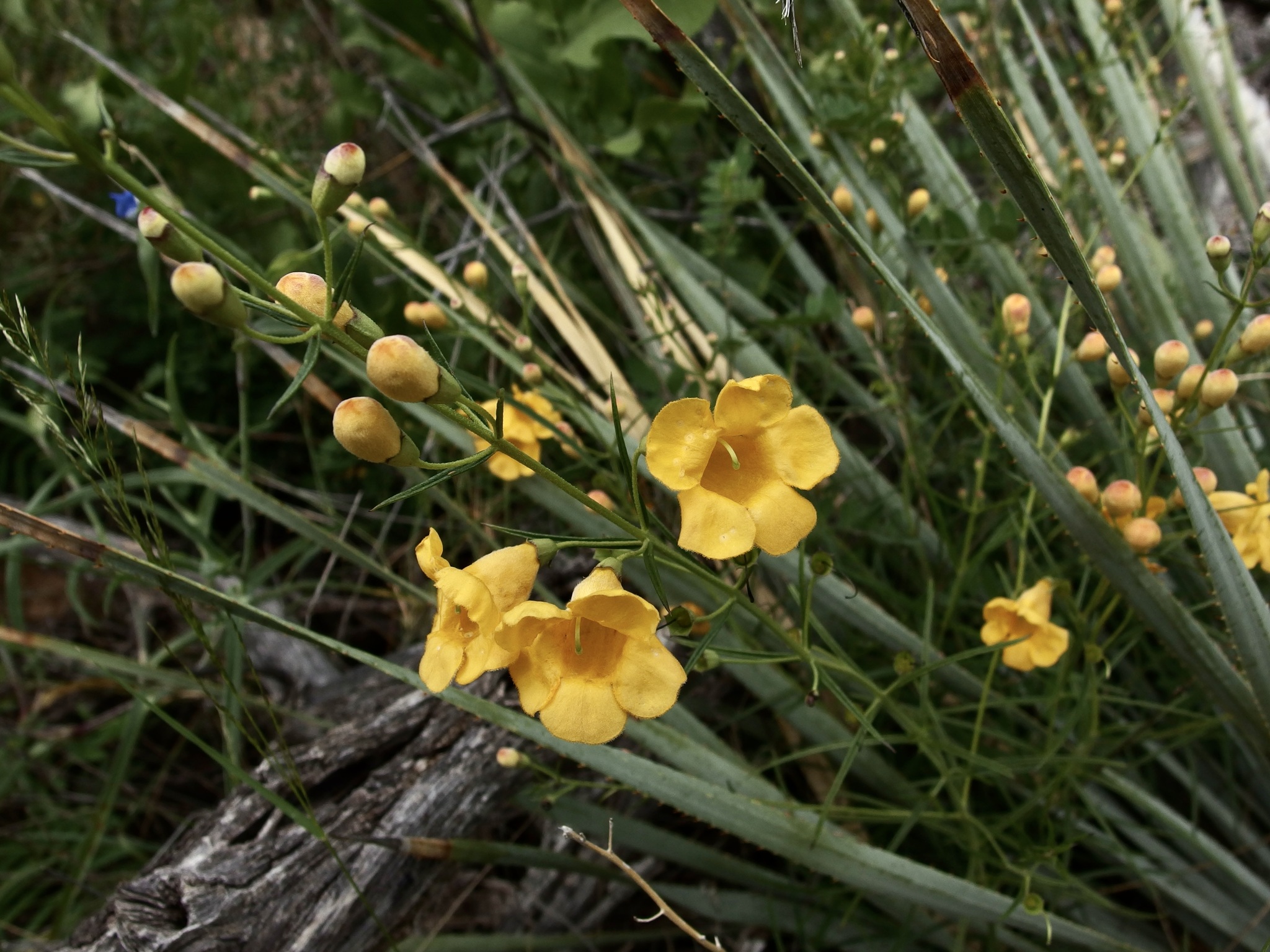
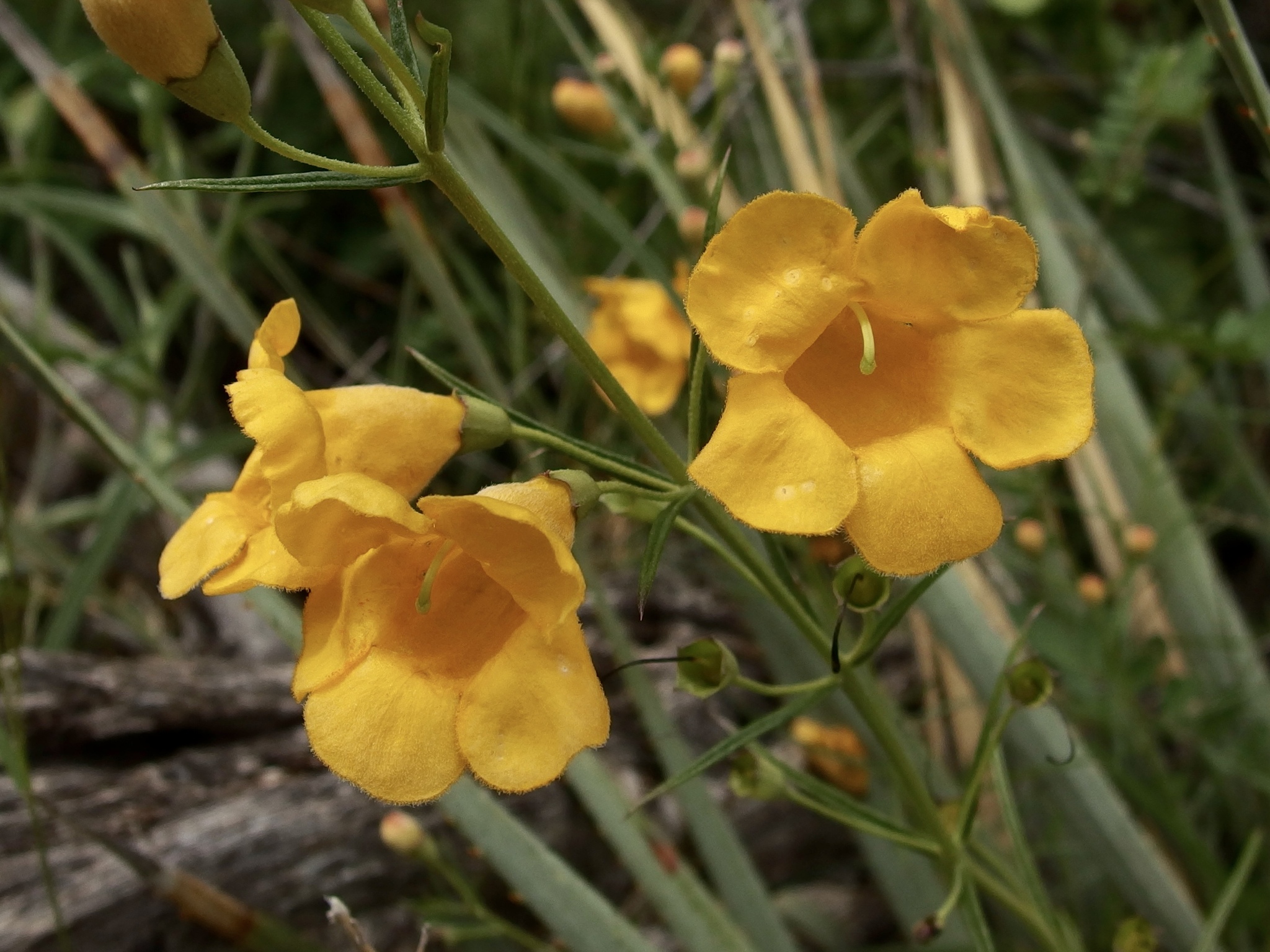
Picture a perennial herb or small subshrub, up to about 60 centimeters tall, rising from a large, woody caudex — a thick, woody base that anchors it to a dry slope — with several stems, simple or branched, carrying narrow, linear leaves that are often rolled inward along their edges and arranged opposite, alternate, or in whorls of three, so the foliage looks like a bundle of green needles with attitude. The flowers are the show: brownish-yellow or orange-yellow, tubular and bell-shaped, with a large corolla 15 to 25 millimeters long, a short tube, and a throat swollen on one side, carried in loose, leafy racemes on long stalks. In bloom, from August into September, the plant looks like a small foxglove that traded the cottage garden for a mountainside — which is exactly what its common name, Arizona desert foxglove, says it is.
Brachystigma is a genus of flowering plants in the broomrape family (Orobanchaceae), and it is a genus of exactly one species. That is not a rounding error or a checklist dispute: Brachystigma contains a single species, Brachystigma wrightii, and the genus guide and the species account are therefore the same plant wearing two hats. The species was first described as Gerardia wrightii by Asa Gray in 1859, from collections made by the botanist Charles Wright, and in 1928 Francis Whittier Pennell placed it in its own genus as Brachystigma wrightii. It has also traveled under the names Agalinis wrightii and Dasistoma wrightii, so a gardener chasing any of those names is hunting the same plant — they just changed its surname along the way, and this guide keeps the long-used Brachystigma, matching the butterfly guide that names it.
The family matters, because the broomrapes are the parasitic-plant family, and Brachystigma is probably a root parasite. The careful word is probably: regional flora treatments describe Brachystigma wrightii as probably root-parasitic, arising from that woody caudex with bristly, backward-pointing hairs on its stems, and most members of its family tap into the roots of neighboring plants for water and nutrients, either fully or partially. Whether this species leans fully on its hosts or merely supplements its own photosynthesis is not settled in the sources consulted for this guide, and this guide does not pretend otherwise. What is settled is the consequence: a plant that may need host roots is not a plant you buy in a pot and drop into a flower bed, and the honest growing advice for Brachystigma is mostly about leaving it where it grows.
The butterfly context for this genus guide is the Black Checkerspot guide, which lists, in its Host plants section, Brachystigma in Arizona, Seymeria in Mexico, and paintbrush (Castilleja). The Black Checkerspot (Chlosyne cyneas) is a rare butterfly in the United States, found in southeastern Arizona north from Mexico, living in mountain meadows and openings in ponderosa pine, oak, and pinyon woods — and Brachystigma’s range and habitat line up with that Arizona footprint exactly. The butterfly’s menu is written at the genus level in its own guide, and since the genus holds one species, the genus guide and the species story are one and the same. This guide claims Brachystigma wrightii as that single species, and no other plant.
How to grow
Growing Brachystigma starts with the only honest advice available: this is a wild plant of dry mountain slopes, not a garden plant, and there is no nursery trade, no cultivar list, and no tested garden recipe for it in the sources consulted for this guide. It grows on dry slopes, rocky mountainsides, and mesas, often among oaks, at elevations of roughly 5,000 to 7,500 feet, in Arizona’s Cochise, Graham, Pima, and Santa Cruz counties, in Hidalgo County in New Mexico, and south into Chihuahua and Sonora in northern Mexico. That is a high-desert, oak-chaparral address, and a plant from that address wants sun, thin rocky soil, summer rain, and winters at elevation — conditions a lowland garden cannot fake and a greenhouse rarely reproduces well.
If you are a gardener in its native range who wants to support the Black Checkerspot, the useful action is conservation, not cultivation. Do not dig wild plants: a plant with a woody caudex and possible host-root connections transplants badly, and removing it from a slope helps nobody, least of all the checkerspot caterpillars that were eating it. Protect the habitat instead — the oak openings, the meadow edges, the dry slopes where it grows — and support the land stewards who keep those slopes intact. Seed collection and propagation are not described in the sources consulted here, and this guide invents no protocol for them: a parasitic or probably-parasitic plant’s germination may depend on chemical signals from host roots, and sowing its seed into potting mix and hoping is a recipe for an empty pot and a false conclusion that the plant is ungrowable.
For the butterfly-watcher, the growing advice is really finding advice. Look for Brachystigma in late summer, in August and September when it flowers, on dry slopes among oaks at elevation, and look for its yellow, bell-shaped flowers and needle-like leaves — the combination is distinctive, and the narrow leaves that are not always opposite can mislead at first glance, so check the flower: the swollen-throated yellow bell is the giveaway. If you find it, you are standing in Black Checkerspot country, and the kindest thing you can do for both plant and butterfly is to admire them, photograph them, and leave them exactly where they are.
Florida note, stated in one line because the answer is that short. Brachystigma does not grow in Florida, is not native to Florida, and has no Florida garden role. Florida gardeners looking for checkerspot host plants should look to the paintbrushes and their relatives in their own region, not to a high-elevation Arizona slope plant.
Water & feeding
Water, for Brachystigma, is the dry-slope story. This is a plant of rocky mountainsides and mesas that receives its moisture as summer rain at elevation, in soil that drains fast and never stays wet. It does not want garden irrigation, rich soil, or mulch piled against its woody base, and in cultivation — where it essentially does not exist — the likeliest killer would be the same one that kills most desert plants in gardens: too much water, too much richness, and a root zone that never dries. The soil science here is the slope story: thin, rocky soil over a dry mountainside holds little organic matter and less water, and the plants that live there survive by going deep, going woody at the base, and, in this family’s case, possibly by borrowing from their neighbors’ roots. A Brachystigma’s roots live in that spare community, and its yearly growth returns little to the soil — it is a plant built for scarcity, not for abundance.
Feeding: none, and the very idea misunderstands the plant. If Brachystigma taps host roots, its fertilizer is its neighbor’s root system, not a bag from a garden center, and feeding it like a garden perennial would be both useless and beside the point. The right scale of feeding for a wild slope plant is zero — leave the slope alone, let the oaks drop their leaves, let the soil stay thin and dry, and let the plant do what it has done on those slopes without any help from us.
Common problems
- Trying to garden it. The most consequential problem in the genus. Brachystigma is a wild, probably root-parasitic slope plant with no garden protocol. The best cultivation is habitat protection, not a pot.
- Wild collection. Digging a plant with a woody caudex and possible host connections kills it and removes a checkerspot host. Never collect from the wild.
- Wrong name, wrong plant. Brachystigma wrightii has traveled as Gerardia wrightii, Agalinis wrightii, and Dasistoma wrightii. If you are chasing the plant under an old name, confirm you have the Arizona desert foxglove, not a different foxglove relative.
- Wrong region. A high-elevation Arizona and New Mexico plant will not thrive in a lowland or Florida garden. Check the range before you dream, and dream locally instead.
- Overwatering. The generic desert-plant killer. Dry slopes drain; garden beds do not. Wet feet on a slope plant mean rot.
- Assuming it is a foxglove. The common name says foxglove, but this is a broomrape relative, not a Digitalis, and its chemistry and ecology are its own. Do not eat it, brew it, or use it medicinally — no traditional use is documented in the sources consulted here, and the family is not a medicine cabinet.
- Caterpillar munching. Black Checkerspot caterpillars eat Brachystigma, and that is the point of the plant’s existence in this guide. A munched plant in the wild is a working host, not a problem.
Harvest
Brachystigma has no garden harvest, and this guide recommends none. There is no food use, no documented medicinal use in the sources consulted here, and no nursery crop to cut. Its harvest is sightings and stewardship: a late-summer walk on a dry oak slope at elevation, yellow bells against rock, and the knowledge that the plant you are looking at is the entire genus — one species, holding up a whole branch of the broomrape family tree all by itself — and that somewhere nearby, a rare black checkerspot may be laying the eggs that will become caterpillars eating those leaves. Leave the plant standing, leave the slope intact, and let the genus go on being one species strong. That is the crop, and it arrives without a single spray, because spraying a checkerspot host would kill the very thing the plant exists to feed.
Browse all plant & pest guides
Saving seeds
This section is going to disappoint anyone who came here with an envelope and a plan, and that disappointment is the point. Brachystigma is not a seed crop, and for this plant, saving seed means leaving it exactly where it is. Read on before you decide whether that sounds like a cop-out or like the most honest advice on this page.
Brachystigma is a genus of one. The entire genus is a single species, Brachystigma wrightii, Arizona desert foxglove, growing wild on dry mountain slopes among oaks at roughly five thousand to seven thousand five hundred feet in Arizona, New Mexico, and northern Mexico. It is not a garden-center plant. No nursery trade exists for it, no garden soil recipe exists for it, and this guide’s own advice is to leave wild populations alone and not transplant from the wild. A seed-saving guide that ignored all of that and handed out sowing instructions would be inventing a garden plant that does not exist.
Then there is the family problem. Brachystigma belongs to the broomrapes, the parasitic-plant family, and it is probably a root parasite, tapping into the roots of neighboring plants for water and nutrients. Whether it leans fully on its hosts or merely supplements its own photosynthesis is not settled in the sources consulted for this guide, and that uncertainty matters enormously for propagation. A seed dropped into a lone pot has no neighbor’s roots to tap, and a seedling that needs a host community will starve politely in sterile potting mix no matter how carefully you water it. That is very likely why no reliable garden propagation protocol exists for this plant: the protocol would have to include the whole slope, oaks and all.
The seed also has a job already, and it is not in your envelope. Brachystigma is the host of a rare checkerspot butterfly, and the seed that ripens on those dry slopes is next year’s foxglove and next year’s caterpillar food. Collecting wild seed from a single-species genus thins the very population you admire, and transplanting wild plants removes both the plant and its butterfly’s pantry. The conservation math here is simple and unforgiving: one genus, one species, one slope community, and no spare plants.
So what does saving Brachystigma seed actually look like? It looks like stewardship. Walk the slope in late summer, admire the yellow bells against the rock, photograph them, and leave every capsule on the plant. If a botanical garden or research program ever offers cultivated material through legitimate channels, that is the only ethical source, and even then you should expect mountain-slope conditions, a host community, and a great deal of humility, not a Florida garden bed. Some plants are saved by being grown. This one is saved by being left alone, and knowing which kind you are looking at is a gardening skill in its own right.
Species
Brachystigma holds one species, so this section is short, and honestly so. Brachystigma wrightii, Arizona desert foxglove, also called Wright’s foxglove, is the genus — a perennial herb or subshrub to about 60 centimeters, with narrow linear leaves, yellow to orange-yellow tubular bell flowers, and a range from southeastern Arizona and southwestern New Mexico into northern Mexico. Its synonyms Gerardia wrightii, Agalinis wrightii, and Dasistoma wrightii name the same plant under older classifications. There are no other Brachystigma species to list, no varieties to sort, and no sister species waiting in the wings — the genus is one plant, and this guide covers it whole.