
🌿 Bull Thistle
What it looks like
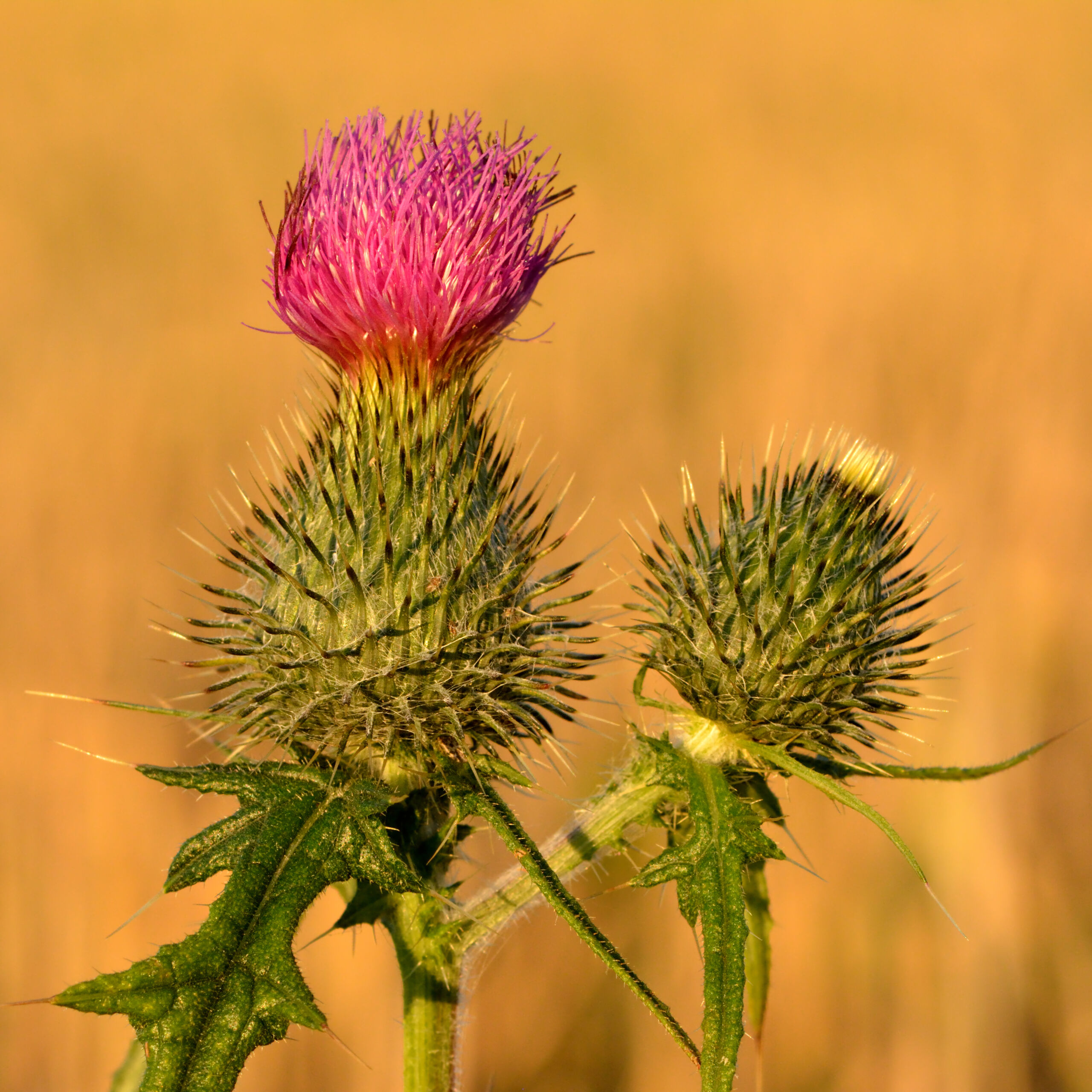
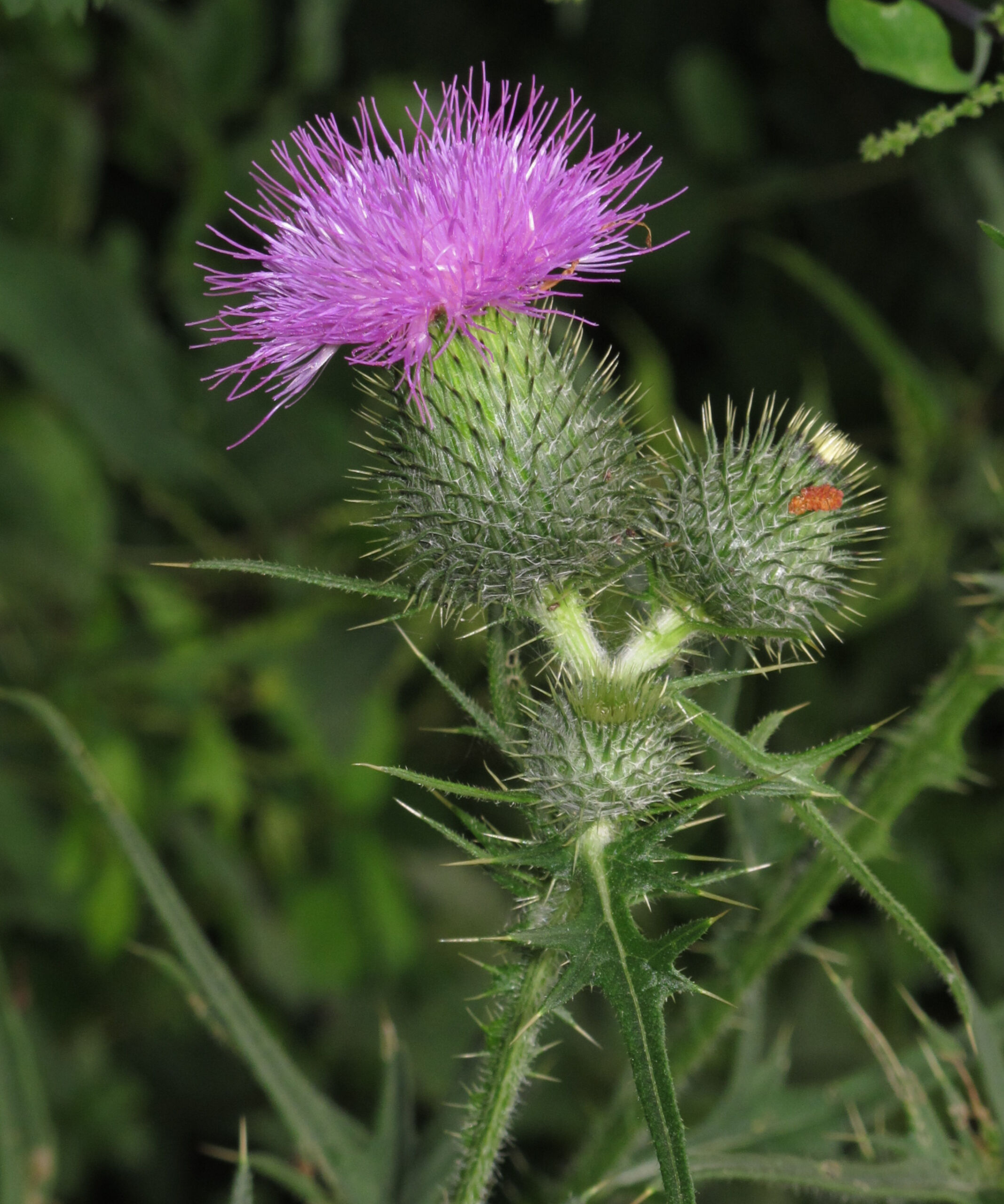
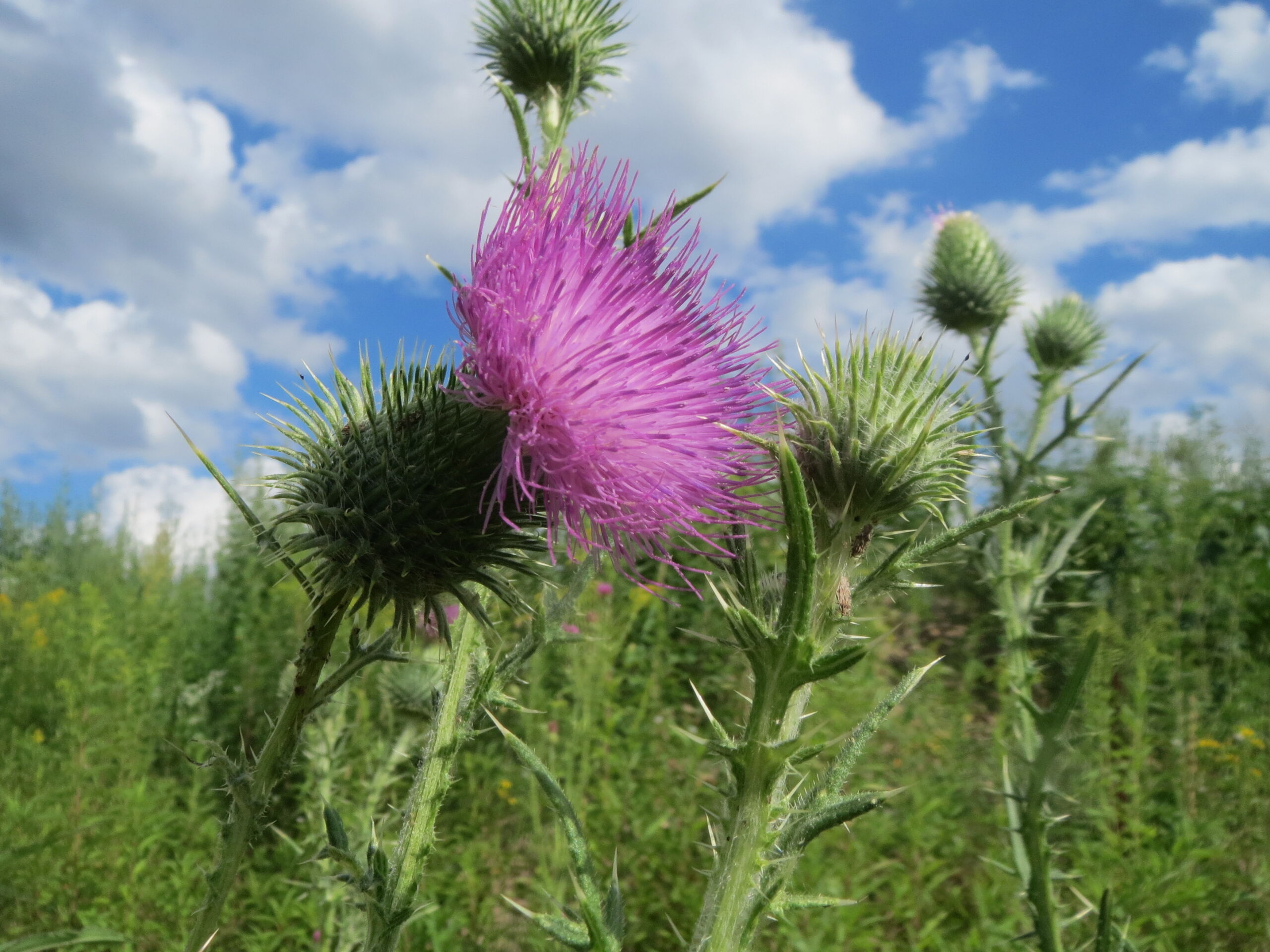
Bull thistle is the thistle most people picture when they hear the word thistle, and it earns that mental image honestly: it is big, it is spiny, and it is unmistakable once it flowers. Bull thistle, also called spear thistle or common thistle, is a biennial in the aster family (Asteraceae), in the genus Cirsium. In its first year it makes a flat basal rosette of deeply lobed, fiercely spiny leaves, hugging the ground and daring you to step on it barefoot. In its second year it bolts, sending up a stout, winged stem — winged because the leaf bases run down the stem as spiny flaps — to 3 to 6 feet tall, sometimes taller in rich ground, branching toward the top into a candelabra of flower heads. The whole plant bristles: stems, leaves, and the bracts cupping each flower head all carry sharp spines, and the field rule is simple — if you can grab it without gloves, it is probably not a bull thistle.
The flower is the payoff for all that armor. Each head is a globe of purple, 1 to 2 inches across, made of hundreds of slender tubular florets, ringed by overlapping bracts each tipped with a long, stiff spine. Bull thistle blooms from July into October, typically a few weeks after many other thistles have finished, which is part of its value to insects: it is still serving nectar and pollen when the summer buffet is thinning out. Bees, butterflies, and other pollinators work the heads hard, and goldfinches later work the seed heads harder still, prying out seeds and lining nests with the down. After flowering, each head ripens into a fluffy white seed head, and each seed carries a feathery pappus — a parachute — that floats it away on the wind. One plant can produce thousands of seeds, which is the first clue to why this plant is both a pollinator favorite and a weed-board headache.
Bull thistle is native to most of Europe, western Asia, and northwestern Africa, and it is now naturalized across North America, from coast to coast, as well as in other temperate regions. It is a plant of disturbed, open ground: pastures, roadsides, field edges, woodland openings, and anywhere the soil has been scraped, grazed, or otherwise opened up. It does not invade deep, undisturbed forest or a thick, healthy meadow so much as it colonizes the gaps, which is why a pasture that is overgrazed or a roadside that is mowed late will suddenly sprout a forest of rosettes. It has a deep taproot, which helps it survive dry spells and makes a second-year plant a genuine chore to pull — and which is why the rosette year is the year to deal with it, if dealing with it is the plan.
The butterfly context is specific, and this guide claims exactly it. The Pale Crescent guide lists, in its Host plants section, thistles (Cirsium), including bull thistle and Canada thistle, as the caterpillar food of that western crescent butterfly. That is the one butterfly-guide mention this species unit covers: the common form “bull thistle” in the Host plants section of the Pale Crescent guide. The genus form “thistles” in that same sentence is covered by the site’s genus thistle guide, not by this species guide, and Canada thistle (Cirsium arvense) is a different species with its own problems and is not covered here either. One mention, one species, claimed plainly.
One plain-text disambiguation, because thistles are a genus full of lookalikes and the stakes of confusing them are real. Bull thistle is not Canada thistle (Cirsium arvense), the perennial, creeping-rooted thistle that spreads by underground stems and is listed as noxious in even more states; Canada thistle’s heads are smaller, its stems are not winged with spines in the same way, and pulling it without getting the roots just makes more of it. Bull thistle is not milk thistle (Silybum marianum), the white-veined medicinal thistle with its own guide. And bull thistle is not any of the native thistles it most resembles and most often gets killed for — tall thistle, field thistle, swamp thistle, and their kin, which are the thistles a butterfly gardener actually wants to keep. The genus thistle guide covers the genus and names those natives; this guide covers bull thistle only, and the difference matters every time a mower or a sprayer is aimed at a thistle patch. Check before you pull.
How to grow
Here is the honest framing for this guide, stated up front because it shapes everything that follows: this is not a plant this guide recommends planting. Bull thistle is listed as a noxious weed in numerous states, it is invasive in many regions, and deliberately sowing it is, in much of its North American range, both ecologically unhelpful and in some jurisdictions unlawful. The growing advice below is therefore written for the gardener who already has it, wants to understand it, wants to manage it, or wants to tell it apart from the native thistles worth keeping — not for anyone shopping for seed. If you want thistles for butterflies, plant a native thistle of your region, from the genus guide’s list, and let the bull thistles be the ones that arrived uninvited.
What bull thistle wants, if it were wanted, is almost nothing: full sun, open ground, and disturbance. It grows in pastures, roadsides, and waste places in a wide range of soils, and it is at its happiest where grass is thin, grazing is heavy, or soil has been turned. Seed germinates in spring or fall, the rosette overwinters, and the flowering stalk rises the following summer. It needs no feeding, no watering beyond rainfall, and no coddling of any kind; a plant that thrives on neglect in a roadside ditch is not a plant that needs a gardener’s help. That toughness is the point of the management advice, too: a healthy, thick sward of grass or a dense native meadow is the best defense against it, because bull thistle colonizes gaps, and a garden with no gaps has nowhere for a rosette to start.
Florida note, stated plainly. Bull thistle is not a Florida native and not a plant Florida gardeners should establish. The Pale Crescent butterfly that eats it is a western butterfly, not a Florida butterfly, so there is no Florida butterfly reason to keep a bull thistle either. In Florida, the thistle story belongs to the native yellow thistle and its kin, which feed local butterflies and belong in the landscape; a spiny biennial from Europe that seeds itself by the thousand into pastures is not doing that job, and it is not doing any other job a Florida garden needs. If one appears in a Florida garden, treat it as a weed to remove in its rosette year, before it bolts and seeds, and plant a native thistle if the goal is butterflies.
Water & feeding
Water: rainfall, and that is plenty. Bull thistle is a plant of open, often dryish disturbed ground, and its deep taproot carries it through dry spells that would finish a shallower plant. It tolerates moist ground too, but it does not need irrigation, and watering a patch of bull thistle is a strange way to spend a summer. If a bull thistle patch is thriving in your garden, water is not the problem and withholding water is not the cure; the cure is competition — thick grass, dense planting, and no bare soil — plus removal before seed set.
Feeding: none, and again, that is the point. Bull thistle builds its 3-to-6-foot spiny tower out of poor soil and sunshine, and fertilizing it mostly produces a bigger, spikier problem. The soil science here is the disturbance story: bare, low-competition soil invites pioneer plants, pioneers like bull thistle stabilize that soil and feed insects while they do it, and then, if the site is left alone, taller and longer-lived plants shade them out. A pasture full of bull thistle is not a pasture with a thistle problem in isolation; it is a pasture with a gap problem, an overgrazing problem, or a bare-soil problem, and the thistle is the symptom that happens to sting.
Common problems
- It is a listed noxious weed. The most consequential problem in this guide. Bull thistle is listed as noxious in numerous states and is invasive in many regions. Check your state and county listing before you do anything with it other than remove it, and never sow, share, or compost its seed heads.
- Seed rain. One plant produces thousands of wind-borne seeds. A plant left to go to seed is next year’s patch, and the year after that’s patch too. Cut or pull before the heads fluff out, and bag the heads if they have already started to open.
- Mistaken identity, in both directions. Native thistles get killed as bull thistle, and bull thistle gets kept as a native. Check the winged, spiny stem, the large spiny-bracted heads, and the biennial habit before deciding, and use the genus guide’s native list as the comparison.
- The taproot. A second-year plant’s deep taproot makes pulling a wrestling match, and a snapped root can regrow. Dig rosettes in year one, when the root is small, or cut flowering stalks at the base before seed set.
- Spines, obviously. Every part of this plant except the inside of a floret is armed. Wear thick gloves and long sleeves for any handling, and keep children and dogs away from a patch in flower — the spines are not decorative.
- Livestock and pasture. Bull thistle invades pastures, reduces forage, and is unpalatable when spiny. Grazing animals avoid it, which lets it seed undisturbed, which is how a few plants become a pasture problem. Mow or remove before flowering in pasture settings.
Harvest
Bull thistle’s harvest is butterflies, birds, and removal — in that order, and the last one is the one this guide most recommends. The pollinator harvest is real: leave a patch that is already flowering, away from pasture and property lines, through its bloom, and bees and butterflies will work it from July into October, when few other flowers are still going. The bird harvest follows: goldfinches and other seed-eaters pick the seed heads apart, and the down lines nests. But the harvest this guide endorses for a gardener is the removal harvest: rosettes dug in year one, flowering stalks cut before the seed heads fluff, heads bagged and trashed rather than composted, and the gap replanted with grass or a native thistle so the next rosette has nowhere to start. That is a harvest with a future in it — fewer thistles next year, more room for the natives that feed the same butterflies without the weed-board listing, and no spines in anyone’s ankle. A plant that feeds butterflies and then seeds itself by the thousand is a plant to admire at arm’s length, preferably with gloves on, and then to replace.
Browse all plant & pest guides
Propagation
Short version: do not propagate bull thistle on purpose. This section deliberately contains no germination instructions, because the plant does not need your help and your neighbours’ pastures do not need your experiment.
Bull thistle (Cirsium vulgare) is a non-native biennial from Eurasia that has spread across most of North America, and it is officially listed as a noxious weed in a number of US states, with further states restricting it as a weed seed. It is not a Florida Class I prohibited plant, and it is recorded in Florida, but its status elsewhere is the warning: where it establishes, it colonises disturbed ground, pastures, roadsides, and field edges, crowds out more useful plants, and earns its keep as a problem. Its spread is by seed alone — wind-borne seed from a single flower head travels a long way — which means every plant allowed to set seed is a new infestation downwind.
The useful work with bull thistle is removal, not multiplication. If you have it, cut plants down to the crown before the flowers produce seed, bag the flower heads rather than composting them, and keep cutting regrowth before it can flower. Established plants will not recover from crown cutting, which is why regular cultivation keeps it out of garden beds. If you want thistles for butterflies and birds — and bull thistle’s flowers are genuinely good for both — plant native thistles instead, which feed the same pollinators without the noxious-weed baggage. Enjoy bull thistle where it volunteers, photograph it, identify it, and then stop it seeding. That is the whole propagation advice, and it is the responsible kind.
Species
Bull thistle is a single species, Cirsium vulgare, and this guide covers that species only, in plain text. It is not Canada thistle (Cirsium arvense), not milk thistle (Silybum marianum), and not any of the native thistles named in the genus thistle guide — tall thistle (Cirsium altissimum), field thistle (Cirsium discolor), swamp thistle (Cirsium muticum), Carolina thistle (Cirsium carolinianum), or yellow thistle (Cirsium horridulum); those relatives are named here so a reader can tell them apart, not claimed by this guide. No named garden varieties of bull thistle were verified for this guide; it is a wild, self-sowing biennial, not a catalog plant, and this guide recommends native thistles, not bull thistle varieties, for butterfly gardens. Grow the natives, identify bull thistle by its winged spiny stem and big spiny heads, and manage it as the noxious weed it is listed as.