
🌿 Calico Flower
What it looks like
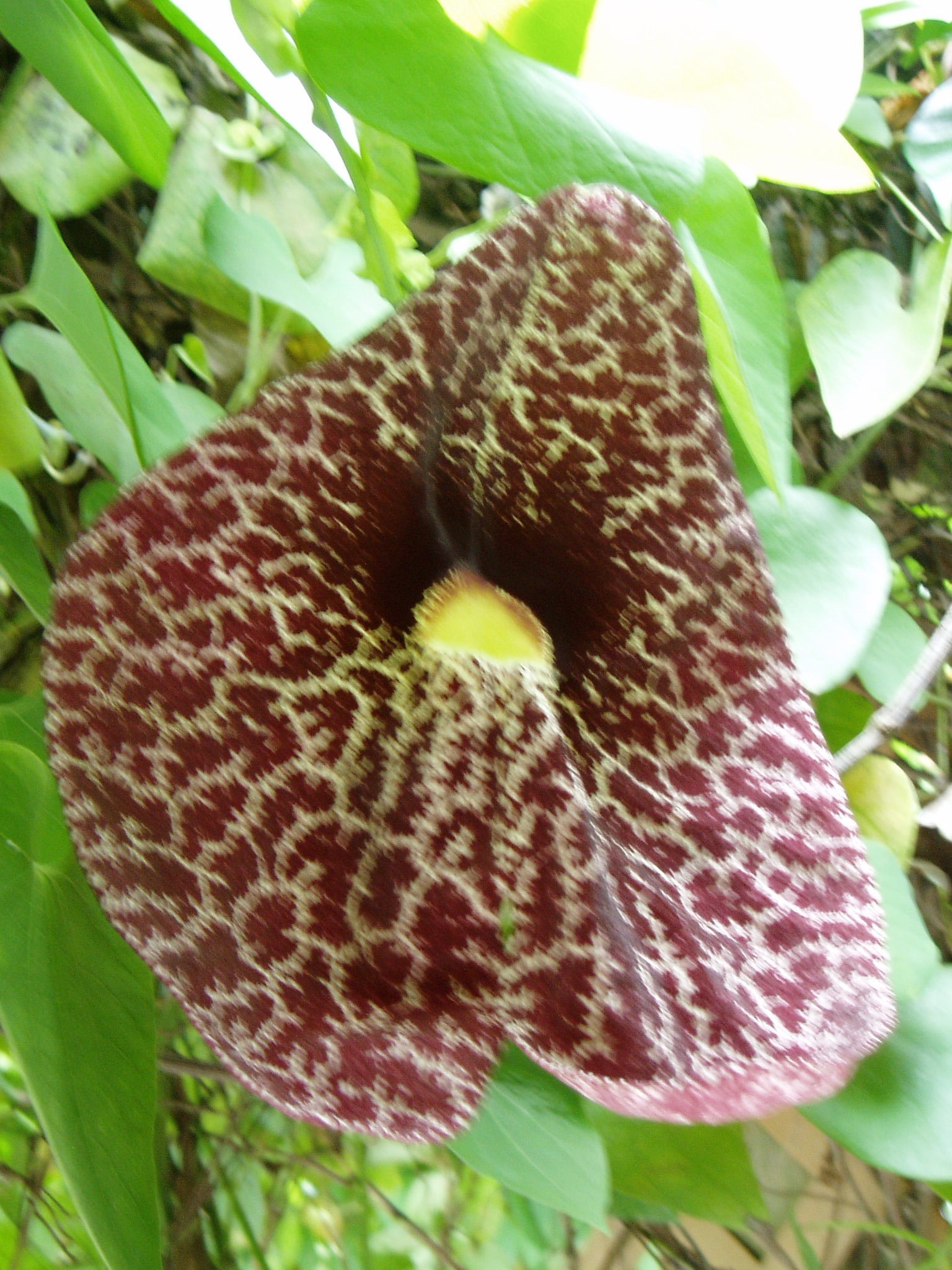
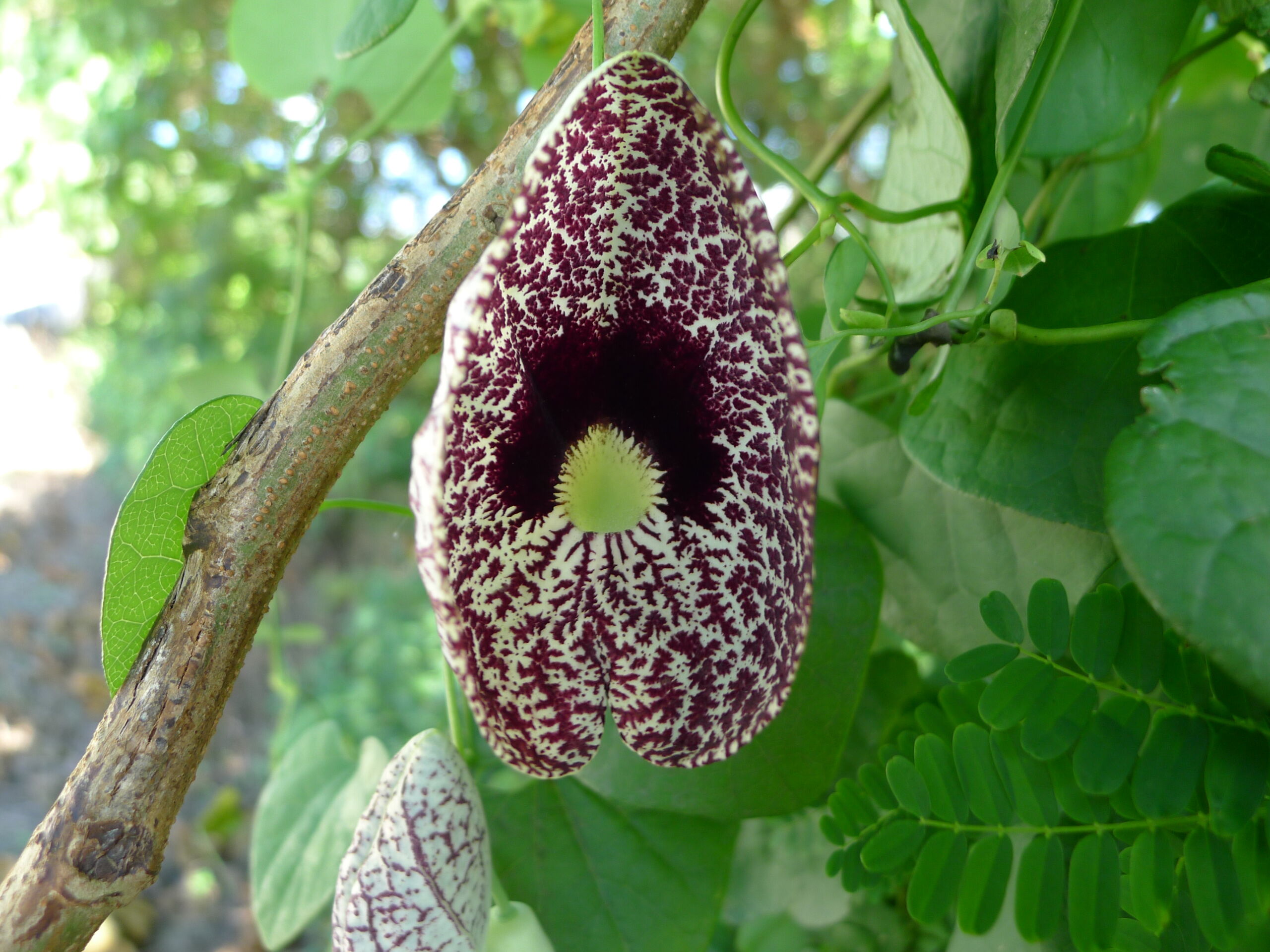
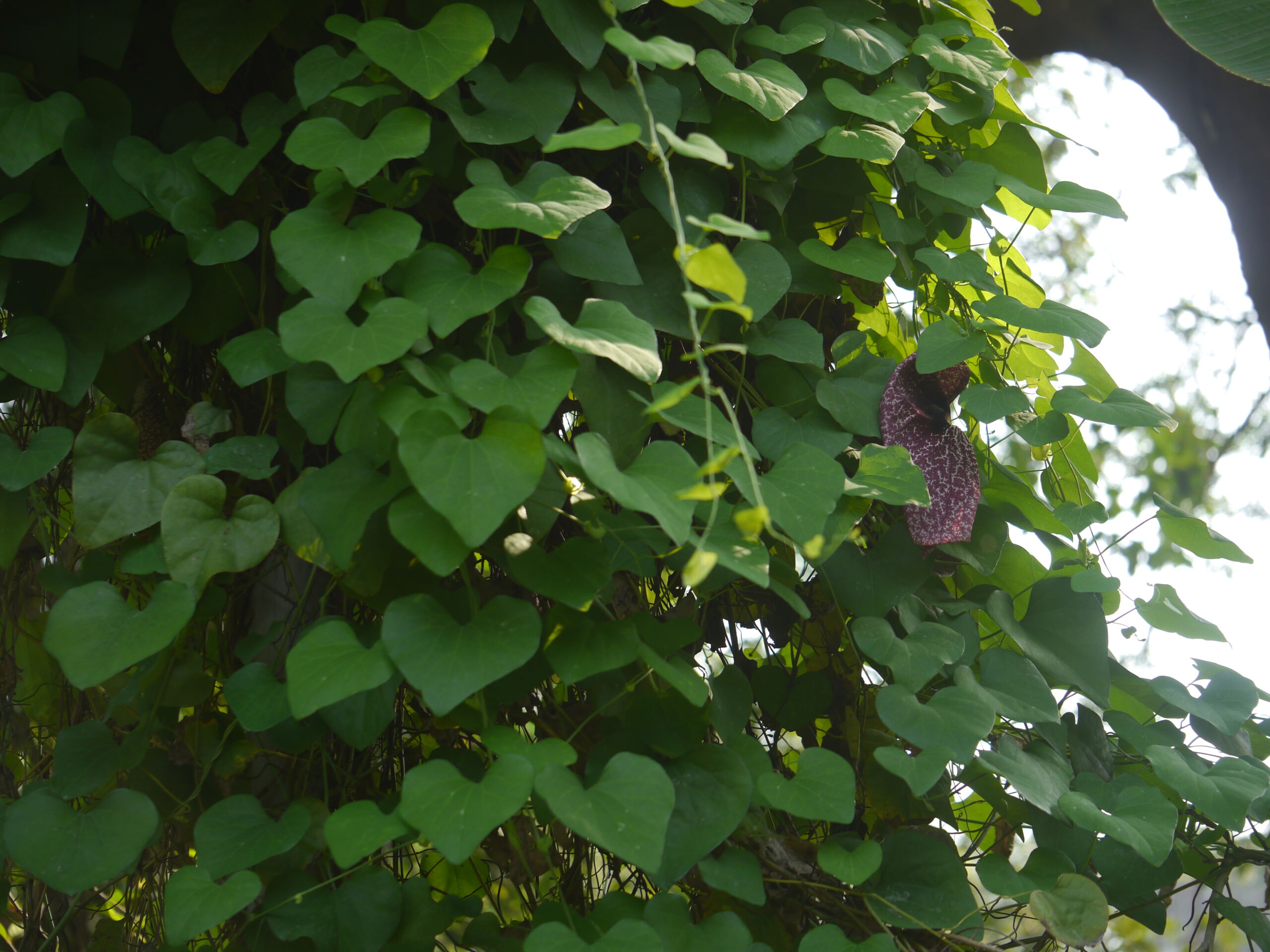
Calico flower is the plant that makes a butterfly gardener do a double take, and then — if they know the story — quietly put the catalog down. It is Aristolochia elegans, a perennial vine from Brazil in the birthwort family (Aristolochiaceae), and it is grown all over the warm world for one reason: the flower. The flower is a curved pipe, greenish-yellow at the tube and flaring into a broad, one-lobed limb patterned in purple-brown spots on a pale ground, like a scrap of printed calico fabric held up to the light. That spotted limb is the whole common name. The leaves are the other half of the identification: broadly triangular to kidney-shaped, heart-based, glossy green, a few centimetres across, carried alternately on slender twining stems, with large rounded false stipules hugging the young shoots. It is an evergreen vine in warm climates, fast-growing, twining in tight coils around wire, fence, or trellis, and capable of reaching about 3 metres and beyond when it is happy — which, in the tropics, it very often is.
Read the name carefully before you buy anything labelled like this, because the pipevine trade is a hall of mirrors. Calico flower is also sold as elegant Dutchman’s pipe, and it has been incorrectly called Aristolochia littoralis in the trade — a name that belongs to a different plant, so a label reading littoralis does not settle what you are holding. The flowers are produced through much of the year in warm climates, scattered among the drooping leaves rather than held up for display, and the vine’s habit is a dense mass of foliage that can smother a small support if it is not pruned. Where it escapes cultivation in tropical regions it is a serious weed, which is worth knowing before admiring its vigor: a plant that cheerfully outgrows its trellis in a greenhouse will cheerfully outgrow its welcome outdoors in a frost-free climate.
Now the part that matters, and the reason this guide exists in a butterfly project at all. Calico flower appears in the Pipevine Swallowtail guide’s Host plants section, in the exact forms “calico flower” and Aristolochia elegans, alongside the native pipevines. Appearing on a host list is not the same as being a good host, and for the pipevine swallowtail (Battus philenor) it is not. Female pipevine swallowtails are attracted to calico flower and lay eggs on it, but their caterpillars usually do not survive on it: the older literature reports larvae refusing the leaves or dying on them, and the plant is described in the butterfly literature as a death trap for pipevine swallowtail larvae. The mechanism is a mismatch, not a mystery — pipevine caterpillars evolved with the chemistry of North American pipevines, and the tropical chemistry of this Brazilian vine is not the chemistry their guts know how to handle. The plant is also a member of a genus whose species all contain aristolochic acids, compounds toxic to people and classified as carcinogenic, so no part of calico flower should ever be eaten, brewed, or used as a home remedy, whatever its old medicinal reputation says.
There is one honest complication, and this guide states it rather than smoothing it over, because a gardener in south Florida or south Texas may meet it. The polydamas swallowtail (Battus polydamas), a tropical cousin of the pipevine swallowtail, does tolerate calico flower: observers in Texas report polydamas caterpillars eating a calico flower vine down to the stems and the vine regrowing from its thick root, and entomologists note that polydamas caterpillars survive on several tropical pipevines that sicken pipevine swallowtail caterpillars. So the trap is specific, not universal: calico flower is a trap for the pipevine swallowtail, and a usable host for the polydamas swallowtail. That distinction does not rescue it as a general butterfly-garden recommendation — most gardeners planting a pipevine are planting it for pipevine swallowtails, and a plant that kills the caterpillars of the butterfly it attracts is worse than no pipevine at all — but it does explain why two gardeners can report opposite experiences with the same vine and both be telling the truth.
One plain-text disambiguation, because the pipevine names tangle badly and buying the wrong vine is exactly how the trap gets planted. This guide covers calico flower (Aristolochia elegans) only. It is not giant Dutchman’s pipe (Aristolochia gigantea), the Brazilian giant with enormous flowers that is likewise a trap for pipevine swallowtails. It is not California pipevine (Aristolochia californica), the northern California native with its own species guide in this project. It is not woolly pipevine (Aristolochia tomentosa), the fuzzy central and southern vine, and it is not Marsh’s pipevine (Aristolochia pentandra), the small south Florida pipevine. The site’s Aristolochia genus guide names calico flower as a plant not to plant for swallowtails, and this species guide is the fuller version of that warning, with the identification details that let you recognize the plant in a nursery before it goes home with you. Buy and plant pipevines by Latin name, species by species, and let this guide be the label-check, not a shopping list.
How to grow
How to grow calico flower is a short section with a long shadow, because the honest answer has two halves that pull in opposite directions. As an ornamental tropical vine, it is easy: give it a sturdy support, a light and airy position out of harsh direct sun, well-drained humus-rich soil, and warmth, and it will twine, leaf out densely, and flower through much of the year. It is evergreen where winters are frost-free, it roots from seed and from root fragments, and it wants the kind of care any vigorous tropical vine wants — a support built for the vine it will become rather than the seedling you planted, pruning to keep it off the roof and the neighbor’s shrubs, and a watchful eye in climates where it can escape, because a vine this vigorous does not stay politely where it is put. In a container or a greenhouse in a cold climate it can be grown as a curiosity, admired for the flower and kept away from any butterfly that might lay eggs on it.
As a butterfly-garden plant, the advice is the opposite, and it is the advice this guide actually wants you to take home: do not plant calico flower for pipevine swallowtails. If your goal is pipevine swallowtails, plant a native pipevine appropriate to your region, by its Latin name — California pipevine in northern California, woolly pipevine in the central and southern states where it is native, Dutchman’s pipe (Aristolochia macrophylla) in the eastern mountains, Marsh’s pipevine in south Florida — and let the butterflies lay on a plant their caterpillars evolved to eat. If you already have a calico flower vine and you also want pipevine swallowtails, the kindest reading is that the vine is an ornamental, not a host, and the swallowtail garden is the native vine you plant beside it, clearly labelled, so that the eggs land on the right leaves. Do not try to fix the trap by spraying, feeding, or pruning; the problem is the plant’s chemistry, and no amount of care changes which species it is.
Florida note, stated plainly because Florida is where the two swallowtail stories overlap. Calico flower is not a Florida native, and it is not a Florida butterfly-garden plant. In Florida, pipevine swallowtails fly statewide and polydamas swallowtails fly in the south, which means a calico flower vine in a Florida garden sits in the flight path of both — a trap for one, a host for the other, and a confusion for the gardener trying to help either. Florida gardeners who want pipevine swallowtails should grow the native pipevine of their region from nursery-grown stock, never from wild collection, and should treat any tropical pipevine sold for butterflies with the label-check this guide describes: Latin name first, common name second, and no sale without the first. A spectacular flower is not a reason to plant a trap, and in a state where the butterflies in question are already navigating habitat loss, the garden that helps is the one planted with the right species.
Water & feeding
Water, for calico flower as an ornamental, is the tropical-vine pattern: moist but never soggy, well-drained soil that holds some humus, watered when the top of the soil dries, and mulched to hold moisture in warm weather. It is not a desert plant and it is not a water plant; it wants the steady moisture of a warm garden bed or a large container, and it sulks — yellowing, thinning, dropping leaves — if it is left either bone-dry or waterlogged for long. In a greenhouse or a frost-free garden it largely waters itself in rainy weather and wants deep watering in dry spells, and a thick mulch helps enormously, holding moisture and cooling the roots in summer while feeding the soil life that keeps moist soil healthy rather than sour.
Feeding: modest, as with most vigorous vines. A spring topdressing of compost is the right scale — not a heavy fertilizer program, which mostly produces soft, leggy growth that flops off the trellis and needs even more pruning. The plant’s real fertilizer is warmth and a good root run: give it the heat it wants and a support it can climb, and it will do the rest, growing fast and flowering freely. None of this changes the butterfly advice, and this section says so on purpose: a well-fed, well-watered calico flower is still a calico flower, and its chemistry is still the wrong chemistry for pipevine swallowtail caterpillars. Good cultivation makes a better ornamental; it does not make a better host.
Common problems
- Planting it for pipevine swallowtails. The most consequential problem in this guide. Females lay eggs on calico flower and the caterpillars usually do not survive. Plant a native pipevine appropriate to your region instead, by Latin name.
- Misidentification in the trade. Sold as elegant Dutchman’s pipe, and sometimes mislabelled Aristolochia littoralis. Check the Latin name on the label, and if the label gives only a common name, do not buy it for butterflies.
- Escaping cultivation. A serious weed of the tropics where it escapes. In frost-free climates, keep it contained, prune hard, and never dump prunings where they can root.
- Toxicity. All parts contain aristolochic acids, toxic to people and pets and classified as carcinogenic. Plant where children and grazing animals will not sample it, and never eat, brew, or use any part medicinally.
- Frost. A frost-tender tropical vine. Cold-climate gardeners can grow it only under glass or as a container curiosity brought in for winter, and should keep it away from egg-laying swallowtails regardless.
- Vigor outrunning its support. A fast twiner that can smother a small trellis. Build for the mature vine, prune regularly, and keep it off roofs, gutters, and neighboring shrubs.
- Caterpillars eating it bare. Polydamas caterpillars may defoliate it completely, and the vine usually regrows from its thick root. That is polydamas success, not pipevine success — do not read a bare vine as proof the plant is safe for all swallowtails.
Harvest
Calico flower’s harvest is seed, cuttings, and identification skill — in that order, and with one firm boundary that this guide states twice because it matters. This is not a food or medicine plant, and no part of this guide recommends eating, brewing, or otherwise ingesting it: aristolochic acids are toxic and carcinogenic, and the traditional medicinal uses of pipevine relatives are history, not a reason to experiment. If you grow it as an ornamental, collect seed from the capsules when they ripen, and propagate from seed or cuttings, disposing of prunings responsibly in climates where the vine can escape rather than composting them where they might root.
The simplest harvest, though, is the one this guide was written to give you: the ability to walk into a nursery, read a pipevine label, and know whether you are looking at a host or a trap. A spotted, flared flower on a glossy, heart-leaved tropical vine labelled calico flower or elegant Dutchman’s pipe is Aristolochia elegans, and if pipevine swallowtails are your goal, it goes back on the bench. The native vine you take home instead — bought by its Latin name, planted on a sturdy support, left unsprayed for the caterpillars — is the harvest that matters, and it arrives without a single spray, because spraying it would kill the very thing you planted it for.
Browse all plant & pest guides
Propagation
Short version: do not propagate calico flower on purpose. This section deliberately contains no germination instructions, because this plant does not need your help and Florida’s natural areas do not need your experiment. Calico flower (Aristolochia elegans, also filed as A. littoralis) is a vigorous tropical vine from South America, and in Florida it is a FISC Category II invasive plant, recorded in the north, central, and south zones, with established wild populations in central and south Florida. UF/IFAS does not recommend it anywhere in the state. Its winged seeds germinate wherever they land, it climbs over native plants and can weigh them down until they collapse, and once established it is difficult to control, spreading by above- and below-ground stems that demand repeated removal.
There is a second reason, and it is the sadder one. Gardeners often plant tropical pipevines hoping to feed pipevine swallowtail caterpillars, but the caterpillars of the pipevine swallowtail cannot survive on tropical pipevines — they lay eggs on them and the larvae die after their first meals, poisoned by a toxin profile their bodies cannot handle. It is an ecological trap: a plant that looks like a host and acts like a grave. The polydamas swallowtail, a tropical cousin, can use it, but if your goal is pipevine swallowtails, this is the wrong vine. Plant a pipevine native to your region instead — in California, that is California pipevine itself — and let the butterflies have a host that actually feeds them.
The useful work with calico flower is removal, not multiplication. If you have it, cut it back hard, bag seed pods rather than composting them, and dig or repeatedly cut regrowth before it can flower and set its wind-borne seed. Do not share cuttings, do not scatter seed, and do not let a pretty flower talk you into an invasive vine. All Aristolochia species are also toxic to people if ingested — aristolochic acids are linked to kidney damage and cancer — so handle removal with gloves and keep trimmings away from children, pets, and livestock.
Varieties
No named garden varieties or cultivars of calico flower were verified for this guide. The plant is grown as the straight species, Aristolochia elegans, and its variation in flower spotting and vine vigor is the variation of a widely grown tropical species, not a catalog of cultivars. Its relatives are not varieties either: giant Dutchman’s pipe (Aristolochia gigantea) is a different, much larger-flowered Brazilian species and likewise a pipevine-swallowtail trap; California pipevine (Aristolochia californica), woolly pipevine (Aristolochia tomentosa), Dutchman’s pipe (Aristolochia macrophylla), and Marsh’s pipevine (Aristolochia pentandra) are different, native species with their own guides. Do not buy a pipevine on a common name alone, and do not accept littoralis on a label as proof of identity — buy the species by its Latin name, and buy the native species for butterflies.