
🌿 Canyon Liveforever
What it looks like

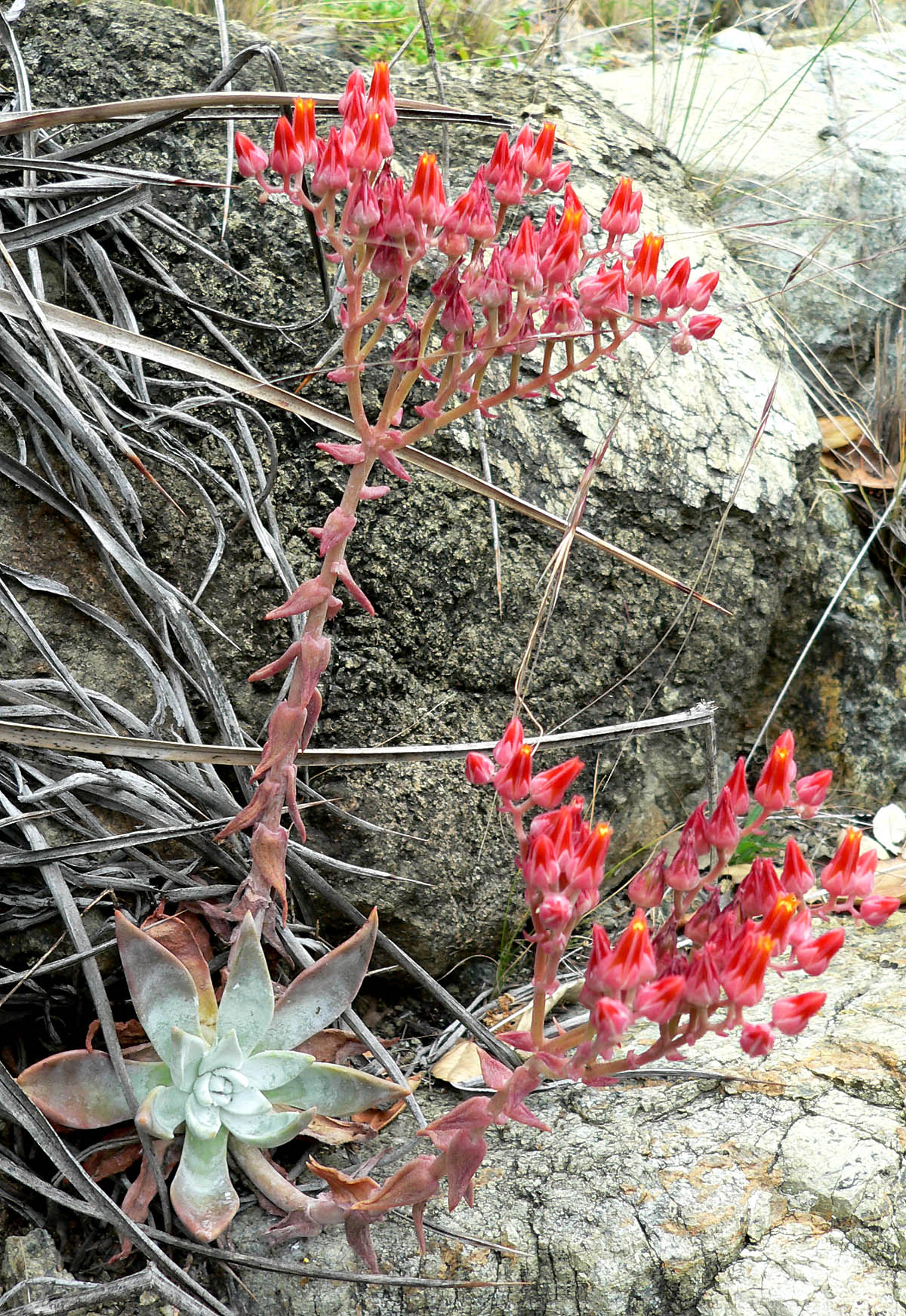

Canyon liveforever is a plant that looks like it was carved, not grown. It is Dudleya cymosa (Lem.) Britton & Rose, in the stonecrop family (Crassulaceae), a perennial low-growing succulent endemic to California, and it spends most of the year as a squat rosette of thick, fleshy, gray-green leaves — a stone flower on a cliff — and then, in spring, it does something startling: it sends up erect red-orange stems topped with clusters of small yellowish-red thimble-shaped flowers, bright enough to look, in the words of one field account, as if they were made of plastic, because of the thick waxy cuticle that helps the plant hold its water. The species name tells you the flower arrangement: cymosa means “in cymes”, and a cyme is a flowering shoot in which the first flower opens at the tip and the rest open from lateral buds beneath it. The common name tells you the plant’s reputation: a “liveforever” is a succulent that lives on neglect, on rock, on almost nothing, and seemingly forever.
But canyon liveforever is not one tidy plant, and this guide says so up front, because pretending otherwise is how gardeners buy the wrong dudleya. Dudleya cymosa is a species complex — described in the standard references as a loosely defined, polyphyletic species with a diverse number of subspecies, varying highly in morphology, distribution, and habitat. The subspecies that carries the common name “canyon liveforever” in the strict sense is Dudleya cymosa subsp. cymosa, the autonymous subspecies: a solitary or few-branched rosette succulent with broad leaves and bright yellow, orange, or red flowers, native to the California Coast Ranges, the Sierra Nevada, and the Santa Monica Mountains, commonly found on rocky outcrops, talus slopes, and in shaded canyons. Its rosettes are 6 to 20 centimetres across, of 6 to 25 leaves, each leaf 3 to 17 centimetres long, 10 to 60 millimetres wide, and 1 to 5 millimetres thick, ovate or deltate to oblanceolate or spatulate — spoon-shaped, in plain language — on a short caudex usually less than 5 centimetres long and 1 to 3.5 centimetres in diameter. The flowers’ calyx is 3 to 7 millimetres long, the petals 7 to 15 millimetres long and 2 to 4 millimetres wide, fused into a tube for 1 to 2.5 millimetres, with petal tips spreading at 45 to 90 degrees, colored yellow, orange, or red, sometimes glaucous along the midrib. Those numbers belong to subsp. cymosa; the species as a whole is wider, messier, and more variable, and any guide that gives a single height and spread for “Dudleya cymosa” without naming a subspecies is averaging across plants that live in different canyons.
The wider species ranges across California — the North Coast Ranges, Cascade Range, Sierra Nevada, Central Western California except the Central Coast, and the Transverse Ranges, with the subspecies cymosa form also reported from California into southwestern Oregon, from a few hundred to about 9,000 feet in elevation, in rocky areas, cliffs, and mountains, doing best in semi-arid places. Elevations of occurrence across the complex vary from 50 to 2700 metres, with significant differentiation among subspecies, each with a rather well-defined geographic distribution, usually associated with specific canyons within one or more mountain ranges. The leaves are classic Crassulaceae leaves: grayish-green, thick and fleshy, usually coming to a tip or point, sometimes flushed purple or red along the edges and tips in the driest conditions, sometimes coated with a fine white powder in the chalky forms. The rosettes do virtually all their growing from fall to spring, when temperatures are cool and water arrives as rain or even occasional snow; from spring to fall, the only moisture many wild plants receive is mist from a nearby fast-flowing river, if they are lucky enough to grow near one. A plant that grows in winter and rests in summer is a plant with a calendar opposite to a gardener’s, and that reversed calendar is the whole secret of growing it.
The butterfly context is one guide, with a host list that this species guide must share honestly with its siblings. The Sonoran Blue Butterfly guide, in its Host plants section, lists: Canyon liveforever (Dudleya cymosa), Lanceleaf liveforever (Dudleya lanceolata), Panamint liveforever (Dudleya saxosa), and other Dudleya species. This draft covers the first form only: “Canyon liveforever” and “Dudleya cymosa” in that section. It does not cover Lanceleaf liveforever or Panamint liveforever, which are separate species units, and it does not cover the genus-level form “other Dudleya species” or the bare “Dudleya” form — a species guide for one dudleya does not cover its genus, under the project’s hard rule, and the coordinator must not wire the genus form here. The species is separately recorded as the larval host plant for the Sonoran blue butterfly, Philotes sonorensis, in the butterfly family Lycaenidae, which is the same relationship the guide describes from the butterfly’s side: a small blue butterfly whose caterpillars eat dudleyas and little else, in the canyons where the dudleyas grow.
One plain-text disambiguation, because the liveforevers are a family of lookalikes and this guide must not swallow them. Canyon liveforever (Dudleya cymosa) is not Lanceleaf liveforever (Dudleya lanceolata) and not Panamint liveforever (Dudleya saxosa), although all three sit in the same Sonoran Blue host list and all three are California rock succulents with rosettes and red-orange flowers. Lanceleaf and Panamint are separate species units, and the differences between them and canyon liveforever — ploidy in one published comparison, elevation and range in others, leaf shape in the field — are species-level work, not something to blur in a species guide. Nor is canyon liveforever the genus Dudleya, which holds many more species than the three in this host list. Buy by Latin name, subspecies where it is given, and nursery-propagated stock only — a rule that matters more for dudleyas than for almost any other plant on this site, for reasons the growing section states plainly.
How to grow
Growing canyon liveforever starts with the calendar flip: this plant grows in the cool months and rests in the hot ones, and a gardener who waters it like a summer annual will rot it. In habitat, the rosettes grow from fall to spring, when temperatures are cool and water is regular, and from spring to fall they sit, mostly dry, on rock, waiting. In cultivation, the translation is: water in fall, winter, and spring, when the plant is growing, and back off hard in summer, when it is dormant — easily grown in dry, rocky, well-drained soils in full sun to part shade, tolerating full sun in cool coastal regions but preferring afternoon shade in warmer areas, drought tolerant, and not needing supplemental water in summer. One garden reference gives hardiness zones 6 to 10 for the species, and this guide reports that figure as one source’s range, not as a promise for every subspecies: a plant from a fog-belt canyon and a plant from an inland mountain slope do not share a zone, and the subspecies you buy matters more than the species zone on the tag. Rosettes run 4 to 6 inches across in garden descriptions, the plant offsets and multiplies by producing new rosettes, and it is a rock garden or container plant first and a bed plant never: it wants a crevice, a slope, a pot with drainage holes the size of a philosophy, and soil that dries between waterings.
Soil is the whole game. Sharp drainage is not a preference for dudleyas; it is the condition of their existence. Use a mineral, gritty mix — rock, pumice, coarse sand, and a little organic matter, not a moisture-holding potting soil — in a container with drainage, or in a rock garden pocket where water runs away rather than pooling. Wet feet kill it faster than drought ever will, and summer water on a dormant rosette is the classic way to lose one: the leaves go soft, the caudex rots, and the plant that survived a canyon summer on mist does not survive a garden summer on a sprinkler. Feed modestly or not at all: a spring topdressing of compost at the start of the growing season is the right scale, and a heavy fertilizer program mostly produces soft growth that rots. Plant it where its rosette can be seen — on a rock, at the edge of a wall, in a shallow bowl — because a dudleya buried in a lush bed is a dudleya about to be overwatered by its neighbors’ irrigation.
Propagation is by seed and by offsets, and both come with the same conservation rule, stated twice because it matters more here than anywhere else in this batch. Dudleyas have been poached from the wild at a scale that drew legislation: the California Native Plant Society sponsored a bill in the California legislature, AB 223, that provides protections for California’s dudleyas, making it unlawful to steal them from state, local, or private lands and sell them. Two subspecies of this very species — marcescens and ovatifolia — are federally listed as threatened species of the United States. Never take a dudleya from the wild, never buy one without a nursery-propagated provenance you trust, and be suspicious of any “canyon liveforever” offered cheap, bare-root, and without a nursery name. Offsets from your own nursery-propagated plant are the honest way to multiply it: detach a rosette, let the cut callus for days, set it on dry gritty mix, and water lightly only once it has rooted, in the growing season. Seed follows the same seasonal logic: sow in the cool growing season, on gritty mix, and do not drown it.
Florida note, stated flatly and without apology: this is a California endemic, and it is a poor Florida bet. Florida’s humidity, summer rain, warm nights, and summer-wet climate are the opposite of a canyon liveforever’s dry-summer dormancy, and a plant that wants a dry rest will rot in a Florida summer no matter how gritty the mix. This guide makes no Florida planting recommendation for it, and a Florida gardener who wants the look — a gray-green rosette succulent for a rock pocket — should plant a succulent adapted to Florida’s climate, not a California cliff plant. The Florida reader’s use for this guide is butterfly context and identification: the Sonoran Blue’s host, explained properly, with its subspecies, its lookalikes, and its poaching warning intact.
Water & feeding
Water, for canyon liveforever, is a seasonal question with a wrong answer in summer. Water in fall, winter, and spring, while the rosette is growing, letting the gritty mix dry between waterings; stop, or nearly stop, in summer, when the plant is dormant and its thick leaves are its water tank. The plant’s own physiology backs this up: as a Crassulaceae member, it is part of the family that lent its name to Crassulacean Acid Metabolism, or CAM, the process by which succulent plants open their stomata at night to take in carbon dioxide and conserve water, storing it as acid overnight and using it for photosynthesis by day. A CAM plant is a plant built to lose as little water as possible, and its thick waxy cuticle — the reason the flowers look plastic — is another layer of the same strategy. Watering a CAM succulent on a summer schedule designed for a leafy annual is not kindness; it is a drowning in slow motion.
Feeding: modest, once, at the start of growth. A light topdressing of compost in fall, as the growing season begins, is plenty; the plant’s yearly growth is a rosette and a flower stem, not a hedge, and it does not need a fertilizer program to make them. The soil science here is the rock-garden story: a mineral soil with little organic matter holds little water, warms fast, drains instantly, and hosts a spare, tough microbial community rather than a lush one — and a dudleya’s roots are built for exactly that community, storing energy in leaves and caudex through the dry months and spending it in a burst of spring flowering. Planting it in rich, moisture-holding soil is not feeding it; it is moving it to a climate its roots never evolved for, and the rot that follows is the plant telling you so.
Common problems
- Summer watering. The classic killer. A dormant dudleya in summer wants to be dry; water on a dormant rosette rots the caudex. Water in the cool growing season, rest it in summer.
- Wet, rich soil. Moisture-holding potting soil and a pot without drainage are a death sentence. Use a gritty, mineral mix and a container that drains, or a rock pocket where water runs away.
- Wild collection and poached stock. Dudleyas are protected in California, and two subspecies of this species are federally listed as threatened. Never take one from the wild; buy nursery-propagated stock from a named nursery, and distrust cheap, bare-root, provenance-free plants.
- Buying the wrong dudleya. Canyon, lanceleaf, and Panamint liveforevers look alike and sit in the same host list. Buy by Latin name and subspecies, not by “liveforever” on a tag.
- Assuming one zone fits the whole complex. Zones 6 to 10 is one source’s species range, not a subspecies promise. A fog-belt canyon plant and an inland slope plant do not share a garden, even under one species name.
- Overwatering by neighbors. A dudleya in a mixed bed gets its neighbors’ irrigation. Plant it alone, on rock or in its own pot, where its dry summer is actually dry.
- Caterpillar defoliation, in the butterfly’s favor. Sonoran blue caterpillars eat dudleya leaves, and that is the point of the host relationship. A healthy rosette recovers; do not spray the caterpillars on a plant you grew for the butterfly.
Harvest
The harvest of canyon liveforever is offsets, seed, and spring flowers — in that order, and with the conservation rule attached to every one of them. Offsets from a nursery-propagated plant, detached, callused, and rooted on dry gritty mix in the growing season, are the honest way to make more plants. Seed, sown in the cool season on gritty mix and watered lightly, is the slow way, and the patient way, and the way that respects the plant’s calendar. The flowers themselves are the show: erect red-orange stems with yellowish-red thimble flowers in a cyme, prized by hummingbirds and butterflies in the garden accounts, and the reason the plant is worth growing at all where it can be grown. Leave most rosettes standing through the season for the Sonoran blue caterpillars where they occur, let the flower stems rise in spring, and let the plant rest in summer without apology. That is the crop: a rock flower that grows in winter, blooms in spring, sleeps in summer, and asks for almost nothing except drainage, sun, and to be left where it was legitimately grown.
Browse all plant & pest guides
Saving seeds
Before anything else, a rule that is not negotiable: never collect canyon liveforever seed, cuttings, or plants from the wild. Dudleya poaching is a real and serious threat, and some populations and subspecies are rare or protected. Everything in this section assumes plants you already grow in your own garden, from nursery stock, not a cliff face you hiked to. Garden-grown plants give you all the seed you need without harming a wild colony, and that is the only way this should be done.
Canyon liveforever seed is dust. The flowers fade, the stalks dry to brown, and inside the tiny dried capsules sit seeds so small that handling them one by one is a fool’s errand. Cut whole dried stalks into a paper bag before they shatter, let them finish drying indoors, then shake and rub the bag to release the seed. Winnow out the chaff by pouring the mix gently from one container to another in a light breeze, or just sow the chaff along with the seed; for a succulent this size, a little debris in the tray is harmless. Do not try to store these seeds like beans for years on end. Dry them thoroughly, keep them cool, dark, and dry in a labeled envelope, and plan to sow them reasonably promptly, while they are fresh, rather than banking on a multi-year shelf life nobody can promise you.
Sowing is surface work, literally. Scatter the seed on top of a very gritty, free-draining mix, press it down gently so it makes contact, and do not bury it. Mist lightly to settle it in, then keep the tray bright but out of harsh direct sun, and barely moist rather than wet. Dudleya seedlings are tiny and slow, and the fastest way to lose them is rot, so air circulation and a gritty mix matter more than fertilizer or fussing. In Florida humidity, that warning doubles: keep seed trays where air moves, let the surface dry between light waterings, and never leave a tray sitting in a saucer of water. Prick seedlings out only once they are big enough to handle without crushing, and grow them on in the same gritty mix.
On growing true, here is the honest split. Seed from a single plant grown alone will usually give you plants that look like the parent species, but canyon liveforever is a species complex, and if several Dudleya are flowering together, bees can mix them, so seedlings from a mixed collection may vary or even be hybrids. That is part of the fun if you are raising species plants, and a problem if you are trying to preserve one particular subspecies. For an exact copy, skip seed entirely and use offsets, the small rosettes that form at the base of the parent. Twist or cut them off with a clean blade, let the wound callus for a day or two, then pot them in gritty mix. Leaf cuttings work too, with the same callus-first rule, but they are slower and less certain than offsets. Seed gives you numbers and surprises; offsets give you the same plant again. Use each for what it is good at.
Species
Dudleya cymosa is a species complex, so this section names its recognized subspecies rather than a list of separate species, in plain text. Dudleya cymosa subsp. cymosa is canyon liveforever in the strict sense, of the California Coast Ranges, Sierra Nevada, and Santa Monica Mountains, with broad leaves and bright yellow, orange, or red flowers. Dudleya cymosa subsp. agourensis is Agoura Hills dudleya. Dudleya cymosa subsp. crebrifolia is San Gabriel River dudleya. Dudleya cymosa subsp. costatifolia is Pierpoint Springs dudleya. Dudleya cymosa subsp. marcescens is Marcescent dudleya, federally listed as threatened. Dudleya cymosa subsp. ovatifolia is Santa Monica Mountains dudleya, federally listed as threatened. Dudleya cymosa subsp. paniculata is Diablo Range dudleya. Dudleya cymosa subsp. pumila is Transverse Ranges liveforever, also called low canyon dudleya and chalky canyon dudleya, with diamond to spoon-shaped leaves sometimes coated with a fine white powder, flowering May through July with bright red, orange, or yellow flowers. This guide covers Dudleya cymosa at species level for the butterfly’s “Canyon liveforever” form; it does not cover Lanceleaf liveforever (Dudleya lanceolata) or Panamint liveforever (Dudleya saxosa), which are separate species units, and it does not cover the genus Dudleya as a whole.