
🌿 Prairie Sedge
What it looks like
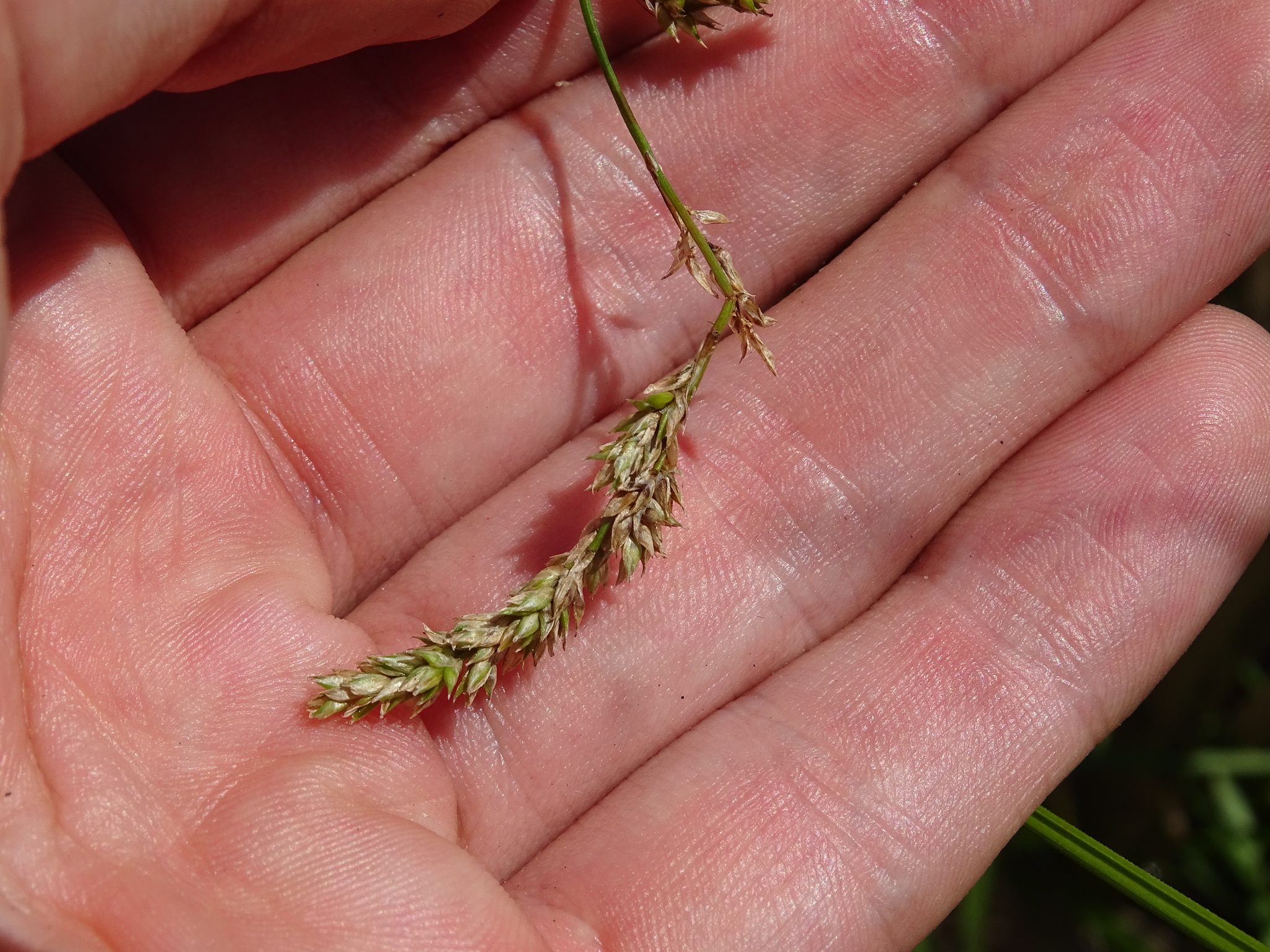
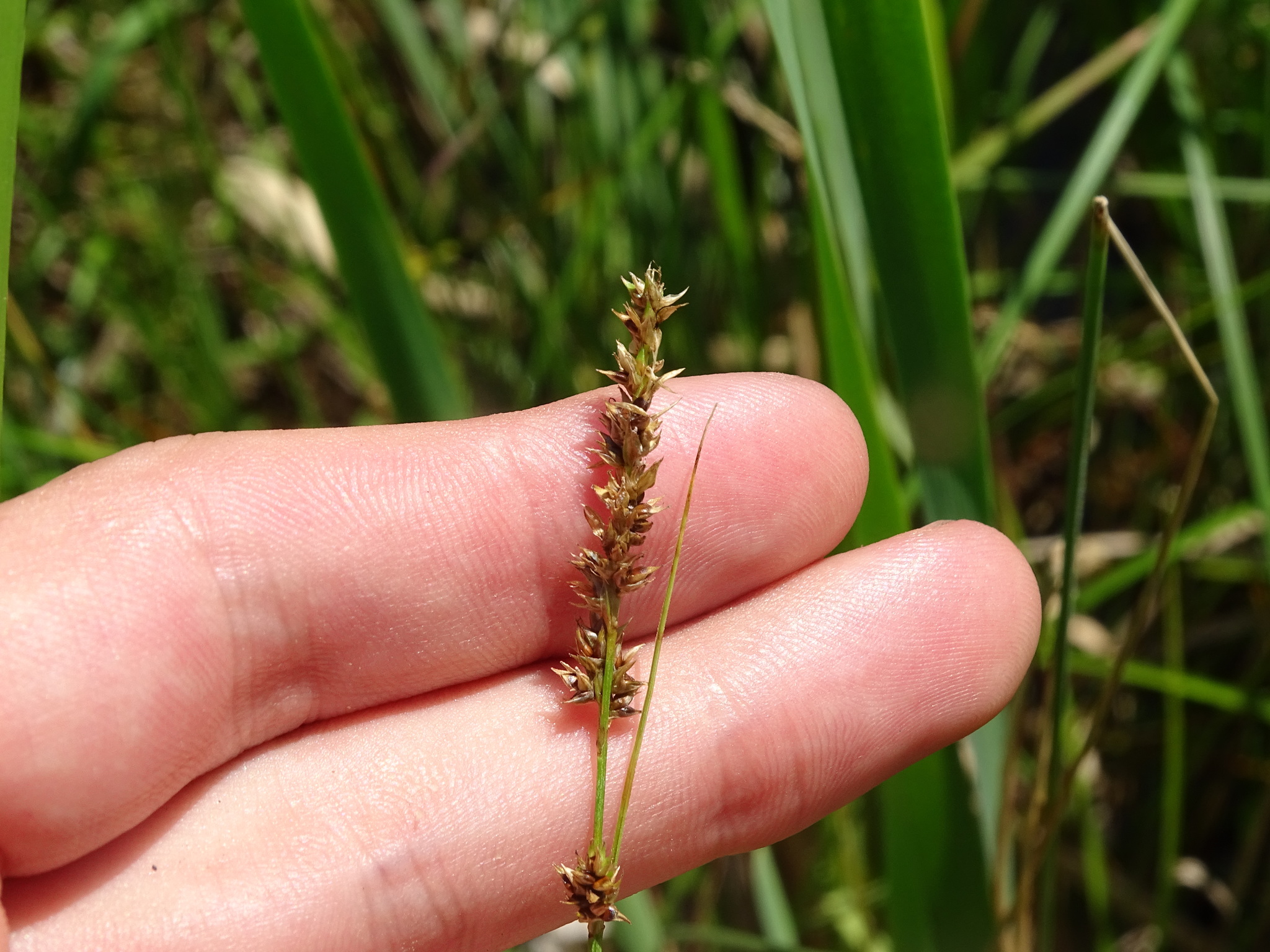
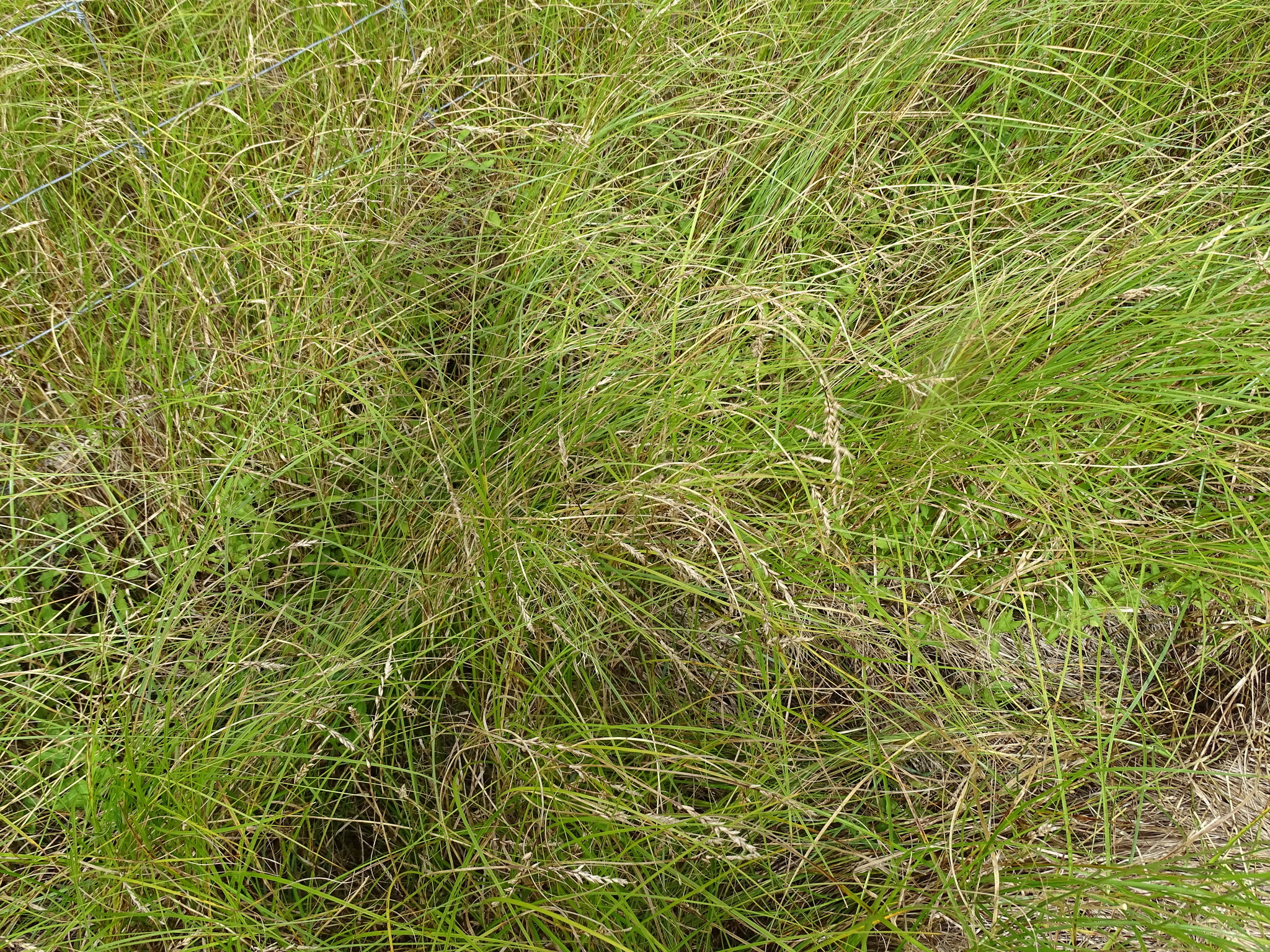
Prairie sedge is a sedge that builds furniture. It is a perennial of the sedge family (Cyperaceae), in the genus Carex, and it grows in dense clumps — tussocks — from short rhizomes, sometimes forming very large tussocks that rise above the wetland soil like grassy hassocks. The stems are erect, slender, three-sided, rough on the angles, roughly 30 to 60 centimeters tall in most floras and elongating to about 3 feet at maturity, and not every plant produces a flowering stem in a given year, which is a useful thing to know before you declare a colony dead. The leaves are basal and alternate, three to five on the lower quarter of the stem, only 1 to 3 millimeters wide and up to about 20 inches long, usually not overtopping the flowering stems, flat or V-shaped in cross-section when young, hairless, and wrapped at the base in a sheath that is not fibrous.
The sheath is the identification, and it is a beautiful one. In prairie sedge the leaf sheaths are distinctly copper-colored at the top — solid coppery-red, especially at the tip — and the tip of the sheath extends 2 to 8 millimeters above the leaf blade connection, like a little copper collar standing proud of the leaf. No other sedge in its fen quite does this, and it is the character that separates prairie sedge from its closest lookalike, the two-stamened sedge (Carex diandra), whose sheaths are white with coppery and white dots and whose inflorescence is more congested and straight where prairie sedge’s arches. The inflorescence itself is elongate, of several sessile, ascending spikes, overlapping above and separate and sometimes branched below, each spike only 3 to 6 millimeters long, with male flowers above and female below, or all female. The perigynia are ascending, lance-shaped, tan to brown, smooth, with serrated margins, 3 to 4 millimeters long tapering to a flattened, grooved beak 1.5 to 2 millimeters long, with two stigmas, and the achene inside is two-sided, filling the perigynium. Fruits ripen from late May into July, and by mid-summer the spikes are the color of the sheath: copper and tan, standing over the green tussock.
The habitat is the other half of the identification, because prairie sedge is a calciphile — a plant that indicates calcium-rich moisture the way a canary indicates a mine. It grows in fens, open swamps, and marshes in calcareous soils, in circumneutral fens, wet meadows, wet prairies, pond shores, drainage ditches, shores, and prairie swales, and it may be the dominant ground cover in some of those places. Its range runs from Quebec west to Alberta and the Yukon, south to New Jersey and Virginia on the East Coast, west to Nebraska and Montana — a northern plant of glaciated country, where the glaciers left limestone till and the groundwater runs hard. In Maine it is known from only a handful of towns and is listed as threatened there, for the simplest reason: scarcity of suitable habitat. Calcareous fens are rare, and a plant that only grows in them is rare by association, even though globally the species is assessed as Least Concern. That split — globally secure, locally threatened — is the whole conservation story of this sedge in one sentence.
The butterfly context is the Mitchell’s satyr story, and prairie sedge is one of its confirmed players. The Mitchell’s satyr guide lists, in its Host plants section, sedges including tussock sedge (Carex stricta) and other Carex species such as Carex buxbaumii, Carex lasiocarpa, Carex leptalea, Carex prairea, and Carex sterilis, plus bulrush in some records. The Mitchell’s satyr is a federally endangered butterfly of prairie fens and sedge meadows, and captive food-preference trials found that six Carex species — including this one — support normal larval development through to the third-instar diapause in August; separate foodplant studies also recorded larvae accepting prairie sedge directly. So the tussock you are looking at is not just a hummock. It is a nursery, and in the fens where the satyr still flies, it is one of the few nurseries the butterfly has left.
One plain-text disambiguation, because “prairie sedge” is a name with squatters. This guide covers Carex prairea only. The site’s Sedge genus guide lists prairie sedge among its group members, but a genus listing is not a species guide, and this guide is the species unit. The common name “prairie sedge” is also applied to Carex bicknellii in some regional lists — a different, upland prairie species — so buy by the Latin name Carex prairea and check the coppery sheaths. And do not confuse it with Carex diandra, its closest lookalike, which has dotted rather than solid-copper sheaths, a straighter and more congested inflorescence, and slightly smaller, more often dark brown perigynia. When in doubt, the sheath settles it: solid copper, standing above the leaf base, is prairea.
How to grow
Growing prairie sedge starts with two questions, not one: do you have wet ground, and is it calcareous? This is a fen plant, and fens are not just wet — they are fed by calcium-rich groundwater, and their plants are adapted to that chemistry. In a garden, the honest equivalents are a rain garden over limestone soils, a pond margin with hard water, a constructed calcareous fen edge, or a wet prairie restoration on glaciated, calcium-rich ground, in full sun to part shade. Plant nursery-propagated stock in spring into wet, organic, calcium-rich soil, and give each tussock room: these clumps grow large, and a tussock that has room to hummock will build the little hillocks that make a fen a fen, while a tussock crammed against a path will sulk. Do not plant it in acidic bog soil and expect fen performance; a calciphile in acid ground is a plant out of its element, and it will tell you so by fading.
Leave it alone after planting, beyond keeping aggressive competitors out until it is established. Prairie sedge forms dense clumps from short rhizomes and may form colonies, but it is not a runner like woollyfruit sedge; it is a builder, and builders work slowly. Do not mow it, do not divide it every year for tidiness, and do not drain the ground to make the patch more convenient. In a wet prairie or fen edge, the tussocks themselves become habitat — hummocks for other plants, shelter for invertebrates, and, where the satyr flies, food for caterpillars. The planting is the tussock field, not the individual plant, and a field of tussocks is a landscape, not a border.
Propagation is by division of the clumps in spring, which is straightforward: lift a tussock section with roots and shoots and replant into wet, calcareous ground at the same depth. Seed is the slower road: sow fresh seed in fall into moist soil and let winter stratify it, and expect seedlings to stay small for a season or more. Either way, the first year is establishment, and the second and third years are when the tussocks start to look like tussocks rather than tufts. Patience, water, and limestone are the whole program.
Florida note, stated plainly: prairie sedge is not a Florida plant. Its range runs south only to Virginia on the East Coast, and it belongs to northern calcareous fens and wet prairies, not to Florida gardens. Florida readers should take the Mitchell’s satyr lesson — protect the fens, plant the wetland sedges native to your own region — and leave this northern tussock builder to the glaciated country it belongs to.
Water & feeding
Water is the job, with a chemistry chaser. Prairie sedge wants wet ground that stays wet — saturated soil, seasonal standing water, a pond shore or fen edge that never fully dries — and it wants that water to be calcium-rich, as fen groundwater is. In a genuinely wet site with normal rainfall it largely waters itself once established. If the ground dries for weeks in summer, the tussocks thin and the colony tells you the site is wrong; if the ground is wet but acidic, the plant may persist without thriving, which is a quieter way of telling you the same thing. The soil life of wet, organic, calcium-rich ground — the microbes, fungi, and invertebrates that cycle nutrients in fen peat — is the plant’s feeding system, and it works slowly, which suits a plant that builds tussocks rather than racing.
Feeding: none from a bag. Do not fertilize a fen sedge. Fen plants live in nutrient-poor water by design, and added fertilizer mostly feeds algae and aggressive competitors that will outgrow the sedge. If a colony looks thin, check water first, check calcium second, and check competition third. Fix the water and the chemistry, and the tussocks will do the rest.
Common problems
- Drying out. The usual killer. A fen sedge in dry ground is on borrowed time. Site it wet, keep it wet, or pick a different sedge.
- Acid ground. A calciphile in an acidic bog is out of its element. If your water and soil are soft and acidic, this is the wrong sedge for the site.
- Wild collection. Never dig this plant from a fen or wet prairie. Calcareous fen habitat is rare, protected in many places, and slow to recover; in Maine and Pennsylvania the species itself is listed as threatened. Buy nursery-propagated stock, and only where the species is native.
- Name collisions. Prairie sedge also means Carex bicknellii in some lists. Buy by the Latin name Carex prairea and check the solid-copper sheaths.
- Lookalike confusion. Carex diandra has dotted sheaths and a straighter, more congested head. When in doubt, check the sheath: solid copper, standing above the leaf base, is prairea.
- Expecting a flower show. Sedge flowers are wind-pollinated spikes. The show here is the tussock field, the copper sheaths, and the hummocks — not petals.
Harvest
There is no food or medicine harvest here, and this guide recommends eating or brewing no part of the plant. The harvest is division in spring — lift a tussock section, replant into wet, calcareous ground — and seed in summer, sown fresh into moist soil in fall. The real harvest is a field of tussocks that holds a wet prairie together, shelters the invertebrates that live between the hummocks, and feeds, in the fens where it still flies, the caterpillars of one of North America’s rarest butterflies. Leave the wild tussocks standing, keep the calcium-rich water where it belongs, and let the copper-sheathed sedge build its hummocks in peace.
Saving seeds
A note on method first: the seed technique below is genus-level Carex practice, applied here because prairie sedge follows the same pattern as its relatives. And a boundary to match: propagate only garden-grown plants. Wild wet-prairie and fen colonies are habitat, not a nursery, so leave wild stands standing and work from plants already in cultivation.
The sedge version of a seed is a small nutlet tucked inside a perigynium, the little bottle-shaped sac that gives each spike its texture. Collect the spikes in summer, when the perigynia are ripe, dry, and easily detached, cutting whole spikes into a paper bag, not plastic, and letting them dry in a shady, airy spot. Once dry, rub the spikes gently to free the seed, and pick out the larger bits of stem and scale by hand. No water, no fermentation: sedge seed wants dry handling, and wet processing only invites mold.
Fresh seed is the best seed. Sow it in fall, on the surface of constantly moist mix or directly into wet ground where the plants are to grow, pressing it into contact with the soil rather than burying it, since many sedges germinate best with light. If you are holding seed over winter instead, give it a cold, moist stratification first: mix it with damp sand or sphagnum in a sealed bag in the refrigerator for several weeks. Sources range from about a month to six weeks or more, so treat a full six weeks as the safe end of the range, then sow into warmth, light, and unrelenting moisture. Germination after chilling typically takes a few weeks, and the seedlings must never dry out, not once, not briefly.
For storage, keep seed cool and dry in an airtight container with a desiccant packet, and sow it the following season rather than banking it for years; sedge seed viability in home storage is not well documented, and fresh seed outperforms old seed by a wide margin. Seedlings will resemble their parents in the broad strokes, since this is a wild species rather than a cultivar, but a seed-grown sedge is a genetic individual, not a photocopy. If you want an exact copy of a particular tussock, divide instead: in spring, lift a tussock section with roots and shoots attached and replant it straight into wet ground, keeping it soaked until it takes hold. Division is the reliable route, seed is the patient one, and a gardener planning a tussock field has room for both.
Browse all plant & pest guides
Species in this group
Prairie sedge (Carex prairea) — the species described in this guide, the tussock-forming calcareous fen sedge with solid-copper sheaths standing above the leaf bases.
Woollyfruit sedge (Carex lasiocarpa) — a colony-forming fen sedge with woolly perigynia, another Mitchell’s satyr host, covered by its own species guide, not by this one.
Bristly-stalked sedge (Carex leptalea) — a delicate single-spiked fen and swamp sedge, another Mitchell’s satyr host, covered by its own species guide, not by this one.
Dioecious sedge (Carex sterilis) — a dioecious calcareous fen sedge, another Mitchell’s satyr host, covered by its own species guide, not by this one.
Tussock sedge (Carex stricta) — the dominant sedge of many satyr fens, covered by the Sedge genus guide’s group listing, not by this guide.
Buxbaum’s sedge (Carex buxbaumii) — a northern fen and wet-meadow sedge, another tested Mitchell’s satyr food plant, not covered by this guide.
Two-stamened sedge (Carex diandra) — the closest lookalike, with dotted rather than solid-copper sheaths and a straighter, more congested inflorescence; not covered by this guide.