
🌿 Chestnut Oak
What it looks like
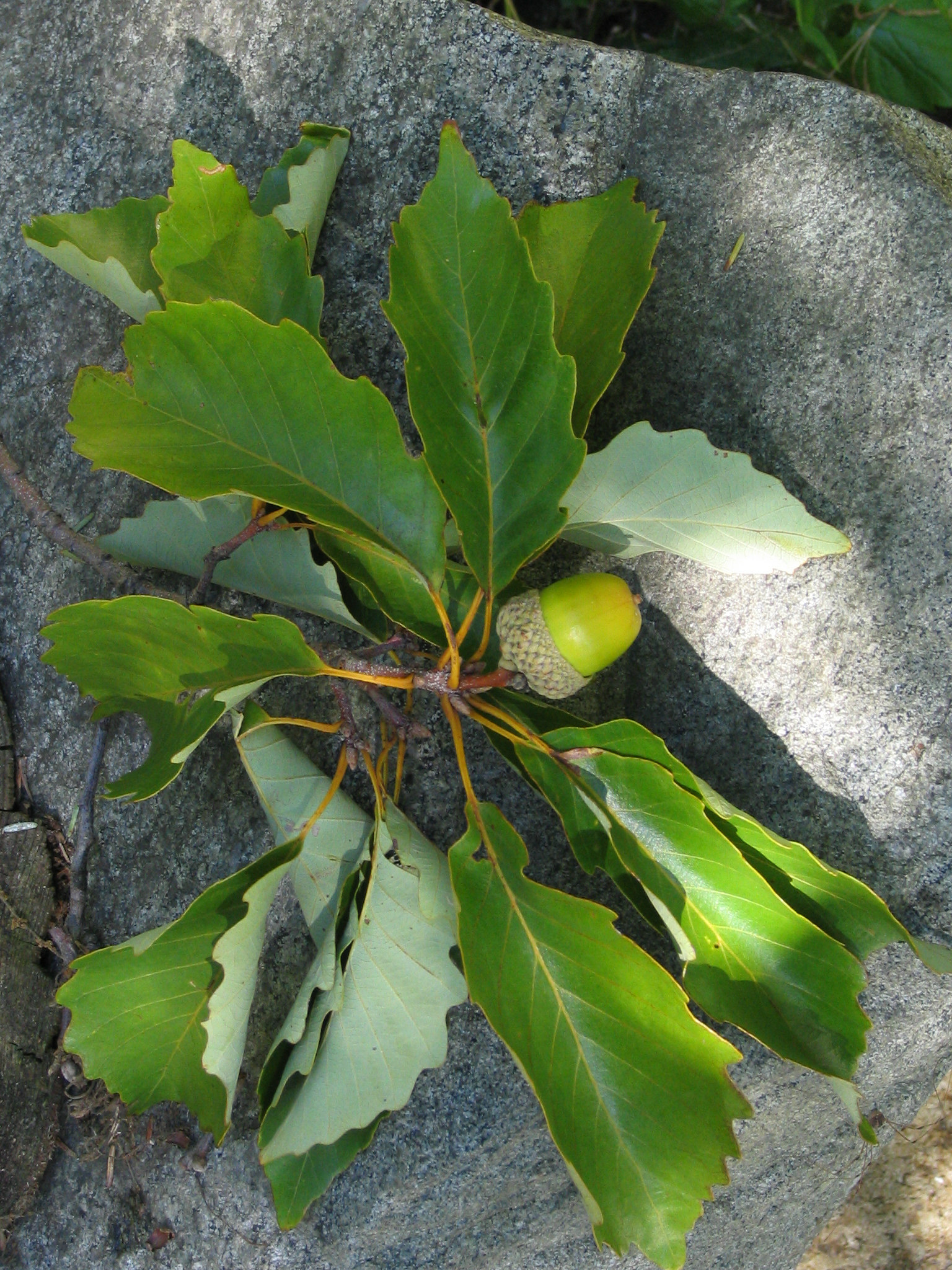

Chestnut oak is a medium to large deciduous tree of the white oak group, in the beech family (Fagaceae), and it is the tree that owns the dry ridge. It grows 50 to 75 feet tall on ridgetops, and under better conditions can reach 100 feet, with a broad, open, irregular crown and a trunk that looks like it was carved by weather on purpose. Its native range runs through the eastern United States, one of the most important ridgetop trees from southern Maine southwest to central Mississippi, with an outlying population in southern Michigan, and it is especially a tree of the Appalachians, where it dominates rocky upland forests and gives its name to whole natural communities. If you have hiked an Appalachian ridge and wondered what tree was holding the thin soil together under your boots, there is a good chance it was this one.
The name is the first thing to get straight, because it comes with a botanical argument attached, and this guide states it openly rather than picking a side in silence. The butterfly guide that sends readers here calls this tree Quercus prinus, and that is the name generations of foresters used. Modern authorities now treat the chestnut oak of the dry ridges as Quercus montana — montana meaning of the mountains, which is exactly where it lives — while the old name Quercus prinus is of uncertain position: some modern checklists list it as a synonym of the swamp chestnut oak instead. The two trees were long lumped together because their leaves and acorns look alike, and they were split because they live very differently. This guide files the tree under the butterfly-guide name, chestnut oak, and gives both Latin names, so that a gardener searching either name lands on the right tree — and so that nobody mistakes this ridge tree for its bottomland cousin. If it grows on a ridge, it is chestnut oak; if it grows in wet bottomlands, it is probably swamp chestnut oak, and that distinction is the whole split in one sentence.
Identification starts with the leaves, which are the reason for the common name: they resemble the leaves of the American chestnut, the tree that once dominated these same ridges before chestnut blight. Chestnut oak leaves are simple, alternate, obovate — broadest beyond the middle — 4 to 8 inches long, thick and leathery, dark green above and paler beneath, with coarse, rounded teeth along the margins rather than the pointed lobes of the red oaks. The leaf shape is the quick field mark against the other white oaks: white oak leaves are deeply lobed, while chestnut oak leaves are toothed but never lobed, like a chestnut leaf that decided to become an oak. The acorns are fairly large, produced yearly, with a scaly cap covering about half the nut, and they are high-value wildlife food for songbirds, ruffed grouse, wild turkey, deer, mice, and other mammals. The bark is the other field mark, and it is unmistakable once you have seen it: mature bark is gray with strong vertical furrows and thick, triangular ridges, a ridge-and-valley pattern, and it is described as the thickest bark of the native oaks. Young bark is smoother and lighter gray; old bark looks like a canyon wall, which suits a tree that lives on canyon rims.
Chestnut oak is a white oak group tree, and that matters for more than taxonomy. White group acorns mature in a single season, and their leaves carry rounded teeth rather than bristle tips, which is the difference a beginner can learn in one walk. The tree is slow-growing and low-maintenance, drought-tolerant once established, and famous for surviving on steep, rocky, dry, sterile sites where other oaks in its range cannot — thin soil over rock, ridgetop sun, and summer drought are its home conditions, not its hardships. It does best in well-drained loams in full sun, prefers acidic soil but tolerates alkaline ground, and it is sensitive to soil compaction, so it is a tree for a park, a large yard, or a woodland edge, not for a tight, paved, walked-on hellstrip. Its wood is high-quality timber, historically sold generically as white oak, and used for fence posts, fuel, and railroad ties, with tannin-rich bark once used in leather processing. The leaves unfurl yellow-bronze in spring, settle to dark green, and turn yellow-brown in fall — not a scarlet show, but a honest autumn color for a tree whose real show is its bark and its silhouette.
The butterfly context is the reason this guide exists in this project, and it is a woodland-edge story. The Banded Hairstreak guide lists, in its Host plants section, oaks, especially chestnut oak, white oak, and northern red oak, plus hickories, walnuts, and American chestnut. Banded hairstreak caterpillars feed on oak leaves, and a chestnut oak on a ridge or in a savanna edge is part of that menu — one tree among the oaks, not the whole story, which is exactly why the guide names several oaks rather than one. Oaks as a group are keystone plants for caterpillars: one wildlife source counts 477 species of Lepidoptera larvae using oaks in central Ohio alone, and over 600 insect species using oaks exclusively. Chestnut oak contributes its share of that feast from the driest, rockiest ground in the forest, which is a useful reminder that a tree does not have to be in rich soil to be rich habitat.
How to grow
Growing chestnut oak starts with accepting that you are planting a big tree on a slow clock, and then giving it the one thing it actually demands: room and drainage. Plant in spring or fall, in full sun, in well-drained soil, with the root flare at grade and the planting hole twice as wide as the root ball but no deeper. Space trees 50 feet apart or more, because a mature spread of 50 to 70 feet is not a suggestion, and a chestnut oak planted 20 feet from a house is a future pruning bill and a present mistake. This is a tree for parks, large yards, and woodland restorations, not for a small lot, and it is happiest where its roots can run deep into uncompacted soil — its roots run deep and are famously low-impact on sidewalks for an oak, but deep roots still need uncompacted ground to get there.
Young trees want regular, deep watering through their first seasons until established, and then they largely look after themselves: established chestnut oaks are drought-tolerant, and overwatering a ridge tree in heavy soil is a faster way to kill it than drought. Mulch a wide ring with wood chips or leaf litter, keep the mulch off the trunk, and leave the leaf litter in fall where you can — oak leaves are slow to break down, and that slow litter is part of how ridge soils build. Prune only in the dormant season, lightly, removing dead, diseased, crossing, or crowded branches, and never removing more than about a quarter of the crown in a year. Oaks are pruned in dormancy partly to avoid oak wilt transmission in spring, and partly because a dormant tree shows you its structure honestly. Stake only if the site is windy and the tree is small, and remove the stake after the first year; a tree that learns to stand on its own grows the trunk it needs.
Propagation is by acorn, sown soon after it falls in autumn, because white group acorns do not wait around — they germinate promptly and resent drying out and long storage. Collect acorns as soon as they drop, discard any with weevil holes or that float in water, and sow them where they are to grow or in deep pots, protected from squirrels, who regard your nursery as their pantry. Seedlings grow slowly, and that is normal: a chestnut oak spends its early years building a root system that can hold a ridge, and the top catches up later. Do not expect a shade tree in five years; expect a tree that is still there in a hundred, holding the same ridge, feeding the same hairstreaks, and dropping acorns for the same turkeys. That is the deal with oaks, and it is a good one.
Florida note, stated plainly because this site is a Florida site and this tree is not a Florida tree. Chestnut oak is absent from Florida — its range stops well north of the state — so no Florida gardener should plant it expecting a native, and no Florida butterfly garden needs it. The Banded Hairstreak reaches Florida, but it uses other oaks there, including live oak, not this one. If you are gardening in Florida and want the oak-caterpillar story, plant the oaks native to your part of the state, and let chestnut oak be the tree you admire on a mountain hike and recognize by its bark, not the tree you order for your yard.
Water & feeding
Water a young chestnut oak deeply and regularly through its growing season so the soil stays evenly moist while roots establish — typically once or twice a week in spring, summer, and fall, less in winter — and then taper off as the tree establishes. A mature tree in well-drained soil with normal rainfall largely waters itself, and in a genuinely dry spell a deep soaking is better than frequent sprinkles, because deep water follows the deep roots this tree is built around. The soil science is the ridge story: thin, rocky, acidic soils hold little water and little fertility, and chestnut oak answers with a deep root system, tough leaves, and a slow growth rate that spends less than a fast tree would. Mulch holds moisture and cools the roots in summer, and the tree’s own leaf fall returns tannin-rich litter that feeds the fungi and microbes of the ridge soil community. Do not plant it in a soggy bottom or a compacted lawn and then water it like a lawn tree; it is a drainage tree, and wet feet are its enemy.
Feeding: modest, and usually unnecessary. In its native ridge soils, chestnut oak grows on little, and a spring topdressing of compost is the right scale of feeding in a garden — not a heavy fertilizer program, which mostly produces soft growth on a tree built for hard ground. If the leaves are pale and the growth is stunted in genuinely poor soil, compost and mulch will do more good than a bag of fertilizer, because they feed the soil community that feeds the tree. This is not a tree that wants to be pushed; it wants to be placed well and then left to the slow work of being an oak.
Common problems
- Wrong tree, wrong place. The commonest problem is planting a 70-foot ridge tree in a small lot, a wet bottom, or compacted soil. Check mature size, drainage, and your state’s range before you buy — and in Florida, do not buy it at all.
- Confusion with swamp chestnut oak. The bottomland cousin (Quercus michauxii) has smoother, flatter, plated bark rather than deeply furrowed ridges, and it wants wet ground. Bark and habitat separate them faster than leaves do.
- Soil compaction. Chestnut oak is sensitive to compacted soil, which starves its deep roots of air and water. Keep vehicles, stockpiles, and heavy foot traffic off the root zone.
- Acorn pests and wildlife competition. Weevils bore acorns, and squirrels, deer, and turkeys harvest most of the crop before you do. If you are collecting seed, gather early, float-test, and protect sowings from squirrels.
- Oak wilt caution. Prune in dormancy and avoid wounding oaks in spring when sap beetles are active, the standard oak precaution across the genus.
- Slow growth impatience. A chestnut oak that looks unimpressive in its first years is building roots, not failing. Judge it at ten years, not at two.
- Caterpillar feeding. Hairstreak and moth caterpillars eat oak leaves, and that is the point of planting an oak. A healthy tree tolerates it; do not spray the caterpillars you planted the tree for.
Harvest
Chestnut oak’s harvest is acorns, timber, shade, and time — in that order of patience required. Acorns drop in fall; gather them promptly for propagation, float-test them, and sow the sinkers where they are to grow or in deep pots, because white group acorns germinate fast and store badly. This guide makes no eating recommendation for the acorns: they are wildlife food first, and different white group acorns vary enough in bitterness that a foraging claim would need a source this guide does not have. The timber harvest, where it applies, is a forestry decision on a decades scale, not a garden one, and the wood’s traditional uses — posts, fuel, ties, tannin — belong to that scale.
The simplest harvest is the one a ridge hiker already knows: stand under a chestnut oak in October, listen to acorns ticking down through the leaves, and know that the tree over your head is feeding grouse, deer, and mice, sheltering hairstreak caterpillars in its leaves, and holding a slope together with roots that go deeper than the soil looks. Leave most trees standing, prune in winter, and let the ridge keep its tree. A chestnut oak does not need your intervention once it is placed well — it needs your restraint, your patience, and your willingness to plant a tree whose shade your grandchildren will enjoy more than you will.
Browse all plant & pest guides
Saving seeds
Chestnut oak seed saving breaks the first rule every bean saver learns, so forget everything you know about drying seeds on a shelf: acorns are recalcitrant, which is the botanist’s polite way of saying they die if they dry out. A chestnut oak acorn is not a tidy little packet of suspended animation like a bean. It is a fat, moist, living embryo wrapped in a shell, already halfway out the door. Chestnut oak sits in the white oak group, and white oak acorns have little or no dormancy — they germinate in the fall, right around the time they drop, sending a taproot down while the shoot politely waits until spring. If you find an acorn in autumn with a root already poking out, that is not a defect. That is the plan.
Collect in fall as soon as acorns start dropping, and gather from the ground under a healthy tree rather than yanking them off branches. A ripe acorn slips easily from its cap, feels heavy and plump, and shows no weevil holes or cracks. Run the float test: drop your haul in a bucket of water and discard the floaters, which are usually hollow, weevil-eaten, or dried out. Keep the sinkers, and keep them moist from this moment on. Do not spread them on a tray to dry, do not leave them in a warm garage for a month, and do not treat them like seed packets. Every hour dry is viability lost.
The honest move is to plant immediately, about an inch deep in deep pots or a prepared bed, with a wire screen over the top, because squirrels, jays, and mice consider your nursery their pantry. If you must hold acorns until spring, store them cold and moist, not cold and dry: a bag of barely damp sand or peat in the refrigerator, checked every couple of weeks for mold, and even then only for a few months at most. Sources agree that white oak acorns keep for months, not years, and Florida humidity makes the mold check non-negotiable — moist, never soggy, and ventilated enough that nothing turns fuzzy.
One more honesty note, and it matters. Oaks are famously promiscuous within their own group: every species in the white oak section can cross with the others, and the natural chestnut oak by white oak hybrid even has its own name. So if other white oaks grow nearby, your seedlings may be hybrids rather than pure chestnut oak, and you will only know when the leaves and bark declare themselves years later. Seedlings grown from an isolated tree come true to species; seedlings from a mixed oak neighborhood are a genetic lottery ticket, and sometimes a very handsome one. Either way, settle in: a seedling oak is a gift to a future gardener, not next season’s crop. You are planting shade, timber, and wildlife food for decades hence, which is exactly why it is worth doing.
Varieties
No named varieties or cultivars of chestnut oak are listed in the sources checked for this guide, and this guide invents none. The plain-text relatives a gardener is most likely to confuse it with are: white oak (Quercus alba), the deeply lobed white group oak with its own guide; swamp chestnut oak (Quercus michauxii), the bottomland cousin with smoother, plated bark; chinkapin oak (Quercus muehlenbergii), the other toothed-leaf white oak of dry ground; and northern red oak (Quercus rubra), the red group oak named alongside chestnut oak in the Banded Hairstreak guide, with pointed, bristle-tipped lobes rather than rounded teeth. Buy by Latin name, check bark and habitat, and let the ridge tell you which oak you are standing under.