
🌰 Chrysolepis chrysophylla
What it looks like
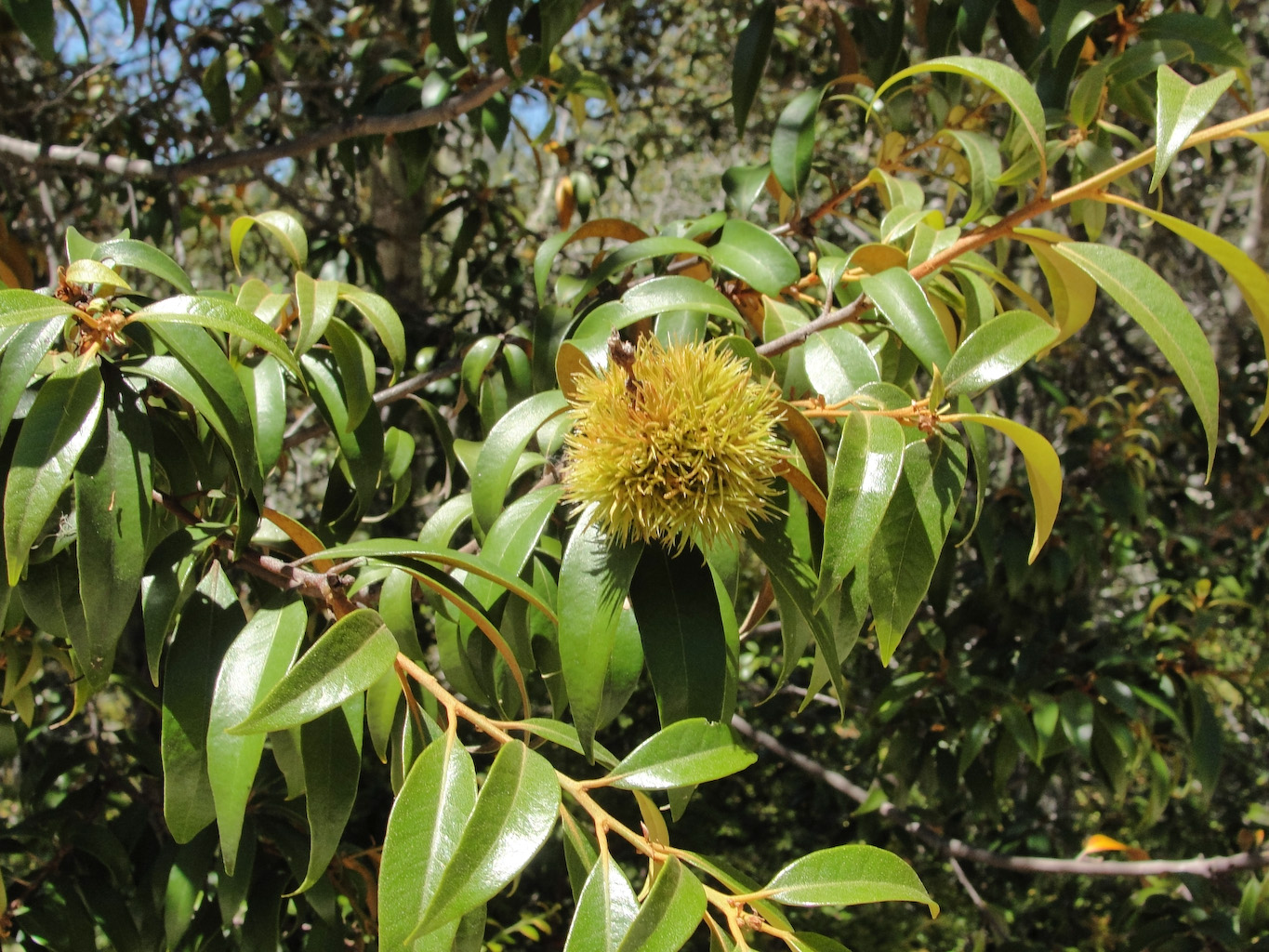
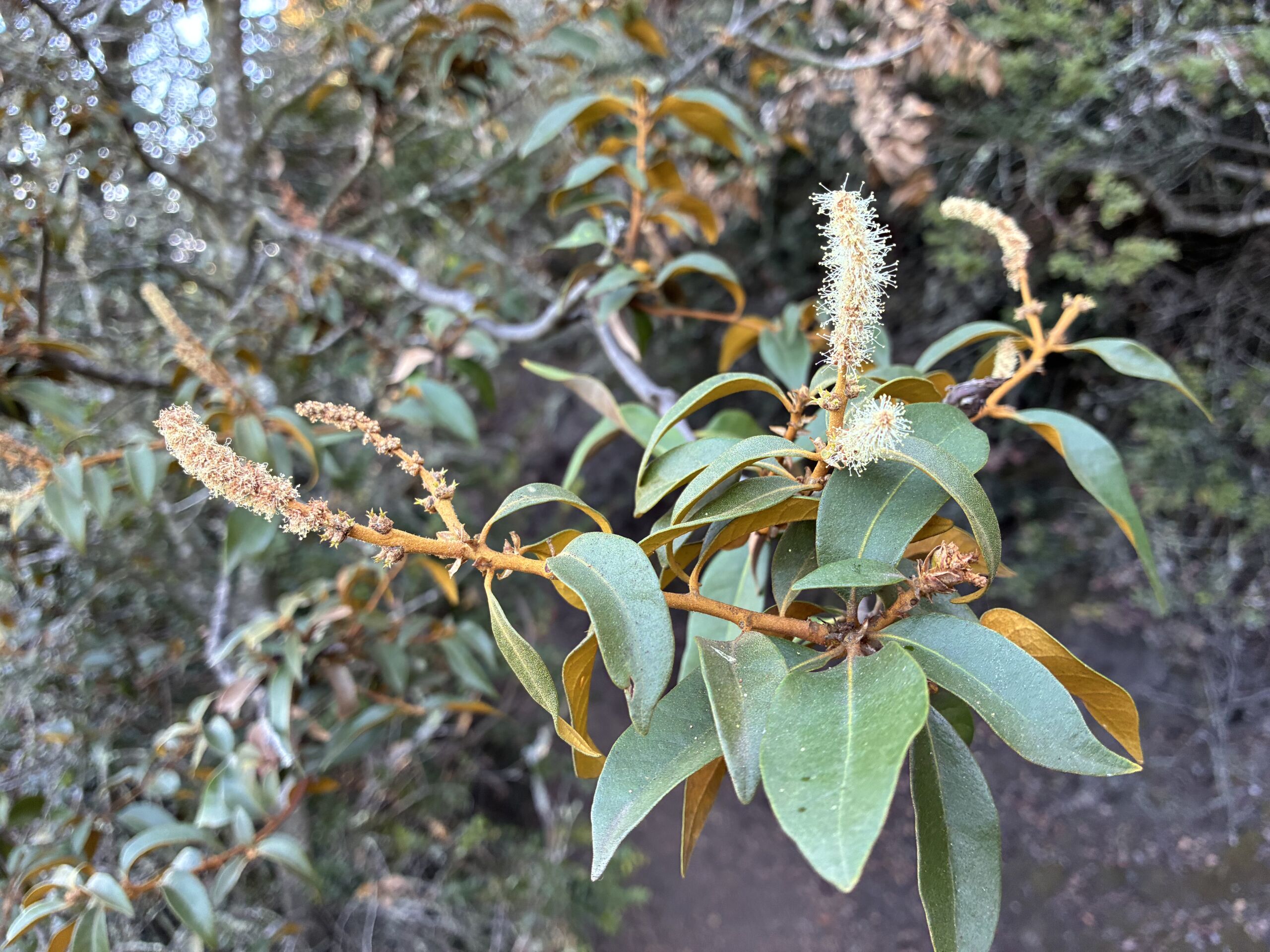
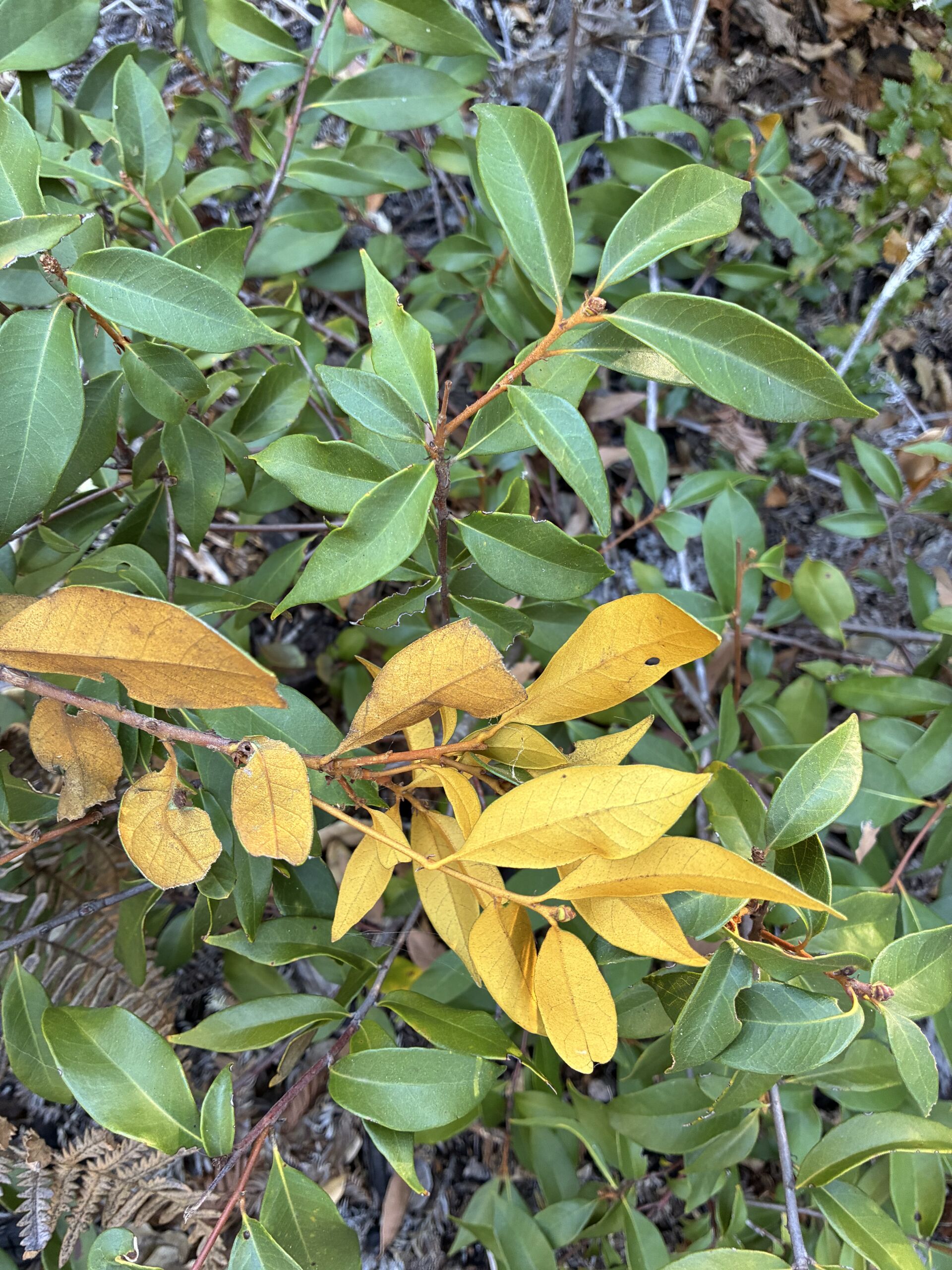
Chrysolepis chrysophylla is an evergreen tree or shrub in the beech family, Fagaceae, known by the common names golden chinkapin, giant chinkapin, golden chinquapin, and western chinquapin, and the spelling of that last word is itself a small adventure: chinquapin and chinkapin are both used for this genus and for its relatives in Castanea and Castanopsis, and gardeners should treat them as the same word wearing two coats. The scientific name is a description in Greek: chryso means golden, lepis means scale, and phyllon means leaf, and together they describe the tree’s signature, leaves coated beneath with dense, shiny, golden scales. Turn over a golden chinkapin leaf and you will see the name written in gold dust, which is a better identification test than any photograph.
The leaves are alternate, simple, and evergreen, lance-shaped to oblong, tapering at both ends, 6 to 12 centimeters long according to most references, with Oregon State University giving 5 to 13 centimeters, dark yellow-green above and coated beneath with golden to pale yellow scales, with a thinner layer of scales above. The leaves persist for 3 to 4 years before falling, so the tree is evergreen in the honest sense: it always carries several years of leaves at once, and it never stands bare. The bark is thick, rough, and furrowed, gray to brown, and the twigs are scurfy with small golden-yellow scales, so even the winter silhouette carries the gold theme.
Size is where this species refuses to be pinned down, and the honest statement is a range with a reason. As a tree in cool, moist sites, valley bottoms, north-facing slopes, and foggy coastal forests, it reaches 20 to 40 meters, 66 to 131 feet, according to the genus account, with Oregon State University recording specimens to 150 feet, usually much smaller. As a shrub on dry sites, higher elevations, and poor soils, it reaches only 3 to 10 meters, 10 to 33 feet, and the shrubby forms were once designated as a separate variety, var. minor, but Oregon State University notes that this variety is no longer recognized as a separate entity, because the differences in form reflect site conditions rather than genetics. A seedling that becomes a tree in a valley and a shrub on a ridge is not two plants; it is one plant reading its landscape, and that flexibility is the species’ survival strategy.
The flowers and fruit place it firmly in the beech family. The tree bears catkins, the male flowers in long, dangling clusters, and the fruit is a small, chestnut-like nut held in a spiny cup, or burr, that splits to release it, much like a miniature chestnut. The nuts are eaten by wildlife, including squirrels, jays, and bears, and the tree grows in climax forests dominated by redwood, white fir, western hemlock, and Shasta red fir, or in mixed forests and chaparral, where it may be an understory shrub or a canopy co-dominant depending on the site. It occurs in coastal areas of the Pacific Coast Ranges from Washington near Seattle south to the San Luis Obispo area of California, with a small disjunct population in the northern Sierra Nevada east of the Sacramento Valley, from sea level to about 1,500 meters, rarely 2,000 meters, which is a long, narrow, coastal range for a tree this large.
One plain-text clarification, because the common name invites it: golden chinkapin is not the Allegheny chinquapin, Castanea pumila, which is a different genus in the same family, a shrubby chestnut of the eastern United States, and the site has a separate guide for that plant. The two share a common name and a family, but they are not the same tree, they do not grow in the same places, and a gardener who wants one should not buy the other by name alone. Golden chinkapin is also not a true chestnut, Castanea, though it is closely related, and its nuts, while chestnut-like, are smaller and borne in a different kind of cup.
How to grow
Grow golden chinkapin by copying a cool, coastal forest edge, not a hot, inland garden. It wants full sun to light shade, well-drained soil, and a stable, moderate climate, and Oregon State University describes it as slow-growing, best on well-drained soil, and adapted to dry summers, which is the Mediterranean pattern it evolved under. It grows on a wide range of soils in the wild, from dry and rocky to deep and rich, but garden accounts consistently prefer well-drained, lime-free soil, with one garden reference giving a pH range of 5.5 to 7.5, and that lime-free preference should be taken seriously: a chalky, alkaline soil is a poor bet for this tree. If your soil is alkaline, plant a different beech-family tree, because golden chinkapin will not thank you for the experiment.
Plant in fall or winter in mild climates, or in spring where winters are hard, and plant it where it will stay, because Oregon State University notes that it transplants with difficulty, which is the polite way of saying that a moved golden chinkapin often dies. Choose the site as if you mean it, 30 to 50 feet from buildings, paths, and other trees, with overhead clearance for a crown that can reach 60 feet or more, and with shelter from desiccating wind and extreme temperature swings, since garden accounts describe it as sensitive to extreme temperature fluctuations and best suited to oceanic and Mediterranean climates. Stake a young tree only until it can stand on its own, and do not plant it in a frost pocket or a heat trap, because both extremes are outside its comfort zone.
Hardiness needs a plain statement, because sources differ at the cold edge. This guide’s hero stats use zones 7 to 9, which is the range given by Oregon State University, hardy to zone 7, and by several garden references. Another garden account stretches it to zones 6 to 9, with tolerance to about 0 degrees Fahrenheit, and the honest reading is that zone 7 is the safe lower limit for most gardeners, with zone 6 a gamble for a sheltered plant from a hardy provenance, and warmer zones fine only where summers are not brutally hot and humid. In Florida, it is not a Florida tree at all: it wants cool, coastal, Mediterranean conditions, and Florida’s hot, humid summers are the opposite of its native pattern. Admire it in Pacific Coast forests, and plant a beech-family tree suited to your region at home.
Pruning is light and structural. Prune in winter while the tree is not pushing growth, remove dead, crossing, or damaged wood, and train a strong central leader while the tree is young, because a mature chinkapin with co-dominant leaders is a storm problem waiting for a windy night. Do not top it, do not shear it into a shape, and do not remove more than a quarter of the crown in any one year. A slow-growing tree pruned hard takes years to forgive you, and a golden chinkapin has better things to do with those years than regrowing a crown you removed.
Water & feeding
Water to establish, then let it be a Mediterranean tree. Through the first two or three years, water deeply every week or two in dry weather, soaking the root zone so roots grow down instead of sideways. Once established, golden chinkapin is drought-tolerant in the dry-summer sense, meaning it survives dry summers on deep soil, but it does better with occasional deep summer water than with total summer drought, especially on hot, exposed sites, and garden accounts describe it as preferring well-drained but moist soil, not desert-dry soil. The nuance is that this tree’s native summers are dry but its native winters are wet and its native air is humid, so a garden plant in a dry, windy, inland site will need more water than one in a sheltered, coastal corner, and both will need less than your lawn.
Do not fertilize it into softness. Golden chinkapin grows well in average to lean soil, and a yearly mulch of bark or leaf litter, kept off the trunk, is all the feeding most trees need. Heavy nitrogen pushes weak, leafy growth that wind and drought then punish, and it does nothing for nut production, which comes from a mature, slightly stressed tree, not a pampered one. If your soil is genuinely poor and the tree is struggling, a single spring application of a balanced, slow-release fertilizer is plenty, and in most native soils it is unnecessary.
Common problems
- Transplant failure. The most common golden chinkapin problem in gardens, and Oregon State University flags it directly: this tree transplants with difficulty. Plant young, plant once, and do not move an established tree unless you have no choice.
- Wrong climate. The second most common problem, and it is a human problem. A tree that wants oceanic and Mediterranean conditions will not thrive in a continental climate with hard freezes and hot, humid summers, no matter how much you water it. Choose the tree for your climate, not for your wish list.
- Alkaline or waterlogged soil. Golden chinkapin prefers lime-free, well-drained soil, and it sulks in chalky or permanently wet ground. Plant in acidic to neutral, well-drained soil, and do not bury the root flare, which invites root rot in any beech-family tree.
- Slow growth mistaken for failure. Not a problem, but the most common false alarm. A golden chinkapin that grows a few inches a year in its first years is growing normally; it is building roots, not racing its neighbors. Judge it at five years, not at five months.
- Size misjudgment. A tree that can reach 100 feet or more does not belong 10 feet from a house, a driveway, or a power line. Measure the mature crown, not the nursery pot, and plant accordingly, even if the nursery plant looks like a shrub today.
- Spiny nut litter. A mature tree drops spiny burrs that are unpleasant underfoot, and they should not be planted over a patio, a path, or a lawn where children play barefoot. Enjoy the wildlife traffic the nuts bring, and site the tree where the burrs fall on mulch, not on feet.
Harvest
There is no kitchen harvest most gardeners should plan from golden chinkapin, though the harvest it gives wildlife is substantial. The small, chestnut-like nuts are eaten by squirrels, jays, bears, and other forest animals, and a mature tree in a forest garden is a wildlife pantry in fall. The nuts are sometimes described as edible in the general chinquapin sense, but this guide does not present them as a garden food crop, because the tree is slow-growing, rarely available in nurseries, and grown as an ornamental and wildlife tree rather than as an orchard tree, and a gardener who wants chestnut-like nuts should plant a chestnut variety bred for that purpose. The honest garden harvest is shade, evergreen structure, golden foliage, and longevity: a tree that holds its leaves for years, shelters birds in every season, and anchors a cool, forested corner of the garden.
Butterfly guides list golden chinkapin as a host plant in two butterfly guides, and that is the per-guide record, stated accurately. The California sister lists it as a host plant under the common name golden chinkapin, with the Latin name Chrysolepis chrysophylla given, and the Propertius duskywing lists it as a host plant under the common name golden chinkapin, also with the Latin name Chrysolepis chrysophylla. In the per-guide file, both entries carry the Latin name alongside a common-name phrase that includes the word golden chinkapin, which is why this species guide, filed under its Latin name, is the honest destination for both mentions. Beech-family foliage feeds a large caterpillar fauna beyond any single guide, and a golden chinkapin in a garden is a caterpillar host whether or not a guide lists every guest.
Propagation is slow and honest. Fresh seed germinates best if sown in fall in deep pots, because the first root dives down fast and a shallow pot will not contain it, and seedlings grow slowly for their first years, putting energy into roots before they put it into height. That slow start is the tree’s strategy, not a failure: a tree that spends its youth building a root system is a tree that survives its first drought. Buy a nursery tree if you can find one, and then leave it alone to become the tree it already plans to be, which may take a decade to show its full character and a century to finish it.
Saving seeds
Golden chinkapin seed is not a packet of dust, it is a nut, and everything about saving it follows from that. The nuts ripen inside spiny, chestnut-like burs, one to three nuts per bur, in late summer to early autumn, and the burs split and drop when they are ready. Wear gloves, because the spines are not decorative. Gather burs as they open, spread them to dry briefly in a warm room, and work the nuts free. Discard any that are cracked, worm-holed, or suspiciously light, and do not bother trying to save seed from a tree too young to bear: even vigorous stump sprouts need several years before they produce sound seed.
The single most important rule is to sow fresh. Golden chinkapin nuts are not beans, and they do not improve with a long stay in a dry jar. The propagation protocol for this species says to sow nuts as soon as they are ripe, and the United States Forest Service seed manual agrees that no cold stratification is needed, though some garden sources still recommend a chill. Fresh autumn sowing sidesteps that argument entirely, which is one of its charms. If you must hold nuts briefly, keep them cool and barely moist rather than bone dry, and protect them from rodents and squirrels at every stage, because every other mammal in the neighbourhood also considers them food.
Sow in deep pots, because the first root dives down fast and a shallow pot will not contain it, and cover with a generous layer of mix, as the protocol directs. Keep the pots moist and partly shaded, and be ready for slow, uneven results: reported germination in trials ranged roughly from one in seven to about one in two seeds, over a couple of weeks to a month, and emergence is hypogeal, meaning the seed leaves stay underground while a shoot pushes up, so do not dig around looking for progress. Seedlings grow slowly, sometimes only a few inches in their first year, and are best grown on in pots through at least their first winter before facing the open ground.
Seedlings grown this way are the straight species, not clones, so expect natural variation between them rather than identical copies of a parent tree. That is normal for a wild tree with no named garden varieties, and it is part of the point: every seedling is a slightly different roll of the golden chinkapin dice. One Florida-flavoured caution, though this is a cool Pacific-coast forest tree rather than a Florida native: do not assume a Florida garden will suit it just because the seed germinated on a windowsill. It wants cool, well-drained, lime-free soil and a forest edge, not a hot, wet, alkaline bed, so save seed for a site that can honestly offer that, or admire the tree and let the squirrels have the nuts.
Varieties
Golden chinkapin is sold as the straight species, and no named garden varieties were verified for this guide. That is stated plainly, not padded: this is not a tree with a catalog of cultivars, and any seller offering a named golden chinkapin variety should be asked to show that the name is real and distinct.
- Chrysolepis chrysophylla, the straight species: The tree or shrub described in this guide, evergreen, golden-scaled beneath the leaves, spiny nut cups, 66 to 131 feet tall as a tree in moist sites and 10 to 33 feet as a shrub on dry, poor sites. This is what nurseries sell, and it is what butterfly guides mean when they list golden chinkapin as a host plant.
The shrubby form once called var. minor is not listed here as a variety, because Oregon State University notes that it is no longer recognized as a separate entity, the differences being site-driven rather than genetic. The only other species in the genus, bush chinquapin (Chrysolepis sempervirens), is not a variety of this tree and is not listed here as if it were: it is a separate, high-elevation shrub species, 3 to 7 feet tall, with smaller leaves and blunt leaf tips, and if you want a chinquapin for a high, dry garden, it is the species to look for, not a variety of this one.