
🌿 Common Milkweed
What it looks like
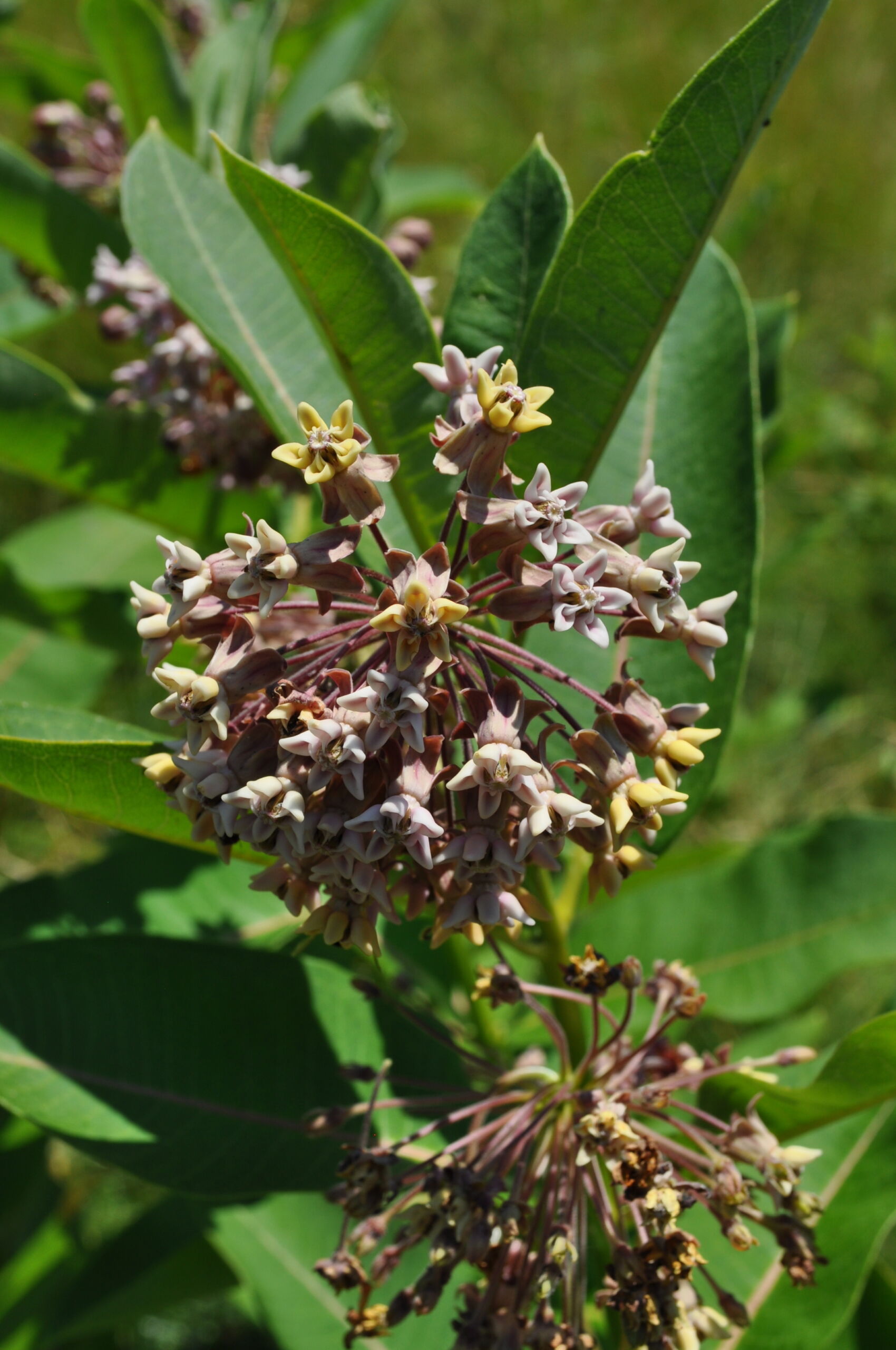
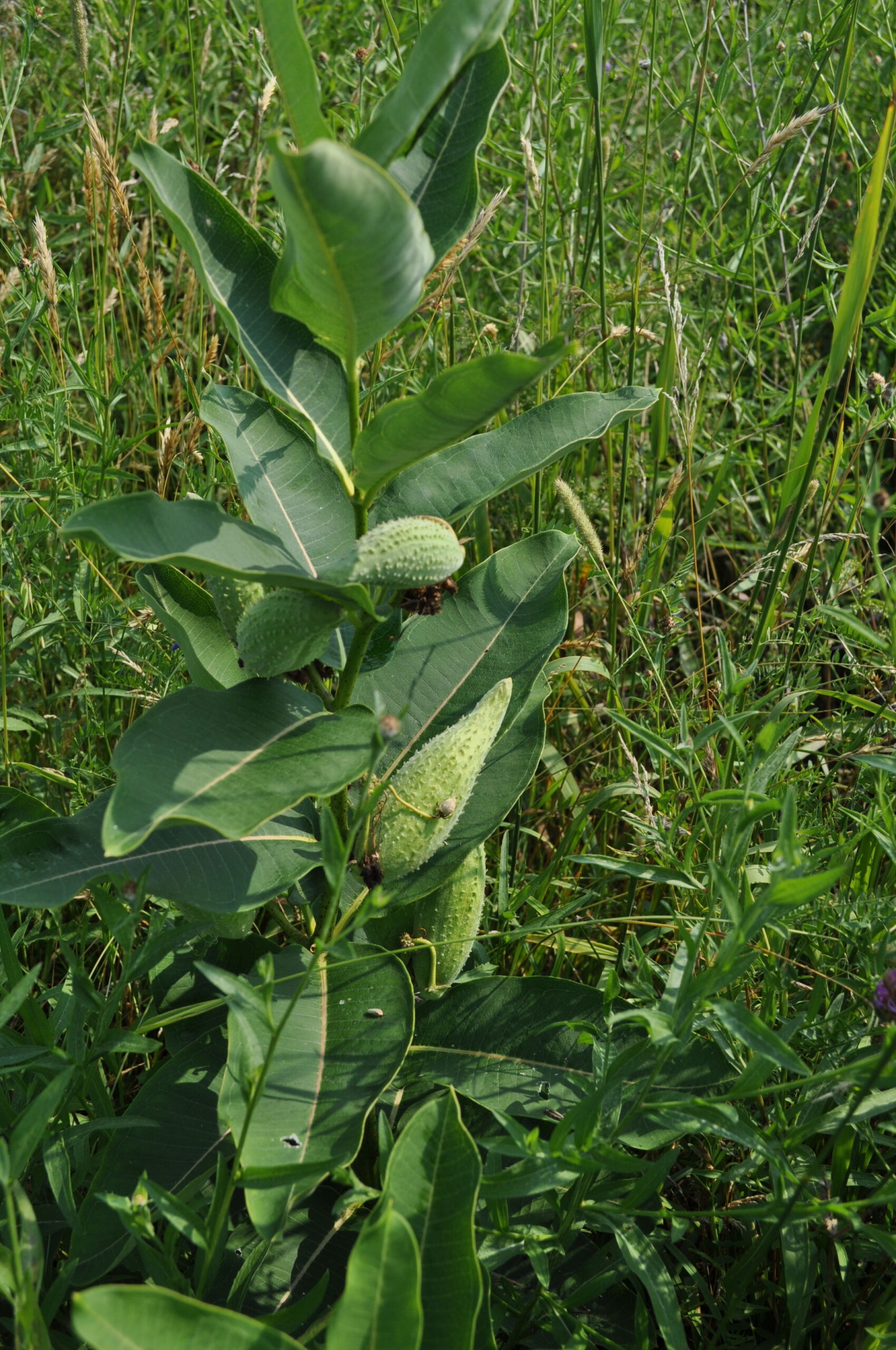
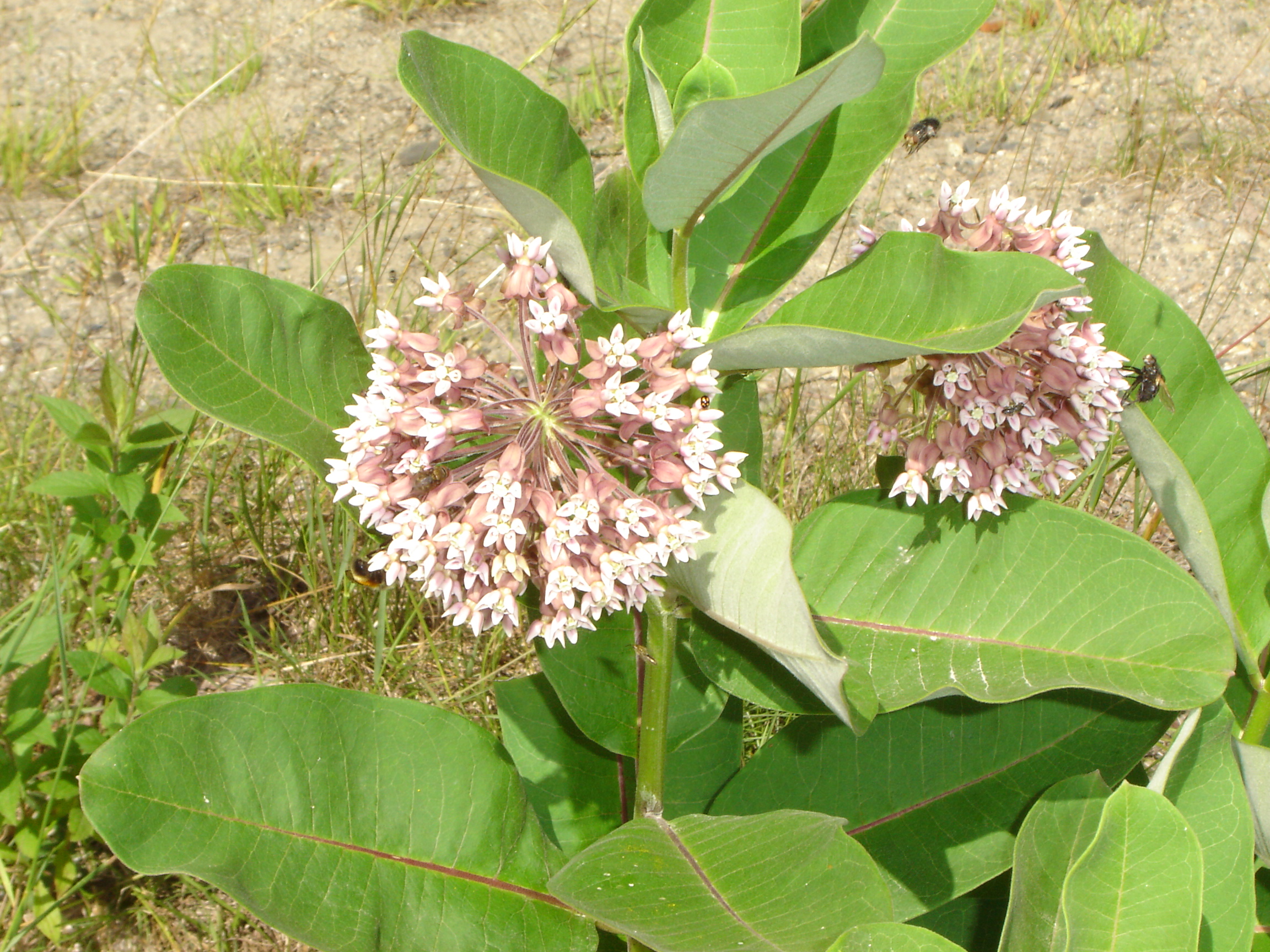
Common milkweed is the most important butterfly plant in eastern North America, and it is not close. Asclepias syriaca L., in the dogbane family (Apocynaceae, formerly the milkweed family Asclepiadaceae), is a clonal perennial forb — a coarse, stout, upright herb growing from spreading underground roots — typically 3 to 5 feet tall, occasionally reaching 8 feet in a ditch or a garden that lets it. Its leaves are simple, opposite, sometimes whorled, broadly ovate to lance-shaped, 1.5 to nearly 5 inches wide, with entire, slightly wavy margins, reddish main veins, very short stalks, and velvety, softly hairy undersides. Its flowers are the reason gardeners plant it and the reason butterflies find it: highly fragrant, pinkish to purplish (rarely white), about a centimeter across individually, borne in globe-shaped clusters — umbels — at the stem tips and in the upper leaf axils, each flower with five strongly reflexed petals and a central crown of five hoods, each with a horn, surrounding a complex structure of fused stamens and style that traps a pollinator’s leg just long enough to attach a pair of pollen sacs. Its fruits are large, warty, somewhat furry, oval follicles, splitting in fall to release flat brown seeds, each attached to a tuft of long, white, silky floss that carries it on the wind. It is native to southern Canada and much of the United States east of the Rocky Mountains, excluding the drier prairies, and it is the milkweed most people picture when they hear the word milkweed — which is fair, because it is the most substantial of the native milkweeds, and the one the monarch migration largely depends on.
The chemistry is the story, and it is a story in two directions. All parts of the plant produce a white latex when cut — the milky sap that gives the milkweed its name — and that latex carries cardiac glycosides, bitter, toxic compounds that make the leaves inedible to most mammals. Monarch caterpillars eat the leaves anyway, sequester the glycosides in their tissues, and carry that chemical defense through pupation into adulthood, making both caterpillars and adults unpalatable to birds: eat the bodyguard’s food, become inedible. More than 450 insect species feed on common milkweed in one way or another — flies, beetles, ants, bees, wasps, butterflies, the red milkweed beetle, the milkweed tussock caterpillar, the large and small milkweed bugs — and the flowers are visited by honeybees and native bumblebees, which are the more effective pollinators because the plant is largely self-incompatible and a bee that visits unrelated plants does the fertilizing that a bee working one clone cannot. Using cardenolide fingerprinting, investigators have found that the great majority of monarchs overwintering in Mexico fed on common milkweed as caterpillars, which is a statistic that explains why this guide exists: plant this species, and you are feeding a migration.
The butterfly story in the butterfly guides themselves is a nectar story, and it is worth stating exactly. The Coral Hairstreak guide lists common milkweed in its Nectar plants section: adults nectar on common milkweed alongside butterfly weed, swamp milkweed, New Jersey tea, dogbane, meadowsweet, and sulphur flower. The same mention form appears in adjacent sections of other guides — the Red-banded Hairstreak and Silvery Checkerspot guides list it under “Nectar plants and how to attract it,” and the Dun Skipper guide under “Adult food and how to attract it” — and this guide covers the mention form itself, leaving the question of which of those sections the linker wires to the coordinator, since the project’s scope is the sections headed exactly “Host plants” and “Nectar plants.” The monarch host story, meanwhile, is not a butterfly-guide plant-list mention at all: it is the plant’s central ecological fact, and it belongs in this guide whether or not any single guide’s list names it. This guide covers Asclepias syriaca only, as a species: the milkweed genus as a whole has its own genus guide, and swamp milkweed, butterfly milkweed, aquatic milkweed, and the other milkweed species have their own profiles and guides, and none of those is this plant.
One disambiguation, because the lookalike is genuinely confusing and genuinely matters. Hemp dogbane (Apocynum cannabinum) is a related species that resembles common milkweed — similar leaves, similar milky sap, similar height — but it branches freely, has smaller, greenish-white, bell-shaped flowers, and is not a monarch host; it is, however, poisonous in its own right. The old foraging confusion between the two is famous: Euell Gibbons, author of Stalking the Wild Asparagus, wrote that milkweed was bitter and toxic and devised a triple-boiling method to make it safe, and later writers suggested he may have inadvertently prepared dogbane instead. Modern foragers debate whether young milkweed shoots are bitter at all, but the identification rule survives the debate intact: if you cannot tell milkweed from dogbane with certainty, do not eat either, and never eat a mature milkweed plant, whose latex is frankly toxic. This guide does not present milkweed as a food crop; it presents it as a butterfly plant that happens to have a complicated edible history, and the complicated part is the warning.
How to grow
Growing common milkweed starts with the only decision that matters: do you have room for a plant that spreads? It is clonal and aggressive, spreading from propagative roots and forming large colonies, and it is not suited to small gardens and formal plantings. Give it a meadow, a field edge, a roadside strip, a loose or wild landscape corner, or a large bed where its spread is welcome, and it will reward you with height, fragrance, and monarchs. Give it a tidy perennial border and it will reward you by showing up in the lawn, the path, and the neighbor’s bed, and you will be writing the removal section of this guide from experience. Plant in full sun for the best flowering — it tolerates light shade but produces fewer flowers — in moist but well-drained soil, though it tolerates dry conditions and clay once established, and it is winter hardy in zones 3 to 9. Space plants 18 to 24 inches apart in a patch, and expect a patch, not a specimen: milkweed’s habit is a colony, and a colony is the unit that feeds monarchs properly, because a female laying eggs wants many stems to choose from, not one lonely plant.
Propagation is by seed and by root cuttings, and seed needs what temperate seeds usually need: a period of cold treatment, cold stratification, before it will germinate — sow in fall or winter-sow, or stratify in the refrigerator for about a month, then sow in spring. Seedlings and cuttings usually bloom in their second year, though cuttings occasionally bloom in their first, so patience is part of the plan. Transplants establish faster than seed, and nursery plants are the honest shortcut if you want flowers sooner. One management trick belongs in every milkweed guide and this one repeats it, because it is the difference between a patch that feeds monarchs in spring and a patch that feeds them at the peak: in the northeastern United States, monarch reproduction peaks in late summer, when most milkweed leaves are old and tough, and plants that are mowed or cut back in June through August regrow rapidly from their roots in time for peak egg-laying, when females prefer quickly growing shoots whose foliage is tender and soft. Cut back a third of your patch in midsummer, staggered, and you will have tender regrowth exactly when the monarchs want it — a mowing schedule as a butterfly management tool, which is the kind of gardening this site is for.
Florida note, by region, because common milkweed’s range and Florida’s milkweed story are not the same story. Common milkweed is native to eastern North America, and its southern range has been expanding, but in Florida the recommended monarch plants are the Florida natives — swamp milkweed and butterflyweed — not this species, and the milkweed genus guide says so plainly. Common milkweed will grow in north Florida as a garden plant, but it is not the Florida native milkweed, and Florida gardeners planting for monarchs should plant the species native to their region first, with common milkweed as a northern gardener’s plant that visits rather than belongs. Tropical milkweed, meanwhile, is the plant to avoid or cut back in fall, because it does not die back and can harbor parasites that harm monarchs — a different species, a different problem, and a reminder to buy milkweed by Latin name.
Water & feeding
Water common milkweed like a field plant: water to establish, then let it largely fend for itself. It prefers moist but well-drained soil and grows best with normal rainfall, but it tolerates dry conditions and clay once its roots are down, and it is one of the more drought-tolerant milkweeds in a loose, sunny site — swamp milkweed excepted from that sentence, since swamp milkweed likes wet feet and this one does not. A thick mulch is unnecessary and can even hinder it: a meadow patch mulched with straw can keep seeds from germinating if the layer is thick enough to hold soil temperatures down in spring, so mulch lightly, if at all, and let the patch’s own leaf litter do the work. In a container, which is not recommended for a spreading clonal plant, water whenever the mix dries and expect it to outgrow the pot — a container milkweed is a temporary resident, not a plan.
Feeding: lean, as befits a field plant. Common milkweed wants lean soil — too much fertility makes floppy, aphid-covered plants, as the genus guide says, and the same rule holds for the species. A spring topdressing of compost is the right scale of feeding, if any is needed at all; a heavy fertilizer program mostly produces soft growth that flops and feeds oleander aphids, which are the bright orange clusters that colonize milkweed shoots and are themselves a food source for ladybugs and lacewings. The soil science here is the old-field story: a disturbed field, a roadside, a pasture edge is a community held open by disturbance, where light reaches the ground, where a deep-rooted perennial can store energy underground and send up new stems each spring, and where the plant’s real fertilizer is its own root system, spreading, storing, and regrowing. Plant it in a sunny, lean patch and you are not just decorating a field edge — you are installing a monarch nursery on top of a root system that has been running its expansion program since the glaciers retreated, and the poison in the sap is the nursery’s security system.
Common problems
- Spreading beyond its welcome. The most common problem with common milkweed is that it works too well: clonal roots send up new stems meters from the parent, and a patch becomes a colony becomes a takeover. Site it where spread is welcome, mow the edges, or grow a clump-forming milkweed — swamp milkweed or butterflyweed — instead.
- Oleander aphids. Bright orange clusters on the shoots, abundant in summer. Blast them with water or leave them for ladybugs and lacewings; do not spray a monarch host plant because it has aphids on it, or you will kill the caterpillars along with the aphids.
- Milkweed beetles and bugs. Red milkweed beetles, large and small milkweed bugs, and tussock caterpillars all feed on the plant, and the damage is mostly cosmetic. They are part of the milkweed community, not a reason to spray.
- Dogbane confusion. Hemp dogbane looks similar, branches freely, and is not a monarch host. If your “milkweed” branches all over, has small greenish-white bell flowers, and never hosts a monarch caterpillar, check whether it is dogbane before blaming the monarchs.
- Milkweed yellows. A phytoplasma disease that yellows and stunts the plant. Remove and destroy affected stems; there is no spray that fixes a phytoplasma, and a healthy patch usually outgrows it.
- Toxicity. The latex carries cardiac glycosides, and mature plants are toxic to people and large animals. Do not eat mature milkweed, do not let children or pets sample it, and be certain of the identification — milkweed versus dogbane — before even considering the young-shoot debate.
- Invasiveness outside its range. Common milkweed is naturalized in many areas outside its native range, including much of Europe, where it has been listed as an invasive alien species in the European Union since 2017, prohibiting import and trade there. Outside North America, check local rules before planting it — a monarch plant at home can be a weed abroad.
- Caterpillar defoliation. Monarch caterpillars may strip leaves in late summer, and that is the point of planting it. A healthy patch regrows from its roots, so do not spray the caterpillars — they are the crop.
Harvest
Common milkweed’s harvest is seed, floss, and butterfly-watching — in that order, and with one firm boundary. This is not a food plant in this guide’s recommendation: the young-shoot debate is recorded above as history and controversy, not as a recipe, and mature plants are toxic, so the harvest this guide recommends is the one that does not go in a pot. If you want seed, collect the follicles when they split in fall and the seeds inside are dark brown — unripe seed is light tan — and sow in fall or stratify and sow in spring, covering lightly with straw or fabric to keep seeds from washing away or being eaten by birds. If you want floss, collect the silky seed hairs when the pods split: historically they stuffed life jackets, insulated winter coats, and provided the background for mounted butterflies, and they are still a beautiful, if impractical, fiber. If you want more plants, take root cuttings in dormancy, and plant them where they have room to become a colony.
The simplest harvest, though, is a summer afternoon in a milkweed patch with no agenda at all: fragrant pink globes overhead, monarchs drifting through the scent they made, caterpillars eating leaves with the confidence of animals that know they are poisonous, and seedpods splitting in fall to send silk across the field like a slow, white weather system. Leave most plants standing through the season for the monarchs, cut back a third of the patch in midsummer for tender regrowth, and let the colony come back bigger next spring. That is the crop, and it arrives without a single spray — because spraying it would kill the very thing you planted it for, and because a plant that has fed a migration for thousands of years does not need your intervention, only your willingness to give it room and then get out of its way.
Browse all plant & pest guides
Saving seeds
Saving common milkweed seed is a race against the wind, and the wind cheats. The pods — those warty green follicles that swell all summer — split in fall, and each seed is attached to a tuft of silk engineered by evolution to catch the slightest breeze. Your job is to be there on the day the pod cracks, not the day after.
Watch the pods from late summer on. When a pod begins to split along its seam and the seeds inside are brown and firm, snip it with a little stem attached and drop it straight into a paper bag. Do this before the silk fluffs out, or you will be chasing your future plants across the yard. Wear gloves: milkweed sap is a milky latex that irritates skin and eyes, and it is the same chemistry that makes the plant a monarch’s armor, so treat it with respect. To clean the seed, open the pod in the bag, pinch the seed end of each silk tuft, and strip the seeds off — or simply hold the pod closed at the silk end and scrape the seeds free. A little fluff in the batch is harmless; a lot of damp pod material is not, so pick out the chunky debris and spread the seed in a single layer to dry for a week or two in a shaded, airy spot. Seed that feels cool or soft is not dry yet. Dry seed feels hard and papery, and it must be fully dry before it goes into storage, especially in Florida, where humidity rehydrates anything left in an open envelope. Store it labeled — species and year — in a paper envelope inside an airtight jar with a desiccant packet, kept cool and dark. Use it within a couple of years for the best germination; milkweed seed does persist in soil for years, but stored seed is a different story, and fresh seed is always the stronger bet.
Now the step most people skip, and then blame the seed for: cold. Common milkweed seed is built to sleep through winter, and it wakes up properly only after a stretch of cold, damp conditions. Sources disagree on exactly how long — some report good germination after just a couple of weeks of cold, others recommend a month or more — so treat a month of cold, moist stratification as a safe middle: mix the seed with damp (not wet) sand or a damp paper towel, seal it in a bag, and refrigerate it. Or skip the fridge entirely and sow outdoors in fall, letting winter do the work the way it evolved to. In Florida, where winters are short and mild, the fridge method is the surer bet, and spring sowing without any chill is the classic way to get a tray of nothing and conclude, wrongly, that the seed was dead. Warmth comes after cold: sow shallowly, keep the mix moist, and expect emergence over several weeks rather than all at once.
Two honesty notes before you scatter. First, seedlings of the straight species grow true to species — you will get common milkweed — but open-pollinated seedlings vary from plant to plant, and seed from a named cultivar will not reliably repeat that cultivar. Second, seed is only half the plant’s plan: common milkweed also runs underground by rhizome, so a patch you start from seed may wander well beyond where you planted it. Give it room, or give it a boundary, and let the monarchs do the rest.
Varieties
Common milkweed is grown as the species, Asclepias syriaca, and no distinct garden varieties are sold under this name — a gardener buying common milkweed is buying the eastern North American species itself, not a cultivar of it. The flowers vary naturally from white, rarely, through pinkish and purplish, but that is variation within the species, not a named variety to shop for. Related milkweeds a gardener may meet are distinct species, not varieties of this one: swamp milkweed (Asclepias incarnata), the moist-ground milkweed with its own native-plant profile; butterfly milkweed (Asclepias tuberosa), the orange, clump-forming milkweed with its own native-plant profile; aquatic milkweed (Asclepias perennis); whorled milkweed (Asclepias verticillata); and purple milkweed (Asclepias purpurascens), the most similar species, with darker flowers and pods lacking the warty projections. Buy by Latin name, and let the common names be nicknames.