
🌸 Coral Vine
What it looks like
Coral vine is a perennial vine in the buckwheat family (Polygonaceae), native to Mexico, where it grows on the coastal plains of both the Pacific and Atlantic sides. It is a tendril climber: thin, wiry stems climb by grasping tendrils, scrambling over fences, shrubs, trees, and anything else in reach, and it can reach 8 to 10 feet in a single season as an annual, 20 to 40 feet as a perennial, and up to 12 metres (about 40 feet) or more in its native habitat. Where it is happy it forms dense, cascading curtains of green and pink that look, from a distance, like someone draped the fence in coral jewelry. That is exactly what the name promises, and it is exactly why it became a garden favorite — and then a problem.
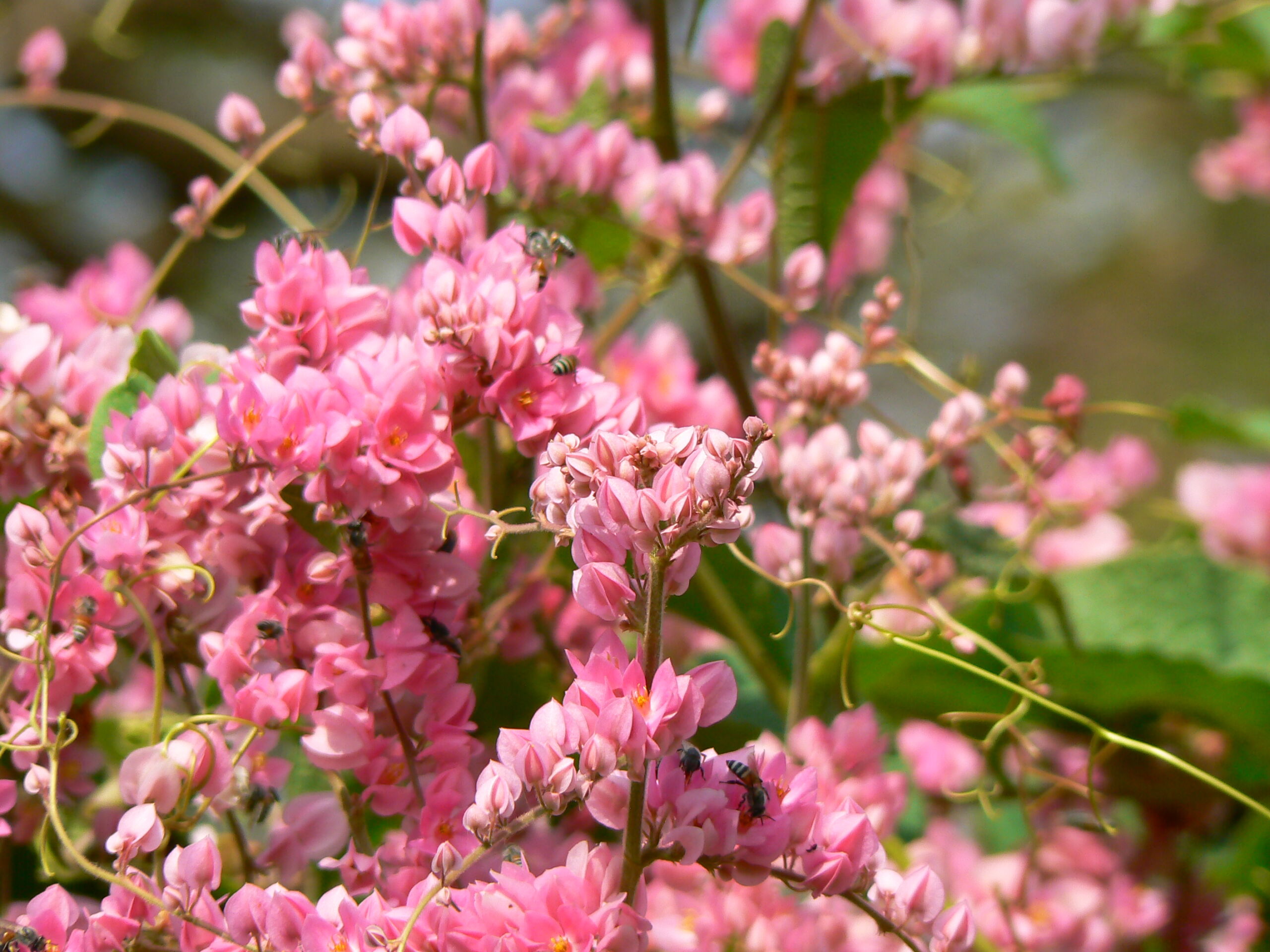
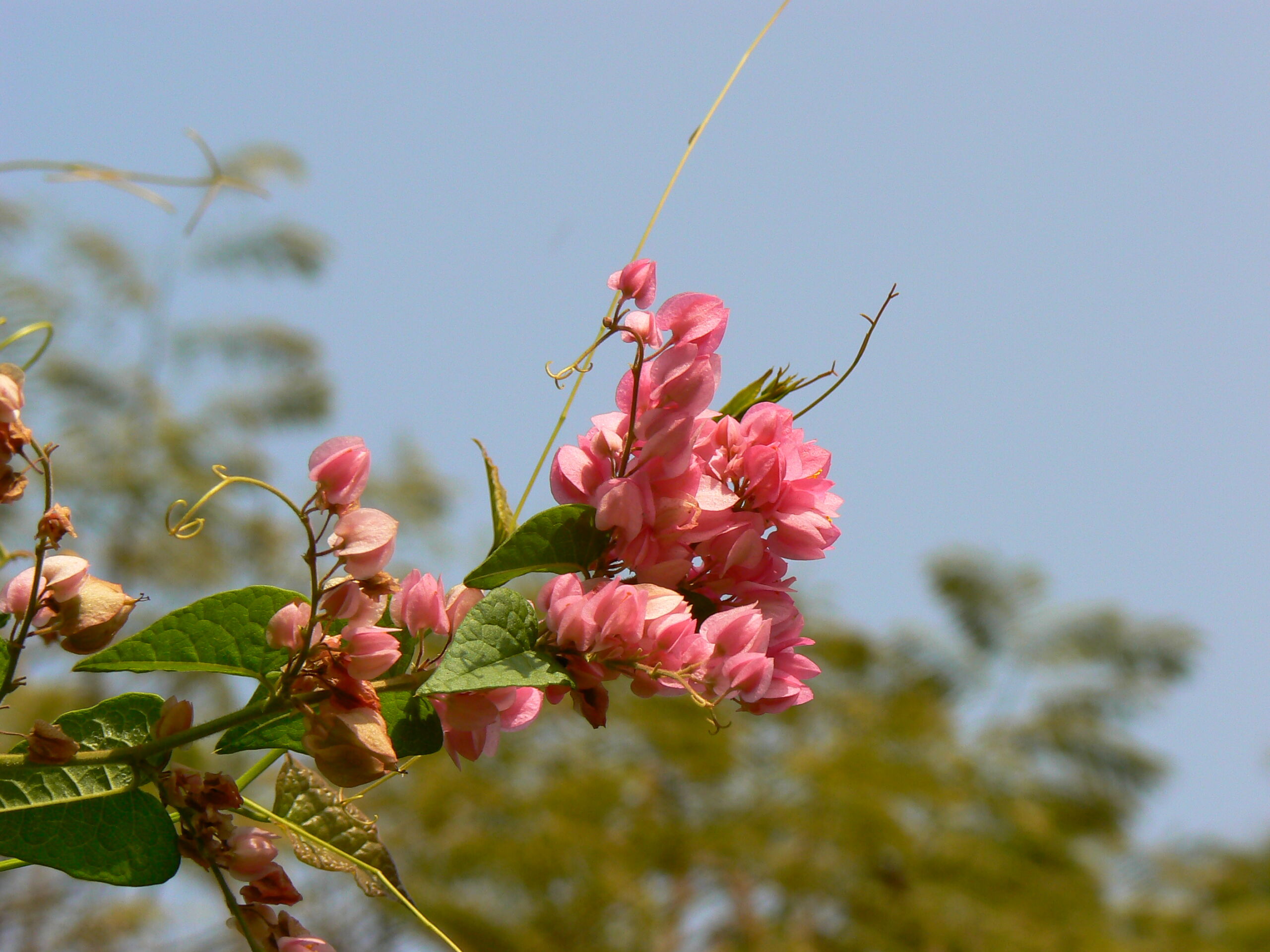
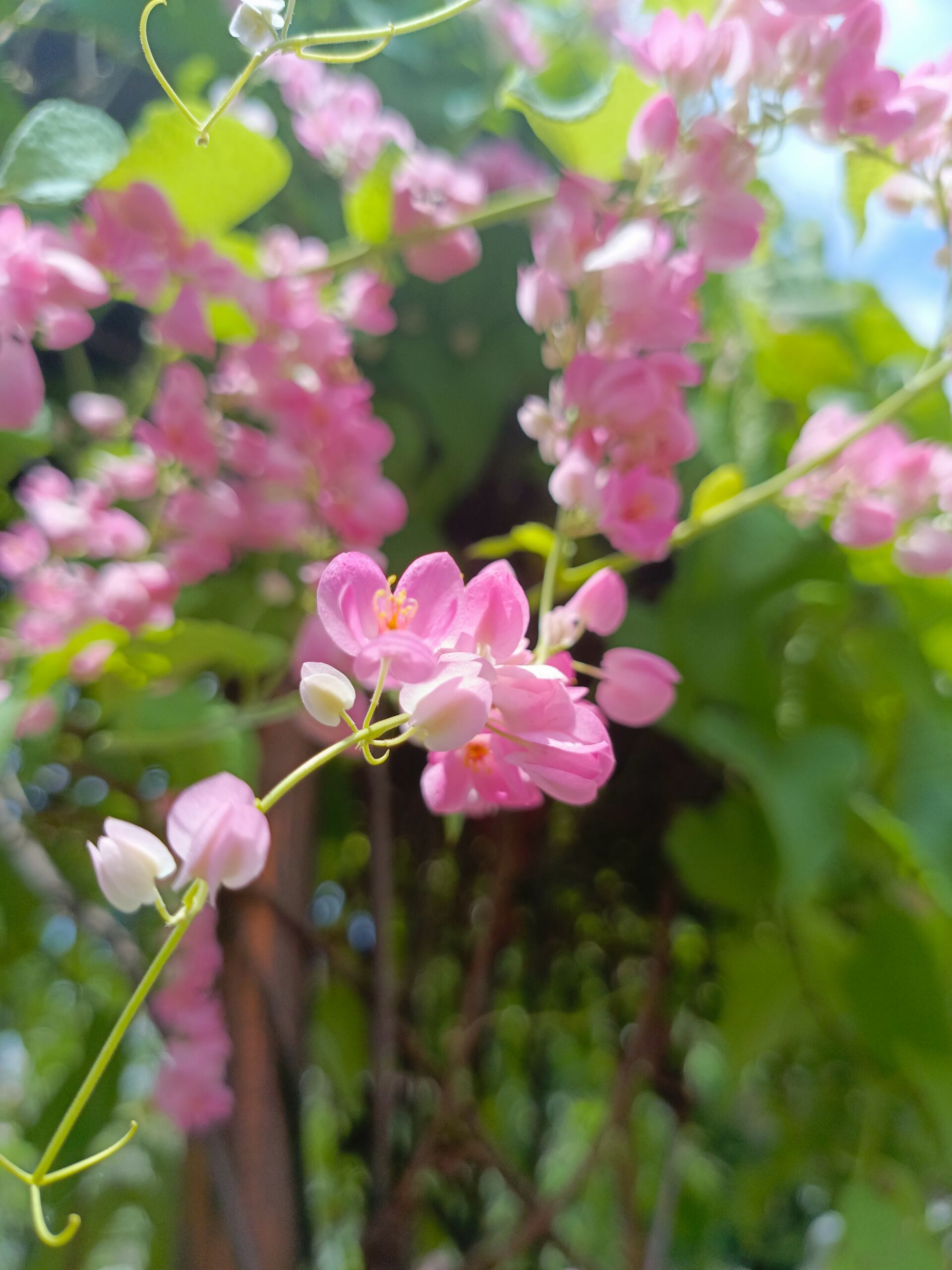
The leaves are the first clue. They are heart-shaped to arrow-shaped (cordate), 1 to 5 inches long, with a pointed tip, a heart-shaped base, and a slightly wavy or toothed margin, carried on short stalks along the stem. The stems themselves are slender and green when young, becoming woody at the base with age, and they end in tendrils that do the climbing. The flowers are the show: small but massed in great numbers in long, loose panicles and racemes at the ends of the stems, each flower with five petal-like tepals — coral vine has no true petals — most often a vivid pink, but also red or white in some forms, with eight stamens and a three-angled ovary. The flower clusters are famous for ending in tendrils themselves, a quirk of this genus: the inflorescence just keeps growing and grabs hold of whatever it touches. Flowering runs from spring through autumn in subtropical gardens and can continue year-round in the tropics, which is why a fence of coral vine is rarely without a few flowers, and why bees, butterflies, and hummingbirds visit it constantly.
Underground is where coral vine becomes hard to kill. It grows large, tuberous roots and thick rootstocks that store energy and resprout after the top is cut, frozen, or burned. It is also a prolific seed producer, and the seeds are built for travel: they float on water, survive ingestion by birds, and are spread by animals including raccoons and pigs. A plant that climbs 40 feet, resprouts from tubers, and seeds itself down every drainage ditch is a plant with a plan, and that plan is how coral vine went from Mexican native to invasive species on several continents, including Hawaii, Guam, the Caribbean, Australia, and, most relevantly for this site, Florida.
For butterflies, coral vine is a nectar plant, not a host plant: the lyside sulphur and the orbed sulphur are the two butterfly guides that list it among their nectar plants. Its flowers are genuinely excellent nectar sources, which is part of the tragedy of its invasive status — it feeds pollinators while smothering the native plants those pollinators also need. In Florida, the Florida Exotic Pest Plant Council lists it as a Category II invasive species, and the University of Florida’s Institute of Food and Agricultural Sciences (UF/IFAS) Assessment rates it as a High Invasion Risk in Central, North, and South Florida zones, with the conclusion: “Predicted to be invasive and not recommended by IFAS.” The UF/IFAS plant directory is blunter: “Do not plant this species in home landscapes. Do not transport the plant to new areas.” This guide is written for identification, for gardeners outside its invasive range, and for Florida readers who need to know what is growing on their fence and what to do about it.
How to grow
Where coral vine is not listed as invasive and is legally grown, it is almost embarrassingly easy to grow, which is the whole problem in a sentence. Give it full sun — it tolerates part shade but flowers best in sun — and average, well-drained soil with medium moisture. It tolerates poor soil, clay, sand, and slightly alkaline conditions, and once established it is highly drought-tolerant. Plant in spring after frost, spacing plants 36 to 60 inches apart, and give it a strong support from day one: a sturdy fence, pergola, or trellis, because a mature vine is heavy and it will climb whatever is nearest, including the tree you did not intend it to climb. In USDA zone 8 it is deciduous, dying back in winter and resprouting from its tubers in spring; in the tropics it is evergreen and can grow year-round. It is cold-sensitive above ground but root-hardy in the warmer parts of its range, so a freeze that kills the top to the ground is an inconvenience, not an ending.
In Florida, do not plant it, and do not accept cuttings or seedlings from a neighbor. If you already have it, containment is the project: cut the vine back hard and repeatedly, dig out as much of the tuberous root system as you can find, and never dump cuttings, seeds, or tubers where they can reach soil or water. Seeds float, so a pile of trimmings near a ditch is a new infestation waiting for the next rain. Report significant infestations to your local extension office or invasive species program, and consider replacing it with one of the native vines named at the end of this guide, which give you the same cascading flowers without the ecological bill.
Propagation is trivially easy, which is another reason to be careful: cuttings root readily, seeds germinate readily, and tuber divisions resprout readily. If you grow it where it is permitted, keep it away from natural areas, cut the flower heads before seed sets if you do not want volunteers, and never share it with a gardener in a region where it is listed as invasive. A plant this vigorous does not need your help spreading; it needs your restraint.
Water & feeding
Coral vine wants average moisture and then wants to be left alone. Water regularly while it establishes and during extended dry spells, but once the tuberous roots are in, it tolerates drought well and needs little supplemental water. Overwatering is more likely to cause trouble than underwatering, especially in heavy soil, where the tubers can rot if they sit wet for long periods. Its salt tolerance is poor, so it is not a good choice for unprotected coastal sites despite its tropical looks — that is one more reason its Florida success is inland and suburban rather than beachfront.
Feeding is minimal. A light application of a balanced fertilizer in spring is more than enough, and in rich soil it needs nothing at all. Overfeeding produces exactly what you do not want from a plant like this: even more growth, even faster. Mulch around the base to conserve moisture and suppress weeds, keeping mulch off the crown, and let the vine’s own vigor do the rest. If your coral vine is growing slowly, the usual cause is too little sun or a cold winter, not hunger.
Common problems
- It is invasive (Florida and beyond): This is the problem that matters. Coral vine smothers native vegetation, climbs into tree canopies, and spreads by seed and tubers into natural areas. It is listed as invasive in Florida (Category II), Hawaii, Guam, the Caribbean, Australia, and elsewhere, and UF/IFAS rates it High Invasion Risk across Florida. If you live where it is listed, the correct response is removal, not management.
- It resprouts from tubers: Cutting the top off does not kill coral vine. The tubers and rootstocks resprout, sometimes repeatedly, and any fragment left in the soil can start again. Removal means digging, and digging means getting the tubers out, not just the vines.
- Seeds travel: Seeds float on water and are eaten and spread by birds and other animals. Never compost seed heads, never dump trimmings near water, and cut flower heads before seed sets if you are growing the plant where it is permitted.
- It smothers its support: Left alone, coral vine will cover a fence, a shrub, and then the tree behind the shrub. Prune hard in late winter or early spring, before new growth starts, and keep it off trees and structures you value.
- Cold damage: In zone 8 and the cooler parts of zone 9, frost kills the top growth to the ground. This looks fatal and usually is not; the tubers resprout in spring. In colder zones it will not survive winter outdoors at all.
- Pests and diseases: Coral vine has few serious pests in the garden, which is part of why it is so successful. Occasional leaf-spot fungi and caterpillar feeding occur but rarely slow it down. Its real “pest” status is the plant itself, in the wrong place.
- Confusion with other vines: Coral vine is sometimes confused with other pink-flowered vines, including some morning glories. Check the leaves (heart-shaped, buckwheat family, no milky sap) and the flower structure (five tepals, no funnel-shaped corolla, tendrils at the ends of the flower clusters) before deciding what you are looking at.
Harvest
Coral vine’s harvest is mostly cautionary. The flowers are its harvest for pollinators: bees, butterflies, and hummingbirds visit them heavily, and a vine in full flower is a genuine wildlife event. Historically, the tubers and seeds were eaten in Mexico — the seeds were traditionally toasted and popped like popcorn, and the tubers were cooked — but those are documented historical uses, not recommendations. Do not eat coral vine from a garden or a wild stand without expert local knowledge, and never harvest it in a way that spreads it: every cutting, tuber, and seed head you carry away is a potential new plant somewhere else. If you are removing coral vine, bag the material, dispose of it with household waste or by a method your local invasive program recommends, and do not compost it. The best harvest from a Florida coral vine is an empty fence and a native vine planted in its place.
Seed prevention, not seed saving
Let us be blunt up front, because this section has a different job from every other seed section on this site: do not save coral vine seed, do not sow it, do not share it, and do not plant it somewhere new. Coral vine, Antigonon leptopus, is listed as a Category II invasive plant in Florida, and the University of Florida’s Institute of Food and Agricultural Sciences does not recommend planting it. This is not a plant that needs your help reproducing. It is a plant that needs you to stop it reproducing, and the seed is the main way it wins.
Understanding the seed is understanding the invasion. Coral vine is a prolific seed producer, and its seeds are built for travel: they float on water, so a rainstorm or a ditch can carry them to a new fence line, and they are eaten and spread by birds and other wildlife, so a vine in your yard can seed a natural area you will never visit. Where the pink flowers were, papery flower parts wrap around small, three-angled, dry fruits, easy to overlook and easy to scatter. On top of that, the vine spreads underground through tubers and rootstocks that resprout after cutting or frost, and through stem fragments, so even a vine you think you removed can return from below. Seed plus tubers plus fragments is a triple threat, and it is why coral vine smothers fences, trees, and native plants across south and central Florida instead of staying politely on its trellis.
Prevention, then, is the whole technique, and timing is everything. If you already have coral vine, cut it back before the flowers turn to seed, and do it with a bag in hand: snip spent flower clusters directly into a bag so loose seed falls into the bag and not onto the soil. Bag all flower, fruit, and seed material and dispose of it with household waste, never in compost, never tossed over the fence, and never carried to another part of the yard. Cutting the top growth alone will not finish the job, because the tubers will resprout; you will need to dig tubers out where you can, or cut regrowth repeatedly until the stored energy runs down, which takes persistence across more than one season. Check the spot after rain, too, because water moves seed even when you did everything right.
The kindest thing to do with a coral vine seed is to make sure it never becomes a plant, and the kindest thing to do with a fence that wants a pink-flowered vine is to plant a native instead. This guide already names the good swaps: coral honeysuckle, with tubular coral-red flowers beloved by hummingbirds; crossvine, a vigorous native climber with orange-red trumpets; and passionflower, the native maypop, with extraordinary purple-and-white flowers that feed Gulf fritillary caterpillars. None of them will eat your fence, and all of them belong here. So enjoy coral vine’s flowers where they already are, admire the pollinators working them, and then, before the seed sets, cut, bag, and trash. That is the seed work this plant deserves.
Varieties
No verified, named garden varieties of coral vine were found in the sources consulted for this guide, so this section is honest about that gap. What gardeners do encounter are color forms, not named varieties: the usual vivid pink, a white-flowered form, and a darker red form, all sold under the species name. Some nursery listings describe cultivated selections with white or dark red flowers, but the names are inconsistent across sources and no single cultivar name could be verified well enough to list here. If you see coral vine sold under a cultivar name, treat it as the species with a color label, not as a distinct, better-behaved plant — the invasive behavior belongs to the species, and a white flower does not change it.
Native alternatives worth planting instead: If you want the cascading pink flowers without the invasive risk, Florida and Gulf Coast gardeners have excellent native options, named here in plain text so you can search for them: coral honeysuckle (Lonicera sempervirens), with tubular coral-red flowers beloved by hummingbirds; crossvine (Bignonia capreolata), a vigorous native climber with orange-red trumpet flowers; and passionflower (Passiflora incarnata), the native maypop, with extraordinary purple-and-white flowers that feed Gulf fritillary caterpillars. None of them will eat your fence, and all of them belong here.