
🍃 Curled Dock
What it looks like
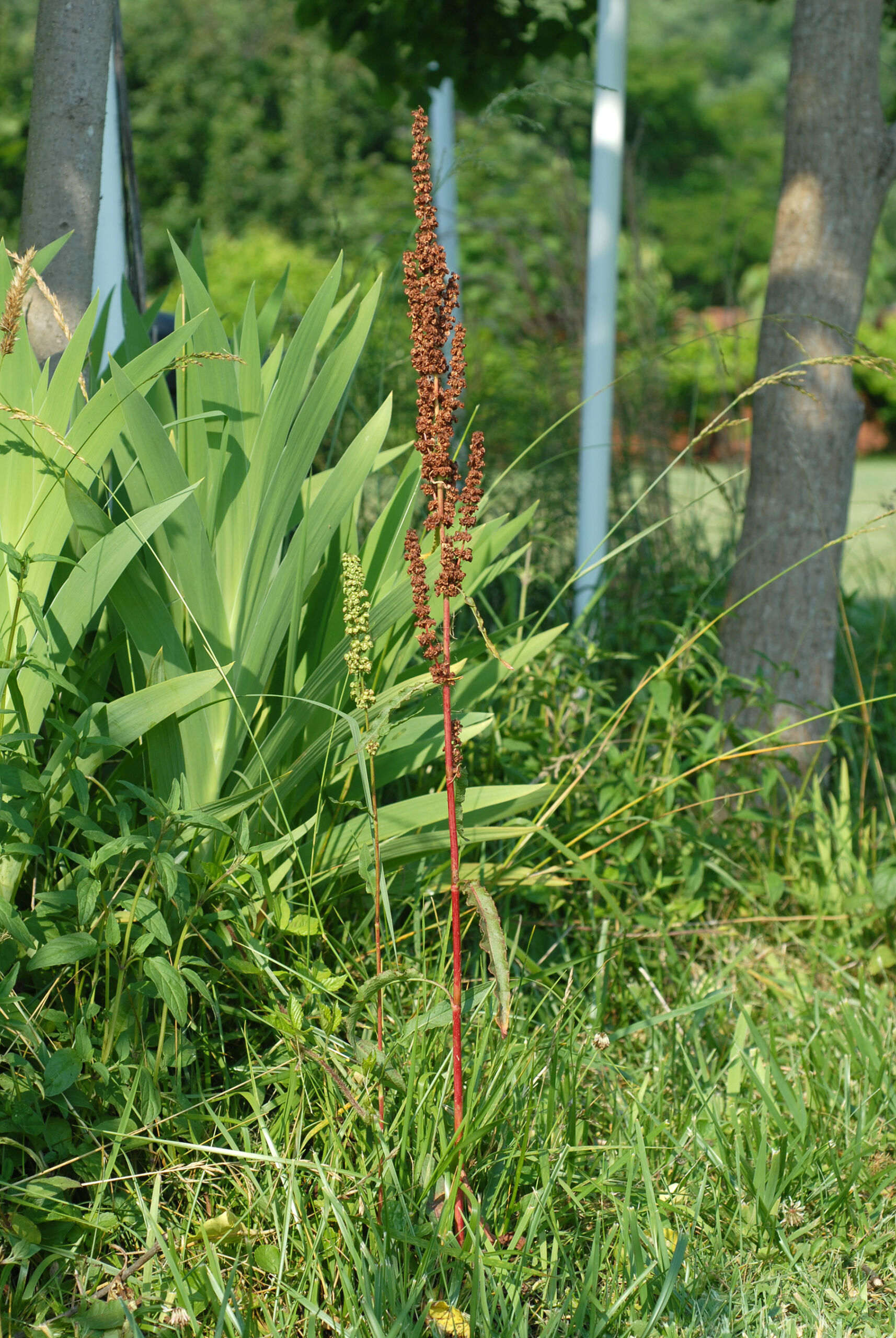
First, the name-clearing, because dock is a whole genus and this guide is about exactly one species: curled dock is Rumex crispus, also called curly dock or yellow dock. The site’s Dock genus guide covers Rumex in general; this guide covers R. crispus specifically, and the two are not interchangeable — a species guide for one dock does not cover the genus, and a genus guide does not tell you the particulars of this plant. When butterfly guides list “curled dock” as a host plant, they mean this species, and this is the guide those links point to.
The name is a perfect description, which is rare enough in botany to celebrate. Rumex is the ancient Latin name for the docks and sorrels, and crispus means curled — and curled dock’s leaves are unmistakably curled, with wavy, crisped margins that look as if someone ran a crimping iron along each edge. It is a perennial herb in the buckwheat family, Polygonaceae, native to Europe and western Asia and now naturalized across temperate regions worldwide, including throughout the United States. It grows upright or semi-upright, 40 to 150 cm tall, from a large, fleshy, yellow, forking taproot that can run deep — one of the reasons it is so hard to remove, and one of the reasons herbalists wanted it.
The plant starts as a basal rosette of smooth, lance-shaped leaves with those signature waved edges, the lower leaves reaching 14 to 24 cm long and sometimes much more, on long stalks. Then it bolts: a stout flowering stalk rises to about 1.5 metres (5 feet), carrying clusters of small greenish or reddish-tinged flowers in whorls along branched stems, the largest cluster at the apex. The flowers are not showy — dock does not do showy — but the fruiting stage is handsome in its own way: the plant turns reddish-brown, and each seed is a shiny brown achene wrapped in the flower’s calyx, a papery three-winged case with a telltale rounded swelling (tubercle) on it. Those cases let the seeds float on water and catch in wool and animal fur, which is how a Eurasian weed colonized the planet without buying a single plane ticket.
Telling curled dock from its relatives is a useful skill. Broadleaf or bitter dock (Rumex obtusifolius) has flatter, broader leaves and fruit valves with teeth along the edges; curled dock’s fruit valves are smooth-edged, rounded, and usually carry that single rounded tubercle. Hybrid docks blur the lines — R. crispus hybridizes readily with other Rumex species — so a plant with in-between characters is not your imagination failing, it is dock genetics doing what dock genetics does.
How to grow
Let us be honest about what “growing” curled dock usually means: for most gardeners it means managing a plant that arrived uninvited, and the advice below covers both deliberately growing it and dealing with it, because the two are the same plant with different attitudes. Curled dock will grow in full sun to part shade, in moist to dry conditions, and in most soil types; it tolerates drought, temporary flooding, and occasional mowing, and it shows up in disturbed soil, waste areas, roadsides, fields, meadows, shorelines, and forest edges. It is not fussy. It is the opposite of fussy.
If you deliberately want it — for butterfly habitat, for the edible young leaves, or for the traditional root harvest — sow seed in spring or autumn in a sunny spot with decent soil, thin seedlings to 12 to 18 inches apart, and then mostly leave it alone. Seed needs light and alternating temperatures to germinate well, so sow shallowly and do not bury it deep. It will form a rosette in its first season and bolt in its second, though in mild climates it can behave as a shorter-lived plant. Give it room, because a mature dock is a big plant with a bigger root, and it shades its neighbors without apology.
Florida note: curled dock is present in Florida and across the southeastern United States, and it grows here as the same tough weed it is everywhere else — it likes seasonally moist ground and disturbed soil, and it will show up in garden beds, paths, and field edges whether invited or not. Do not plant it near natural areas anywhere, and in Florida do not let it seed into wetlands or ditches: a plant whose seeds float downstream is a plant that does not stay where you put it. For butterfly habitat, the honest Florida advice is to tolerate the plants that arrive on their own in a managed corner rather than sowing it deliberately — the copper butterflies that use it will find volunteer plants perfectly well.
Removing curled dock, should you want to, is a root job, not a leaf job. Cut it down and it regrows from the crown; dig out the whole taproot, yellow fork and all, and you have a chance. Even then, seeds in the soil stay viable for decades — reported to remain viable for up to 50 years in some accounts — so a cleared patch can sprout dock again years later. This is not a failure of your weeding. This is dock being dock.
Water & feeding
Water it if you are growing it deliberately, and do not bother if you are not — it will find its own. Curled dock prefers moist ground but tolerates dry spells once its taproot is down, and it handles temporary flooding that would drown fussier plants. In a garden bed, water during dry spells in the establishment year and then back off; a mature plant with a deep taproot is largely self-sufficient, and overwatering just makes it bigger and more enthusiastic about seeding.
Feeding is unnecessary and, if your goal is control, counterproductive. Dock thrives on poor to middling soil and does not need fertilizer; feeding it produces a larger plant with more seed, which is the opposite of what most gardeners want. If you are growing it for leaf harvest, a little compost keeps the leaves tender, but the plant will produce leaves on neglect alone. The taproot’s job is hauling nutrients up from the subsoil, and it is very good at its job.
Common problems
- It seeds everywhere. A single plant produces thousands of seeds, and they stay viable in soil for decades. If you do not want dock forever, cut flower stalks before seed sets. This is the single most important management point.
- It regrows from the root. Mowing, cutting, or snapping the top off leaves the crown and taproot intact. Dig the whole root out, or expect a comeback.
- It hybridizes. Curled dock crosses readily with other docks, so odd-looking plants with in-between characters are common. Do not agonize over a perfect identification on a hybrid — note it and move on.
- Oxalic acid. Like sorrel and rhubarb, dock leaves contain oxalates, which give the sharp, sour taste. Young leaves in small amounts, cooked, are the traditional use; older leaves get bitter and tougher, and large quantities are not a good idea, especially for people prone to kidney stones.
- It is a weed with a reputation. Curled dock is listed as a noxious or environmental weed in parts of Australia and elsewhere, and it is unwelcome in pastures and crops. Check your local rules before deliberately planting it, and never plant it near natural areas.
- Copper caterpillars defoliate it. American copper and gray copper caterpillars eat curled dock leaves — that is the butterfly connection, and it is a feature, not a bug. A chewed dock in a butterfly corner is doing its job.
Harvest
Harvest depends on which dock you want. For greens, pick young spring leaves from the rosette before the plant bolts, when they are tender and least bitter, and cook them — boiling in a change or two of water tames both the bitterness and the oxalates. They cook down like spinach with a lemony tang, and they were historically eaten as a spring potherb, including by people who used the young stems as a rhubarb substitute in pies. Treat this as a traditional use in small amounts, not a staple: dock is a weed you can eat, not a vegetable you should live on.
For seed, let the stalks ripen until the papery cases turn brown, cut the whole stalk, and thresh it over a sheet — but only do this if you genuinely want more dock, because you will get more dock, for years, whether you want it or not. For root, the traditional harvest is autumn, digging the yellow taproot, cleaning it, slicing it, and drying it for tea or tincture use in herbal practice. The yellow color comes from anthraquinone compounds, including chrysophanic acid and emodin, the same family of compounds that make the root a traditional gentle laxative and skin remedy. This guide reports that traditional use without prescribing it: dock root is a strong-tasting herbal medicine, not a casual tea, and anyone using it medicinally should know what they are doing or ask someone who does.
Preventing seeds
Let us be blunt up front: this is not a section about saving curled dock seed, because deliberately saving curled dock seed is a terrible idea. Curled dock (Rumex crispus) is a weedy Rumex that already does its own seed saving with far more enthusiasm than any gardener should. A single plant can produce tens of thousands of seeds, each one wrapped in a papery, winged case built for travel — it floats on water to new ground and snags onto fur, feathers, and wool for an overland lift. Worse, that seed stays alive in the soil for decades, so one careless summer can stock your beds with dock seedlings for years to come. The plant does not need your help. It needs a deadline.
The deadline is simple: cut every flower stalk at its base as soon as the flowers fade, before the papery cases turn brown and harden. Do not wait until the stalk looks dramatic and rust-coloured, because by then the seed is already viable and every bump of the stalk shakes it loose. Cut on a calm day, lower the stalk gently into a bag rather than carrying it open across the garden, and put the bag in the trash — not the compost heap. Home compost rarely gets hot enough to kill dock seed, and composting a seed stalk is just laundering next year’s weeds through this year’s bin. The same goes for pulled plants with seed heads attached: bag them, trash them, and do not leave them lying on the ground to finish ripening out of spite.
Two more habits complete the prevention plan. First, respect the taproot: dock regrows from root fragments, so chopping a plant up while digging, or tossing roots on the compost, just multiplies it. Dig deep, get the whole root, and dispose of fragments the same way as seed heads. Second, harvest young leaves before the plant bolts if you eat dock at all — picking the rosette young doubles as weed control, since a plant kept in leaf never gets to flower. Mowing also stops seed production on a patch you cannot dig out, though it will not kill the taproot. Expect to patrol for seedlings for years after any plant that did set seed; that is not failure, that is the seed bank doing exactly what evolution designed it to do, and your job is simply to never let it restock.
Varieties
Curled dock is usually met as the species, not as a cultivar — nobody is breeding show docks for the garden center. But it does have recognized subspecies with distinct habitat preferences, and they are worth knowing because they explain why the “same” plant turns up in such different places.
Rumex crispus subsp. crispus — the typical form, found on waste and cultivated ground, the dock of roadsides, gardens, and fields.
Rumex crispus subsp. littoreus — the coastal form, found along shores and in salty, windswept places where the typical form would sulk.
Rumex crispus subsp. uliginosus — the wet form, found on tidal estuarine mud and in places that spend part of the year underwater.
Other subspecies have been described, and the species hybridizes freely with its relatives, so field plants do not always fit neatly into one box. Gardeners will also meet it under its common names — curly dock, curled dock, yellow dock, sour dock, narrow-leaf dock — which all refer to this same species, though “yellow dock” is sometimes used loosely for other docks too, so Latin is the safer label when it matters.
For most gardeners, the honest advice is this: you do not need to buy curled dock, and you probably should not. Learn to recognize it, decide whether the patch in your garden is a butterfly corner or a weed problem, and manage it accordingly — cut before seed if it is a problem, leave a plant or two standing if the coppers are using it.