
🌿 Cuscuta
What it looks like
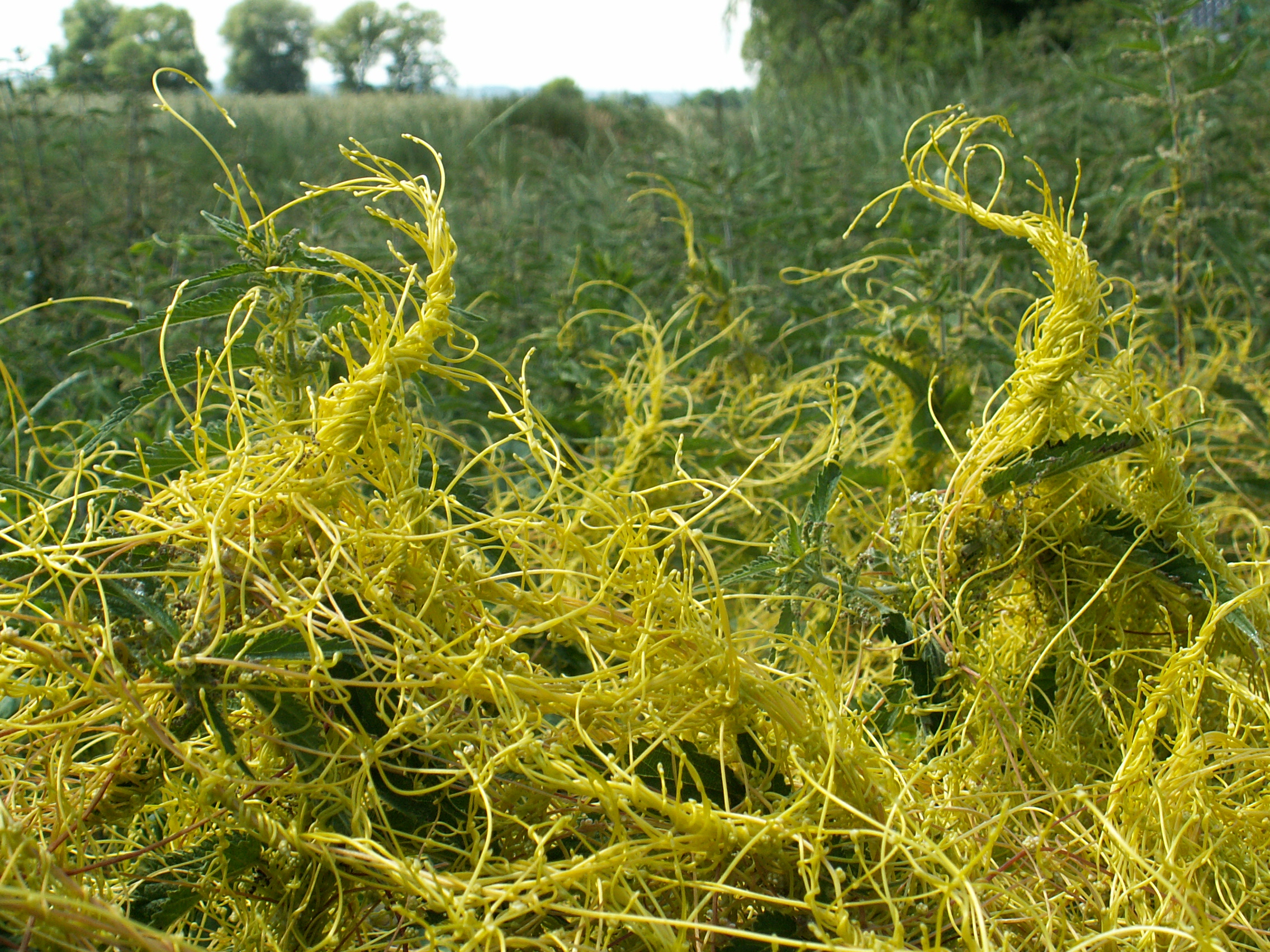
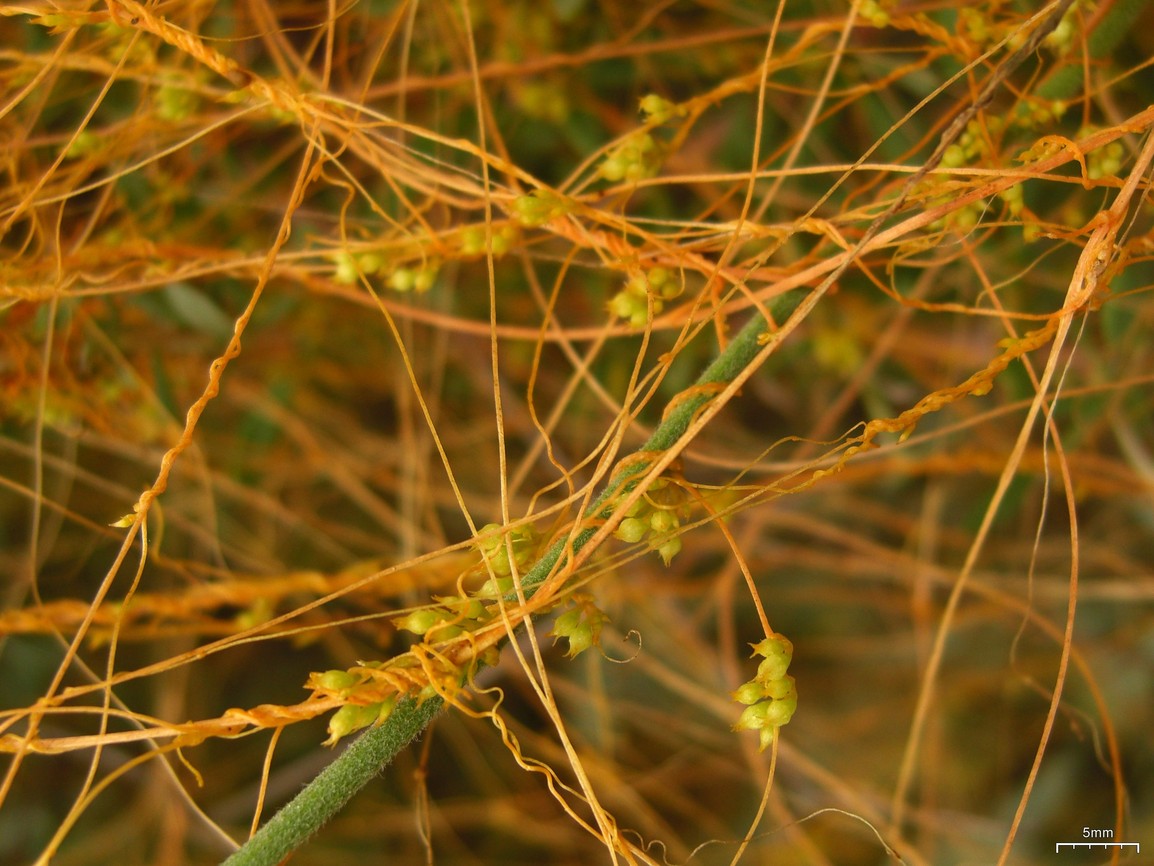
First, the warning, because this guide breaks the usual pattern twice over: this is a guide to a plant you should learn to recognize and never plant, and to a plant that does not really grow in the way garden guides usually mean. Dodder is the common name for the genus Cuscuta, and it is one of the strangest plants in North America: a vine with no real leaves, no real roots, and almost no chlorophyll, that lives entirely by stealing from other plants. If you have ever seen a shrub or a crop row draped in a tangled net of yellow, orange, or red spaghetti, you have seen dodder. Gardeners have given it a whole shelf of folk names — strangle tare, devil’s guts, wizard’s net, love vine, angel hair — and every one of them is a description of what it looks like when it arrives. This guide is here so you can name it on sight, understand what it is doing, and stop it before it seeds.
The genus is Cuscuta, established by Linnaeus in 1753, and it contains roughly 170 to 200 species depending on which treatment you follow — the count varies because dodder species are notoriously hard to tell apart, and treatments disagree about where one species ends and the next begins. It was once given its own family, Cuscutaceae, but molecular work has nested it inside the morning glory family (Convolvulaceae), which makes dodder, in evolutionary terms, a morning glory that took a very surprising turn: it kept the twining vine habit and threw away almost everything else. The plants are obligate parasites, meaning they cannot complete their life cycle without a host. Most are annuals, though a few persist longer, and they occur in temperate and tropical regions worldwide, on a huge range of hosts — broadleaf crops, ornamentals, native plants, weeds, and some monocots.
In the field, dodder is unmistakable once you know it, and that is the point of this section. The stems are slender, thread-like, and fleshy, usually 0.5 to 1.5 millimeters across, in shades of pale green, yellow, orange, or red depending on the species and the host’s nutrients, twining and coiling around the stems and leaves of host plants in a dense, tangled net. There are no true leaves: only minute, triangular scales, 1 to 2 millimeters long, along the stems. There are no roots on a mature plant. The flowers are tiny, bell-shaped, white, cream, or sometimes pinkish, about 2 to 5 millimeters across, clustered in dense groups along the stems, usually in summer and early autumn. The fruits are small, rounded capsules, each containing 1 to 4 tiny, hard-coated seeds about 1 to 2 millimeters across. A single plant can produce an enormous number of seeds, and those seeds, with their extremely hard coats, can remain viable in soil for up to 20 years in optimum conditions — which is why a dodder patch you cleared this year can come back from seed a decade later, and why the management section below is about years, not weekends.
The parasitism itself is the nerdy heart of the genus, and it is worth understanding because it explains every management rule. A dodder seed germinates in soil and sends up a slender, yellowish shoot with no roots. That seedling has days, not weeks: it must contact a suitable host within about 5 to 10 days or it dies. It finds the host by growing toward it, guided by touch and by chemical cues from the host plant. On contact, the stem coils around the host and develops haustoria — small, wart-like suckers that penetrate the host’s tissue and tap directly into its vascular system, drawing off water and photosynthates, the sugars the host made by photosynthesis. Once attached, the seedling’s connection to the soil withers away, and the dodder is now entirely dependent on its host, growing rapidly, branching from one host plant to the next, and smothering a circle of vegetation that can reach 10 feet across from a single plant. Infected hosts show reduced vigor, yellowing leaves, stunted growth, reduced flowering, and reduced yield, and a heavy infestation can kill them outright. Dodder can also carry plant viruses between hosts, acting as an alternate host for some viral plant diseases — one more reason a patch is not a curiosity to leave alone.
The butterfly context for this genus guide is a single Host plants mention at exactly the genus level, and it is the reason a genus guide, rather than a species guide, is the honest unit. The Brown Elfin guide lists its major western hosts as madrone (Arbutus species) and dodder (Cuscuta species) — dodder named as the genus Cuscuta, with no species stated. This draft covers that genus-level form, “dodder” and “Cuscuta”, only. It does not assign the Brown Elfin’s dodder to any one species, because the guide does not say which one. And a plain statement of the relationship, because it surprises people: the Brown Elfin is a butterfly whose caterpillars feed on a parasite. The caterpillars eat dodder stems, which are themselves eating a host plant — a food chain with a thief in the middle. That does not make dodder a plant to introduce: the Brown Elfin also feeds on bearberry, leatherleaf, Labrador tea, madrone, and a long list of other hosts, and a gardener feeding Brown Elfins has no reason to plant a parasite to do it.
One plain-text disambiguation, because dodder has a famous lookalike that is not a dodder at all. The laurel dodder or love vine of the laurel family (Cassytha filiformis) is a thread-like stem parasite of tropical trees that looks strikingly like a Cuscuta and is sometimes called dodder, but it belongs to a different family entirely (Lauraceae) and is not covered here. Within Cuscuta, the species a North American gardener is most likely to meet are field dodder (Cuscuta campestris), the widespread pest of alfalfa and other legumes, native to central North America and now a weed worldwide; five-angled dodder (Cuscuta pentagona), long confused with field dodder in the literature but a distinct species; European dodder (Cuscuta europaea), the Eurasian species photographed in this guide; California dodder (Cuscuta californica), the western species photographed in this guide; and lesser dodder (Cuscuta epithymum), the red-pigmented Eurasian species of thyme and gorse. Species identification in the field requires flowers and fruiting material and often a specialist, which is another reason this guide stays at the genus level for its butterfly wiring: the genus is what you can recognize, and the genus is what the butterfly guide names.
How to grow
There is no growing section in the usual sense for dodder, and this guide does not pretend otherwise. Do not plant it. Do not sow its seed, do not transplant a strand of it onto a host “to see what happens,” and do not move soil, hay, or plant material from an infested patch to a clean bed. Dodder seed travels with contaminated crop seed, with hay and forage, with soil on equipment, tools, and footwear, and with water runoff, and a single season of carelessness can seed a patch that outlives your tenancy. If you buy seed — especially clover, alfalfa, or other legume seed, the crops dodder loves most — buy certified dodder-free seed from a reputable source, and check the label. If you bring in hay or mulch, know where it came from. Prevention, in the extension literature, is consistently called the most cost-efficient control there is, and for once the literature is understating it: prevention is the only control that does not take years.
What follows, then, is not growing advice but the management half of the guide, because a gardener who finds dodder needs to know what to do on the day they find it. The critical window is early. A new infestation, before attachment, can be controlled by hand-pulling, cultivation, or mowing — pull the seedlings before they find a host and they die on their own. After attachment, the rules change: cut the host plant below the point of attachment, and remove all dodder and debris, bagging it or burning it (where burning is legal and safe) before seeds ripen, because stem fragments can resprout and seeds in debris will seed the next patch. Do not compost dodder material. Clean equipment, tools, and footwear thoroughly before leaving an infested area, and do not transport infested material or forage to other areas. Where dodder is established, rotate away from host plants toward non-hosts, and avoid planting susceptible hosts in the infested ground until the seed bank is exhausted — which, given seed viability measured in decades, means planning in years and checking the patch every season for resprouts. Extension sources also discuss herbicide options, including pre-emergence treatments that reduce dodder establishment and contact treatments applied to both dodder and host, but this guide does not prescribe chemicals: herbicide registrations, rates, and legal status vary by place and by crop, and the right call is your local extension service, the product label, and the rules where you live — not a garden guide.
Florida note, stated plainly. Dodder occurs in Florida, as it occurs across most of the United States, and Florida gardeners should know it on sight — the orange spaghetti on a shrub or a crop row is not a fungus, not a vine you planted, and not something to admire for a season. It is a parasite with a seed bank measured in decades, and the response is the same as anywhere: remove it before it seeds, bag or burn the debris, clean your tools, and do not move infested material. The Brown Elfin, the butterfly behind this guide’s genus mention, is a northern and western butterfly, and its dodder hosts are western hosts — Florida gardeners spotting dodder are dealing with a pest to manage, not a butterfly host to protect, and this guide does not ask them to do otherwise. If you are unsure whether a thread-like orange vine is dodder, take a sample (bagged, not loose) to your local extension office for identification before you act on a guess.
Water & feeding
Water and feeding, for dodder, are questions you ask the host, not the parasite — which is the whole joke and the whole problem. Dodder takes its water and its sugars from the host plant through its haustoria, so a well-watered, well-fed host is a well-fed dodder, and a stressed host is a dodder with a shrinking pantry. There is no fertilizer program for dodder, no watering schedule, and no soil pH to adjust, because the parasite does not touch the soil after its first days of life. The soil science that matters here is the seed bank: hard-coated dodder seeds sitting in soil, waiting years for the right germination conditions, are a soil problem in the strictest sense — a reserve of future infestations stored in the ground you garden. Tillage can exhaust that bank over time if no host plants are present, because seedlings that germinate and find no host die, but tillage also brings buried seed to the surface, so it is a multi-year strategy, not a single pass. The honest summary is that dodder’s water and feeding section is one sentence long: it eats what your plants eat, and the way to starve it is to remove it and its hosts from the ground it has seeded.
Common problems
- It spreads by seed for decades. The defining problem. Hard-coated seeds stay viable in soil for up to 20 years in optimum conditions, so a cleared patch needs watching for seasons, not weeks, and soil moved from an infested area carries the problem with it.
- It spreads by fragments. Stem pieces can resprout and reattach. Bag or burn all removed material before seeds ripen; do not compost it and do not leave it on the ground.
- It smothers and weakens hosts. A single plant can cover a circle up to 10 feet across, reducing host vigor, flowering, and yield, and killing heavily infested plants. Ornamental shrubs, crops, and native plants are all fair game — dodder is famously non-specific about its hosts.
- It carries plant viruses. Dodder acts as an alternate host for some viral plant diseases and can move them between plants. A patch near a vegetable garden or a crop is a disease risk, not just a weed problem.
- It arrives in seed and hay. Contaminated legume seed, hay, forage, and mulch are the classic routes in. Buy certified dodder-free seed, know your hay source, and clean equipment after working infested ground.
- Species identification is hard. Field dodder, five-angled dodder, and their relatives are difficult to separate without flowers, fruit, and often expert help. Manage it at the genus level — it is dodder, and it needs removing — and send a bagged sample to extension if the species matters for regulation or reporting.
- Some dodders are regulated. Dodder species appear on noxious-weed and quarantine lists in various places, and seed lots may need to be certified free of contamination. Check your local and state rules before moving any material that might contain it.
Harvest
There is no harvest in this guide, and that omission is deliberate. Dodder is not a food plant, not a medicine plant, and not a craft plant for a home gardener — it is a parasite whose only yield is more dodder. Its historical folk uses, where they exist, belong to herbal traditions this guide does not recommend, and its one modern “use,” as a research organism for studying parasitism, belongs to laboratories, not gardens. The only harvest worth naming is the one to prevent: the seed harvest. If you find dodder, the crop you are trying to stop is the round capsule with its 1 to 4 hard seeds, ripening in late summer and autumn, and the way to stop it is to remove the vines before those capsules ripen, bag or burn the material, and watch the spot next year, and the year after, for the seedlings that will come up from seed already in the soil. And the butterfly harvest, if you can call it that, is free and requires no planting at all: Brown Elfins will find the madrone, bearberry, and other hosts already in their range, and dodder on a western shrub will do its butterfly work without your help or your garden bed.
Browse all plant & pest guides
Propagation
Do not propagate dodder. This is not a section with germination instructions that we have coyly hidden — there are deliberately none here, because Cuscuta should not be planted, shared, saved, or sown by any home gardener, full stop. Dodder is a leafless parasite with no chlorophyll of its own: it survives by wrapping around a host plant and tapping into its veins with suckers called haustoria, draining water and nutrients until the host is weakened, stunted, or dead. It attacks an enormous range of garden plants, ornamentals, and crops, and once it is established it is miserable to get rid of, because it can regrow from fragments left embedded in the host. A plant whose entire business model is stealing from your other plants is not a propagation project; it is a problem to prevent.
The prevention case is even stronger than the parasitism alone. Dodder seed stays alive in soil for decades, so one patch allowed to set seed can haunt a bed for years, and the seed spreads the way weeds love best — in contaminated seed lots, in moved soil, and on uncleaned tools and boots. It is, in fact, the only weed restricted by law as a contaminant in crop seed in every state on the mainland United States, which tells you how seriously agriculture takes a plant that looks like a tangle of orange string. Some native dodder species have a legitimate place in wild ecosystems, and that place is in the wild, unplanted and unmanaged by gardeners — not transplanted into a garden bed next to your tomatoes.
If you find dodder, the only harvest worth making is the one that prevents seed: remove the vines and the affected host growth before the dodder flowers and sets its hard round capsules, bag the material immediately, and put it in the trash or burn it where local rules allow — never in compost, which will not reliably kill the seed. Clean your tools and shoes afterwards, and watch the spot for new seedlings for several years, pulling any that appear before they can attach to a host. Gardeners with an infested patch should also favour plants dodder does not attack, such as ornamental grasses and other monocots, until the seed bank is exhausted. Enjoy dodder the way it deserves to be enjoyed: as a fascinating, slightly horrifying biology lesson you admire from a safe distance, in someone else’s wild patch, while your own garden stays gloriously parasite-free.
Species
Cuscuta is a genus of roughly 170 to 200 species, depending on treatment, and no guide can list them all, so this section names the species a North American gardener or butterfly-watcher is most likely to meet, in plain text. Field dodder (Cuscuta campestris) is the widespread pest of alfalfa and other legumes, native to central North America and now a weed worldwide. Five-angled dodder (Cuscuta pentagona) is the species long confused with field dodder in the literature, now recognized as distinct. European dodder (Cuscuta europaea) is the Eurasian species photographed in this guide. California dodder (Cuscuta californica) is the western species photographed in this guide. Lesser dodder (Cuscuta epithymum) is the red-pigmented Eurasian species of thyme, gorse, and other hosts. This genus guide covers genus-level forms — “dodder” and “Cuscuta” — only; species-level forms belong to species guides, not to this one. The laurel dodder (Cassytha filiformis) is not a Cuscuta at all and is not covered here. Manage dodder at the genus level, and let the species, where it matters, be determined by extension, not by guesswork.